Restless and Peaceful with Li Wei
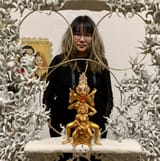
BEIJING — I arrived at Dongfeng Art District one afternoon, a 20-minute drive east of the more famous 798 and Caochangdi arts districts in northeast Beijing. It’s a short but somewhat winding drive away from the shinier parts of Chaoyang District, Beijing’s most economically-developed area. “Dongfeng” means “East Wind,” and the area hosts a number of arts studios and makeshift galleries. Tucked away in a corner is a two-story studio, sprawling by New York standards, belonging to native Beijinger Li Wei (黎薇).
Li was blasting the song “Your Own Personal Jesus,” the Marilyn Manson version, as her Bichon Frise Momo runs up to the door to greet me. His work taps into Western music, especially American Goth, which is known for its embrace of the “darker side.” It’s often difficult to find more obscure Western bands’ music in China, but he”s familiar with Marilyn Manson, Nine Inch Nails and Rammstein, among others. “I especially like Marilyn Manson,” he told me in Chinese. “His work completely embodies the two sides of human nature: the restless and the peaceful.”
Though he speaks English quietly and deliberately (the same way I do with Mandarin), he sings along to the Manson song in perfect tune, taking time to rock out in the midst of our studio visit.
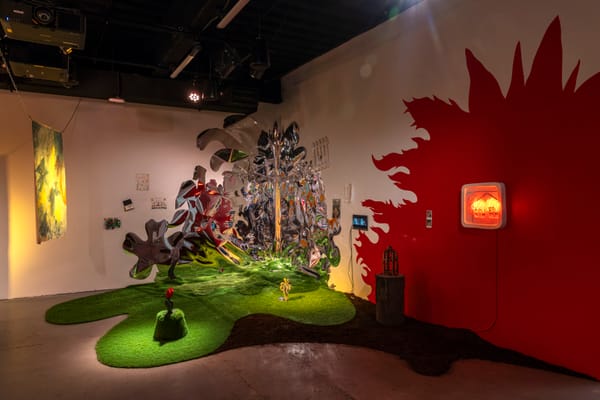
In the center of his space, assistants are busily putting together the finishing touches on Hero (英雄), his September solo exhibition at Today Art Museum. The work is grotesque, disturbing and it hasn’t even been installed fully yet. But for now I must hold my tongue, as the substance of Li Wei’s upcoming installation remains a secret.
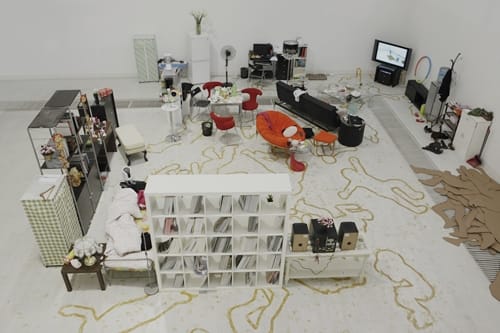
His most recent piece, “Being Absent,” was exhibited at Linda Gallery’s Alibi, a show that explored things left out or unsaid. Li’s work consisted of mustard yellow figures on the floor, reminiscent of crime scene outlines. For the duration of the exhibition, which opened on June 4, viewers slowly erased the outlines by walking over them. Edward Sanderson, a Beijing arts writer, recently remarked on Alibi that for Li the process of slow disappearance “reflected the fact that there are certain events for which the evidence may disappear, but the memory will not.”
The added layer was the arrangement of furniture, according to Amber Wang (王一妃), curator at Linda Gallery. The furniture grew over time, creating harmony over the slowly disappearing outlines.
Recounting Memory
A graduate of Beijing’s Central Academy of Fine Art, Li has received growing attention (link in Chinese) this year, including the above-mentioned show at Linda Gallery, an international contemporary art space from Jakarta; and group shows at Today Art Museum, CIGE and White Box Museum. His upcoming exhibition at Today will be his first museum solo show.
When I asked Li to describe his work a bit more, he replied, “I can’t say what kind of artist I am.” He is known most of all for his installations, room-size works that encourage visitor interaction. “My work is about what hides behind the surface, and discovering the hidden crisis. Because often what comes out is an illusion.”
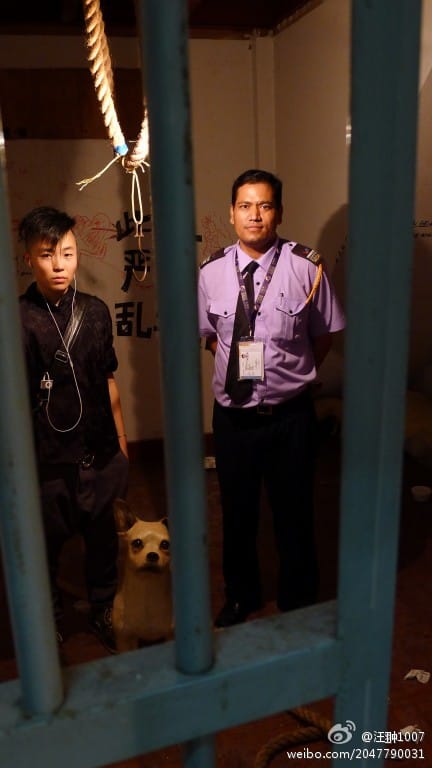
Forgetting plays an important role in the artist’s work, which strives to bring out what others would rather forget. At a recent exhibition of Chinese sculpture at the Nam Van Old Court Building, a former court of law in Macau, the former Portuguese colony near Hong Kong, Li installed a sculpture of a lone dog in a prison cell under a solitary light. In corners, he placed symbols of power in disarray, like a beatstick and the Macau city logo, with graffiti scribbled on the wall.
The work, titled “Insignificant Civilization” also looks at this issue of memory and forgetting. “In dark corners,” he wrote in his statement, which was translated into English, “little things are constantly overlooked and forgotten … Only on the premise of equity will civilization revert to its original significance, and become truly meaningful.”
Much of his work looks at contemporary society, and some of the challenges therein. While discussing the notion of critical examination, Li Wei throws out the idea that artists must be skeptical at all times of their work and of society.
“I am often skeptical of everything I do,” he said, citing a number of popular artists whose works have become formulaic and commercial. “Art shouldn’t trick people.”
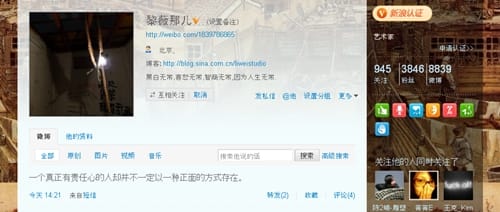
Indeed, Li lays himself bare each day to nearly 4,000 followers on Weibo, a number that reflects his growing appeal beyond the art world.
Posting throughout the day, he touches upon everything from society and art to quirky designs. He is as open on his microblogging account as he is in person, and he uses the platform to critically evaluate his work and chat with his audience. It’s a surprisingly free medium, allowing for frank discussions about everything, including politics. His prolific posts often attract multiple retweets and comments.
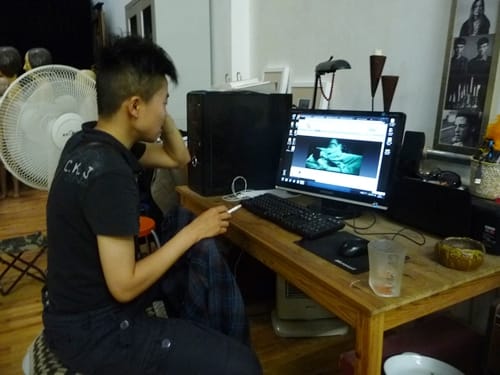
“Whenever I have nothing going on,” he says. “I talk on Weibo. This lets anyone see who I naturally am.”
It will be interesting to see how Li Wei manages his solo show at Today Art Museum, a large art space located near Beijing’s Central Business District, which is reminiscent of Manhattan’s or Los Angeles’s downtown business area. But in China, as elsewhere, and this is something Li obviously knows, there’s always a dark side swept away, just beneath the surface.
Li Wei’s Hero opens September 17 at Today Art Museum.