Mother of George: The Tyranny of Expectations
Mother of George is a sobriquet of simple expectations. Adenike is to give Ayodele a child, a son, and he is to be named George after Ayo’s father. It's straight-forward, almost comfortably commanding, prophetic in its understated authority. You will have a child.

Mother of George is a sobriquet of simple expectations. Adenike is to give Ayodele a child, a son, and he is to be named George after Ayo’s father. It’s straight-forward, almost comfortably commanding, prophetic in its understated authority. You will have a child.
Mother of George, the film, tells the tale in much the same way. It’s almost a fairy tale in its dateless, secretly complicated sweep. At one point in the film, a character notes how Ike and Ayo have been “married quite some time.” Time passes unaccountably.
But as with all things lean and understated, both Mother of George the film and Mother of George the expectation grow to become irrepressibly fraught. Adenike and Ayodele cannot conceive.
Set in the Crown Heights neighborhood of Brooklyn, Mother of George unfolds a story of love and family in the new but loaded union of Ike and Ayo and their Yoruba family. The movie opens with the two being marred in a lovely scene, a wedding smoldering with color, movement, family. Adenike is here told what she must do: becomes the mother of George; Ayodele, on the other hand, is told by friends what he can do: sleep around so long as he comes home to do his actual sleeping.
Both Ike and Dele observe these rules carefully. Nevertheless, George is not forthcoming. His absence grows to becomes the fundamental crisis of the film, an issue so singular and personal that it will intimately involve all the core characters of the film. Director Andrew Dosunmu is able to subtly enlarge the film in this way. Moments speak of larger concerns, even when the film and its dialogue are spare, and while there are times that this spareness of speech and action can weigh on the film, making scenes and moments feel too bare, too long, less is more in Mother of George.
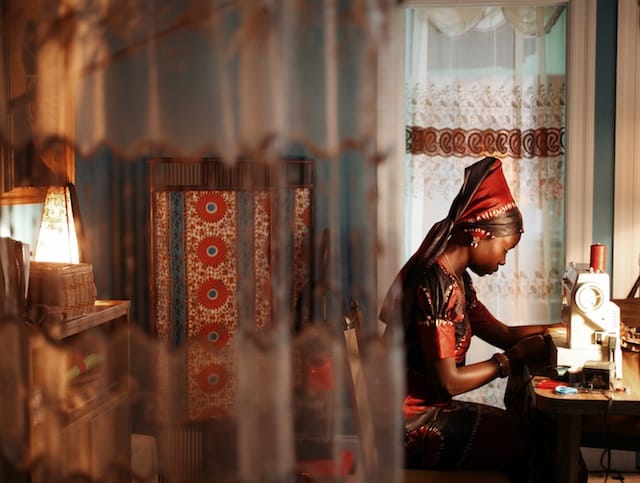
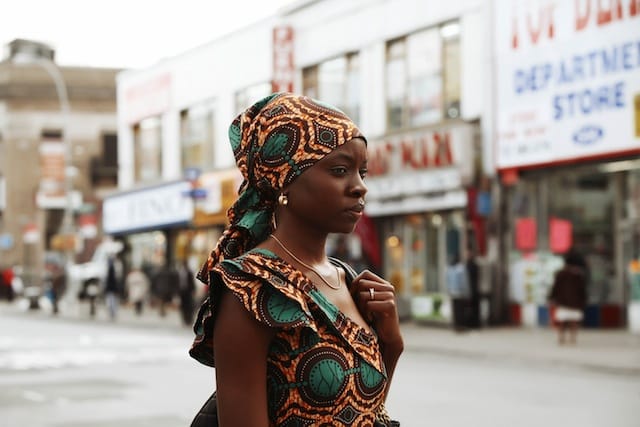
Moreover, it’s a consistency in the film. Dosumu and Cinematographer Bradford Young imbue the film with a beautiful, perfumed imagery. Scenes waft in slow-motion, deep and weighted, like glacial versions of James Nares’ Street. In others characters emerge out of darkness or are brought slowly into focus. The rooms themselves are fractured and smoky — sets hang with transparent drapes, frosty plastic kitchen doors. The film is absorbingly observant. Neighborhood streets are so colorful they seem to envelope Ike, while the colors and patterns of her Yoruba dress set her off dramatically from the others outdoors.
But not as an exotic or alien other. A.O. Scott, in his review, writes elegantly of the film’s knowingness, noting how “It is both strange and familiar, not so much because their milieu and cultural background may be new to some viewers, but because human beings are mysterious and surprising. There is something irresistible about a movie that reaches that conclusion.”
Ike is deeply pained by their conception issues. Not just because her responsibility is to bear a son, but because she wants to be a mother, because she believes at some level that being a mother would bring her joy. These are separate motivations for her, but not so in the extreme pressure of the family’s expectation and culture, where they’re crushed and flattened like pennies on a train track. You can see the gravity of it weighing on her, strangely pushing her further and further. Then something happens, something intended to help the family, but which may actually put the whole family at risk. It’s all in the service of fulfilling a most unsimple of simple things.
Mother of George is playing in New York at Cinema Village (22 East 12th Street, Greenwich Village, Manhattan) through Thursday, October 18. For a schedule of current and upcoming screenings of the film visit the Mother of George website.