My Queasy, Forest-Scented Stroll Through LA’s New AI Art Museum
Refik Anadol’s Dataland is a whirling, glaring, hyper-stimulating audio-visual-olfactory voyage that has more in common with Disneyland.

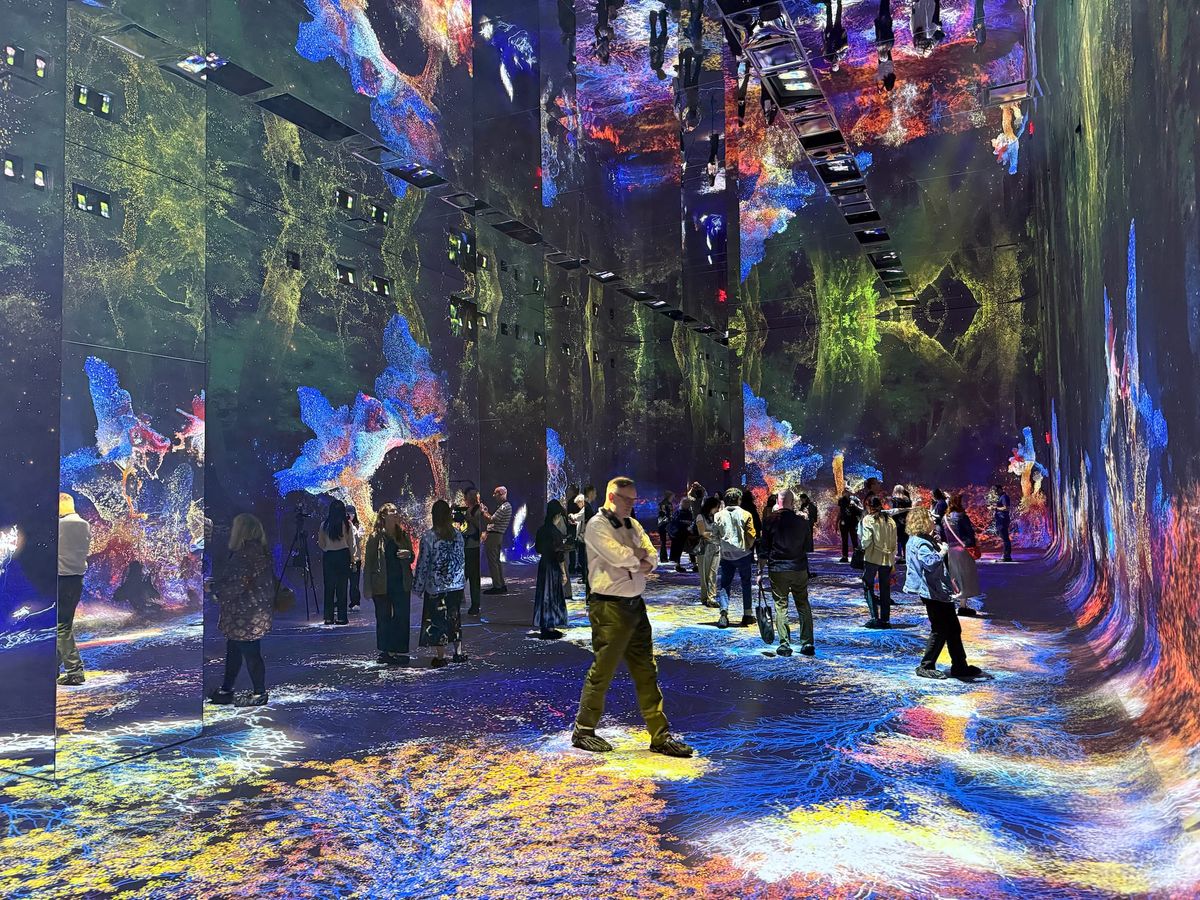
LOS ANGELES — I stepped onto the escalator and descended into a cavernous mirrored space, as dazzling light projections covering the walls, floor, and ceiling morphed into hard-edged cyber-graphics, then branching mycological networks, then color-saturated flowers and trees. A thunderous soundtrack swelled from ambient minimalism to cinematic triumph, peppered with bird chirps and the howls of monkeys. The scent of a damp forest floor wafted through the air, dispersed by a device I wore around my neck. The walls seemed to shift around me, and my heart began racing. It was exhilarating. It was mesmerizing. I felt like I was going to be sick.
This was my initial experience of Dataland, billed as “the world’s first museum of AI Arts,” co-founded by media artist Refik Anadol and Efsun Erkılıç and opening to the public on June 20. Anadol works with AI and technology to create abstract data visualizations that can be captivating, but have garnered criticism for being overhyped, superficial, or soulless. Dataland’s inaugural exhibition, Machine Dreams: Rainforest, is an immersive experience that synthesizes 1.2 billion data points about the natural world into a whirling, booming, glaring, hyper-stimulating audio-visual-olfactory voyage. However, data is only as meaningful as the stories it can tell and what we can glean from it, and in this digital funhouse, data itself is the star of the show, an end rather than a tool.
Dataland occupies 25,000 square feet in the Grand LA, the Frank Gehry-designed luxury apartment tower situated on Grand Avenue in Downtown Los Angeles, across from the Broad Museum and the Disney Concert Hall (also designed by Gehry) — the site of Anadol’s “Dreams” (2018), hallucinatory projections created with machine learning algorithms. The slick video intro to the press event last Friday suggested that Dataland fits within a lineage of other LA cultural institutions and museums. In reality, it has more in common with our theme parks like Disneyland, with their meticulous crafting of “experience.” (Regular tickets cost between $49 and $79, with priority access passes, also evoking the amusement park model, priced between $89 and $129.)
It also seems closer in content to our natural history museums. The core of Dataland is the “Large Nature Model” (LNM), “a nature-based AI trained on one of the world’s largest permission-based datasets of the natural world,” according to its website. To gather this data, Dataland partnered with the Smithsonian Institution, the Cornell Lab of Ornithology, the Getty Conservation Institute, the Natural History Museum in London, and others, and conducted its own surveys of 16 rainforests around the world. All of this data is assembled in the Living Encyclopedia, which is currently available to the public for $10/month but will be free starting on June 20, according to a representative.
In addition to a stated commitment to “ethical AI,” Dataland also touts its focus on sustainability. Its LNM is hosted on “Google Cloud infrastructure in a low-CO2 compute zone in Oregon, operating on 87 percent carbon-free renewable energy.” According to a spokesperson, “the LNM uses roughly one smartphone charge to re-iterate the artwork for every visitor.”
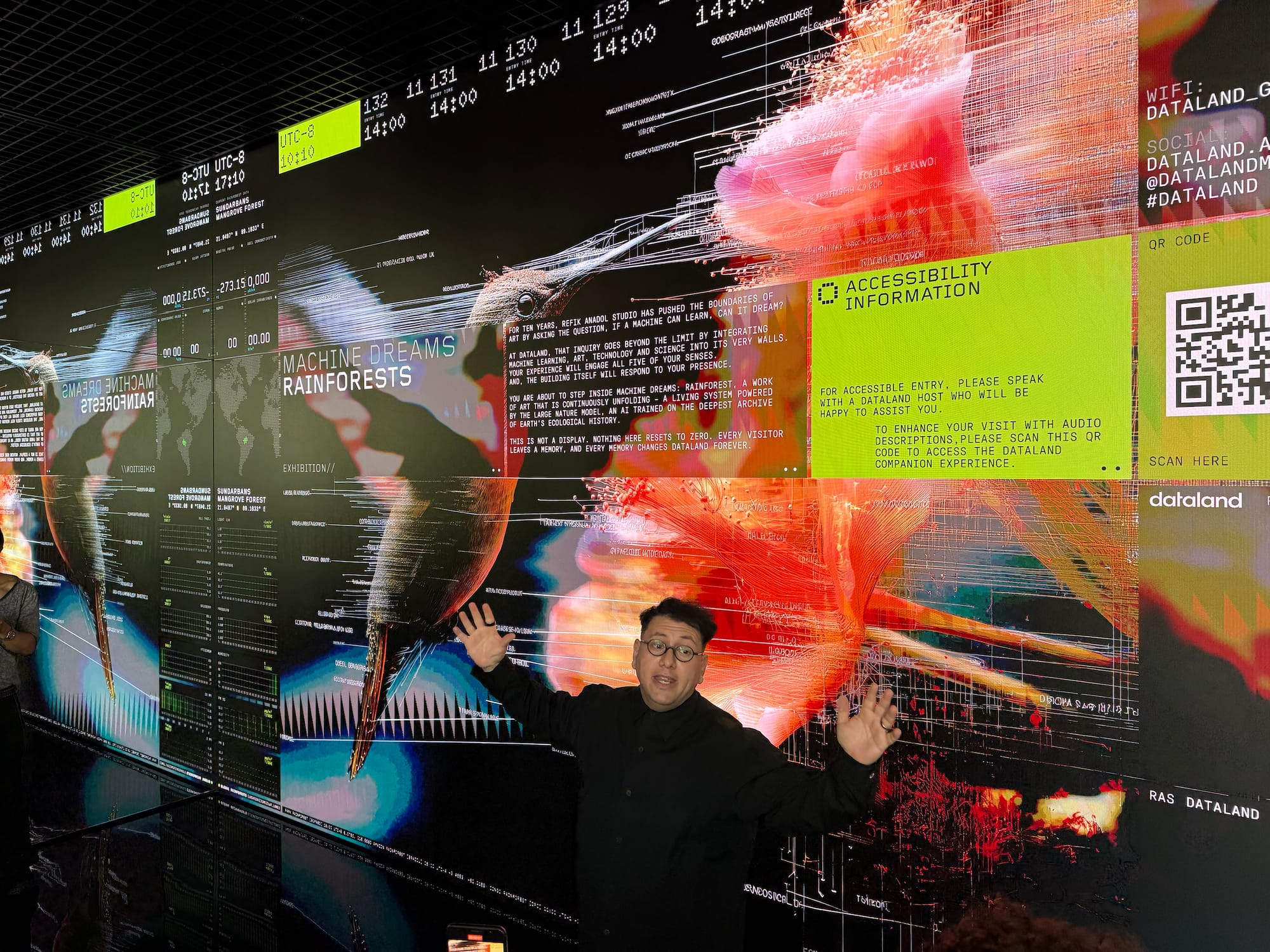
Dataland’s data may be easily accessible to the public; however, information about its finances and governance are not. “Refik and Efsun prefer not to disclose the cost of the museum or the investors,” a spokesperson told Hyperallergic, and since Dataland is a “for-profit cultural institution” and not a nonprofit, it is not obligated to share that information. A list of partners and collaborators includes the US semiconductor company NVIDIA, Google Cloud, L’Oréal Luxe (which crafted the experiential scents), design firm Gensler, ARUP (creators of Dataland’s cinema-scale acoustics), and Valerie Confections, who crafted chocolates that, though delicious, are data-based in some way that was not apparent. The RAS AI Foundation, a nonprofit also co-founded by Anadol and Erkılıç, oversees “philanthropic initiatives, learning programs, and broader public engagement.”
Unlike a traditional museum, there is no board or curatorial structure, though a spokesperson noted that close advisors include Serpentine Galleries Director Hans Ulrich Obrist, LACMA CEO Michael Govan, MoMA architecture Senior Curator Paola Antonelli, former MoMA director Glenn Lowry, and Mira Lane from Google.
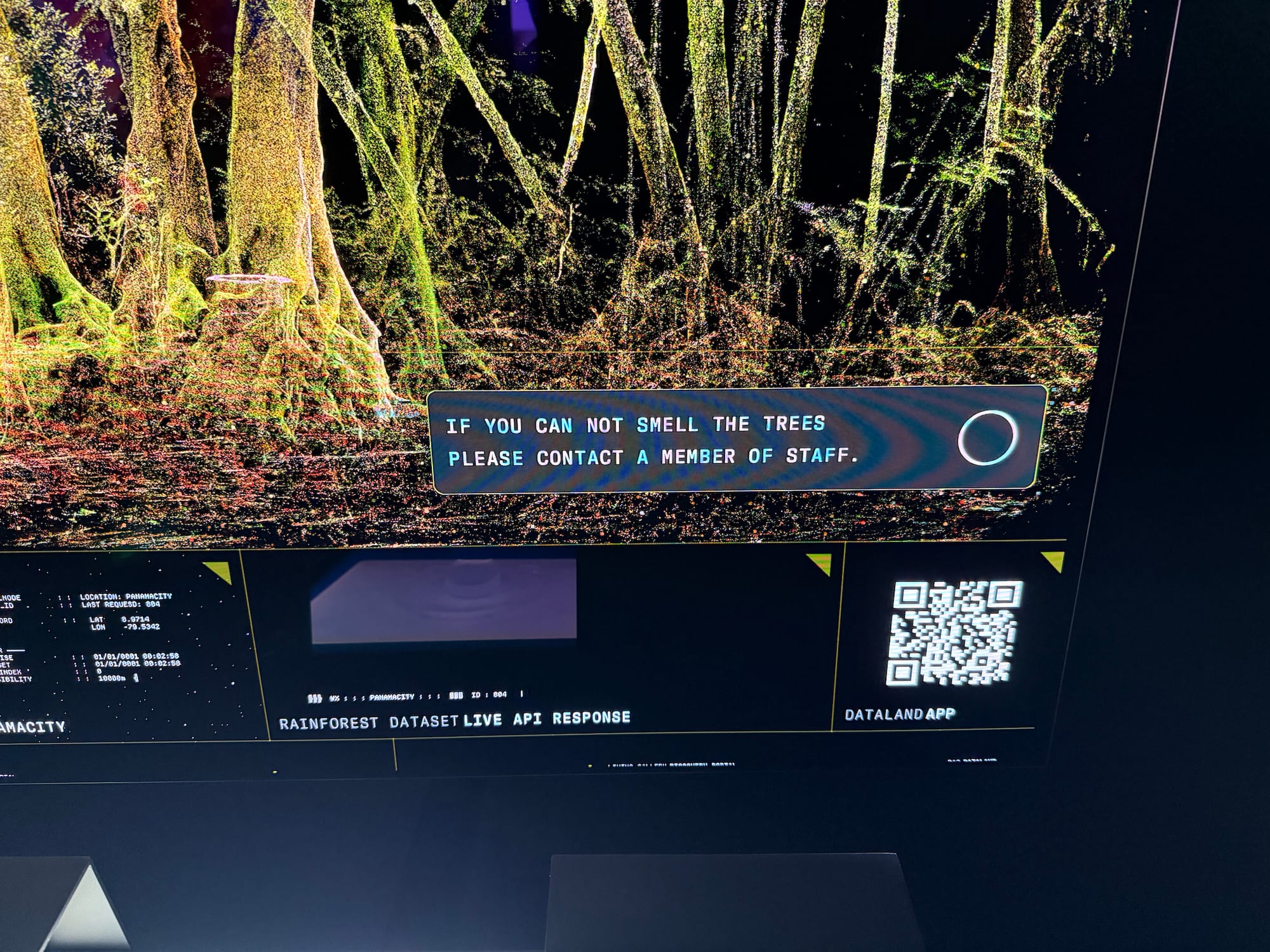
After leaving the “Latent Forest,” visitors enter the “Latent Gallery,” in which they can interact with the LNM firsthand. As I dragged, pinched, and clicked on a transparent panel on a pedestal, I was able to access images and information about flora and fauna around the globe projected onto the wall. With the flick of my wrist, I zoomed and scanned through the data models, selecting the biome I wanted to explore. Did I feel a bit like Neo in the Matrix? Yes. Do I remember anything about the species I pulled up from the data cloud? No; in fact, the experience seemed to numb my ability to retain knowledge.
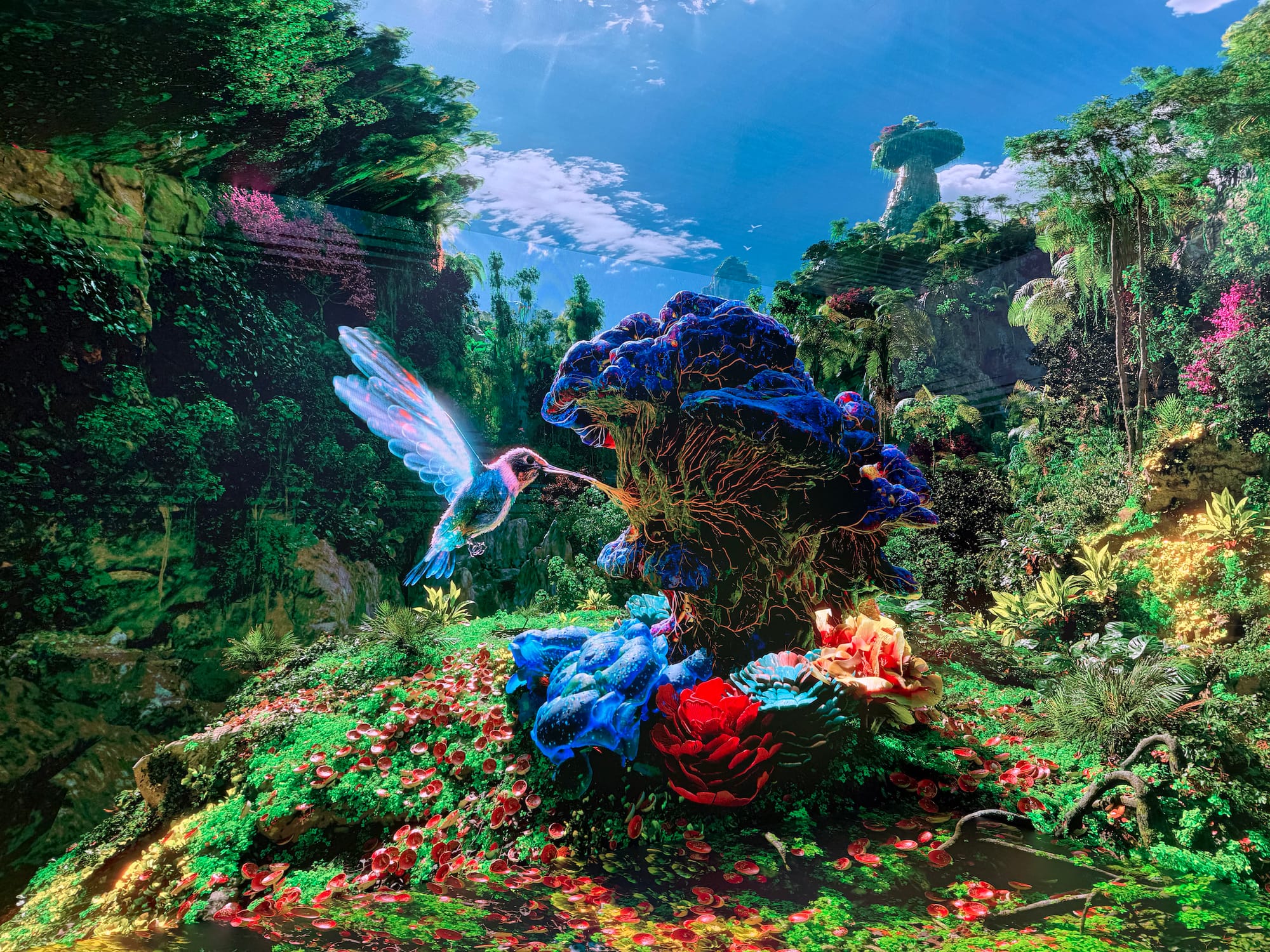
The next gallery, “The Dream of Ruwe Pinu,” is based on one of Anadol’s trips to the Amazon Rainforest. He dreamt of a translucent hummingbird that a spiritual leader of the Yawanawá community told him was a mythological figure called “Ruwe Pinu.” (Anadol previously collaborated with members of the Yawanawá on an AI blockchain collection that raised $1.5 million to protect their cultural heritage.) In an intimate gallery that accommodates nine visitors at a time, an immersive projection depicts a hummingbird visiting a mystical tree, veins of blue energy emanating from its roots, immediately bringing to mind the “Tree of Souls” from the Avatar franchise. It ends with the mating call of the now-extinct Hawaiian Kaua’i ‘ō’ō bird. Although grounded in data and personal experience, the piece offers a vague ecological message, juxtaposing two birds from unrelated cultures without adequate context or rationale other than “extinction is bad.”
The final gallery, “The Sanctuary,” incorporates biometric data from the visitors themselves that has been collected throughout the visit by a wristband — or “Data.Token” — monitoring our heart rate, temperature, skin conductivity, and something called "emotional temperature.” All this data is processed and regurgitated onto the wall in a churning psychedelic soup, mutating into an undulating floral sea that seemed more like an aesthetic justification for data harvesting, a cynical way to “include” visitors as collaborators in the spectacle. (According to Dataland, each visitor’s information collected is anonymized and deleted after their visit, unless they want to retain a “unique computational memory” as a souvenir of their experience.)
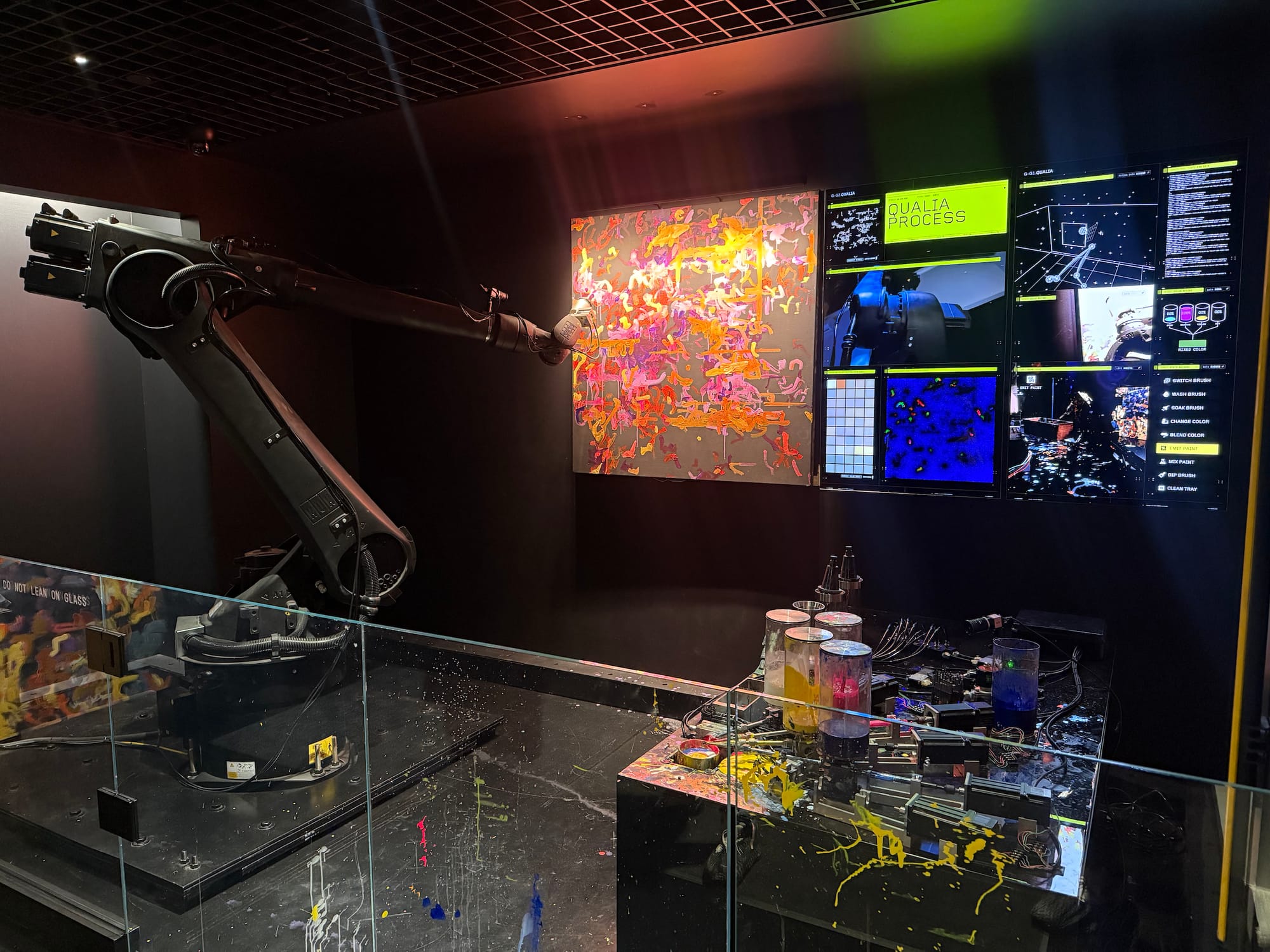
On my way out, I was confronted by Qualia, a robotic arm that paints one abstract data-driven painting each day. After the overwhelming simulacra of the previous hour, its Zen-like movements almost felt like a welcome sign of humanity.