Please, No More Disaffected White Girls
Anika Jade Levy’s “Flat Earth” is navel-gazing, ouroboric, masturbatory — a Dimes Square novel for Dimes Square people.

Editor’s Note: The following story contains mentions of self-harm and sexual assault. If you or someone you know is struggling, call or text 988 or visit 988lifeline.org to reach the Suicide & Crisis Lifeline. To reach the National Sexual Assault Hotline, call 1-800-656-HOPE (4673) or visit online.rainn.org.
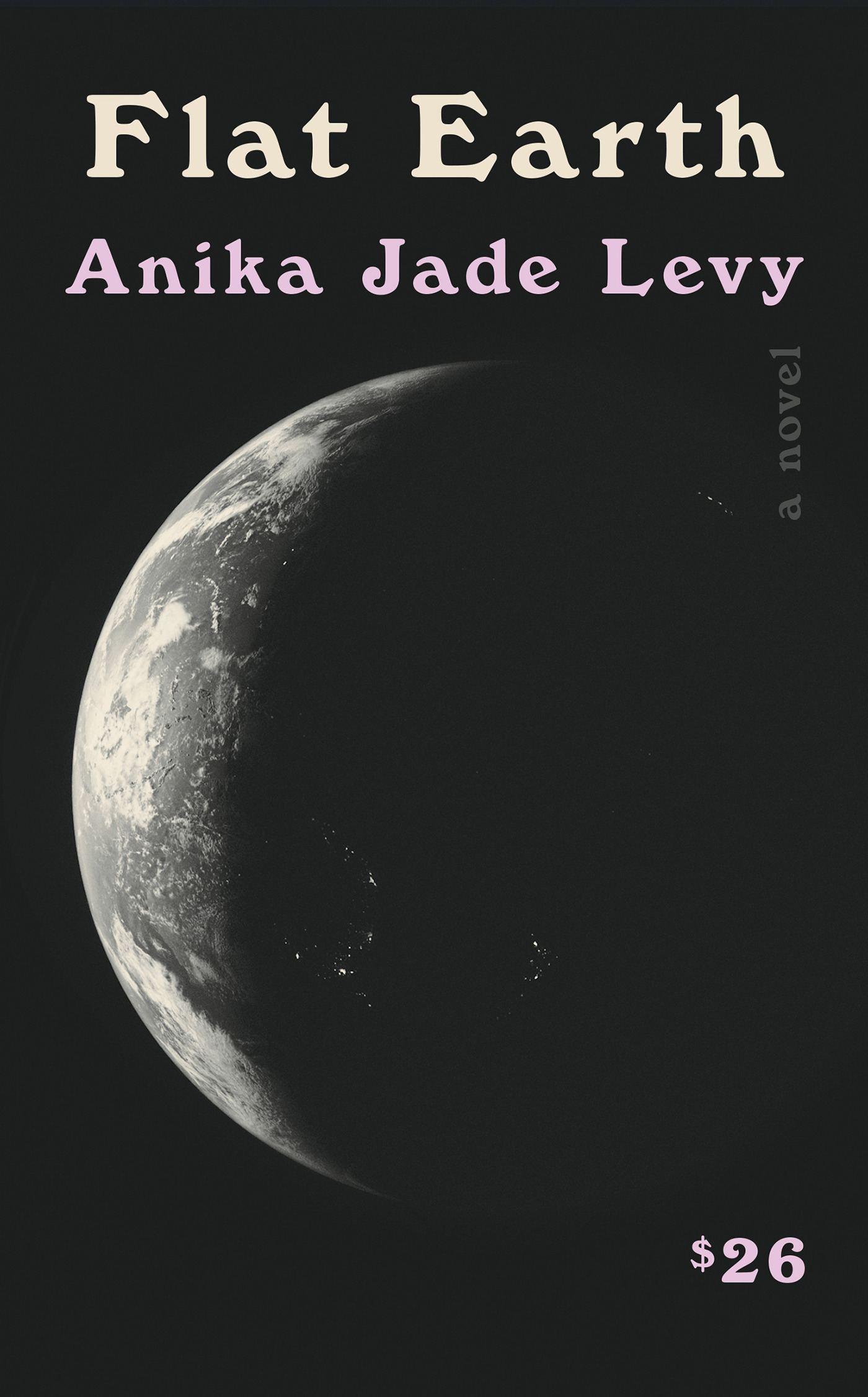
How do I describe the plot of Anika Jade Levy’s Flat Earth (2025)? It’s about a girl named Avery, who’s vaguely in grad school (“media studies”). She’s jealous of her best friend, Frances, a hot-girl heir to a shipping empire who makes an art film about flat-earth conspiracists in flyover country that transforms her into an artworld darling.
We are offered a number of glancingly weird details about Avery. For example, she keeps Frances’s cut-off fishtail braid in a Tupperware container under her bed; she’s hooking up with a law professor because he’s the only one who’s “sufficiently violent” with her; and, by the same logic, she won’t fuck an obituarist from a good family because he’s too attentive. These so-called character traits are passingly evocative but ultimately empty because they don’t excavate an actual character, just betray her lack of depth, a sense of numbed-out nothingness. Avery herself makes almost no attempt at introspection, as if she knows there’s no point — she’s not interesting. I would feel bad for her, if only I cared.
One might say that the flatness is the point. A similarly detached tone permeates the entire book, and not just because Avery is the narrator. It’s made up of clipped sentences that often have some surprising but emotionless turn: “If I had endometriosis, that meant I might never be able to have a baby. On the other hand, maybe I could write about my diagnosis for a feminist magazine.” Those units — sometimes a single sentence, sometimes a small paragraph — are the fundamental formula of this book, and it’s in this writing style that Levy really shines. But each of these small sections is a flash that immediately fades into unimportance, like when something bright catches your eye, only to find it's just fluorescent light glancing off a stranger’s iPhone.
Take another provocative sentence: “I saw the boy who sexually assaulted me in high school had earned an advanced degree in public policy and city planning.” It’s just another way to emphasize that Avery is so emptied of feeling that not even sexual trauma will trigger the slightest response. That’s interesting, in a sense — this sort of anesthetized sluggishness, this inward-turning deflation in the face of overwhelm, truly feels like the defining mood of our time, as seen in everything from the phenomenon of doomscrolling to the pulse-check of the Whitney Biennial. But each line is essentially that same move over and over again, and its returns are diminishing, like hitting a vape. Here, Avery’s assault almost seems like the set-up for a punchline, and it feels tired in both senses of the word.
Every single plot point feels just like that: another clever aside stuffed with internet dogwhistles, something to snicker at — Adderall shortages, Instagram ads for freezing your eggs, QAnon, incels. There’s the sense that literally nothing here — not people, not events, not things — has any substance of its own, that everything can blend and recombine into a kind of nihilistic 21st-century sestina. An Australian life coach who gives Avery a constant diet of terrible advice takes her own life, for instance, and the obituarist from a good family who Avery won’t fuck writes the obituary. This is not a book that stays with you, that deepens in the back of your mind and layers into your experience, illuminating something about life or the world or even itself, as good pieces of art are able to. It's a book that wants you to know how smart it is, rather than feel something. Instead of moving you, it just comments on the contemporary condition of being unmoved, and does so over and over again. It slides right off you, as frictionless as scrolling (or, according to Avery, being infertile or having sex or being assaulted).
Somehow, that’s not the worst of it. This is a book that wants to have its cake, and eat it too — it frames itself as a critique of blasé disaffection while embodying it. In other words, it tries to preempt criticism by being self-aware — a cop-out endemic to the artworld. It digests and regurgitates its failures and calls that the point because it’s less difficult than actually trying. By that same token, though most individual lines are masterful, some Rupi Kaur-esque writing is buried so deep within the cesspool of irony that it’s impossible to tell whether it’s sincere: “We love you enduring your father”; “where the Sculptor had seen a castle, I had only seen a ruin.”
Flat Earth’s inability to rise up above the maladapted muck that is its subject is not a fault of its premise. There are ways to probe that sense of hyper-contemporary malaise that can move a reader: Vincenzo Latronico’s Perfection (2022) also has that dopamine-kick style, that eviscerating critique of the flattening of internet culture and art world. But there is also an ethics in it, a judgment about this position. A book doesn’t need to offer answers to be thoughtful. And there are ways to write a character who is simultaneously fully fleshed and seemingly absent of feeling, as in Nella Larsen’s Quicksand (1928), which makes you wonder and care about the larger systems that spat out such a weirdly disaffected character, as scholars like Sianne Ngai have pointed out. Avery, on the other hand, is just another dissociated artworld White girl, a symptom more than a victim.
I know many people who have modeled their whole personalities off the same platonic nonentity as Avery clearly has. But I also know that the art world is more than aging, Xan-ed out White girls fucking unfaithful law professors after gallery openings, a genre that feels disproportionally represented in contemporary writing. Flat Earth is navel-gazing, ouroboric, masturbatory — a Dimes Square novel for Dimes Square people. It’s the artworld for those who don’t actually believe in art.