Required Reading
This week, a chilling performance in Shanghai, the sale of the Washington Post, history of London coffeehouses, privacy and art, TED Talk as propaganda, and more.


This week, a chilling performance in Shanghai, the sale of the Washington Post, history of London coffeehouses, privacy and art, TED Talk as propaganda, and more.
The Washington Post was sold to Jeff Bezos, of Amazon fame, and there are many interesting theories regarding what this might mean. Two of my favorites:
- “Why the Sale of The Washington Post Seems So Significant” by James Fallows (The Atlantic): “So let us hope that this is what the sale signifies: the beginning of a phase in which this Gilded Age’s major beneficiaries re-invest in the infrastructure of our public intelligence. We hope it marks a beginning, because we know it marks an end.”
- “Why Jeff Bezos Bought the Washington Post: Six Theories” by Jason Calacanis (Launch.co): “1. EGO: Newspapers are the new sports teams for the billionaire set … 2. INFLUENCE: Bezos is buying influence in Washington … 3. INTEGRATION: Newspaper delivery is a trojan horse for daily home delivery … “
This story about a performance art work in Shanghai is chilling:
Life imitated art, startlingly and crudely, in the city of Hai’an, north of Shanghai, when two men rushed the stage and groped the painter and performance artist Yan Yinhong as she danced “One Person’s Battlefield” — her furious comment on sexual violence against women.
The assault continued through her entire performance as she dodged the men who kissed and groped her, grappled her to the floor and thrust their hands up her skirt, the audience making only halfhearted efforts to help as they stood by and recorded the incident with phones and cameras.
Did she report it to the police? No: “How could you report that here?” she asked. “To me, their interference showed the vileness of society, and our society is vile,” Ms. Yan said in a telephone interview.
I recently discovered this fascinating post by Hyperallergic’s poetry editor, Joe Pan, on performance artist Ann Liv Young. It provides a fascinating take on the enigma that is Young’s Sherry Vignon persona:
Urinating in public is an act which Ann Liv Young’s become known for … She peed to retake control of the situation, & to ask us to follow her back into the magic space of our shared performance, which we did. During the crazier moments of performances like this one, people sometimes leave, & I’ve never understood why; I’m always excited by the prospect of what might come next: will the artist try to outdo herself, or reel the strangeness in a bit & give us all a breather?
The lost world of the London coffeehouse:
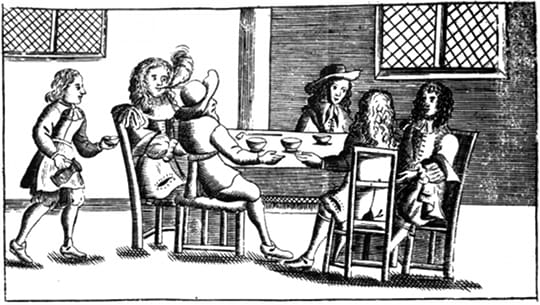
London’s coffee craze began in 1652 when Pasqua Rosée, the Greek servant of a coffee-loving British Levant merchant, opened London’s first coffeehouse (or rather, coffee shack) against the stone wall of St Michael’s churchyard in a labyrinth of alleys off Cornhill. Coffee was a smash hit; within a couple of years, Pasqua was selling over 600 dishes of coffee a day to the horror of the local tavern keepers.
… No respectable women would have been seen dead in a coffeehouse. It wasn’t long before wives became frustrated at the amount of time their husbands were idling away “deposing princes, settling the bounds of kingdoms, and balancing the power of Europe with great justice and impartiality”, as Richard Steele put it in the Tatler, all from the comfort of a fireside bench. In 1674, years of simmering resentment erupted into the volcano of fury that was the Women’s Petition Against Coffee. The fair sex lambasted the “Excessive use of that Newfangled, Abominable, Heathenish Liquor called COFFEE” which, as they saw it, had reduced their virile industrious men into effeminate, babbling, French layabouts. Retaliation was swift and acerbic in the form of the vulgar Men’s Answer to the Women’s Petition Against Coffee, which claimed it was “base adulterate wine” and “muddy ale” that made men impotent. Coffee, in fact, was the Viagra of the day, making “the erection more vigorous, the ejaculation more full, add[ing] a spiritual ascendency to the sperm”.
Even if Kevin Cassem’s language is a little stiff, he makes some interesting points in this consideration of Triple Canopy’s Refresh (i.e. “slow down” the web) dream for TheClaudiusApp:
The language of Triple Canopy’s capital campaign, “Refresh,” in support of its upcoming 3.0 re-launch is nothing new. It follows decades of technofuturist predictions of a better world via the outsourcing of civilization’s advance — a dream deferred, seemingly endlessly, bringing instead as its return a blanket forgetting of history, the parodic inverse of an idealized future that never actualizes.
Laura Parker writes about the “journey to make video games into art” for The New Yorker:
The concept of the auteur is relatively new to gaming. Only a small group of developers have earned the title, people like Shigeru Miyamoto, Hideo Kojima, and Warren Spector. Chen considers himself a commercial artist, whose role is as much to create “real art” — the kind that [film critic Roger] Ebert referred to — as it is to produce marketable entertainment.
A writer at the MinnPost suggests that the Detroit Institute of Arts may want to consider leasing their art collection rather than selling it:
Orr could potentially lease the artwork as collateral to raise money for a loan, says Dennis Enright, a national expert in privatization of government assets with NW Financial in Hoboken, N.J.
“You could create a revenue stream around it. It’s definitely not a normal governmental world activity, but certainly private collectors use their art as collateral and bet it against for their own private interests,” Mr. Enright said.
Hmmmm … a judge has upheld artist Arne Svenson’s right to display and advertise a series of photographs he took of his neighbors without their permission. The Art Newspaper reports:
The judge concluded that “while it makes plaintiffs cringe to think their private lives and images of their small children can find their way into the public forum of an art exhibition, there is no redress under the current laws of the State of New York”. She added that publications and advertisements could reprint Svenson’s images: “Since art is protected by the First Amendment, any advertising that is undertaken in connection with promoting that art is permitted,” she wrote. The Fosters’ lawyer did not immediately respond to a request for comment on the ruling.
The lawsuit highlights the shifting definition of privacy in dense cities like New York, experts say.
When a TED Talk is used as a propaganda tool.
And you may be interested to know that CNN’s “chief medical correspondent” Dr. Sanjay Gupta has changed his mind on medicinal marijuana:
It is perhaps no surprise then that 76% of physicians recently surveyed said they would approve the use of marijuana to help ease a woman’s pain from breast cancer.
Required Reading is published every Sunday morning EST, and it is comprised of a short list of art-related links to long-form articles, videos, blog posts or photo essays worth a second look.