Required Reading
This week, the Detroit Institute of Arts needs to come up with money, the collector at the center of the Nazi-era art loot, Bob Dylan and Pharrell Williams push buttons, Wikipedia's problems, fact vs. opinion on American cable news, walls around the world, and more.

This week, the Detroit Institute of Arts needs to come up with money, the collector at the center of the Nazi-era art loot, Bob Dylan and Pharrell Williams push buttons, Wikipedia’s problems, fact vs. opinion on American cable news, walls around the world, and more.
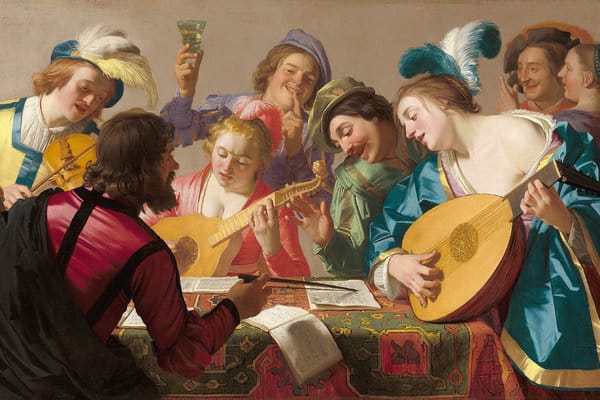
There are still many questions about the status of the Detroit Institute of Arts and this Q&A in the Detroit Free Press may help you make sense of things (though not everything is very encouraging for those that love the museum). For instance:
Responding to a question, [Detroit’s emergency manager Kevyn] Orr said again that if the Detroit Institute of Arts can’t come up with a way to “help” Detroit, he will force the issue. His implication was that somehow the DIA is holding out.
How much help would the emergency manager like from the DIA? The number we have heard is $500 million. And how is the DIA to come up with a half-billion dollars?
… Can we sell art in storage? Yes, but for $500 million, the galleries would have to be raided of some of our most beloved treasures … There are some valuable works in storage, but sending Detroit $500 million means selling treasures, treasures we hold in trust for our kids and grandkids, not Detroit’s creditors.
This week, everyone was chattering about two projects that are pushing some boundaries for online music videos:
- Pharrell Williams’s “Happy“
- an interactive music video for Bob Dylan’s classic “Like A Rolling Stone“
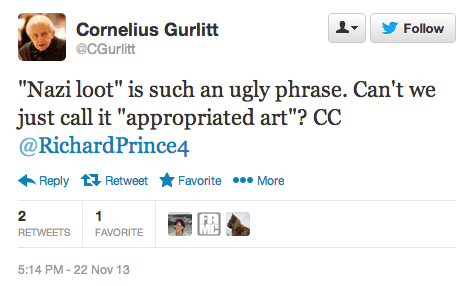
A fascinating look by Spiegel Online at the art collector in the center of the Nazi-era art collection that recently surfaced, Cornelius Gurlitt:
Gurlitt seems trapped in another time. He stopped watching television when Germany’s second public television network was launched, the “new station” with its trademark Mainzelmännchen cartoon characters. That was in 1963. He books his hotel rooms months in advance by post, with letters written on a typewriter and signed with a fountain pen, which include the request to send a taxi to pick him up from the train station. His world is slow and quiet.
He is amazed by telephones that display the caller’s phone number. He knows that it’s possible to search for things on the Internet, but he has never done it. He has spent his life living with his pictures. He lacks interaction with other people, and he has gathered his life experiences from books.
He talks about Franz Kafka’s “In the Penal Colony,” a short story about an explorer who witnesses condemned prisoners, who don’t know what crime they have committed, being tortured and killed on a remote island. He says that the emptying of his apartment was similarly tragic.
Yet Wikipedia and its stated ambition to “compile the sum of all human knowledge” are in trouble. The volunteer workforce that built the project’s flagship, the English-language Wikipedia — and must defend it against vandalism, hoaxes, and manipulation — has shrunk by more than a third since 2007 and is still shrinking. Those participants left seem incapable of fixing the flaws that keep Wikipedia from becoming a high-quality encyclopedia by any standard, including the project’s own. Among the significant problems that aren’t getting resolved is the site’s skewed coverage: its entries on Pokemon and female porn stars are comprehensive, but its pages on female novelists or places in sub-Saharan Africa are sketchy. Authoritative entries remain elusive. Of the 1,000 articles that the project’s own volunteers have tagged as forming the core of a good encyclopedia, most don’t earn even Wikipedia’s own middle-ranking quality scores.
The Los Angeles County Museum of Art announced the unveiling of a new Southeast Asian Art website:
… Southeast Asian Art (http://seasian.catalog.lacma.org), a new website featuring in-depth scholarship authored by professor and curator Dr. Robert Brown. The online publication focuses on 34 highlights from the museum’s extraordinary collection of Southeast Asian art (complemented by numerous comparative images) and includes extended essays on topics such as light symbolism, female deities, and the impact of Buddhism on Sri Lankan and Southeast Asian art. Southeast Asian Art is the first in a series of online scholarly catalogue designed to provide an in-depth, web-based reading experience previously available only in print publications, enhanced with unique rich media features such as videos, 360-degree image rotation for select objects, and an easy online citation tool.
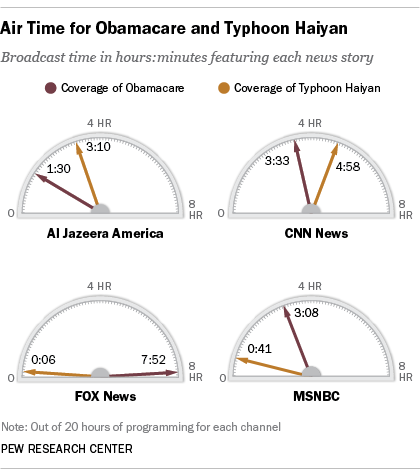
The Pew Research Center looked at US cable coverage of two major issues in the last few weeks, the roll out of Obamacare and the Philippines typhoon. What they found was a clear pattern:
Al Jazeera America stood out in another way last week. In the sample studied, it offered by far the least amount of opinion (41%) when it came to commentary and opinion versus reporting or fact-based statements. That compared with 72% opinion on CNN, 86% on MSNBC, and 97% on the Fox News Channel.
And in some cultural journalism news … “Bloomberg, the New York-based financial news giant, is shutting down its Muse brand of cultural journalism and has laid off its theater critic … Bloomberg plans to continue to cover the arts, but with an emphasis on luxury.”
Two works from Banksy’s NYC residency in October are going to be for sale at Art Miami during the December art fairs:
The two pieces set to go on sale at the Dec. 3-8 Art Miami fair are a 1,500-pound (680kg) chunk of a Brooklyn warehouse wall on which Banksy painted a heart-shaped balloon covered in Band-Aids, and the rear door of a Manhattan car Banksy used to paint a struggling, Herculean figure surrounded by running horses.
It has almost been 25 years since the Berlin Wall came down, but it seems that walls are popping up everywhere around the world. The Guardian looks at the “walled world” in this interactive feature that explores various barriers from Israel to Korea, from Morocco to Brazil — India has the longest at 2,500 miles — and how they create an illusion of security:
So in general, concludes Pullan, walls are “more symbolic than anything else. But their symbolism is enormous. Even now, Berlin remains best known for the wall. The most recognisable image of Jerusalem is now, arguably, its wall. The visual impact is so very strong. If you want to get across the idea of division, a wall is very, very powerful.”
Required Reading is published every Sunday morning EST, and it is comprised of a short list of art-related links to long-form articles, videos, blog posts or photo essays worth a second look.