Required Reading
This week, advice for artists, unemployment in the arts, the monumentality of bronze, revolutionary graffiti of Egypt, architectural copies, Facebook friendships, and more.

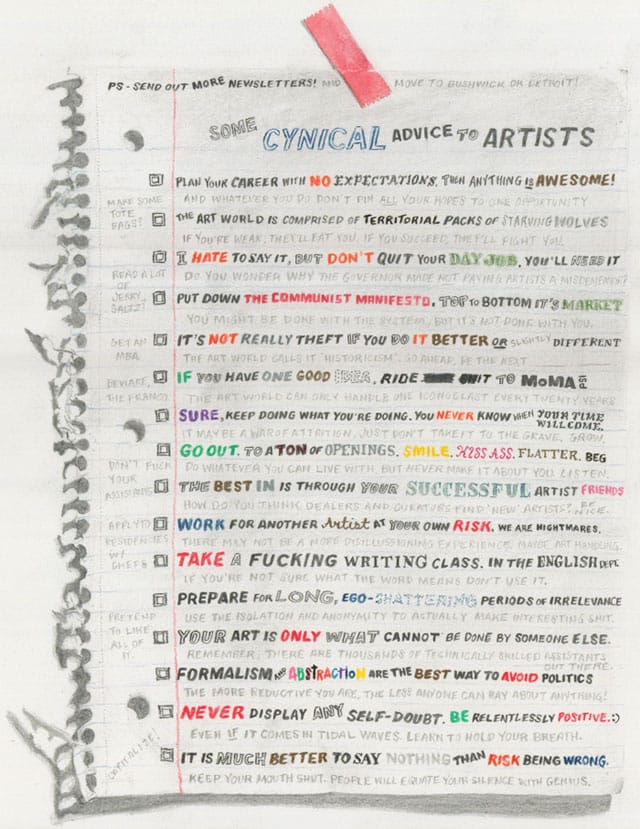
This week, advice for artists, unemployment in the arts, the monumentality of bronze, revolutionary graffiti of Egypt, architectural copies, Facebook friendships, and more.

WSJ has crunched the 2010 employment numbers for various college majors in the US and the “art” category may be of particular interest to Hyperallergic readers.
The unemployment figure for art history & criticism is 6.9%, while the figures are higher for commercial art & graphic design majors (8.1%), studio arts majors (8%), and film, video and photographic arts majors (7.3%), but lower for art and music education majors (4.2%).
James Davidson writes of the Royal Academy of Arts’ new Bronze exhibition, which features bronze works from the ancient times until today. One of the masterpieces, according to Davidson, is a larger than lifesize dancing satyr from circa 300 BCE that was discovered on the southern coast of Sicily in 1998. He starts his review with a quote from an ancient author:
“I’ve done it,” Horace shouts at the end of his third book of Odes. “I’ve made a monument more lasting than bronze … Something that neither biting rain, nor an immeasurable succession of years could cause to crumble.” Bronze has long been a byword for enduring monumentality …
The revolutionary graffiti of Egypt is under threat and many people are working to save it. CBS reports:
Throughout the past 19 months, graffiti has also sought to keep alive the spirit of the young activists’ vision of the revolution despite continual setbacks — including by enshrining their heroes.
And then this surprise:
“Graffiti has won us freedoms we had never dreamed of before,” said Mohammed Hashem, a prominent publisher whose office in downtown Cairo has been among the most favorite meeting places for leftist revolutionaries. “It has been the strongest voice of the revolution.”
Ironically, graffiti has also broken into an Egyptian art world long dominated by elites who tended more to traditional landscapes or abstract art.
An exhibit at the 2012 Venice Architecture Biennale explores the topic of copying in architecture. Excuse me while I copy and paste Archdaily’s description of the show [emphasis theirs]:
The exhibition, curated by FAT, uses a series of installations to explore the concept of copying in architecture. Historically, copying was the means by which architecture was disseminated — it was, in short, a common ground of the discipline. Yet the copy has also been considered the enemy of progress and an inauthentic dead end. The copy can therefore be schizophrenically characterized as architecture’s perfect, evil twin, at once fundamental to architecture’s mode of production and a source of its inspiration, yet also its nemesis. The installation comprises five projects that explore the significance and possibilities on the copy in architecture.
A graduate thesis titled “Transmedia Art Exhibitions, From Bauhaus to Your House” has been published online. Written by Julia Fryett, she describes the work as “an experiment in open access academic publishing,” which considering the silly (and expensive) rules covering image rights in academic publishing sounds like a great idea. Fryett explains a little about the word “transmedia”:
Though the term transmedia was popularized in 2003, it echoes avant-garde exhibition design strategies theorized by Herbert Bayer and Frederick Kiesler nearly seventy years prior. This project considers transmedia within the trajectory of art history, questioning how it can be employed as a curatorial methodology aligning with Bauhaus and De Stijl notions of immersion and interactivity.
(h/t @nealstimler)
The Brooklyn Rail published a conversation between painter Louise Fishman and painter/blogger Sharon Butler. And Fishman offers this sage advice:
The painting, and my experience in the studio — and I think most painters would say this— is really all there is. The rest of it is fluff. One has to be careful not to get seduced by success, which is really difficult and, particularly for young people, but even at my age, it’s very seductive. Things that happen around one’s work, when there is a positive response out there, can turn in a second. The audience for art is very fickle.
Aaron Mattock visited the recent Performa-organized panel “Why Dance in the Art World?” He reports:
“Last year we were arguing about re-performance,” Schlenzka said. “This year we’re arguing about dance.” There’s a lot to argue about. We find ourselves in the midst of an ephemeral art explosion: the moment of performance, of dance in the art world, is happening.
Is this new? Homans started off with a resounding ‘no.’ She gave us her explication of the last 3,000 years of ballet history and its relationship to art, by way of King Louis XIV, the French Revolution, and Lincoln Kirstein’s involvement with the Museum of Modern Art’s (now closed) Dance and Theater collection, all to say that dance and the art world have always been strongly linked. As she contextualized it, dance and the physical body reflect who we think we are as a society. Dance in museums, she argued, is part of a larger rethinking of public space and public life, with a shift toward the experiential: the self at the center of an experience-based life involved with the outer world through both the body and technology.
The New Museum has been publishing some of their classic panel recordings on the web. This one from 1998 discusses the graffiti collection of renowned artist Martin Wong. The discussion features curator/anarchist Alan Moore, curator Dan Cameron, art historian Yasmin Ramirez, curator/historian Carlo McCormick, and artist/archivist Stefan Eins. Wong’s collection is currently at the Museum of the City of New York, and sadly the museum has yet to properly catalogue or exhibit it. Shame on them!
Oh, Camille Paglia, we have missed your opinions (sometimes on topics you know little about), and this time she has taken to the WSJ to discuss the future of art — you decide if this one is on the mark or not. She writes:
What has sapped artistic creativity and innovation in the arts? Two major causes can be identified, one relating to an expansion of form and the other to a contraction of ideology.
And ever wonder how Facebook friendships translate into real world connections? This interactive map demonstrates where Facebook ties are the strongest. For instance, here are the countries with the most friendship connections to US users: 1. Mexico, 2. Canada, 3. Dominican Republic, 4. UK, 5. Australia.
Required Reading is published every Sunday morning EST, and it is comprised of a short list of art-related links to long-form articles, videos, blog posts or photo essays worth a second look.