Russia Moves to Label Pussy Riot an “Extremist” Group
It’s an attempt to “erase Pussy Riot from the minds of Russian citizens,” the feminist art collective’s co-founder Nadya Tolokonnikova told Hyperallergic.

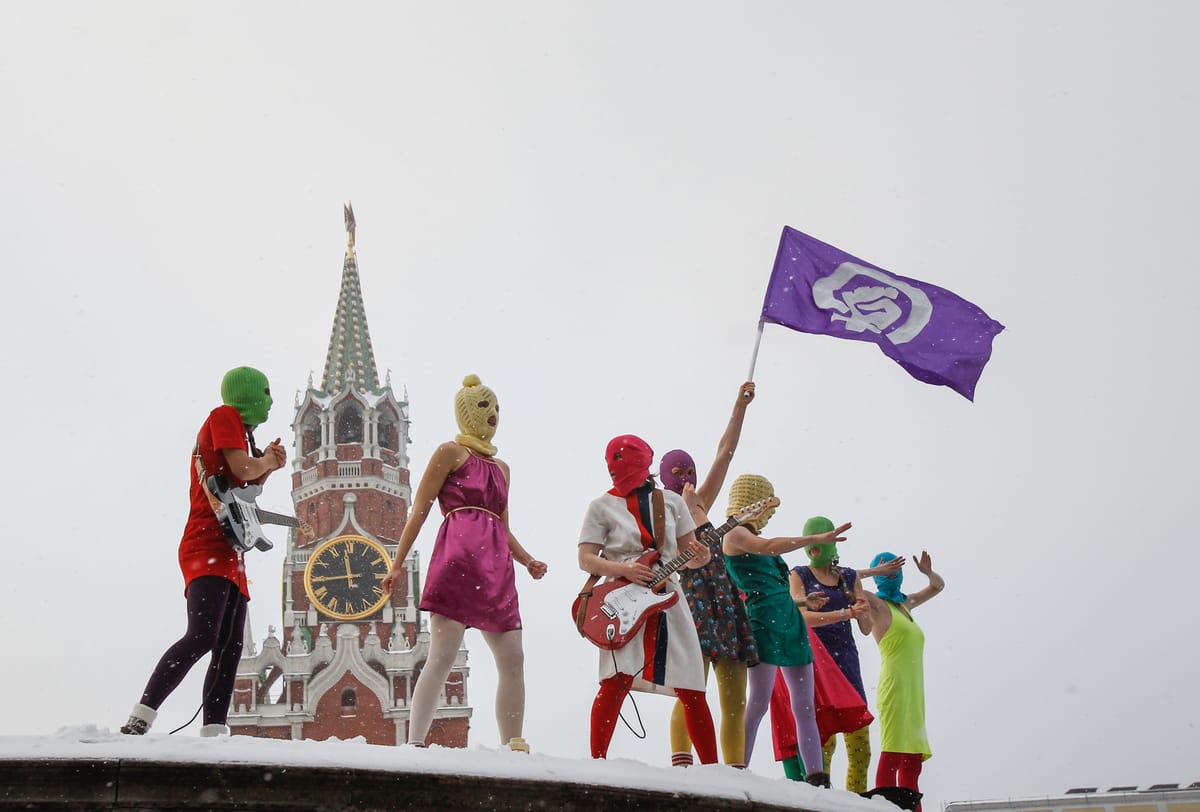
The Russian feminist dissident group Pussy Riot could soon be labeled an "extremist" organization as part of the country's recent attempts to quell dissent.
Russia's prosecutor general opened a case against the feminist art group on Friday, November 28. The “extremist” label, commonly deployed by the government as justification for stifling political opposition, would officially ban the collective's activities in Russia following a suite of prosecutorial actions against its members for anti-government performance art in recent years. A Moscow court will hold a hearing on December 15 to determine the organization's designation, according to a representative of Pussy Riot founder Nadya Tolokonnikova.
Best known for the 2012 anti-Putin protest performance "Punk Prayer" in Moscow's Cathedral of Christ the Savior, members of the collective, including Tolokonnikova, were sentenced to two years in prison for "hooliganism on the grounds of religious hatred." In September, A Moscow court sentenced five Pussy Riot members to prison in absentia related to performances that criticized Vladimir Putin's regime.
Reached by email, Tolokonnikova told Hyperallergic that the "extremist" label would deepen the government's suppression of the group, which the creators envisioned evolving into a movement beyond its members.
"We’ve been radioactive for years, but being designated as an extremist organization gives the state more legal tools to punish people for any association with us," Tolokonnikova said. "Photographers who worked with me in Europe and the US have asked me not to credit them because they fear for their families still living in Russia or Belarus."
Tolokonnikova lives in geographical anonymity following her prison sentence and her 2023 arrest in absentia and placement on a Russian wanted list for criminals.
The effort to label the group with the notorious designation, which the Russian Supreme Court also ascribed to the entire global LGBTQ+ community in 2023, coincides with crackdowns on watchdog organizations last week. Russian courts have reportedly convicted individuals for displaying LGBTQ+ symbols or for participating in what the government considers to be the LGBTQ+ "movement."
Last week, the Russian government labeled Human Rights Watch, which has criticized the country's invasion of Ukraine and suppression of dissent, an "undesirable" organization. The designation will require the organization to cease operations in Russia and could criminalize cooperation with or support for its work. Russia's Supreme Court ruled last week that the late opposition leader Alexei Navalny's Anti-Corruption Foundation was a "terrorist" organization, escalating from its previous designation of "undesirable."
Tolokonnikova told Hyperallergic that on Russian media platforms, the name Pussy Riot would be accompanied by a disclaimer stating its designation if efforts succeed.
"You can't say good things about us, or it'd be considered partaking in extremism," Tolokonnikova said.
According to the artist, the law would apply retroactively and could result in the imprisonment of "anyone who has ever supported Pussy Riot," including tourists or visitors to Russia.
Tolokonnikova said her primary concern with the government's new attempts to suppress her group is the safety of her supporters, who are unable to leave Russia.
"The law is designed to erase Pussy Riot from the minds of Russian citizens," Tolokonnikova said.