So You’ve Been Invited to Documenta 16. Here’s Our Advice.
As two documenta 15 artists who were mercilessly vilified due to our support of Palestine, here’s what you need to consider when you make your choice.

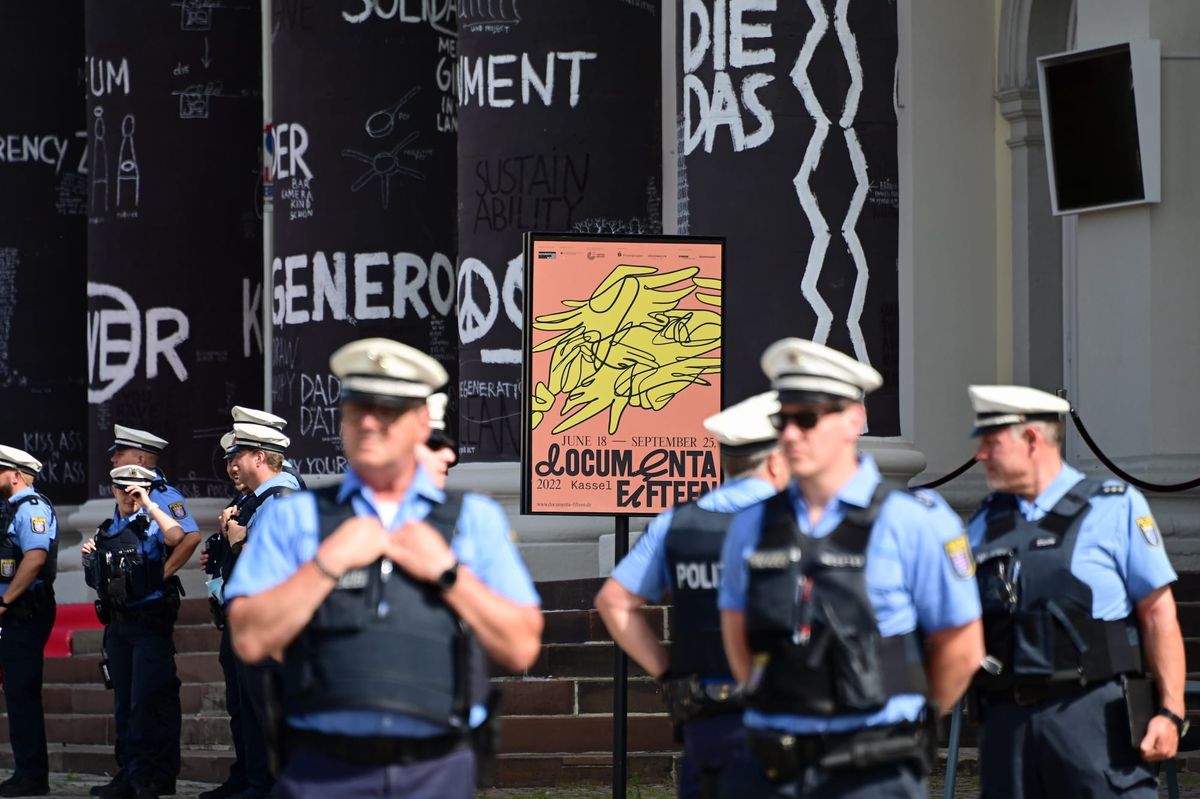
Over the past few months, several artist friends who have been invited to participate in the upcoming documenta 16 have contacted us for advice, asking whether they should accept, refuse early on, or accept for now and withdraw at a later stage. As two artists who participated in documenta 15, we understand the dilemma. An invitation to documenta is not something one receives thoughtlessly. It is hard to turn down, and these days, it is also becoming hard to accept.
A few years ago, exhibiting at documenta was considered a lifetime achievement. But after the multi-faceted attacks on Palestinian artists and works of pro-Palestinian art at documenta 15 — and the collapse of the German state’s moral standing through its support for the genocide in Palestine and considering Israel its Staatsräson (“reason of state”) — this assumption has been shattered. There is no meaningful distance between the German state and its art institutions: Almost every museum, Kunsthalle, and festival, documenta included, is funded by the federal, regional, or municipal government, and thus steered by the conditions those funders set. As such, artists have to seriously ask themselves whether participating in documenta 16 will negatively affect one's career and well-being.
Our friends ask us for advice because of what the two of us, among many others, went through during documenta 15. We were subjected to severe and vicious attacks by the German media, political activists, politicians, and the establishment, built on unfounded, fabricated, and destructive accusations of antisemitism, which eventually led to attacks and vandalism of our exhibition venues, alongside those of other artists. This experience left scars on our lives and careers, making it hard to apply for jobs, funding, or exhibition opportunities. The stress and burnout we had to endure as a result of these attacks were enormous, and the energy it took came from our work and our lives — that toll can’t be overstated. This is why we decided to stay anonymous in this piece: to avoid any return to the stress and fear we had to deal with, which still haunts us even after nearly five years.
To those friends who are asking, and others who are wondering, we will not tell you whether to participate in documenta 16 or not. This is your own decision about what you wish to lend your voice to — personally, politically, creatively. But we can tell you what we wish we had known, and what you need to consider when you make your choice.
Since the beginning of the current genocide in Palestine, the German cultural scene has been in crisis. It has lost its credibility and shown how much it functions as the soft hand of state power. It has no independence from state politics and is unable to stand up against the position of the state due to the way arts and culture are funded in Germany. In 2019, the Bundestag passed a non-binding resolution calling for federal funding to be withheld from any organization or project that supports Boycott, Divestment, Sanctions (BDS). Non-binding as it was, it became a political tool to suppress any institutional support for the Palestinian cause. Another resolution in November 2024 tied public funding to the International Holocaust Remembrance Alliance’s controversial definition of antisemitism — which documenta officially adopted in early 2025. The rest of Germany’s major cultural institutions, except for a few independent ones, bent with little resistance. Like the others, documenta depends on state and federal funding; and like the others, it has no spine. German institutions are struggling to emerge from this crisis and regain their credibility without revising their positions or standing up to political pressure. At this point and under these conditions, documenta as an institution will likely benefit more from your participation than you will.