Social Realisms Inside a Forgotten Armaments Museum
In the Albanian city of Gjirokastër, nothing strikes quite so hard as the armaments museum, hidden away inside a medieval castle atop a hill.
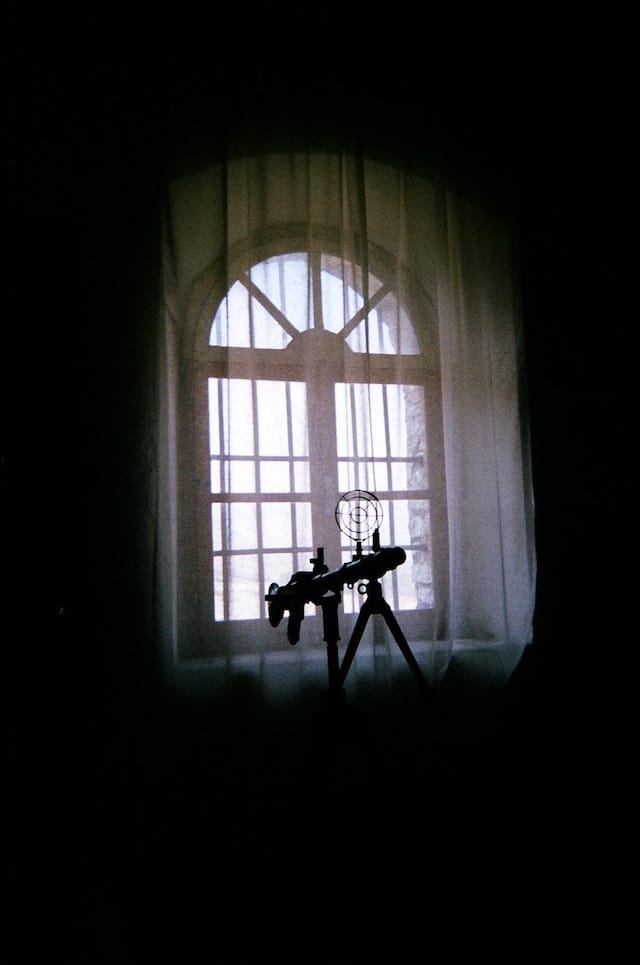
In southern Albania, there is a city called Gjirokastër sitting on top of a hill. Albania’s former Communist dictator Enver Hoxha was born there, but so was Ismail Kadare, the country’s greatest author. In Chronicle in Stone, Kadare describes it thus:
It was a slanted city, set at a sharper angle than perhaps any other city on earth, and it defied the laws of architecture and city planning. The top of one house might graze the foundation of another, and it was surely the only place in the world where if you slipped and fell in the street, you might well land on the roof of a house – a peculiarity known most intimately to drunks.
It’s a jagged, steep, stony city, and I went there to photograph it this summer. This is the dizzying view from the top:
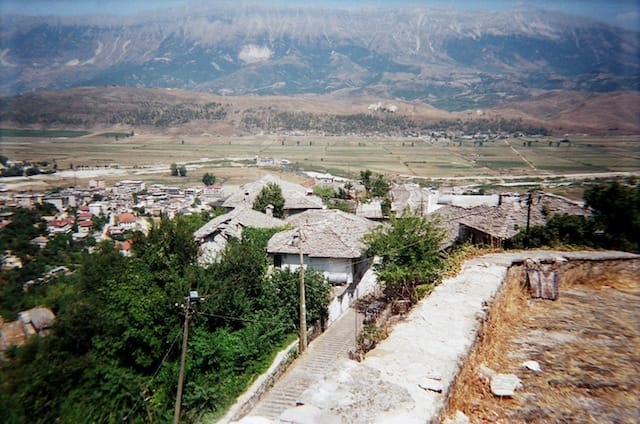
Many are Gjirokastër’s striking visual aspects. On the other side of walls built out of the same grey-white as the cobblestones and slates and endless winding streets, dense red fabrics and thick wooden panelling muffle the interiors of traditional buildings. Mountains loom on all sides, the farthest-off outlined almost imperceptibly in purple.
But nothing strikes quite so hard as the armaments museum, hidden away inside the medieval castle which perches atop the hill, looking over Gjirokastër. The citadel has been there since the 12th century, with significant expansions made by the deliciously named but rather horrible King Zog in the 1930s, particularly to the prison.
That prison was closed in 1968, after years of being used by the governments of both Zog and his Communist inheritors, the latter particularly keen on locking up political prisoners. Since 1971, an armaments museum has taken up residence in the former prison – and what an extraordinary museum it is.
It takes some finding. As you enter the castle, a dark and quite drippy passageway opens up, the guns of exhibited tanks peering out of the gloom:
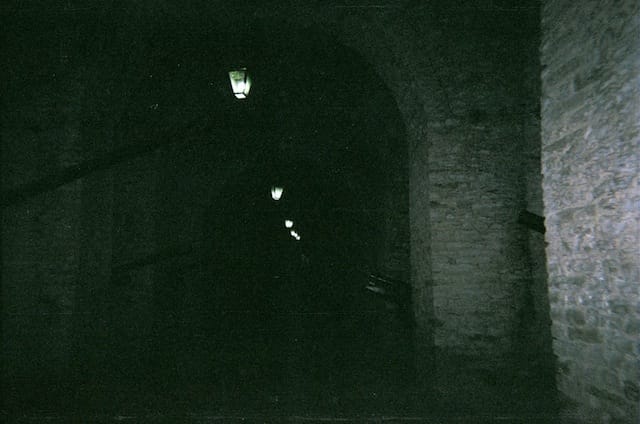
You’ll already have paid 200 Lek ($1.89) to get this far, but at the other end of this spooky passage is a door with a bit of paper on it, inviting you to pay a further 200 Lek to enter the museum. I saw some Italian tourists balk at the sum, but I told them it was worth it.
Tucked inside the castle’s old prison, the armament museum mostly displays weapons from the twentieth century, along with displays and photographs commemmorating the Communist resistance against the German occupation of World War II. In these furtively snapped film shots (I’m ashamed to say that photography is not allowed), I hope something of the museum’s feeling of improbably stylish total desertion comes across.
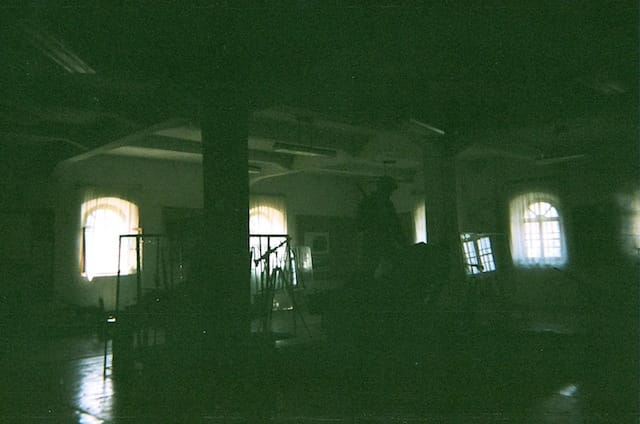
The light is strong but the rooms are thick-walled and cool. It is eerie to be surrounded by gun after gun after gun.
The truly disconcerting thing about the armaments museum, however, is the visual anachronism of the displays. I can’t be sure, but I’d wager that the museum has not been updated since it was installed in the very early 1970s. So, socialist realist sculptures sit alongside diagrams of World War II battlefronts: they chime with, rather than contradict, one another.
An Amazonian embodiment of Albania (her skirt becomes mountains) grips a rifle while casting a priest and a military man out of her country:
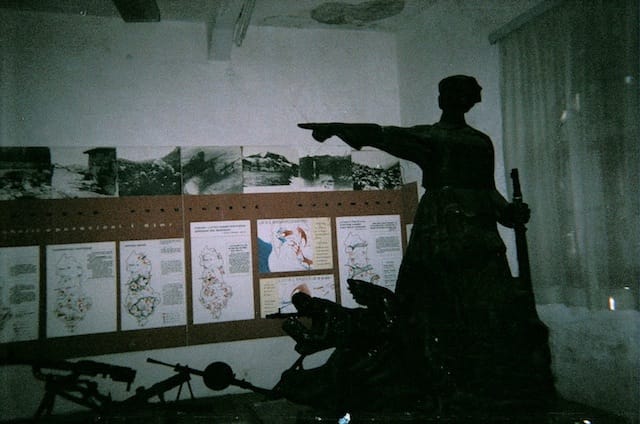
Religion was indeed banned in Albania in 1967, making it the first and only constitutionally atheist state.
That note of the rational extermination of culture drew me to the conclusion that there’s an aesthetic ascetiscism to the armaments museum — a restrained but mannered Modernism — which seems to draw its historical threads together. The exhibits memorialise the resistance in gorgeously antiquated style, but with the forward-looking confidence of socialism. The feel is of a paradoxically dated preoccupation with the future: not just the look of capital-M Modernism, but the feeling of walking around in that very moment in time.
As you emerge blinking on to the castle roof, more surprises await. An enormous red, metal structure hovers perplexingly into view:
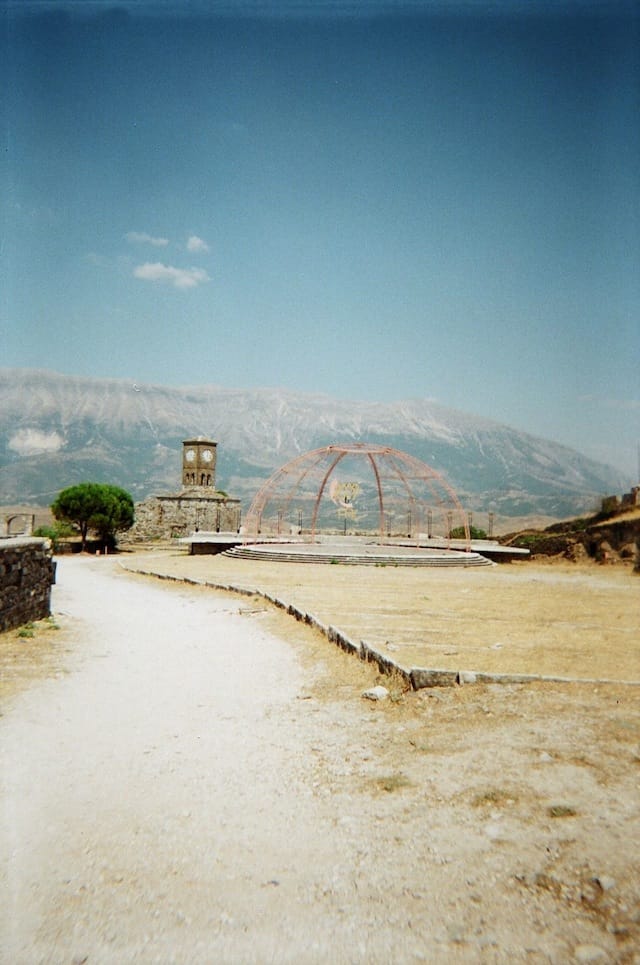
It takes a few minutes to cross this rooftop courtyard to read the sign which explains that this is a stage for the Gjirokastër National Folklore Festival, which seems to happen every four years or so. It looks like next one will be in 2014, but nobody seems totally sure.
Around the corner, another surprise. This is a Lockheed T-33A-1-LO Shooting Star. In other words, an American plane:
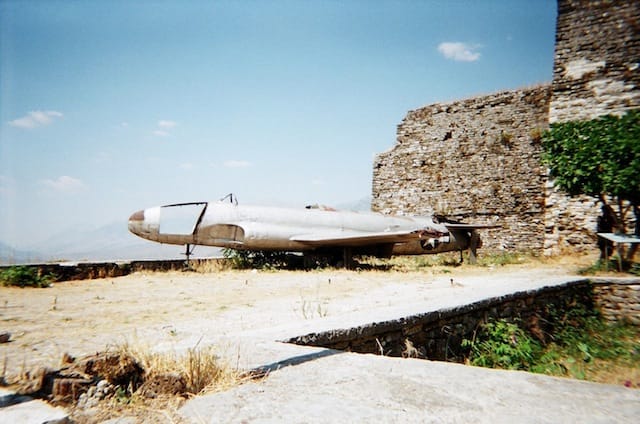
It was forced to land in 1957 after entering Albanian airspace. Apparently the prisoners were momentarily jubilant as the plane circled, imagining that rescue was coming. But it was not to be. The Americans were accused of spying and the plane captured, although the claim goes that it was an innocent journey.
But there it sits, still, not maintained by anybody but staying very shiny and proud, its nose sticking out over an enormous valley full of extraordinary things to see. Every detail of the castle — the tanks, the guns, the plane, the fonts on the exhibition walls — seems to cast you out of time. Gjirokastër takes its visitor on a jagged and unharmonious excursion through the objects and styles of the twentieth century as it happened in this particular corner of the world. I’ve never been so simply surprised by an historical site. As Kadare puts it, “the traveller seeing it for the first time was tempted to compare it to something, but soon found that impossible, for the city rejected all comparisons.” He’s right — I haven’t seen anything like it.