Steve DiBenedetto’s Cosmic Sense of the Absurd
He conceives of a painting as a search for a functional structure, a talisman that can aid viewers amid our collective sense of traumatic crisis.

Steve DiBenedetto, who began exhibiting in the 1980s, has become one of the best painters of his generation. A bundle of contradictions, restlessly moving between figuration and abstraction, he loves to push the paint around in his work — adding, scraping, changing — as he seeks links between the body and visionary states. The otherworldliness we encounter in his work is comic and unnerving, the perfect combination for these upside-down times.
The title of his current exhibition at Derek Eller, Spiral Architect, brings together two of his ongoing preoccupations — a line that winds around a center and the designer of a functional environment. Together, they underscore DiBenedetto’s conception of a painting as a search for a functional structure, a talisman that can aid viewers amid our collective sense of traumatic crisis. In contrast to artists such as Hilma af Klint and Forrest Bess, who believed they were conduits transmitting messages from a higher power, DiBenedetto wants to unlock the viewer’s own psychic unconsciousness and tap into the mind’s capacity for attaining visionary states. In this way, he is constantly reaching toward a cosmic sense of the absurd.
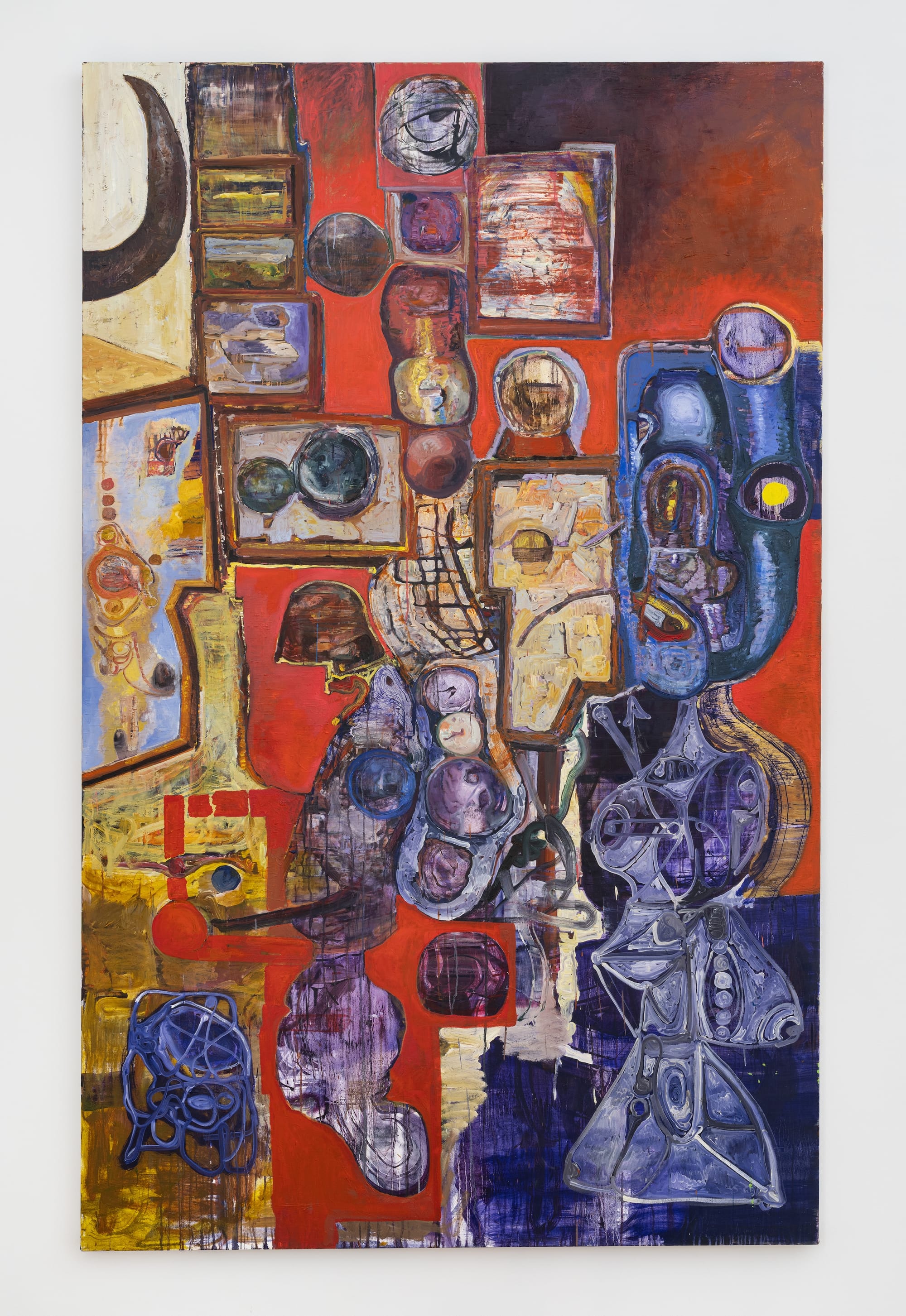
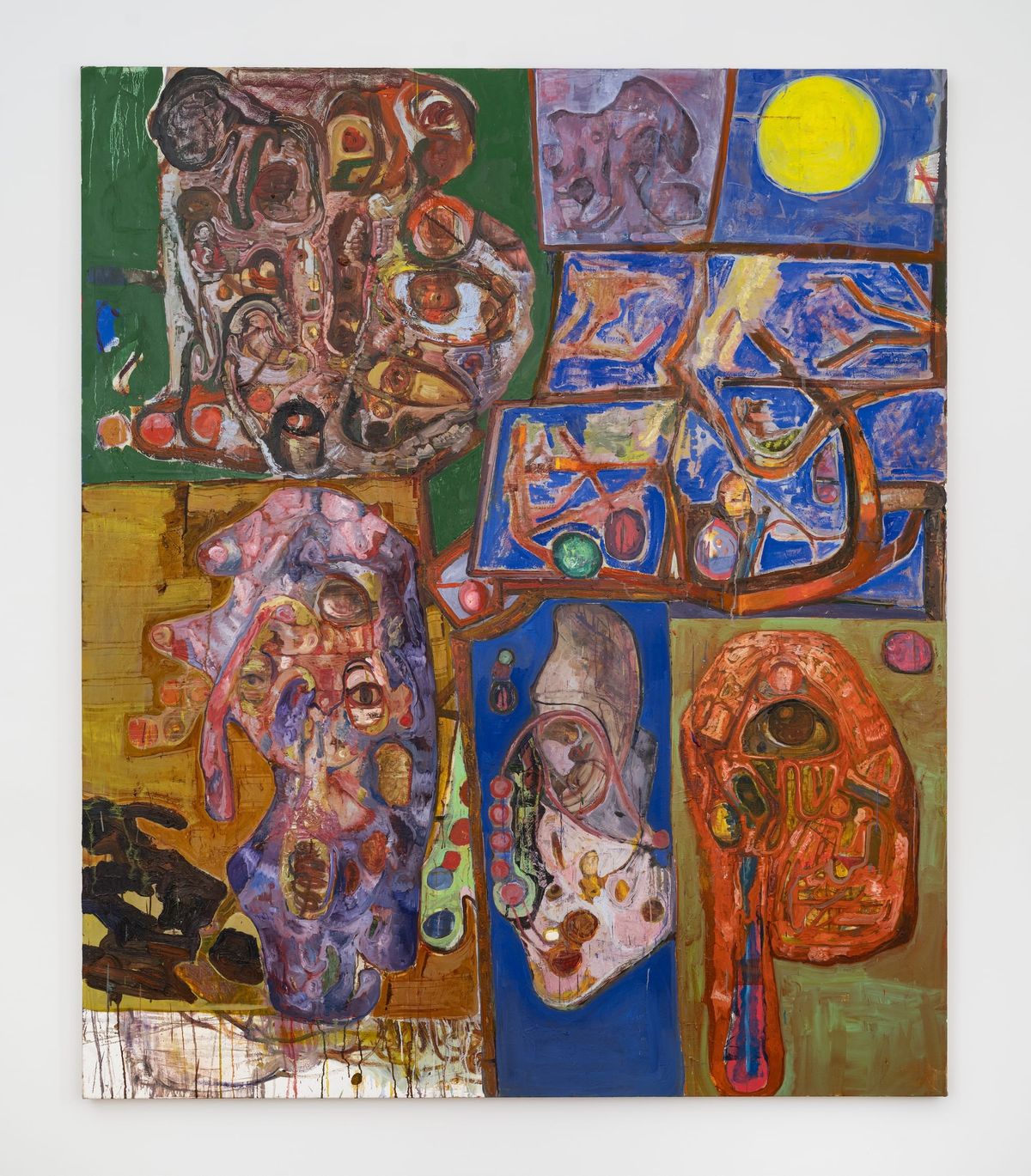
There are 17 paintings in the exhibition; four of which are 7.3 by 6.2 feet (~2.2 by 1.9 meters) or larger, while the rest are 24 by 20 inches (~60.1 by 50.8 centimeters) or smaller. In the large ones — all replete with disembodied body parts that recall humans, octopi, cellular forms, and machines — we sense a brain-body relationship in a state of turbulent reformation.
In “The Octopus Paradox” (2025–26), isolated rectangles around the work’s edges contain non-human forms of life. They are connected by tubular forms to a strange Rube Goldberg-esque concoction rising from the painting’s bottom edge. Between the rectangles and forms, we see other tubes connecting the figural form to vacuoles and sacs filled with disembodied parts, including a large eye and cellular forms. We have entered a world of science fiction, laboratory experiments, and computer wizardry run amok. By reworking the surface, DiBenedetto gets encrusted areas, smeared passages, drips, and crisply defined forms to work in tandem with tonal relationships and jewel-like color. Visually mesmerizing, the effect is both absurdly funny and deeply disturbing.
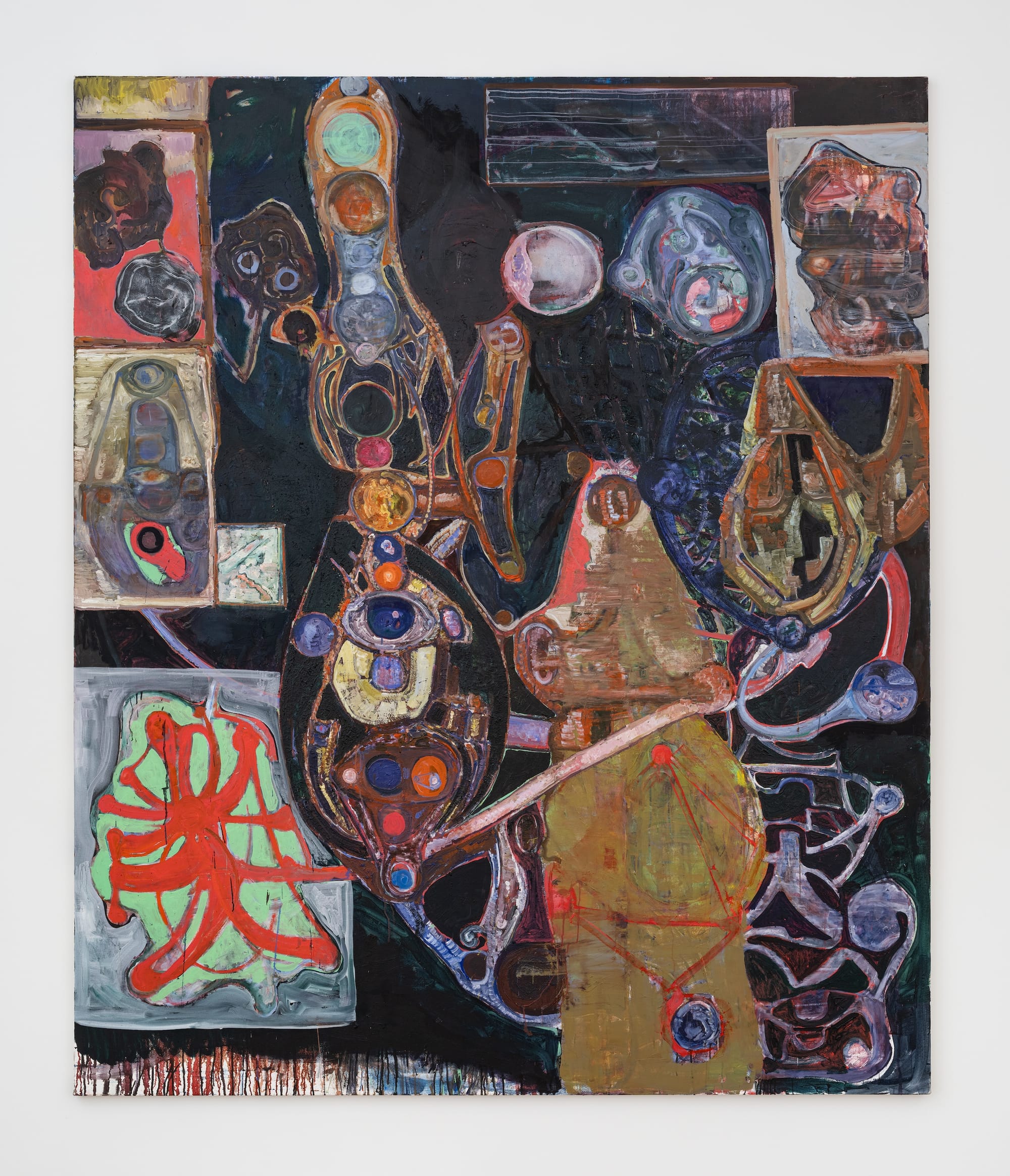
This technique has carried DiBenedetto into a speculative territory that is all his own. Each area of his large paintings requires a different treatment to keep the entire work from devolving into chaos. His visionary impulse propels him toward an inchoate state without crossing over. By reaching the porous border separating order from chaos, he conveys the state of anxiety many of us currently inhabit, unsure of how to proceed in this threatened world.
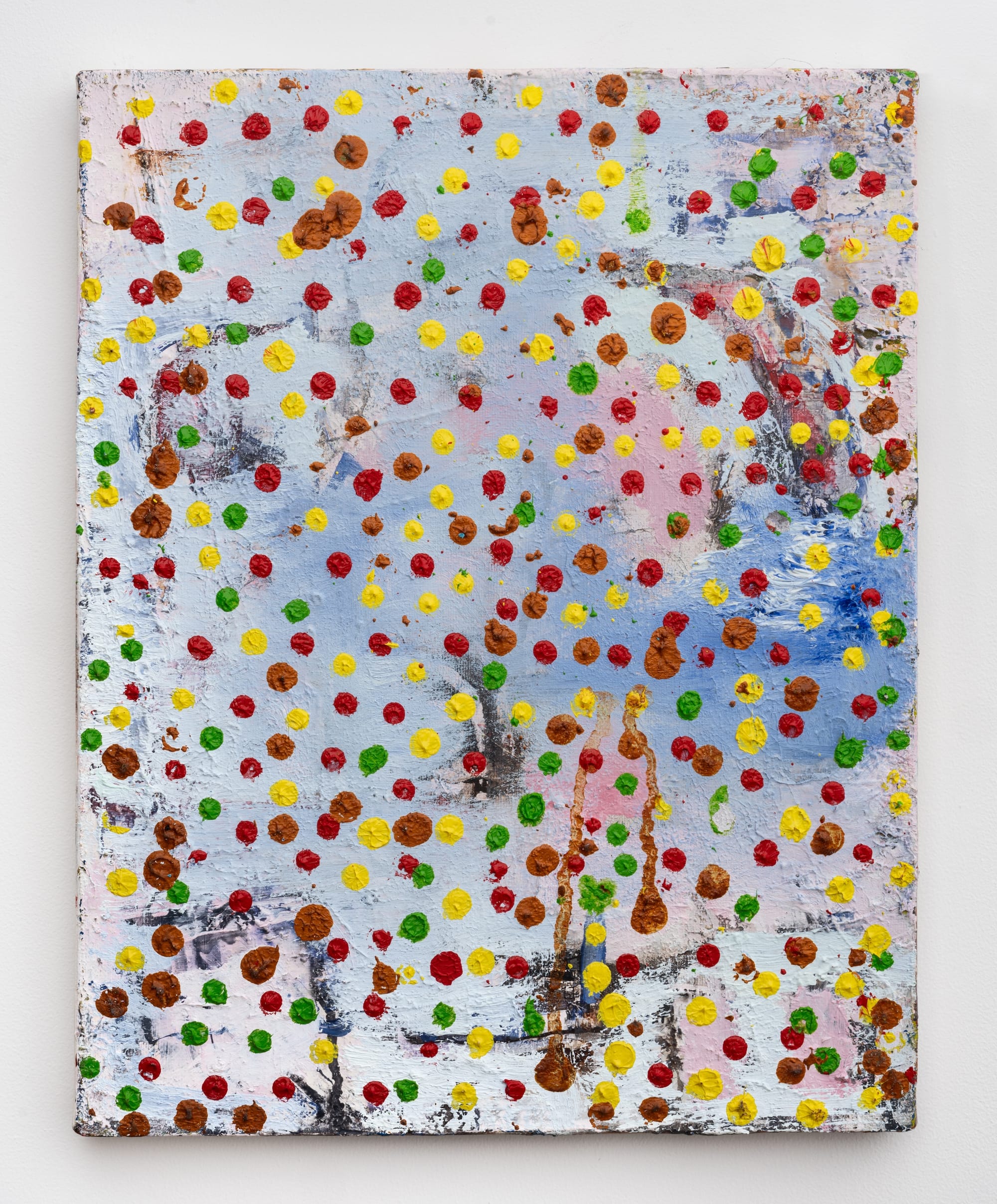
The 13 intimately scaled paintings reveal DiBenedetto pushing his process-based method in other directions. Dated 2022 to 2026, “Interstellar Antifreeze” depicts a tarry black and pink head seen in profile, covered with white dots of paint. “Ok, I lied” (2023) is a thinly painted ground of pale blue with small areas of pink and dark blue covered with different-sized dots of red, green, and yellow that DiBenedetto applied by brush, so that they culminate in a peak. In the other paintings, many of which are made of bands and lines connecting outlined nodes that resemble distortions of the Kabbalah Tree of Life (Etz Chaim), DiBenedetto arrives at different surfaces, from those that appear worn by time to ones that are firm and clear. Others resemble topographic views of ancient cities whose names and histories are lost to us.
DiBenedetto touches on the gamut of anxieties and hopes we face in a rapidly accelerating world that seems to have lost its moral compass by evoking indecipherable, mystical diagrams, maps of forgotten kingdoms, and life-forms comprised of different unnamable identities. Filtering a mixture of humor, mystery, belief, doubt, religion, and science through a skeptical viewpoint, he takes measure of our befuddled grasping for certainty.
Spiral Architect continues at Derek Eller Gallery (38 Walker Street, Tribeca, Manhattan) through April 25. The exhibition was organized by the gallery.