Suffering From “Creative Hangover”? You’re Not Alone
A new study finds that artists experience negative emotions the morning after their most productive days.

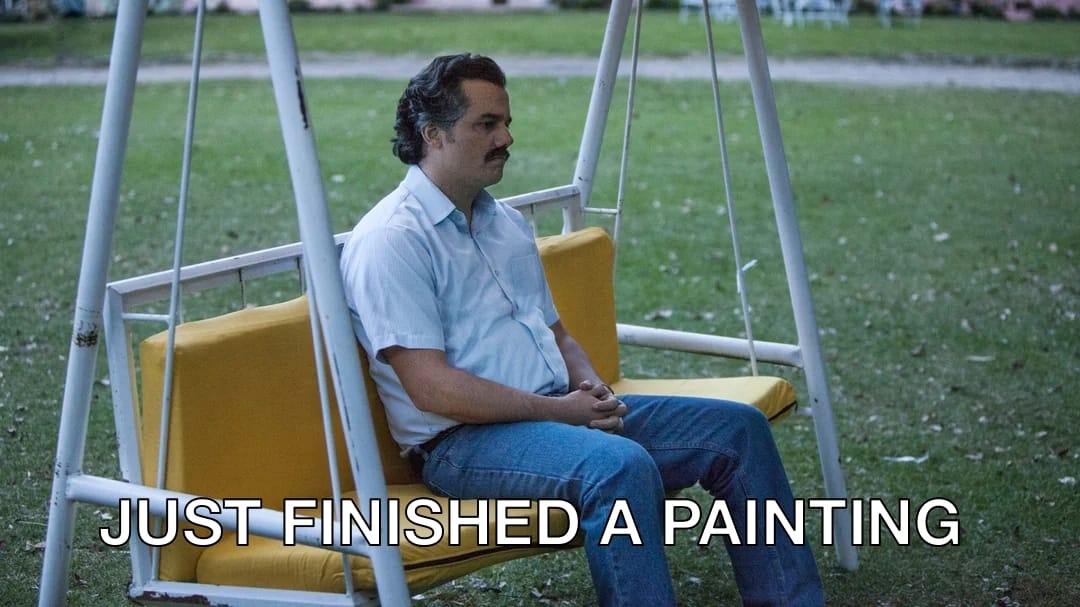
Every artist knows the feeling of emptiness that follows the completion of a project, especially a big one. You feel deflated, exhausted. You can’t imagine doing it again, but you also can’t imagine leaving art behind.
A newly published study in The Journal of Positive Psychology now has a name for this sort of artistic whiplash: “creative hangover.”
Researchers tracked 355 adults over 13 days using daily diary surveys and found that professional artists tend to experience negative emotions the morning after their most creative days, even though creativity, while in the process of making art, reliably improves their moment-to-moment feeling states.
The study, led by researchers Kaile Smith and Jennifer Drake from the Department of Psychology at the Graduate Center of the City University of New York, split participants into two groups: 202 creative practitioners (people who earn income from creative work, formally study a creative discipline, or devote over 20 weekly hours to serious creative hobbies) and 153 comparison participants (individuals who engage in creative activities at more typical levels).
Though all people have the capacity to be creative, the fact remains that some do so in a professional context and others on a more need-to or want-to basis. Since they are creating for fun rather than for their livelihood, the comparison group experiences “lower intensity and less frequent sustained creative demands,” wrote Smith and Drake.
To measure well-being, the researchers used the PERMA framework, a psychological research model that tracks Positive emotions, Engagement, Relationships, Meaning, and Accomplishment.
Both participant groups reported feeling comprehensively better on days when they engaged in creative activities, citing positive emotions, a strong sense of meaning, feelings of accomplishment, and improved social connection. The next morning, however, brought divergence: While casual creators tended to carry the good feelings forward, waking up with improved moods and relationships, creative practitioners fell into melancholy.
“Creativity is usually framed as a straightforward path to feeling better,” Smith said in a statement accompanying the study. “What surprised us is that for creative practitioners, there can be a next-day emotional cost, even when the same-day effects are positive.”
The researchers offered several explanations, principally that professional creative work demands intense self-regulation.
“Creative work requires intensive self-regulatory processes, including managing emotions, sustaining effort through obstacles, and continuously revising one’s approach, which can be cognitively taxing,” the researchers wrote.
Creative professionals are also far more accustomed to the acute sting of a hard session, artist’s block, lack of progress, and negative feedback. Neurobiological factors might also be at play, as intense creative engagement could deplete dopaminergic resources.
“Creative professionals are often under intense pressure to perform, to produce, and to evaluate their own work,” said Drake, who specializes in the psychology of the arts. She’s careful not to let the finding tip into the familiar tortured artist trope. “This study shows why blanket claims like ‘creativity is always good for you’ miss important nuance,” she added.
Indeed, the picture is more complicated than the simple suffering. Notably, creative practitioners in the study actually started out with higher baseline well-being than the comparison group. Creative practitioners reported feeling more engaged, connected to others, and more likely to draw a sense of meaning from their lives. The daily artistic grind certainly exacts a cost, but it seems like a life built around creative work offers psychological rewards overall.
The study also surfaced a telling asymmetry in how the two groups experience negativity. For casual creators, feeling bad one day actually predicted more creativity the next day, almost as if they were reaching for artistry as a mood stabilizer. For professionals, however, no such pattern emerged. Their creative output was largely unaffected by how they felt the day before, which the researchers chalk up to an occupational hazard: creative professionals often have to create regardless of how they feel.