Text Messages Reveal How University of Texas Leaders Axed an Anti-ICE Show
The school’s president and provost discussed removing artworks “of concern” before shuttering Victor Quiñonez’s exhibition, alarming free speech advocates.

Weeks after the University of North Texas (UNT) abruptly axed an exhibition of works criticizing the treatment of immigrants in the United States, newly obtained internal communications show how university administrators deliberated their controversial action.
According to public records first reported by independent journalist Adam Schrader and reviewed by Hyperallergic, the Texas university's Provost Michael McPherson and President Harrison Keller discussed cancelling Victor “Marka27” Quiñonez’s show Ni de Aquí, Ni de Allá in private text messages. Since the school canceled the exhibition without explanation in February, free speech groups, including the American Civil Liberties Union of Texas, have accused UNT of censorship, and the majority of the current Studio Art MFA cohort has withdrawn from upcoming thesis shows in solidarity with Quiñonez.
Days before canceling the show, McPherson and Keller discussed removing specific works from the exhibition in text exchanges obtained via a public records request.
“Our group met this morning regarding the gallery show. We believe all pieces that are of concern can be removed, and the rest of the exhibition can continue,” McPherson wrote to Keller on February 6. “You ok with that?” Keller replied, “Yes. Thank you for your help with this.”
In another message, McPherson wrote to Harrison, "Sorry it happened. But I think we've gotten ahead of this."
“I think it’ll be easier to manage any barking from our friends in Austin,” McPherson continued in the text thread, referencing the comparatively liberal state capital. “There will likely be some folks who are upset about perceived censorship. UBSC [the University Brand Strategy and Communications office] is ready to address any such.”
"Coming down totally on Monday," McPherson texted Keller on the evening of February 6, shifting away from a push to remove individual pieces to dismantling the exhibition entirely.
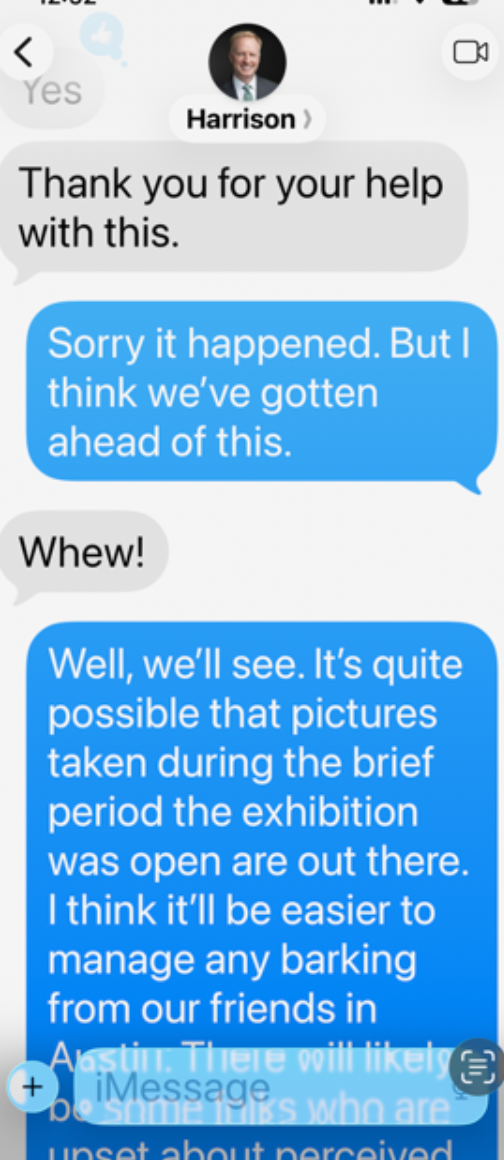
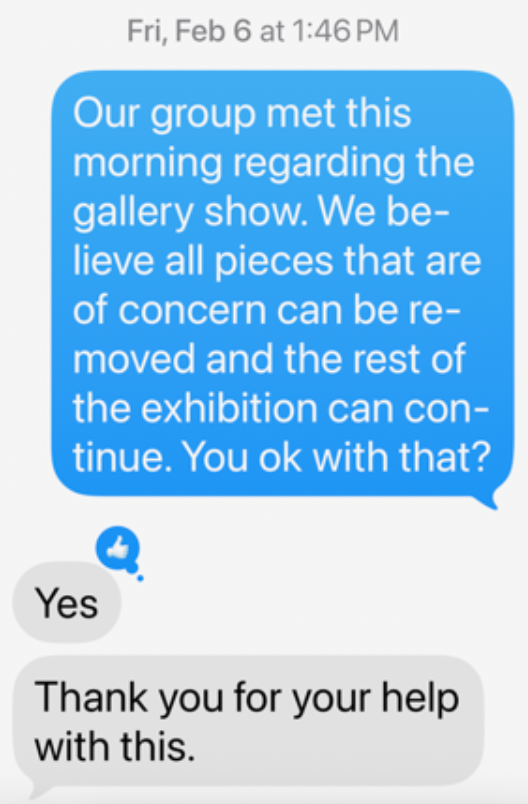
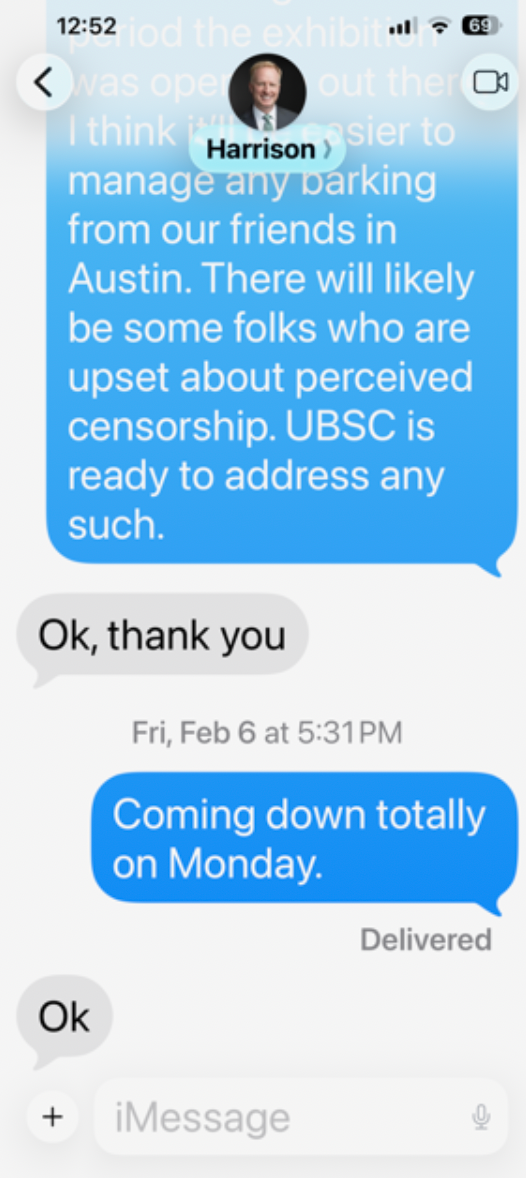
Texts between UNT's president and provost (screenshot Hyperallergic via public records)
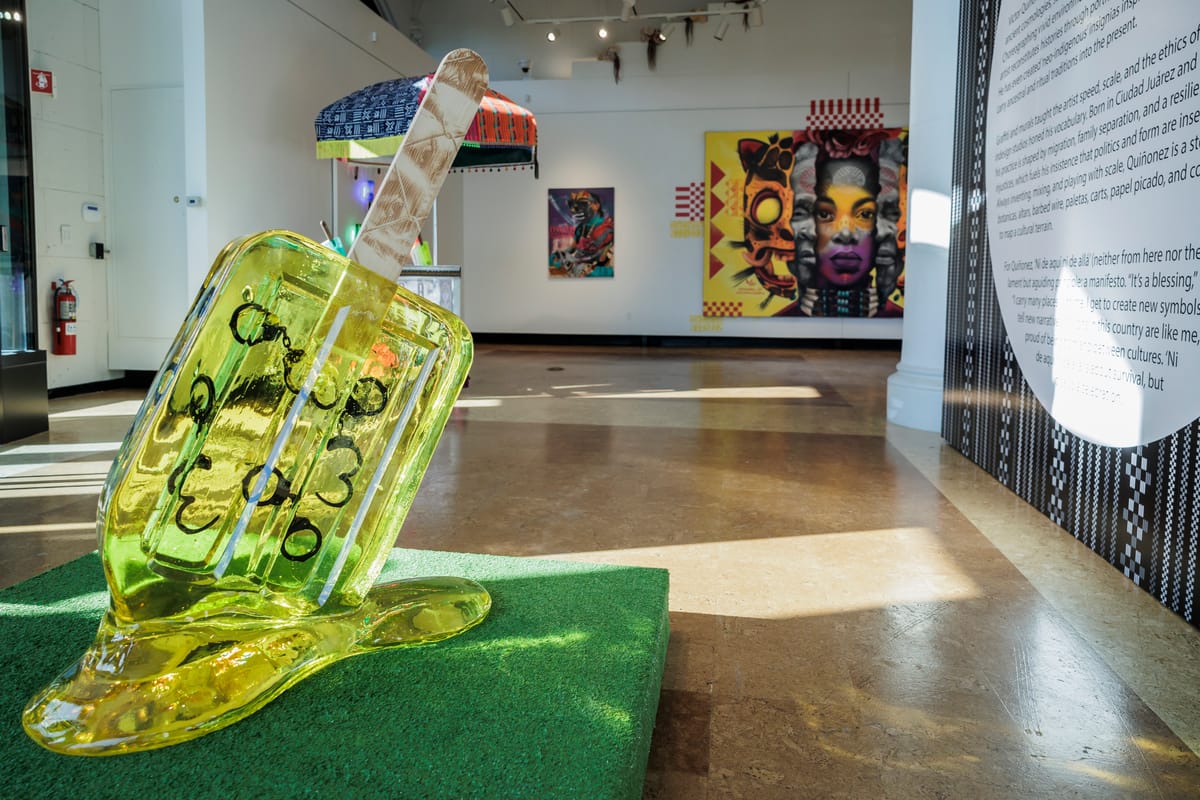
Quiñonez, who was born in Mexico and witnessed his own father’s deportation, had included works from his I.C.E Scream sculptural series in the exhibition, which would have run from February 3 through May 1. Quiñonez's enormous resin forms are modeled after paletas (popsicles) and sometimes contain suspended guns and handcuffs in a critique of the treatment of Latino immigrants by the federal government.
Days after the show opened at the College of Visual Arts and Design (CVAD) gallery, students noticed that the windows had been covered up. Quiñonez then received a short email from CVAD leadership informing him simply that UNT had terminated its loan with Boston University, which had previously shown the works and was lending them to the Texas school.
Reacting to the newly revealed text exchanges between UNT's president and provost, Quiñonez told Hyperallergic that the conversations demonstrated “the magnitude that art has when it speaks truth to power.”
“We will not be silenced, and I'm hopeful that institutions, museums, and organizations on the right side of history will step up for artists creating work that unites us,” Quiñonez said.
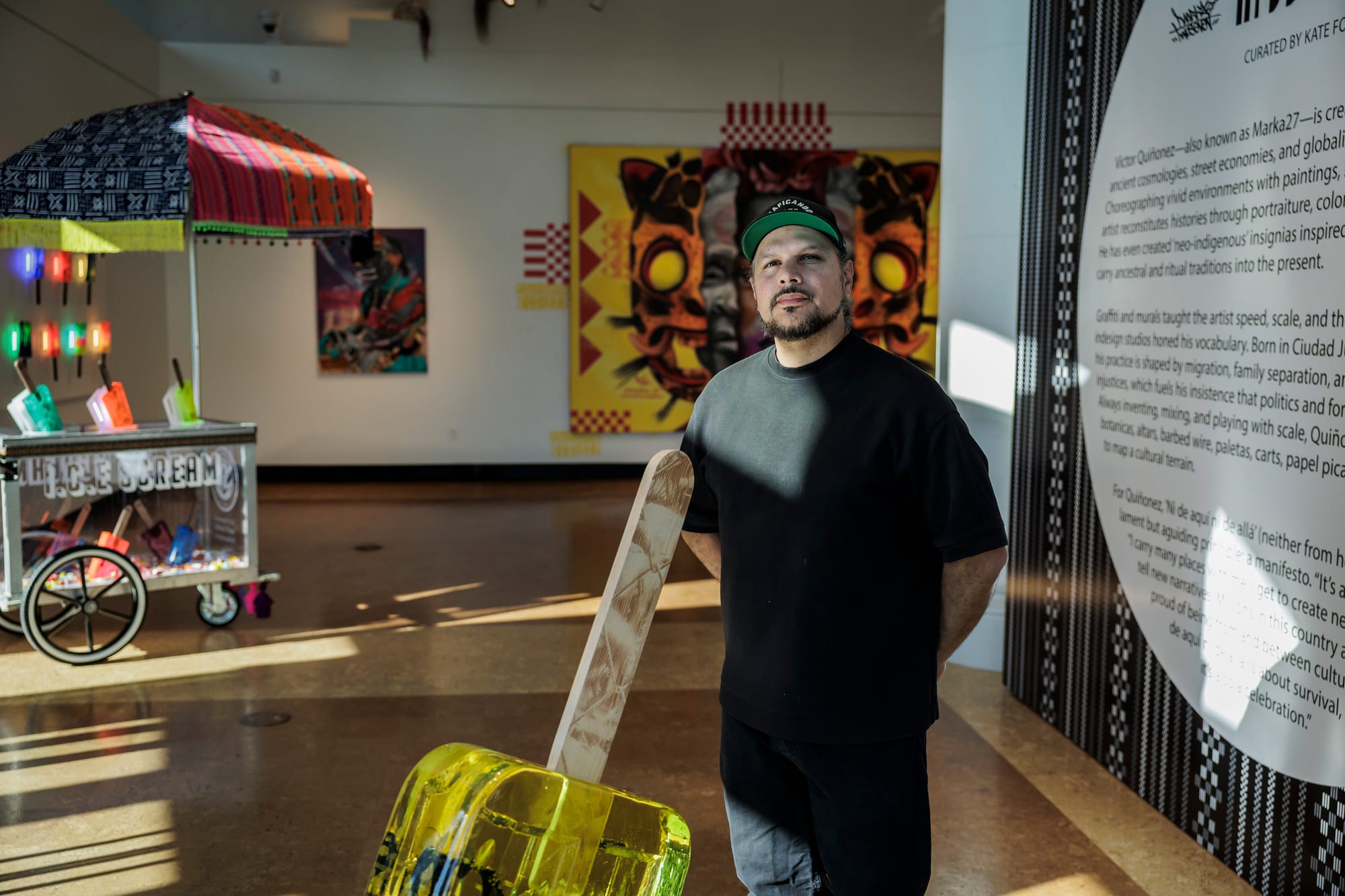
Other documents turned over by the university's public records office included emails between CVAD staff. In email chains, CVAD's dean, Karen Hutzel, provided an email template for gallery director Stefanie Dlugosz-Acton to notify the artist of the cancellation.
Hutzel suggested beginning the email with a “personalized greeting that does not express regret or an apology.”
Another document reviewed by Hyperallergic, titled "CVAD Art Gallery," provides a timeline of the events leading up to the removal. It is unclear who created the document. According to the timeline, Dean Hutzel visited the exhibition with her family on February 2; a week later, on February 9, the show was “being packed up, being pulled down right now.”
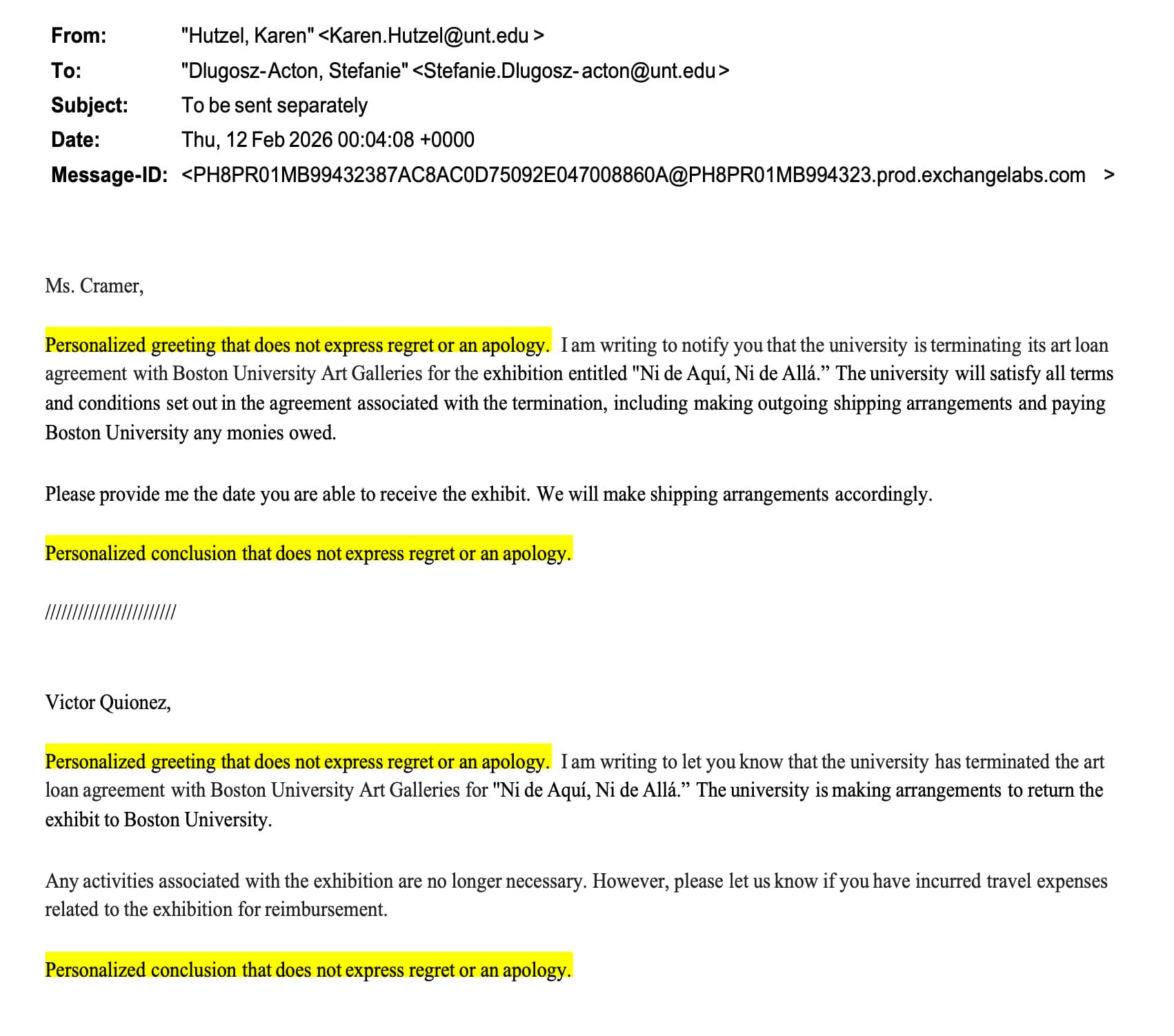
The document also references a policy for art exhibited on campus that was implemented last year, after a pro-Palestine art exhibition at a UNT student gallery was partly dismantled following accusations of antisemitism from Republicans. The new policy claims to protect free expression under the university's “viewpoint-neutral regulations.”
Another page outlines arguments for and against de-installing the exhibition. When Hyperallergic screened the bullet-point list with an AI writing detector, the document was determined to be likely AI-generated. (Hyperallergic has reached out to UNT for comment.) Among the reasons to remove the artwork, the list cites creating "a safe and respectful campus environment" if the works promote hate or discrimination, and notes that “if the installation causes significant disruption, prevents the normal function of the university, or poses a safety risk, administrators may argue they have a right to remove it.”
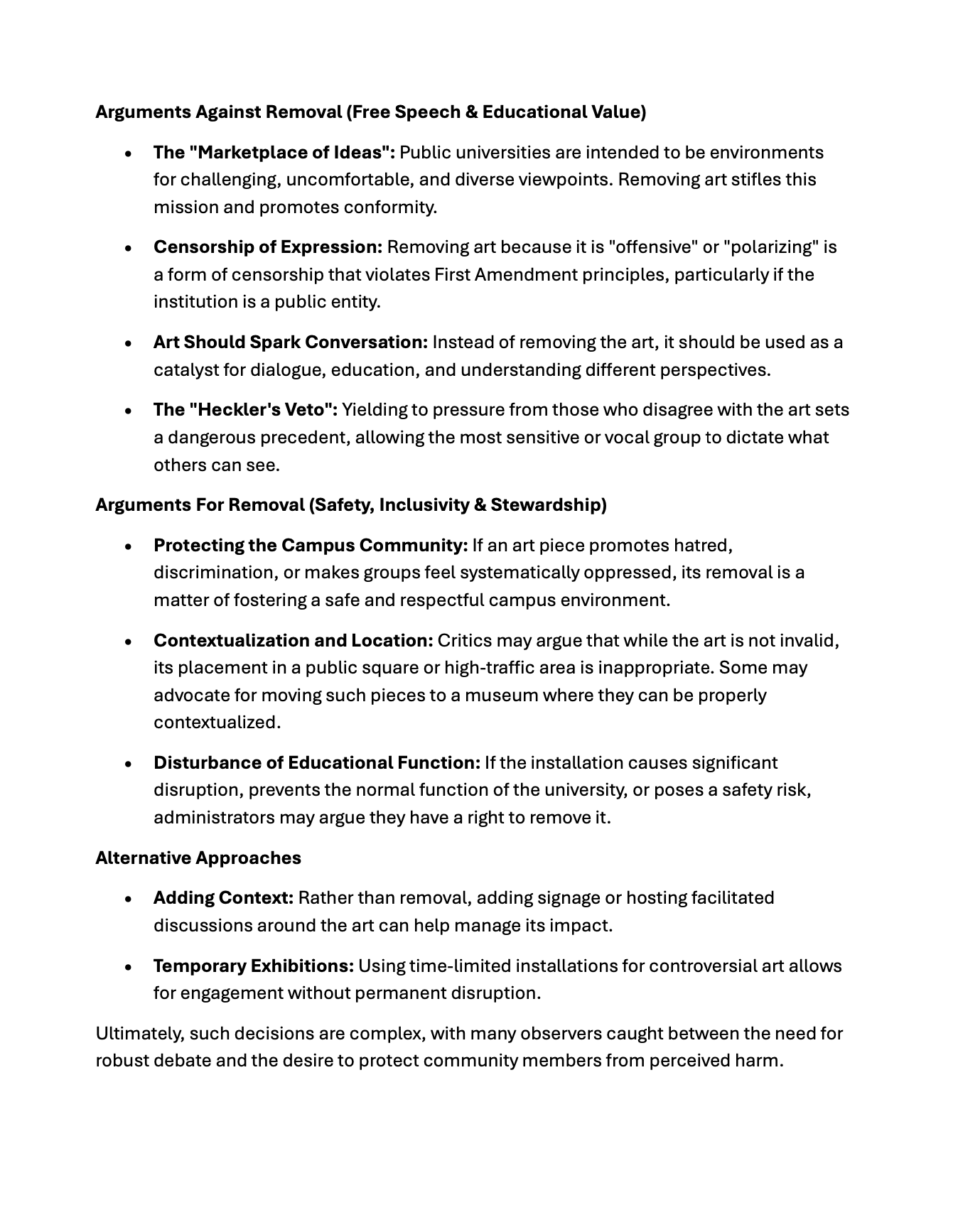
What these recently obtained emails and text messages do not address is UNT’s reason for cancelling the exhibition, which the school has not publicly commented on.
A text message to James Coll, UNT's vice president of brand strategy and communications, suggested one possible phrasing for a statement: “We canceled the exhibit based on concerns about potential disruption and subsequent impact on the educational environment and campus safety.” The statement, however, was never made public.
Some members of the campus community who spoke to Hyperallergic said they suspected that the school took down Quiñonez’s artworks under pressure from Republicans, or to avoid angering government officials who support President Trump's immigration crackdown.
Last summer, Texas's Republican-led state legislature passed a highly criticized bill that gives the government control over curricula and other content at public colleges and universities, and establishes an "Office of the Ombudsman" appointed by the governor to ensure compliance.
UNT has also recently come under fire from Texas Attorney General Ken Paxton, a supporter of President Trump’s deportation campaign who recently launched investigations into three school districts where students protested ICE violence. Last year, Paxton had pledged to investigate UNT for failing to address “left-wing extremism” on its campus in the wake of right-wing commentator Charlie Kirk’s assassination.
The ACLU of Texas and the National Coalition Against Censorship are among the free speech advocacy groups that have publicly condemned the university’s actions.
“Public universities are meant to foster critical thinking and open debate on a wide range of topics — including immigration, identity, and human rights — not shut down learning because it makes a few people uncomfortable,” ACLU of Texas attorney Chloe Kempf said in a statement.
UNT has not yet responded to multiple requests for comment from Hyperallergic.