The Artist Mapping Knoxville’s Art Scene With Wood and Wire
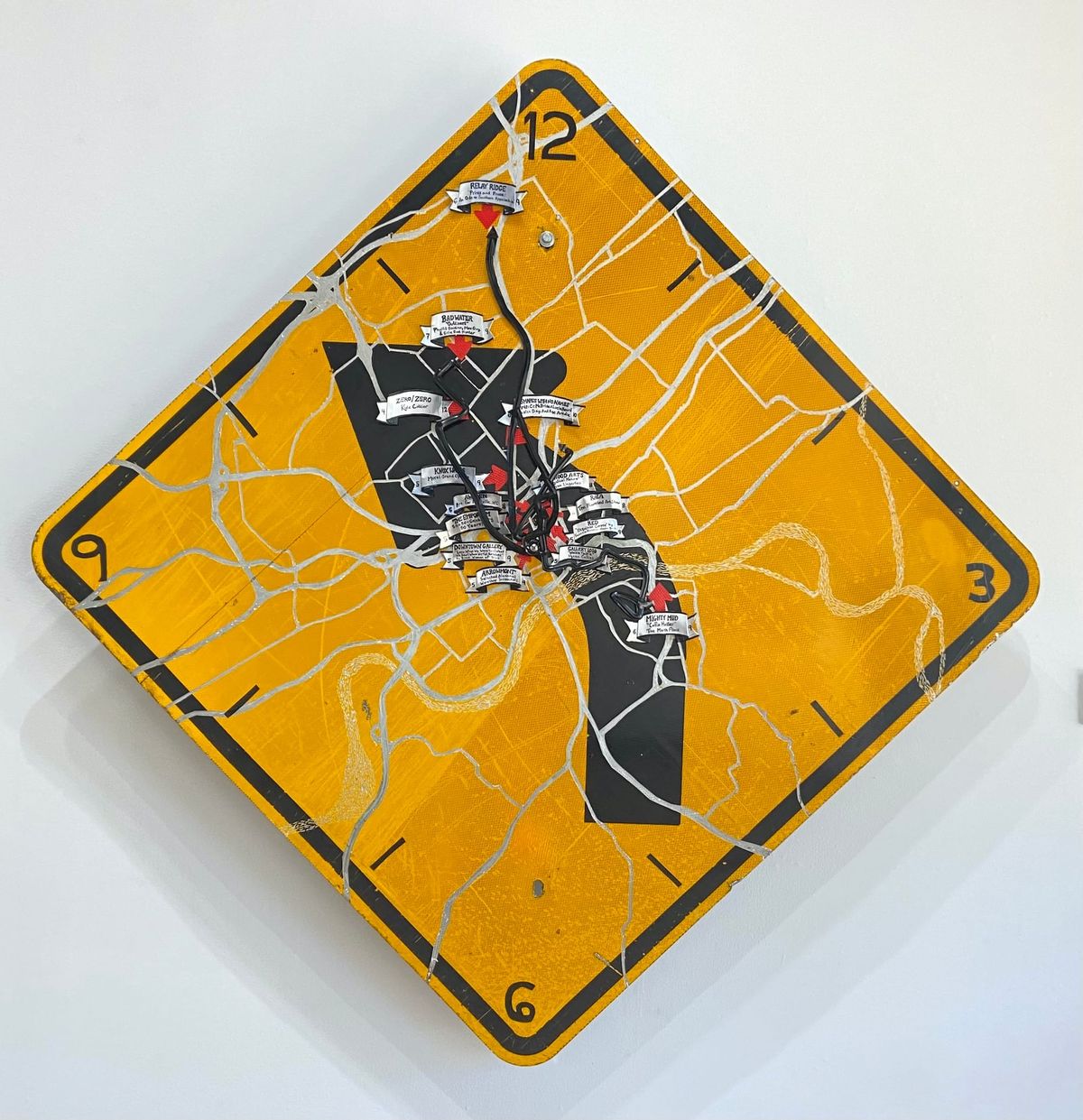
Three years ago, Lauren Farkas sketched a plan to see exhibitions during the city’s monthly art walk. Now, she crafts eclectic maps for each event to make the art scene more accessible.

KNOXVILLE, Tenn. — On the first Friday of each month, a dozen or more exhibitions open across galleries, studios, and temporary spaces in Knoxville. For many people in the small city’s art community, the night is either an overwhelming jumble or a repetitive routine. Artist Lauren Farkas’s maps offer a way through.
“If everything is on the map, people get overwhelmed,” Farkas told Hyperallergic. “I put all the things that I would like to go to if I had enough time on the map.”
Farkas, a high school art teacher at L&N STEM Academy who has lived in Knoxville for nine years, said that she considers her educational work to be “a long-form performance piece.” She approaches each map as an artwork with a similar sense of structure: The geography remains fixed, while the shows and events shift from month to month.
Anchored by the Knoxville Museum of Art (KMA) and the University of Tennessee School of Art, the city's arts ecosystem extends beyond downtown’s familiar gallery circuit to include a growing network of artist-run spaces, community studios, and exhibitions that many attendees might otherwise overlook.
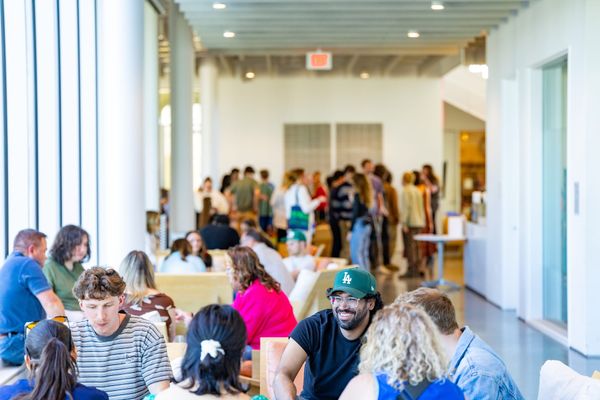
Farkas has used watercolor, tape, and digital animation, among other forms, to craft First Friday maps that help people make sense of the evening’s many possibilities — and feel confident exploring them.
“It’s an invitation, especially for people who might not otherwise feel they belong in those spaces,” Farkas explained.
One map transformed a pair of white sneakers into a walking guide, with Knoxville’s streets and gallery locations etched directly into the soles so that each step echoed the idea of an “art walk.” Another was made entirely from locally harvested materials — paper mulberry pulp, goldenrod, black walnut ink, acorns, and charred wood — creating, as Farkas describes it, “a map of the place with the place.”
For Kelsie Conley, assistant curator at the KMA, the maps transcend the role of an ordinary event guide. “They slow us down and change the way we experience the city,” she said. “They still do the practical work of helping us move through the city, but the information becomes something you have to spend time with. They ask us to think about the city as something that is felt, rather than just a fixed collection of destinations.”


The maps began as a way to orient Farkas herself in the city’s vibrant arts scene. Three years ago, she was sitting at her desk, scrolling through her phone, and making a plan for the evening. She sketched a map for herself in colored pencil — an attempt to make sense of First Fridays and get to as many shows as possible, thinking her way through time and space. She shared it on her Instagram story. A few friends started referencing it, and a project took shape.
“It was useful for me, and someone else used it,” Farkas said. “I thought, ‘Maybe that’s a need or a deficit in the local art world here.’”
Farkas continued creating simple maps over the next few months, posting them to her Instagram story. Around month four or five, she tried using different materials — watercolors led to markers, embroidery, wood ash, gouache on vellum, and even a double-sided shadow lamp.
Her audience is not easy to track, and she doesn’t always know who is using the maps. Some follow along through her Substack; others may just learn about her work through word of mouth.

The maps have already changed how people experience First Friday; Conley also credits them with flattening the boundaries within Knoxville’s art scene. “There’s no hierarchy to them,” she said. Whether it’s an exhibition at a major gallery or in someone’s apartment, Farkas treats them as equally worthy of attention.
Artist Josh Shorey describes First Friday as “a tradition and a distributed network” — a monthly event that has evolved organically, without a central organizing body. When a photographer who had recently moved to Knoxville from Los Angeles asked him how First Friday worked, Shorey found himself pulling up one of Farkas’s maps to explain it.
“Doing this for every First Friday builds a culture,” said Farkas. “It helps build consistency. I want people to see the value and interconnectedness of everything happening on First Friday.”