The Center Cannot Hold at the Toronto Biennial
It’s a provocative and discursive exploration of how artists respond to our late-capitalist epoch, but its focus on “rupture” raises questions.


TORONTO — At the World Economic Forum in Davos, Switzerland, this year, Canadian Prime Minister Mark Carney declared that the world is “in the midst of a rupture, not a transition.” The line is quoted in the catalog for the fourth Toronto Biennial of Art, Things Fall Apart, and could serve as the exhibition’s epigraph.
Curated by Allison Glenn, who spent her childhood in Detroit, crossing into Canada through Windsor, the edition brings together more than 30 artists and collectives across Toronto and, for the first time, sites beyond it, including Anchorage in Alaska and Times Square in New York.
Glenn keeps the Biennial’s long-running focus on water, taking the Great Lakes as her point of departure to ask what artists who work with rupture can teach us about histories, borders, and movement. With Canada–United States relations at an unprecedented low, a cross-border exhibition built around shared waterways feels just right.
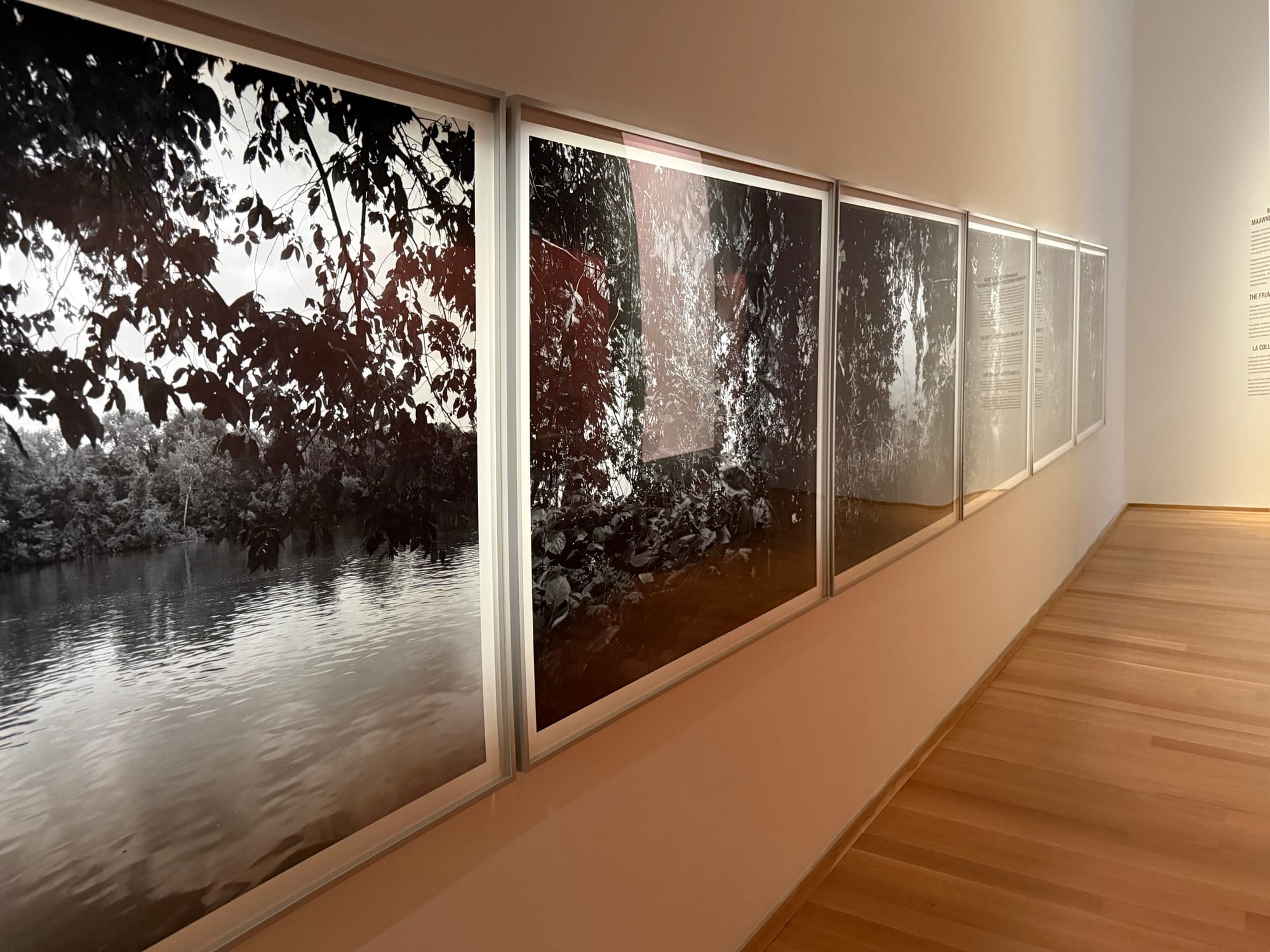
The most affecting works treat histories of rupture as an imaginative encounter to be conjured rather than a settled narrative to be recorded. At the Art Gallery of Ontario (AGO), Dawoud Bey’s Material Histories, Living Landscapes hangs photographs from three landscape series tightly together around his two-channel video “350,000” (2023), alongside sculptures and ritual objects from the AGO’s collection with roots in Nigeria, Ghana, and the Kingdom of Kongo. The pairing sets up a striking sonic and visual call and response across the Middle Passage, elucidating the ways the afterlife of slavery permeates the physical world around us. The film’s point-of-view movement through dense woods, accompanied by the sound of heavy breathing and black-and-white images of gnarled landscapes and old homes, suggests that the fight to live free from racial violence is still an urgent one today.