The Sunflower Effect of Kyung-Me
The artist’s current series marks a shift in her practice, evoking the life span of a sunflower — from blooming to dying, from sharply defined forms to rivulets of dissolution.

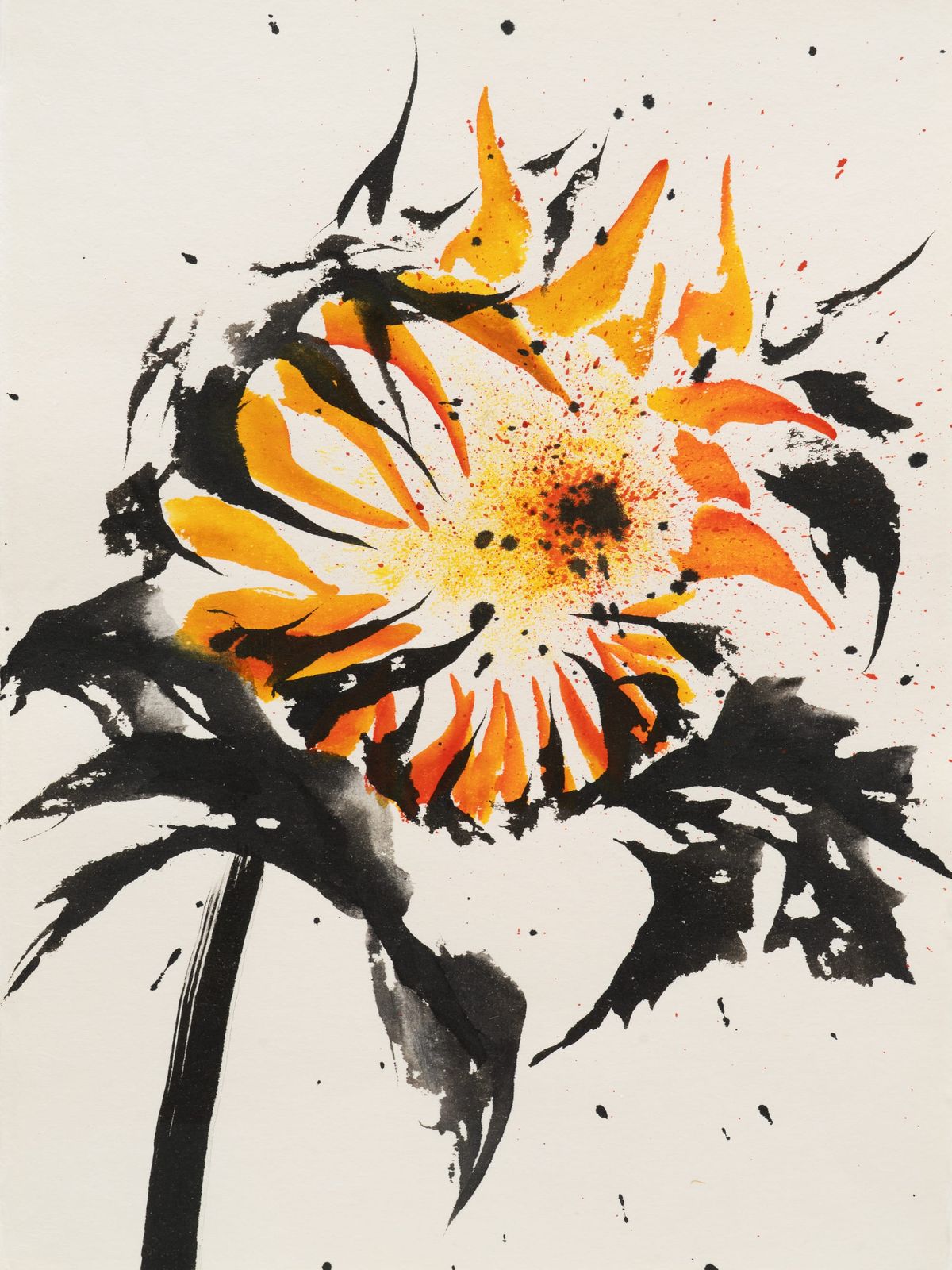
Kyung-Me has yet to be recognized as one of the most compelling artists of her generation. Now in her mid-30s, she has transformed her process to make at least four distinct bodies of work. First, she published her graphic novel, Bad Korean (2016), a pictorial diary done in pastel and colored pencil of a gullible young woman in New York, looking for love. Alienated and unhappy, she believes sex, alcohol, food, and dressing hip will help her escape her hyper-awareness of not fitting in. Told in snippets of speech, such as the repeated phrase “I want to be your only friend,” the self-deprecating narrative is an engrossing combination of quiet desperation and blunt humor. It is easy to imagine that Kyung-Me could have authored a series of books about this character, but she didn’t. In Copy Kitty (2020), Kyung-Me used graphite to depict an intricate, wordless tale of a cat who keeps changing her identity in the pursuit of love and affection from a young blonde man.
While the themes of alienation and trying to fit in — a common trope for those living in the diaspora — convey a narrative ripe for exploration, Kyung-Me shifted everything about her work for her first solo exhibition in 2022 at Bureau, which I reviewed. Working meticulously with pen and pencil, she created eight drawings of elaborately detailed, nested rooms. About this dream house, whose occupant’s face is always hidden, I wrote that it was "as if she drew each line with a razor blade that cuts deep but draws no blood. The effect is mesmerizing and unsettling."