Wally Hedrick Protested War With Sex
The countercultural San Francisco artist specialized in antiwar art and the transcendent potential of sex in the era of flower power.
LOS ANGELES — Sex Politics Religion, the title of California Beat artist Wally Hedrick’s first retrospective in 40 years, refers to three subjects that were considered verboten for mixed company when I was growing up in the 1950 and ’60s. For Hedrick, who was part of San Francisco’s mid-century countercultural movement, these topics inspired decades of creative output through which he mused about philosophical issues and protested war and politics. The show is split between Parker Gallery, which frequently platforms artists from the Bay Area’s storied art history, and The Box, which often highlights underrepresented artists and politically charged art. Between the two spaces, viewers encounter some early paintings that poke fun at Abstract Expressionism or employ text to create visual and verbal puns. However, the dominant focus in both spaces is on art that condemns war or celebrates heterosexual sex as joyous and even spiritual.
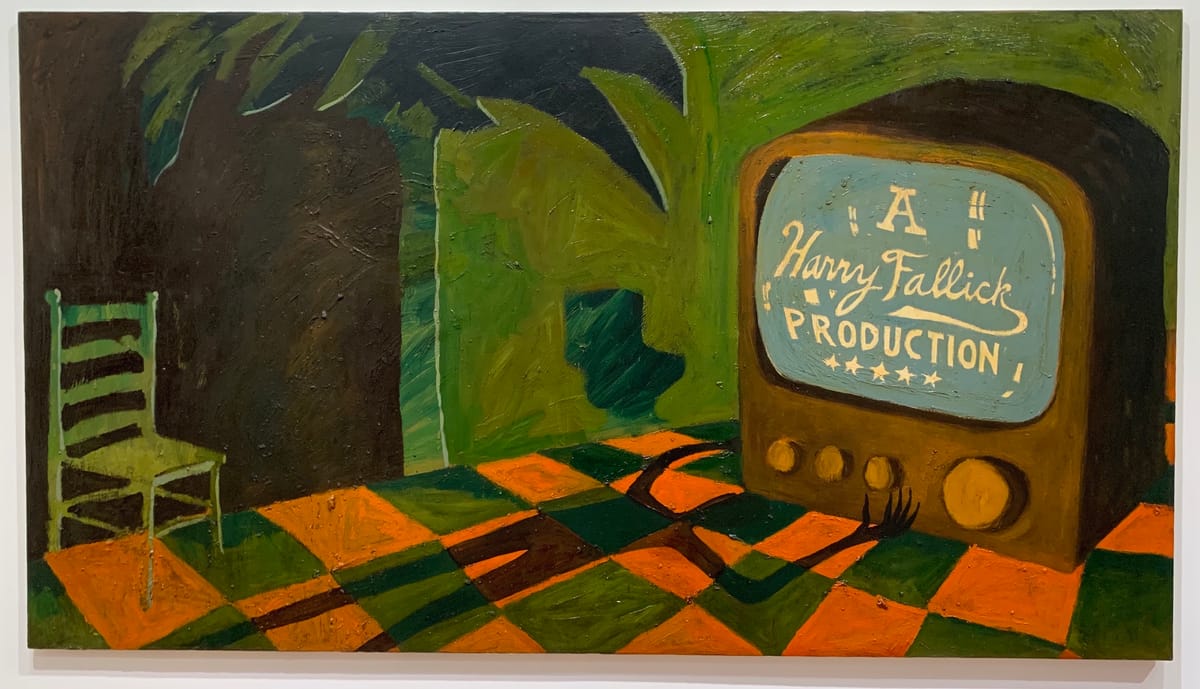
Hedrick was indeed a clever humorist. He rejected Abstract Expressionism at the height of its popularity, opting to do whatever he pleased, including painting a satirical commentary laced with sexual innuendo. “A Harry Fallick Production” (1959) refers to the increasing presence of the relatively new medium of television, also known as the “idiot box” at the time, in American culture. In this work, Hedrick depicts a corner of his studio with an oversized TV, held up like Atlas’s globe by a shadow on the floor, with the painting’s title on its screen. The imagery was inspired by an actual program with the name Harold Fallick in the credits. The artist turned it into a witty double entendre and viewed Fallick as his alter ego, in homage to Marcel Duchamp’s Rrose Sélavy.
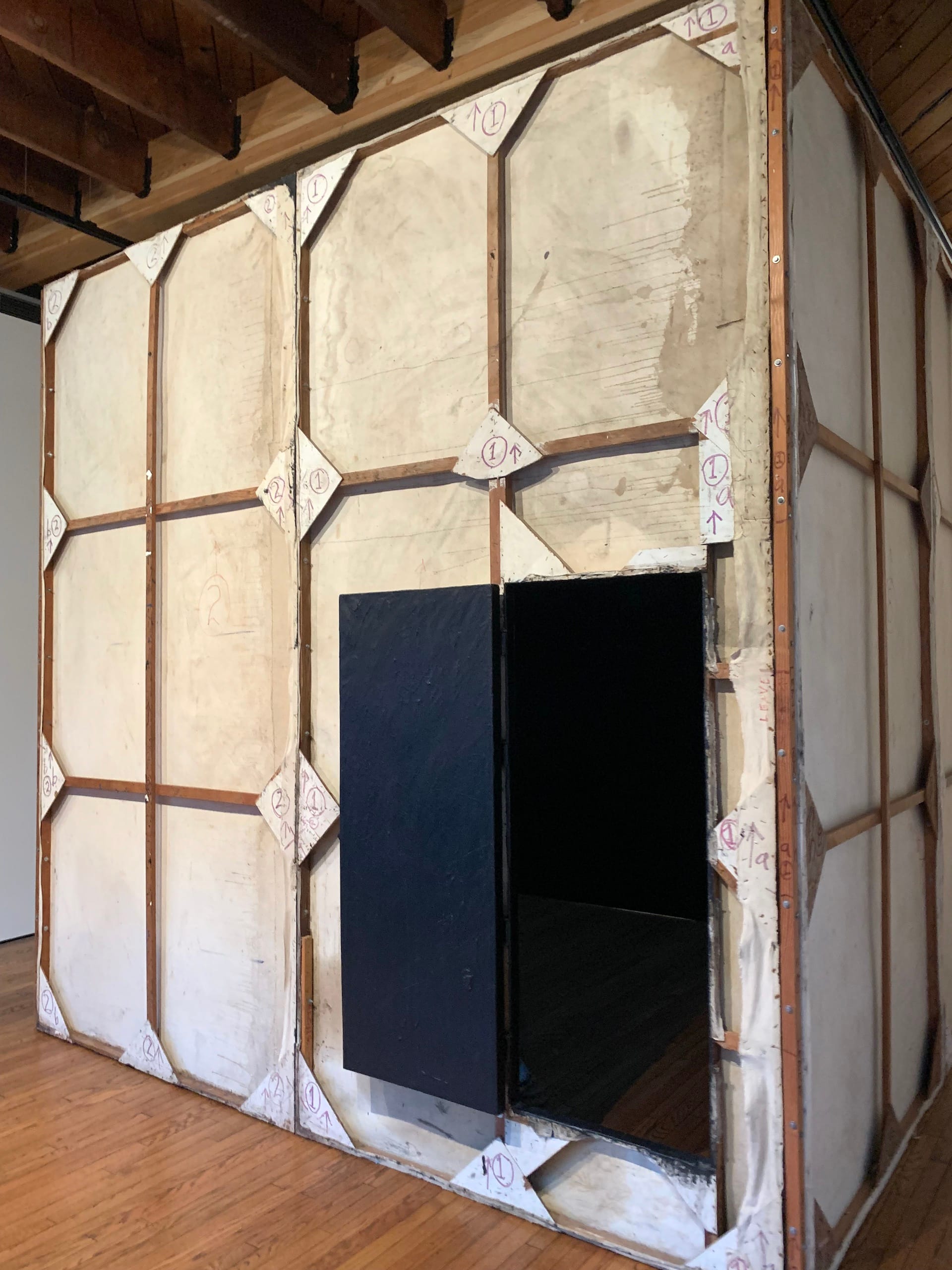
When it came to more consequential matters, Hedrick took a more serious tone. As a veteran of the Korean War, he responded to the Vietnam War’s escalation in 1957 by painting over some of his existing works in black. He saw this as an act of resistance, an antiwar gesture that would deny Western culture his contribution as an artist. Ten years later, as the war dragged on, he created the first incarnation of his immersive installation “War Room.” The structure takes the form of a large room, with stretcher bars on the exterior, and an interior composed of eight 11 by 5 ½-foot canvases — which he called “wounded veterans” — bolted together and painted black. “War Room,” installed with the door facing viewers in a small niche at Parker Gallery, was meant to be a contemplative space where people could confront their feelings about the war, through anger or meditative solemnity. He continued to make the black paintings during subsequent wars, and updated “War Room” by adding new layers of paint when he reinstalled it in conjunction with the Gulf War in 1992 and the US Occupation of Iraq in 2002.
In a 1974 interview with Paul Karlstrom for the Archives of American Art, Hedrick suggested that the primary ingredients in art-making might be “art, love, and spirit.” “Spirit + Idea #1” (1958), a dark brown abstract composition whose curving linear striations suggest a human spine or the core of a heart symbol, seems to bear this out. Hedrick was familiar with the then-prevalent idea of connecting love and sex to spirituality: He cofounded the Six Gallery, where Allen Ginsberg debuted the poem “Howl,” which includes the line “Everything is holy!,” and he was friends with fellow Beat artist Wallace Berman, whose mantra was, “Art is Love is God.” So it’s unsurprising that several of his paintings celebrate sex as metaphysical.
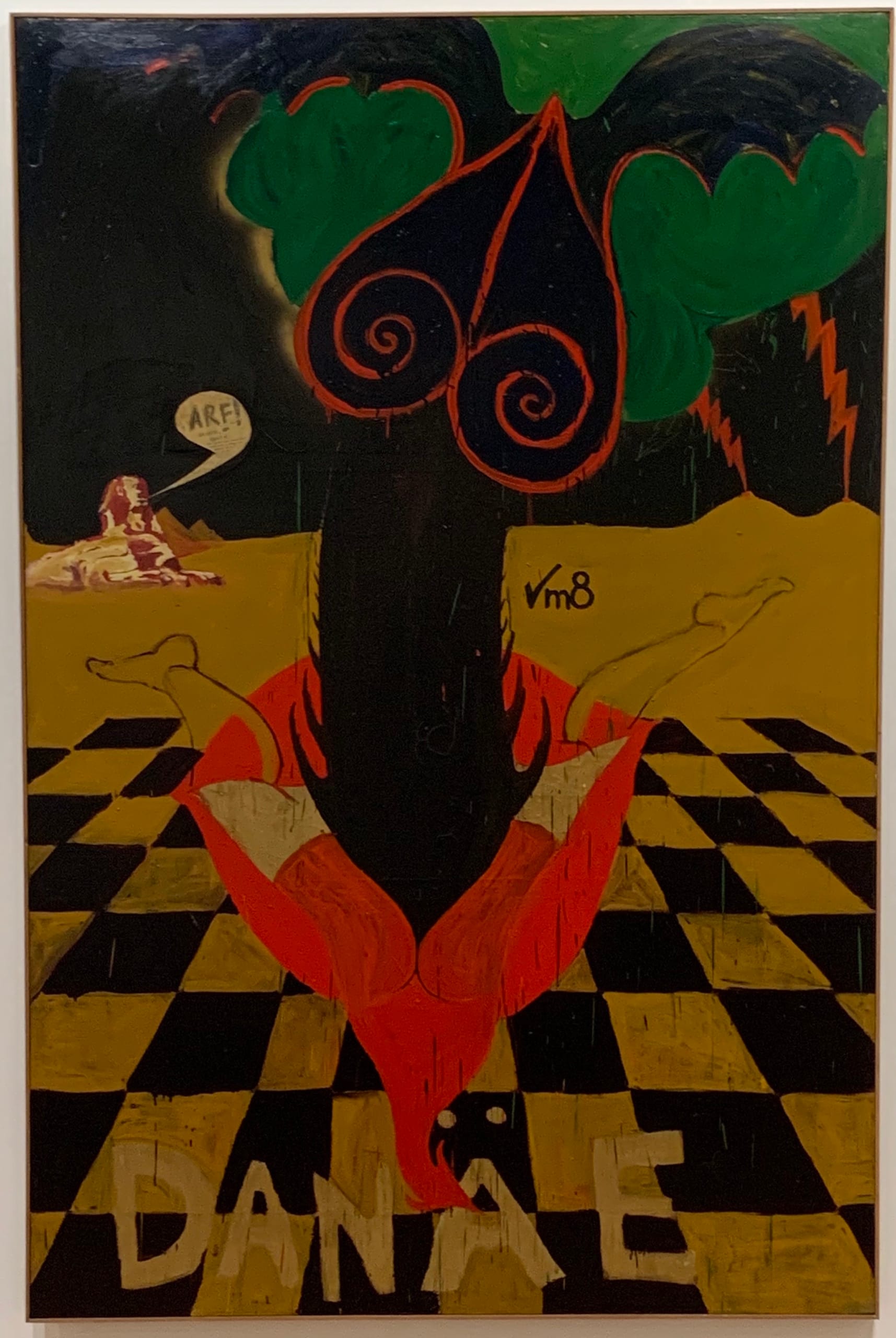
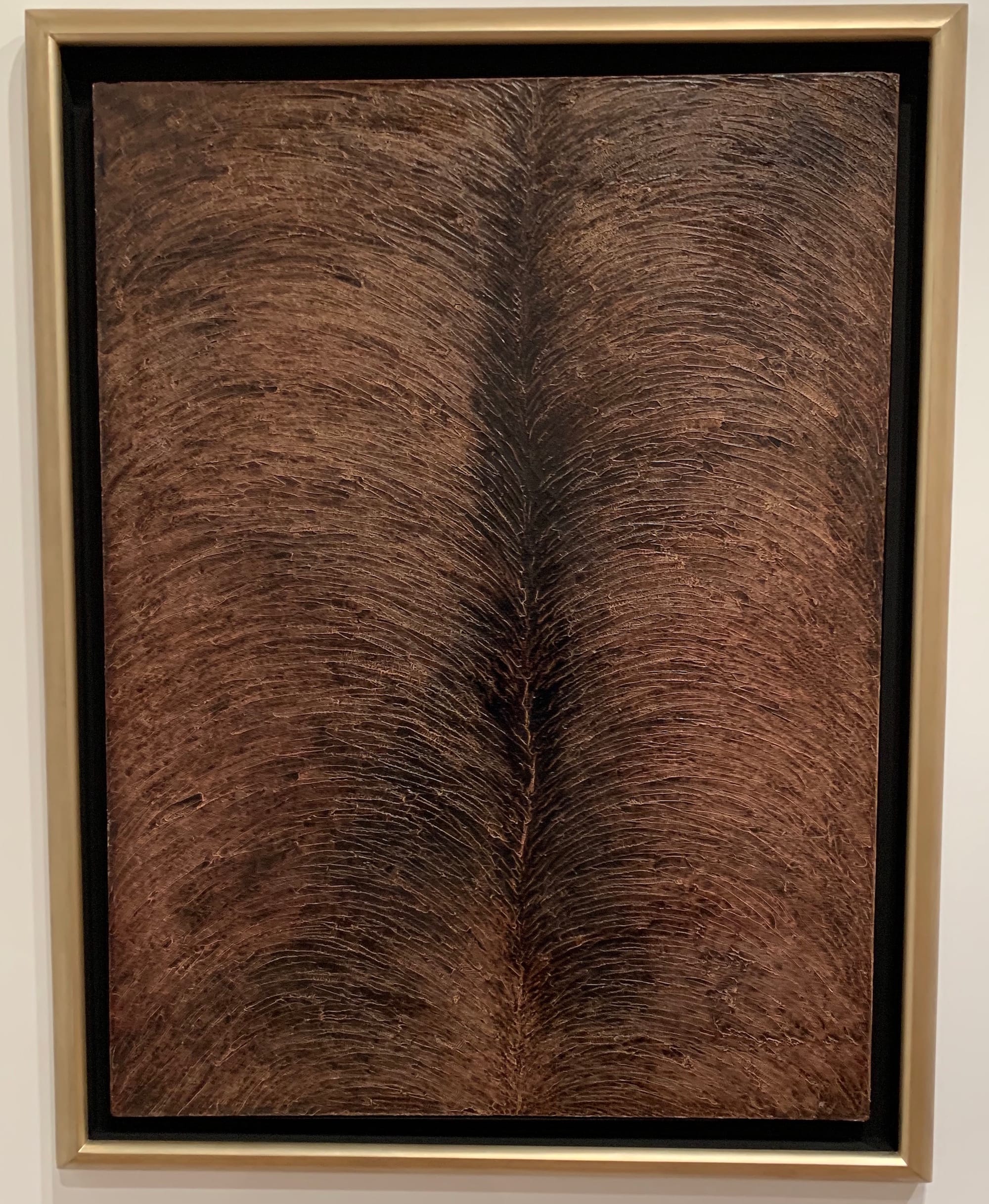
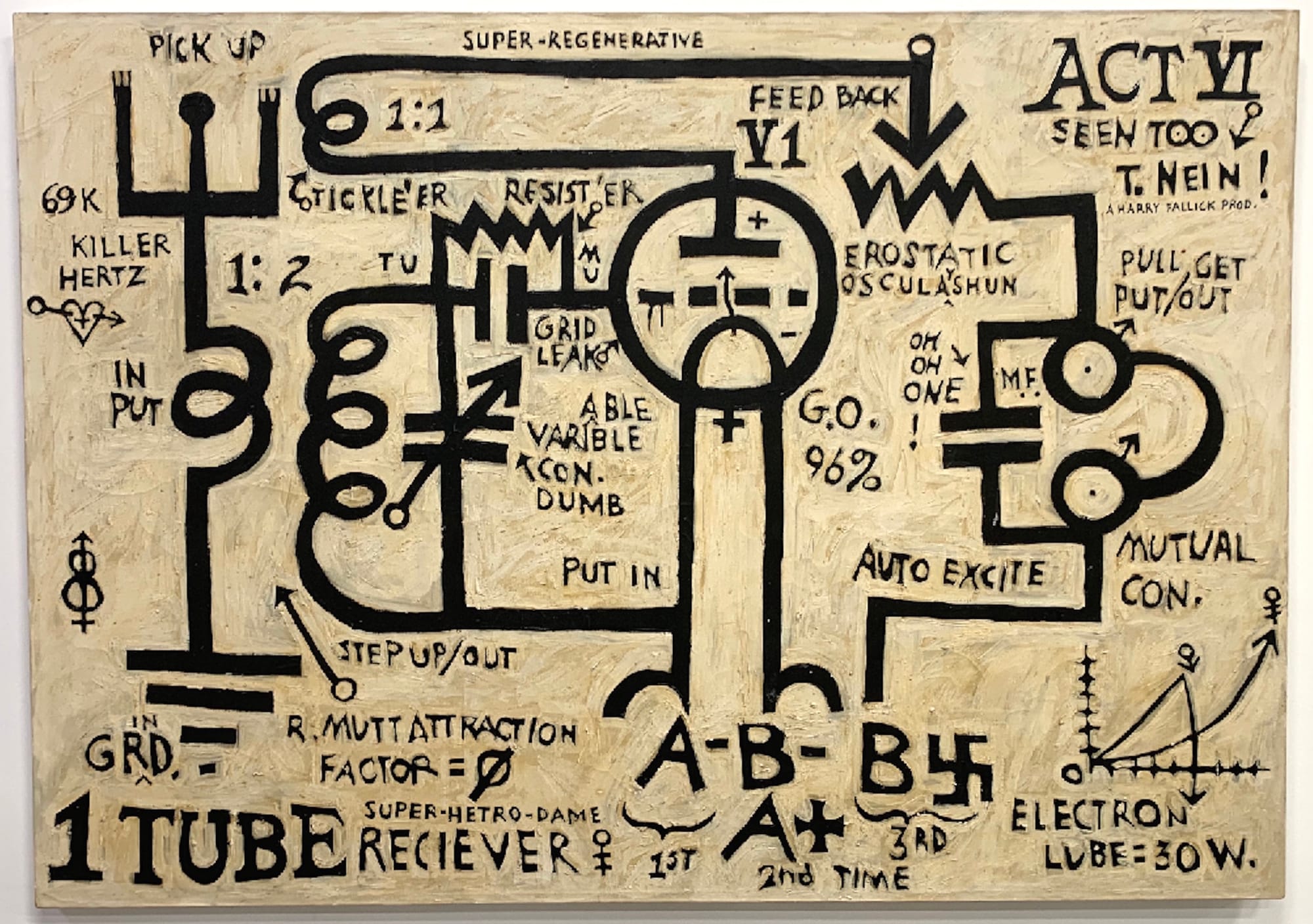
In “Danäe” (1980–81), referencing the mythological princess who was divinely impregnated by Zeus, a giant phallus penetrates a vagina. “1 Tube Super-Hetro Dame Receiver” (1978) and “Mojo: Electrosex Kit #10” (1979) are Duchamp-inspired black and white painted diagrams representing the mechanics of sex. The latter includes the word “ore-gone,” a pun on the orgone boxes that fascinated the Beats in the 1950s. Wilhelm Reich’s invention was intended to collect “orgone energy,” an unproven cosmic force released through sex that Reich believed to have healing powers. Hedrick also refers to the idea in “2/14/77” (1977), a small monochromatic brown Valentine’s Day painting — a close-up view of sex with a penis and vagina constructed from striations like those in “Spirit + Idea #1” — and in “Metamatic Attraction” (1983), where the initials of Hedrick and his then-girlfriend are enveloped in charged electrical currents, magnetically attracted to one another. Hedrick eschewed the notion of working in a single style, instead exploring a particular idea in a variety of formats and with great ingenuity, something that comes across in both shows.
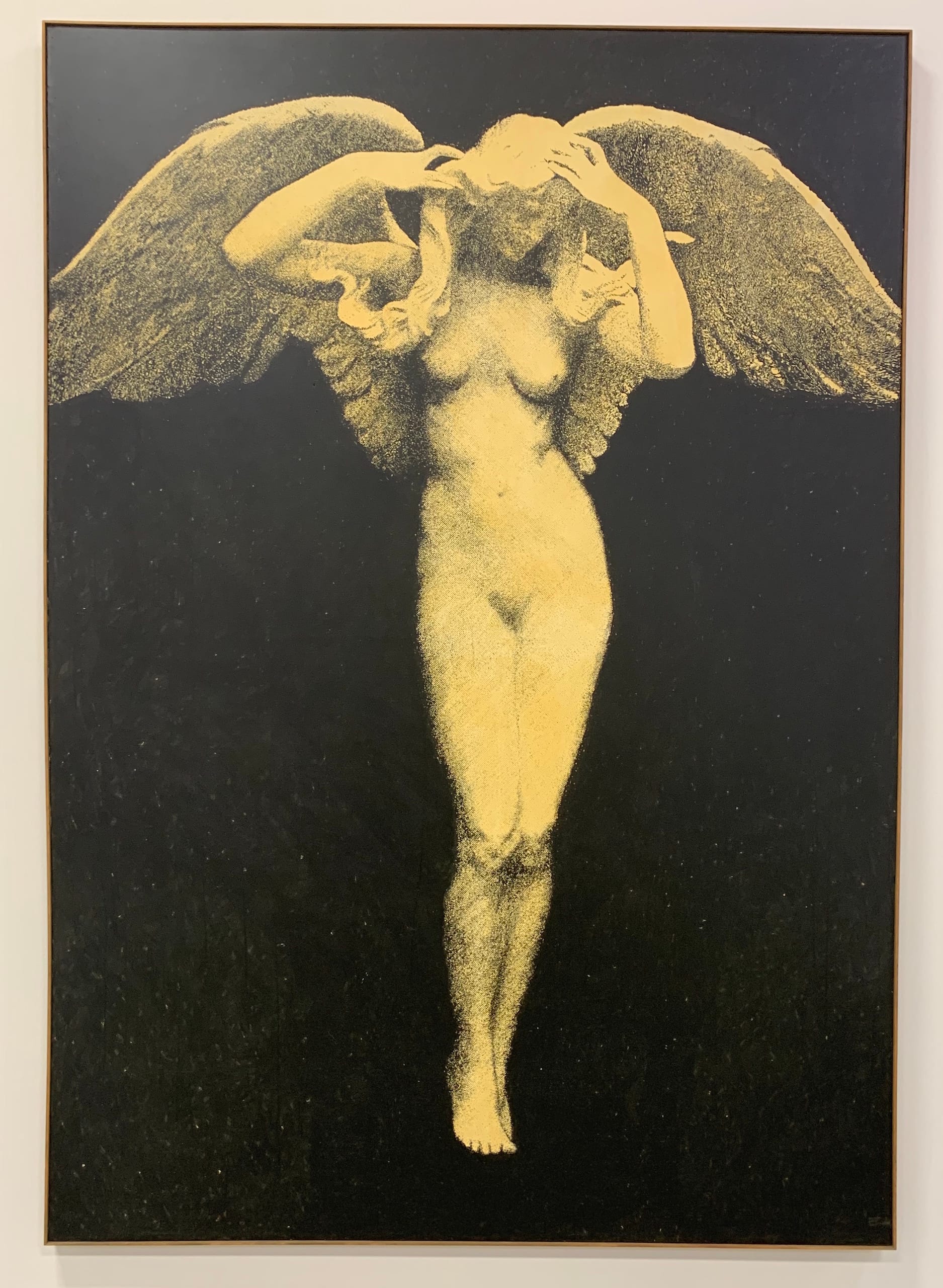
For one of his last paintings, “Peace Awakening/WWW.COM (Wiggy with Wings” (2000), Hedrick appropriated the image of a nude winged woman from a sculpture that was exhibited in San Francisco at the Panama-Pacific International in 1915. A tribute to “Wiggy,” his final partner in life and love, the painting embodies the late 1960s antiwar slogan “Make Love Not War.” Although Hedrick left us more than 20 years ago, his peace and love message continues to find new voices, including that of Bad Bunny, who ended his recent Super Bowl halftime show by reminding us, “The only thing more powerful than hate is love.”
Wally Hedrick: Sex Politics Religion continues at Parker Gallery (6700 Melrose Avenue, Hollywood, Los Angeles) and The Box (805 Traction Avenue, Arts District, Los Angeles) through April 4. The exhibition was organized by the galleries.