What’s So New About the New Museum Building?
The Lower East Side institution's OMA-designed, $82 million expansion debuted this week to mixed reviews.

An old friend returned to Nolita this week after a lengthy absence, and from the looks of it, she had a lot of work done.
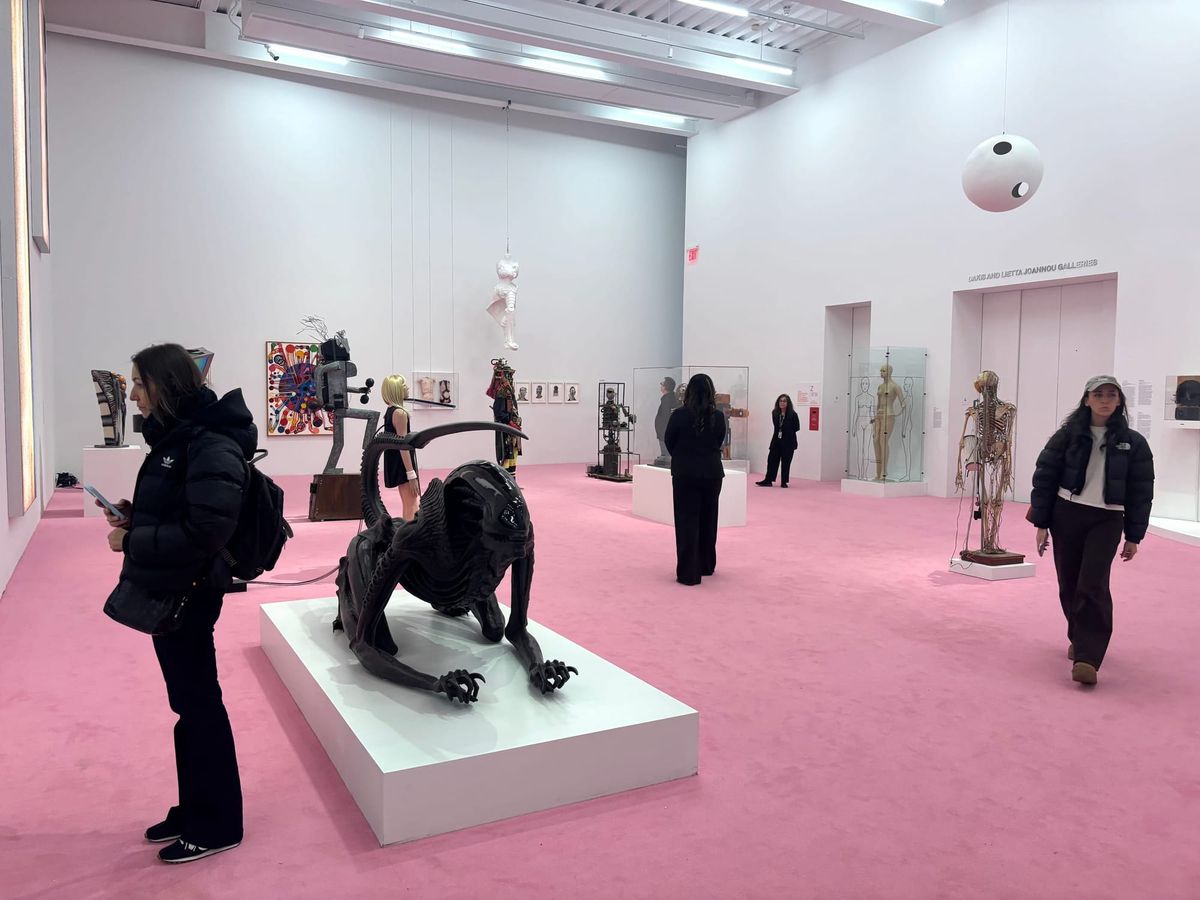
After shutting down for two years for an $82 million expansion, the New Museum will reopen to the public tomorrow, March 21, to celebrate its new OMA-designed addition with three site-specific commissions and a sprawling new exhibition of 732 artworks titled New Humans: Memories of the Future.
For some downtown art denizens, the building’s renovations could not be finished soon enough.
“Our opening marks a transformative moment for the museum, one in development for a decade,” board president James-Keith Brown told guests during a press preview on Wednesday. “This building reflects who we are — forward-looking and globally engaged.”
But staff preparing for the museum’s grand opening were more focused on the present than the future. The space was so recently completed that bits of masking tape were still stuck to the stairway railings, and a handful of missing wall panels revealed internal wires, rebar, and insulation.
“If you see some blue tape around, that’s because that’s what exhibitions are made of. You’d be surprised what you can accomplish with a little blue tape,” New Museum Artistic Director Massimiliano Gioni told preview guests. “We were working very late. I hope you can’t really tell. If you do tell, please forgive us.”
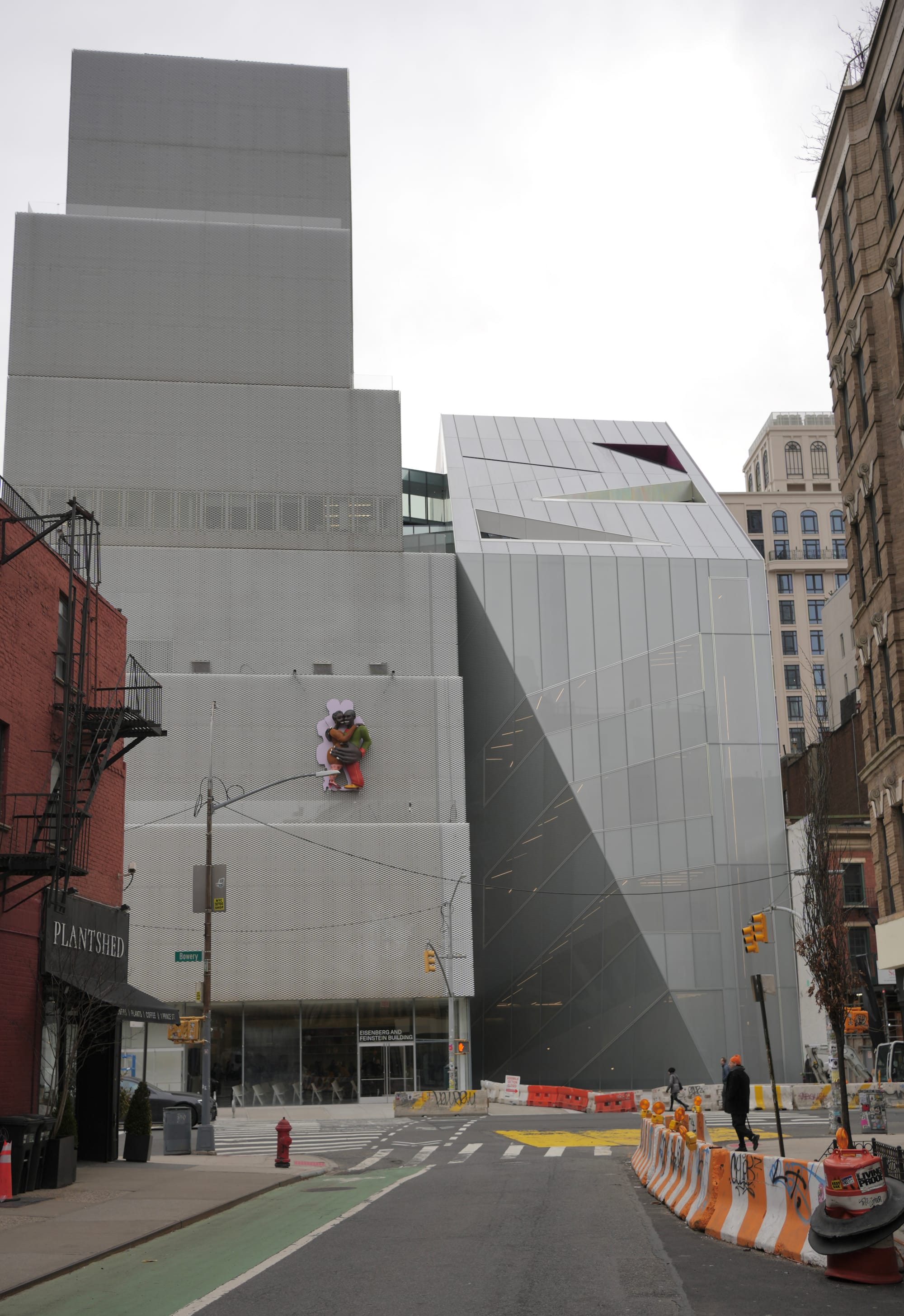
The jaunty, off-white addition appears attached to the SANAA-designed flagship like a conjoined twin, with Tschabalala Self’s facade installation “Art Lovers” (2025), depicting a Black couple kissing, fittingly marking the spot where the two buildings meet.
But fans familiar with the museum’s original chaotic lobby, cramped galleries, and narrow stairways will notice several changes.
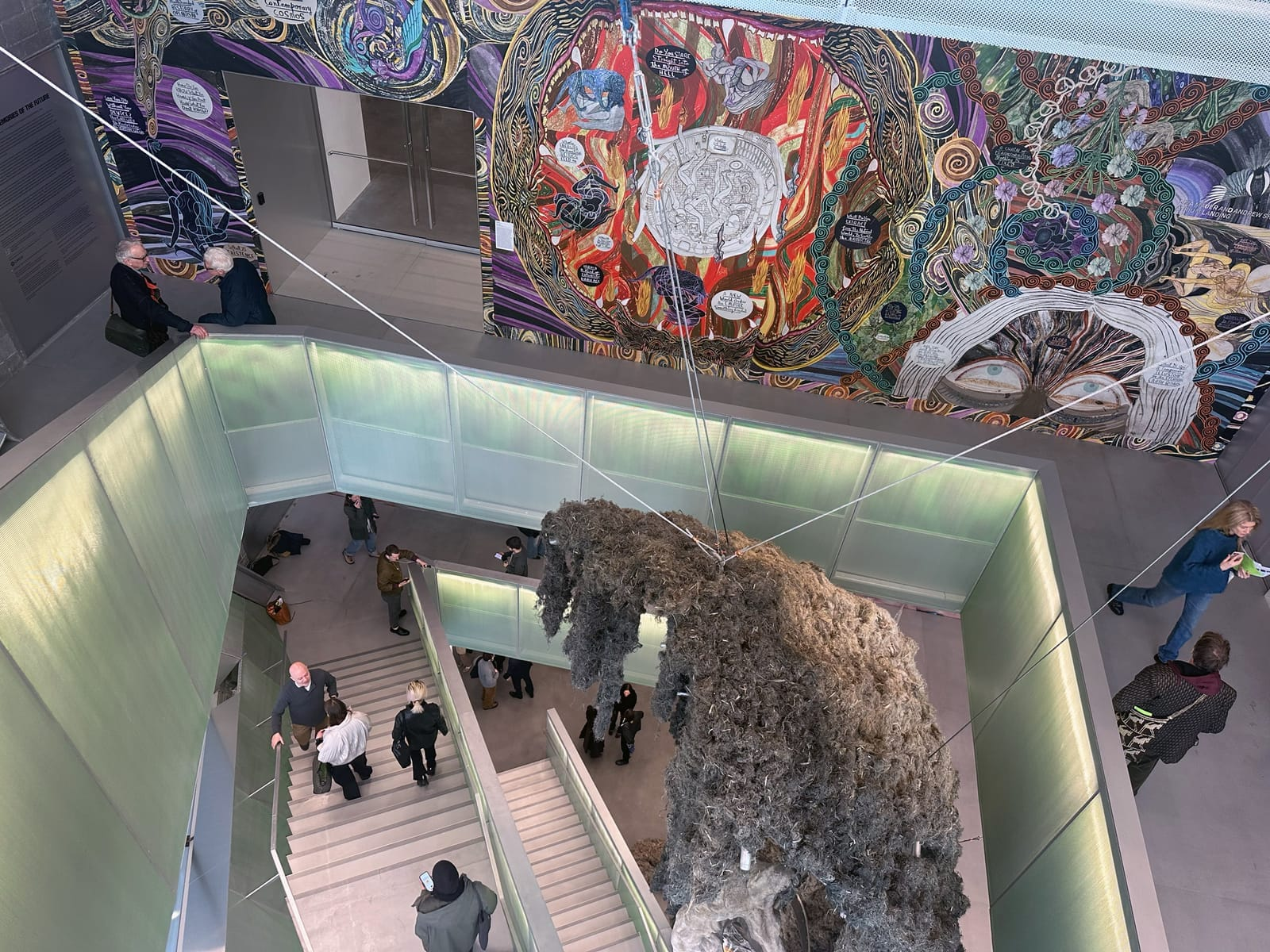
The main entrance opens onto a new atrium stairway to its right, winding its way up seven floors while allowing more light and air throughout the gallery spaces (be careful, though — as Hyperallergic’s editors observed earlier this week, those smooth perforated metal stairs can be slippery).
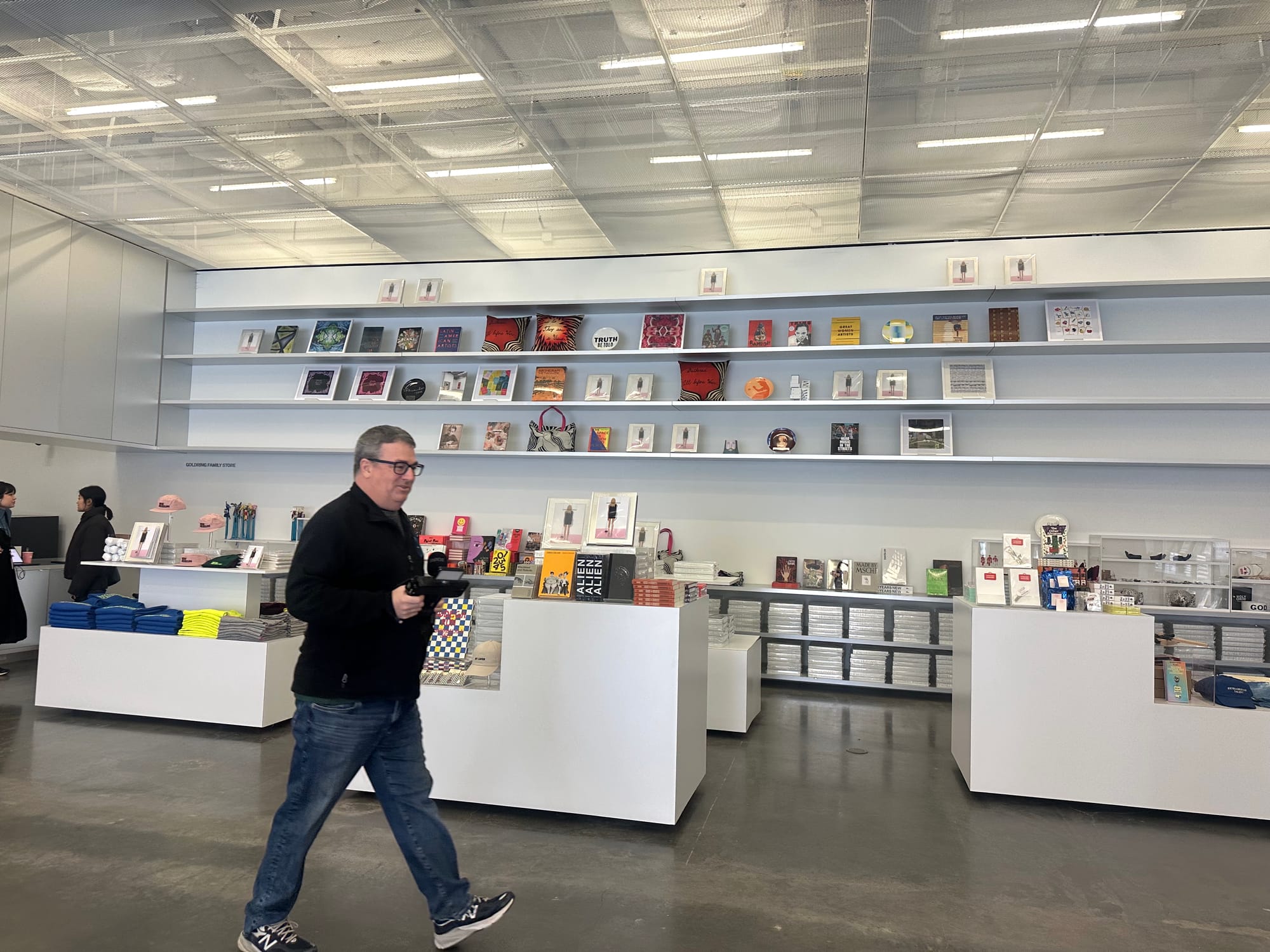
The coat check, whose long lines frequently blocked the museum’s entrance during its popular free Thursday night events, has been relocated to a back corner of the ground floor, away from areas where people congregate. Its gift shop, previously at the entrance, has also shifted to the back of the lobby, replacing a small special exhibition space, while its existing bay of elevators remains (a new plaza extending into Bowery and Prince Street that will host art installations and public events appeared almost ready).
Most impressively, the new wing’s gallery spaces on the second, third, and fourth floors blend seamlessly with the older rooms in the SANAA-designed portion of the museum, allowing a smooth flow of traffic while increasing its capacity. The current exhibition tends to dead-end in a corner of the floors behind the stairway, though that’s likely due to the show's curation rather than its floor design.
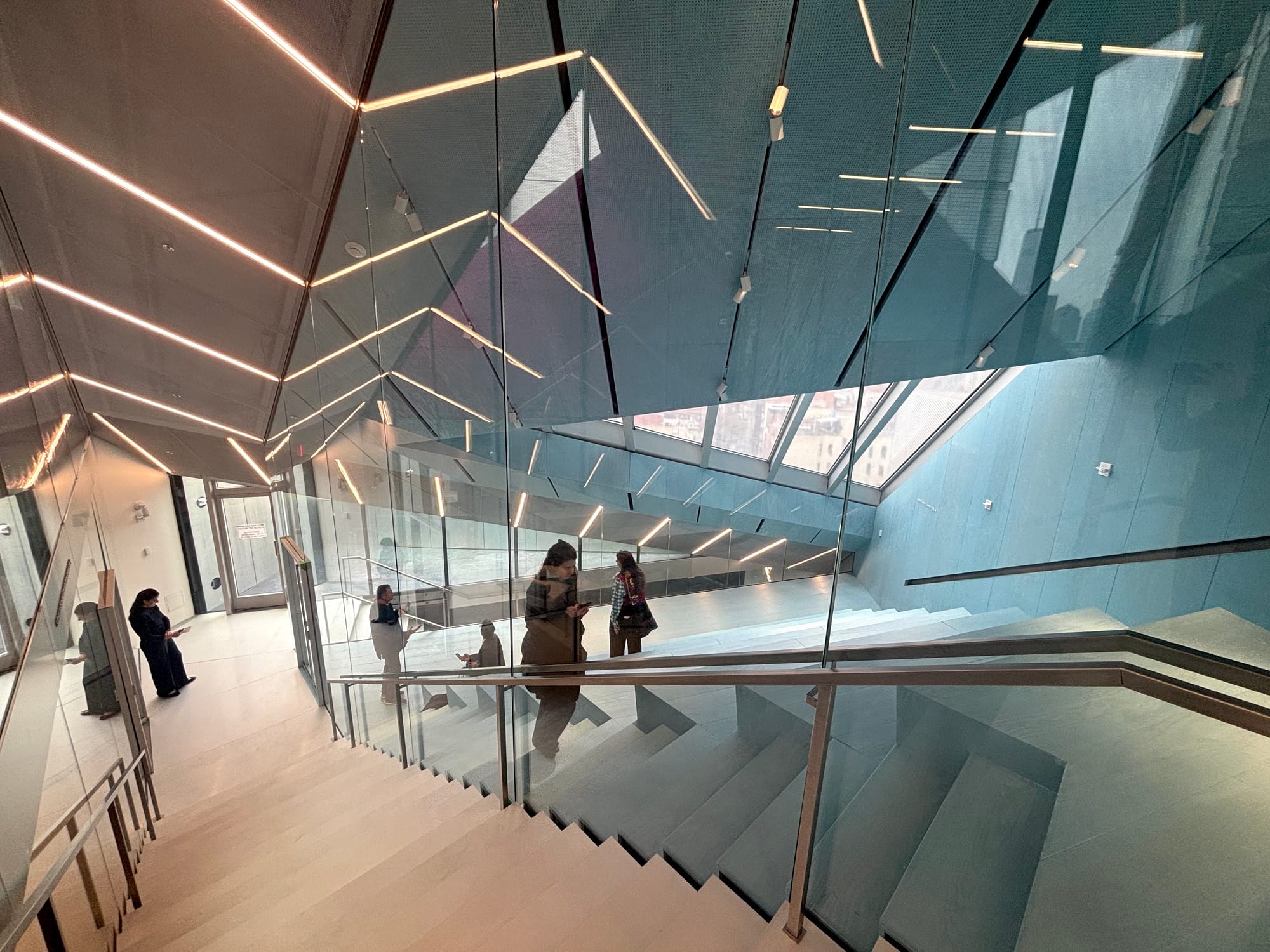
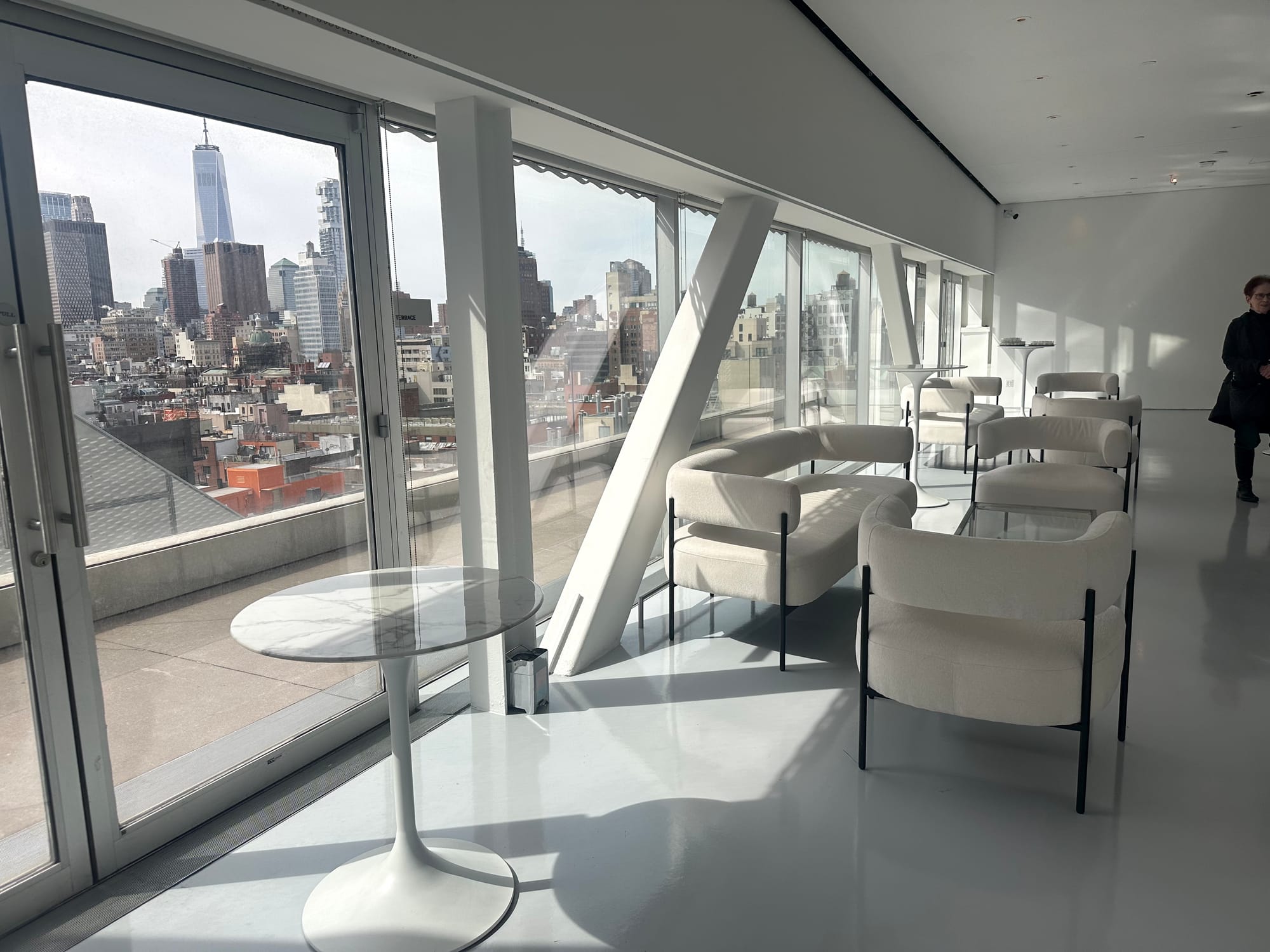
Above the galleries, visitors will encounter a sparse computer lab for NEW INC., the museum’s Art and technology “incubator,” a small pyramid-shaped, blue-hued auditorium that seats 75 people, and several outdoor terraces with spectacular views of the Manhattan skyline.
Lisa Phillips, director of the New Museum, compared its upper floors to the “brain” of the building, where design, fabrication, and discussion would co-exist.
“As you go up it gets more delirious and there are more touches with humor and color,” she told the press, a likely reference to Rem Koolhaas's 1978 New York architecture manifesto. A pop of magenta punctuates a triangular terrace. “The aesthetic is playful and fun. It’s beautiful, rough, and not precious. It’s a place of discovery and a site of production.”
Museum officials have envisioned extending their campus along Bowery since moving into their SANAA-designed flagship in 2007. The board agreed to purchase its neighboring property once it was on the market and used it for artist residencies and a gallery annex, as well as for its NEW INC. and the new media art project Rhizome.
By 2016, they determined an entirely new building on the adjacent lot would best suit their needs. They chose OMA New York’s Shohei Shigematsu and Rem Koolhaas, who conceived a structure that would connect with the museum’s SANAA-designed home without consuming it.
Shigematsu told preview attendees this week that the project was different from other museum expansions because they were asked to design a distinct pair that was “in constant dialogue” with the original building. One was more vertically oriented, the other more horizontal, yet together they created a “broader spatial and programmatic repertoire for the institution,” Shigematsu said.
But when digital renderings were released in 2024, many online users expressed shock at the new hard-edged facade. Some called it “soulless,” “out of character for the rest of the block,” and an “oversized hulk.”
First impressions of the building, now that it is officially inaugurated, have been similarly mixed. The complex’s seemingly split personality delighted New York Magazine architecture critic Justin Davidson, who wrote that “the structure projects spectacle and deference at the same time.”
But critic Christopher Hawthorne, writing for his weekly architecture newsletter Punch List, called the expansion “sleek, slick, try-hard, angular, studiously aloof, and photogenic (but only if you don’t look too closely),” arguing that it jars with the spirit of the contemporary art kunsthalle.
“The squat, shard-like $82-million OMA wing seems tailored—the last verb you’d ever choose to describe the SANAA building—for another institution entirely, the kind that has decided it needs a sit-down, ground-floor restaurant and a pair of Wonkaesque glass elevators and a grand Atrium Stair (capitalized per the press release) and a Sky Room (ditto),” Hawthorne wrote.
Others observed that the new addition’s steep staircase and its smooth finish could challenge large crowds moving in both directions.
"It is, in short, not at all welcoming, and compares poorly with the much more gracious, elegantly and thoughtfully finished staircase at the Studio Museum [in Harlem],” critic and Hyperallergic contributor Aruna d’Souza posted on Instagram. “It is a hint, to me at least, that even if the exhibition is about the human, the building is not exactly thinking of humans at all.”
A user's comment on Facebook read, simply: “The new addition looks like a Tesla.”
The architects introduced an atrium stairway that served as a “public spine,” connecting the building vertically while revealing the museum's activities within. They also expanded the gallery floors, giving curators more options to create a continuous horizontal flow or build distinct rooms for exhibitions.
Shigematsu’s architecture studio was on the other side of Prince Street, allowing his team to monitor the project’s progress through a telescope in the office. He said he felt connected to the museum because it opened the same year he moved to New York.
“Over the years, I watched its growth parallel to my own experience in the city, both evolving through constant change,” he said. “To now take part in this new chapter of the museum feels both personal and indelibly meaningful.”