When a Palestinian Artist Asserts Her Own Humanity
Basma al-Sharif’s screening at Kunstakademie Düsseldorf was met with threats and a smear campaign, proving the point of her films on separation and displacement.


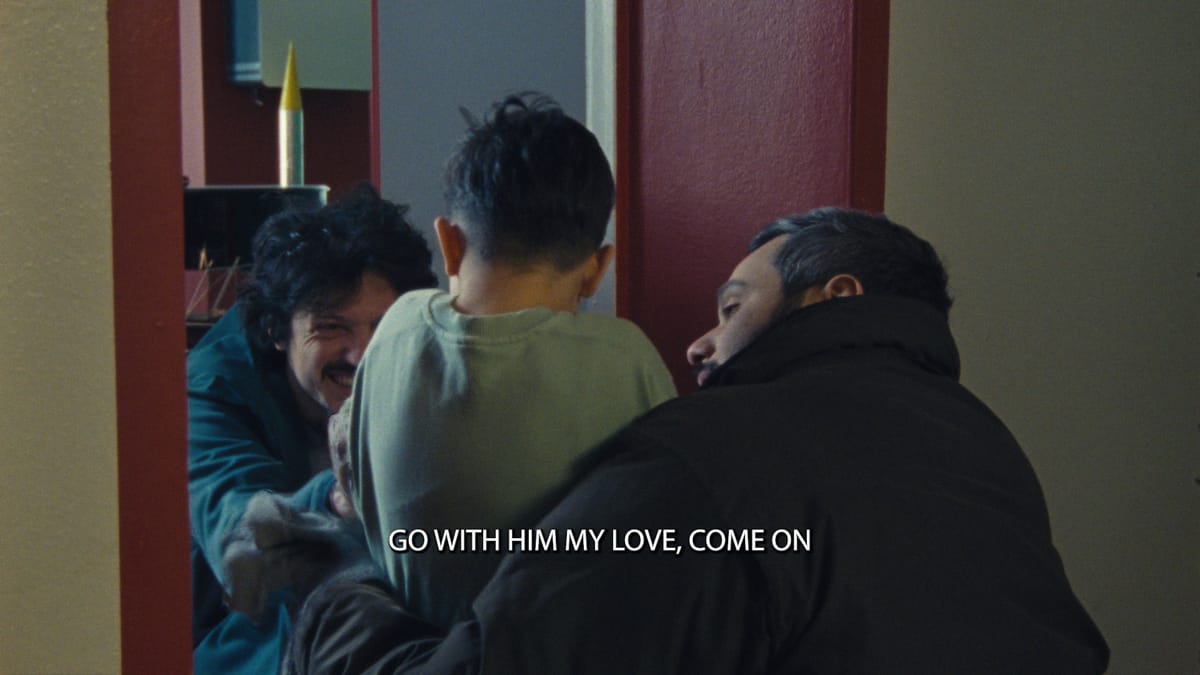
There is a scene in “Morgenkreis | Morning Circle” (2025), a 16-mm film by Berlin-based Palestinian artist Basma al-Sharif, that unfolds at the threshold of a daycare center. A young boy clings to his father, his fists locked into the fabric of his coat, his arms wrapped tightly around him. The father gently tries to pry himself free while a daycare worker crouches nearby, attempting to distract the child and coax him inside. It is an ordinary moment, one that anyone who has ever been a child — or cared for one — recognizes instantly, as well as the gut-wrenching feeling it provokes. The scene is filled with the quiet panic of separation: the fear of being forced to let go.
The political charge of the scene lies precisely in its setting. Kindergarten was invented in Germany in the 19th century and became a cornerstone of the modern European liberal project. Far from a neutral space of care, it has historically functioned as one of the first institutions through which the state organizes a child’s entry into social life, shaping citizens through routines of discipline, language, and belonging, such as the daily ritual of the morning circle. At stake is a carefully managed process of detachment: from parent to institution, from home to nation, from private intimacy to public order.
As an artist whose work addresses the diasporic condition that has formed her own biography, al-Sharif suggests that the kernel of the trauma of being forcibly separated from one’s country of origin can be found in the violence of a child’s unwilling displacement from their parent. The grand historical exile of a people is made accessible through an intimate, visceral memory that all human beings share.
But she also exposes the latent violence embedded in this seemingly benign structure. The kindergarten is a microcosm of a broader political fantasy central to European modernity — the belief that the so-called “other” can be assimilated through the “civilizing” mechanisms of liberal institutions. What appears to be a universal developmental ritual begins to reveal its ideological scaffolding. The child who learns to separate from the parent mirrors another, more brutal form of estrangement: the refugee severed from homeland, the colonized subject expected to embrace a system that denies their history, language, and political claims.
In late 2025, al-Sharif accepted an invitation to present “Morgenkreis” and another short film in January at Kunstakademie Düsseldorf as part of a series organized by the student collective SPARTA. After taking a monthlong leave of absence from email to meet work deadlines over the holidays, she returned to discover that she was at the center of a parochial storm of accusations adjudicated in the German media. The controversy, ironically, stemmed not from the work itself but from the artist’s arguably tamer social media posts containing references to historical injustices and symbols of resistance that, over two years into the genocide in Gaza, have become part of a global decolonial human rights discourse increasingly under attack.
Spearheaded by a pro-Israel advocacy group within the conservative Christian Democratic Party, the smear campaign included a dossier of screenshots of the artist’s Instagram posts about the occupation of Palestine and an open letter demanding that the screening and talk be cancelled. Soon public officials joined in, including Düsseldorf’s mayor, its non-Jewish antisemitism commissioner, and a cultural minister, along with other groups and media — among the many actors who have participated in a yearslong, nationwide effort to silence the voices of Palestinians and their allies, predominantly non-White immigrants, artists, activists, and intellectuals. An epidemic of virulent anti-Muslim racism and xenophobia masquerading as historical guilt.
The reaction of the academy’s director, Donatella Fioretti, was unusual in Germany’s current political climate of post-factual denunciation, preemptive obedience, and cowardice. Faced with spuriously justified demands to cancel the event, she simply refused — opting only to limit attendance to academy members for their own protection from the multiple threats of violence voiced online. On January 21, the day of the event, dozens of protestors gathered outside the venue, parroting the same tired accusations that have reverberated across numerous elite universities in the United States and Europe, while the artist was quietly escorted inside through a back entrance. The same bureaucratic machine that famously dismissed Joseph Beuys in 1972 for adhering to his dictum that “every human being is an artist” by occupying the academy offices with applicants who had been denied entry to his course now calls for the resignation of an administrator for upholding the university as a space for critical exchange and dialogue — an act that has become a rarity in the lazy, intellectually impoverished climate of current German public discourse.
Reckoning with both the silent refusal of empathy and the constant noise of historical revisionism as an artist living in Germany during an ongoing genocide of her people, al-Sharif has found a remarkable way of representing life in the diaspora under occupation. She has described herself as “someone who is essentially not from anywhere” while accepting the designation of her work as “post-Palestinian” — an acknowledgment of her relatively privileged fate of not having endured the violence of occupation and genocide on the ground and yet intrinsically shaped by it, in addition to the nostalgia and loss of exile and rootlessness and the burden of being endlessly tasked with defending her very identity from censure or erasure. As the artist and the packed audience that attended her public screening and talk in Berlin just a few weeks later understand, the frontline is not TikTok or Instagram or any other social media platform these cultural police patrol incessantly, but the artwork itself — the place where, al-Sharif says, she wishes to connect her viewers to the Palestinian struggle with a visceral rather than cognitive understanding of it.
It is curious to consider the Berlin of 2025 in al-Sharif’s “Morgenkreis” in relation to the Berlin of 1987 in Wim Wenders’s Wings of Desire. It is also significant to compare the two directors' relationship to politics and cinema. “We have to stay out of politics … we are the opposite of politics,” Wenders famously stammered at the 2026 Berlinale when asked to qualify the festival’s selective treatment of human rights. Wings of Desire, a film about the desire to become human, seems to predicate such humanity on a universal notion of subjectivity that excludes, even dehumanizes, the vast collective “other” outside of the White male European experience. As a filmmaker, al-Sharif understands that every film is political; as a Palestinian, born into a system of occupation and apartheid, she knows that her very existence is political.
Set in a gloomy present-day Berlin, “Morgenkreis” is devoid of the histrionic romance imbued in the city by Wings of Desire. While Wenders frames Berlin through monuments and contemplative aerial viewpoints — church towers, columns, libraries, spaces of historical memory, and transcendence — al-Sharif’s grounded gaze, set to a slowed-down rendition of the Al Jazeera theme music, moves through constricted inhospitable spaces: the backseat of a car, a housing complex, the ascetic bureaucratic interiors designed to manage and control certain populations.
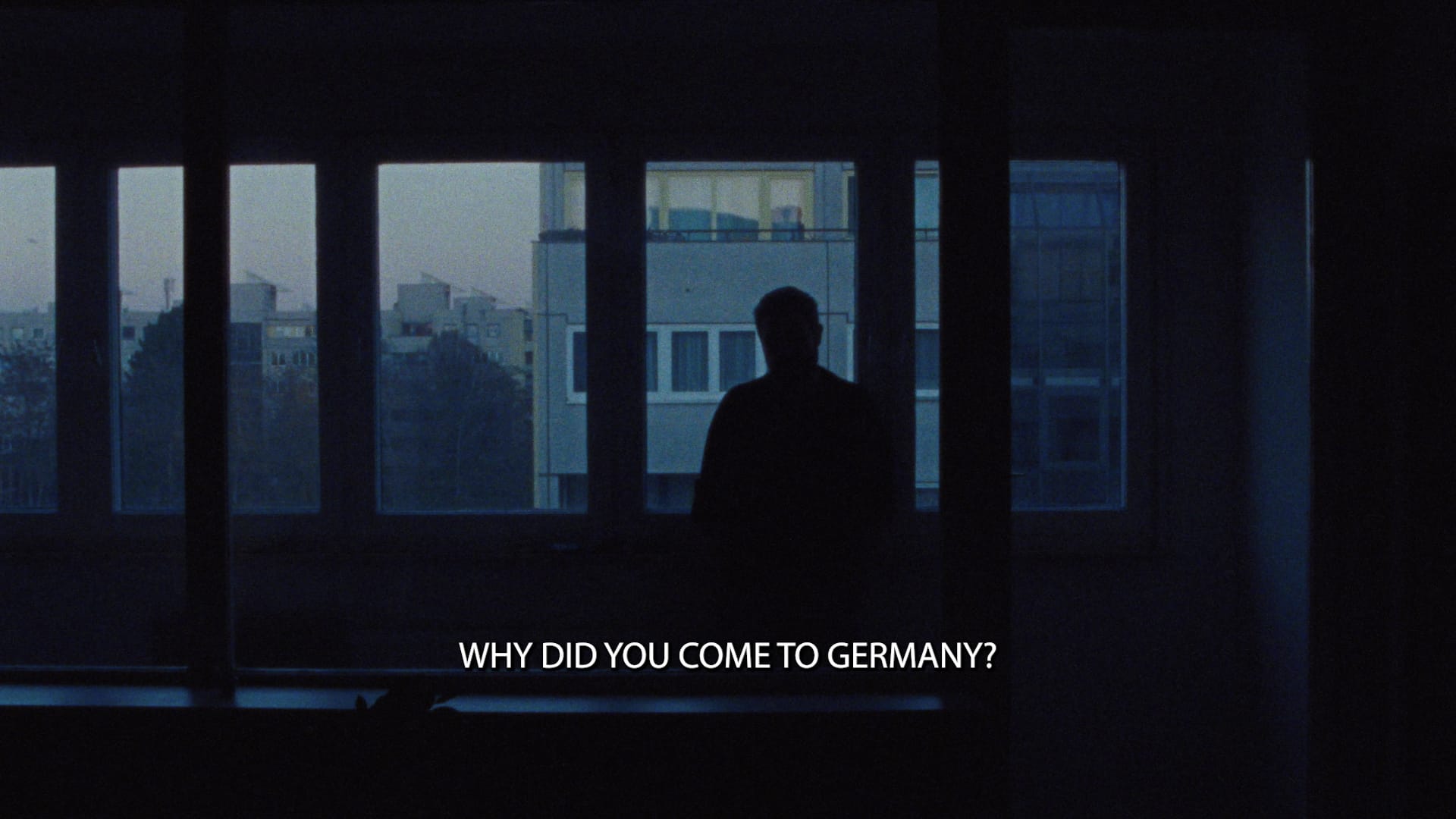
Where Wenders’s angels — invisible to everyone except the children they metaphorize — roam around a desolate Potsdamer Platz in 1987, less than two years before the fall of the wall would unleash a slow-moving tsunami of gentrification, al-Sharif’s camera meets the impermeable glass and steel surface of corporate finance. The city has been occupied by capital, its buildings only offering flat, reflective surfaces with no apertures or access points for the disoriented gaze of the unwelcome. When the camera does manage to broach a space of interiority, it enters the home of an Armenian-Lebanese father, standing before a window, answering the invasive questions of an oblivious off-camera interviewer about the family’s assimilation into their new country. The bureaucratic violence of an integration policy that marginalizes and excludes is palpable as the camera hovers around the modest dwellings, twice panning past a television screen showing aerial footage of long-extinguished neighborhoods in Gaza recorded by photojournalist Yaser Murtaja, among the hundreds of young innocents brutally gunned down by Israeli soldiers during the 2018 March of Return.
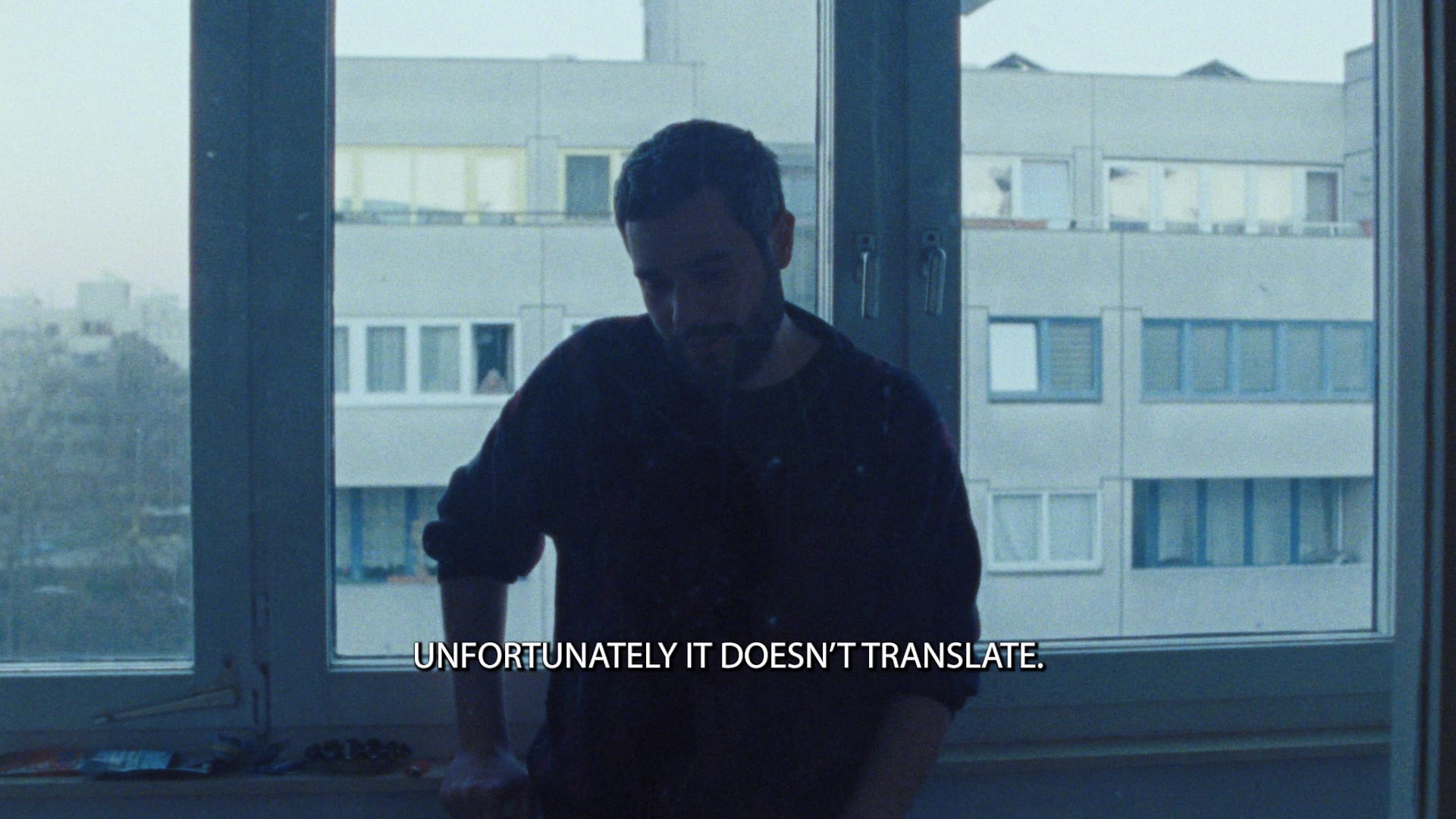
And yet subtle gestures of resistance appear everywhere: The mother, notably absent (likely working, contrary to the inquisitor’s expectations), evades the interrogation altogether, while at times the father deflects the intrusion by offering sardonic responses to inane questions or sharing a private joke in Arabic with his son — “unfortunately it doesn’t translate,” he informs the disembodied voice, asserting what philosopher Édouard Glissant eloquently termed the right to opacity.
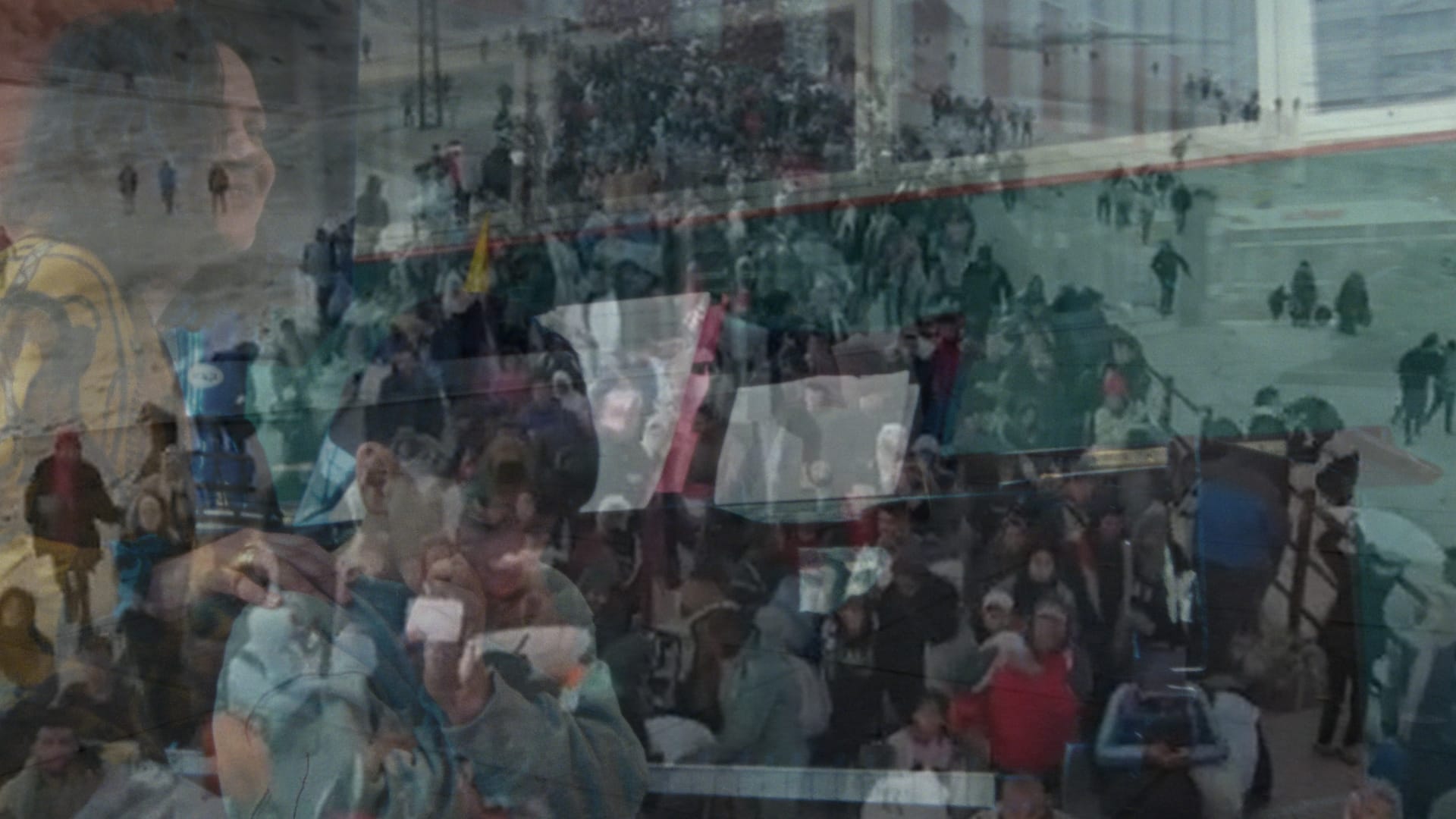
The son’s own rebellion comes later in the film: Successfully wrestled away from his father, he tentatively enters the space of the kindergarten, surveilled by the other children who observe his discomfort. In an act of solidarity and complicity, a kind caretaker ultimately leads the children in a jovial revolt against the tedium of the morning circle, allowing the young boy to escape. The high-speed circular motion of the camera captures frames of the young children dancing and swinging each other around in a cathartic frenzy, overlaid by footage of tens of thousands of Gazans returning home on foot along the main coastal road of the strip after the first failed ceasefire of January 2025. Set to a raw, hypnotic track by the Egyptian experimental electronic musician Maurice Louca, an ominous guttural voice repeatedly drones in Arabic, “Wake up / don’t fall asleep / we’re saluting the parrot.”
Liberated from the confines of the kindergarten, the boy whirls around alone on the playground outside, working himself up into such a dizzying stupor that he stumbles to the ground, disoriented, struggling to stay balanced. Ordinarily, this would be an innocent if not joyful scene of abandon, that is, if we hadn’t spent the last three years witnessing children who look like him being dehumanized and reduced to rubble — martyred and transfigured into the real angels of our collective consciousness.