15 Shows to See in New York City This April
Margaret Curtis’s deconstruction of American myth, quotidian objects by Marsden Hartley, and Wendy Red Star’s bead-inspired installation are among our picks.




With the endless blockbusters exhibitions in New York City this spring — from Raphael at The Met to the Whitney Biennial to the reopening of the New Museum — it can be easy to overlook shows at galleries, independent art spaces, and smaller venues.
That would be a mistake. New York’s only as rich as it is because of that constant flux of new, experimental, and occasionally batshit art that’s years or decades away from entering more established spaces, if it ever does at all. Some of these shows only run for a couple of weeks. Tough on an editor; lucky for you.
Below, we’ve rounded up our favorite exhibitions this month, from an all-immigrant exhibition in Queens to DAZE’s city-inspired aesthetics to Naufus Ramírez-Figueroa’s reimagining of a play censored during Guatemala's civil war. As Seph Rodney puts it, you’ll feel the full spectrum of humanity here. — Lisa Yin Zhang, associate editor
E. Jane: Cryptid or let the body be
Anonymous Gallery, 136 Baxter Street, Chinatown, Manhattan
Through April 10
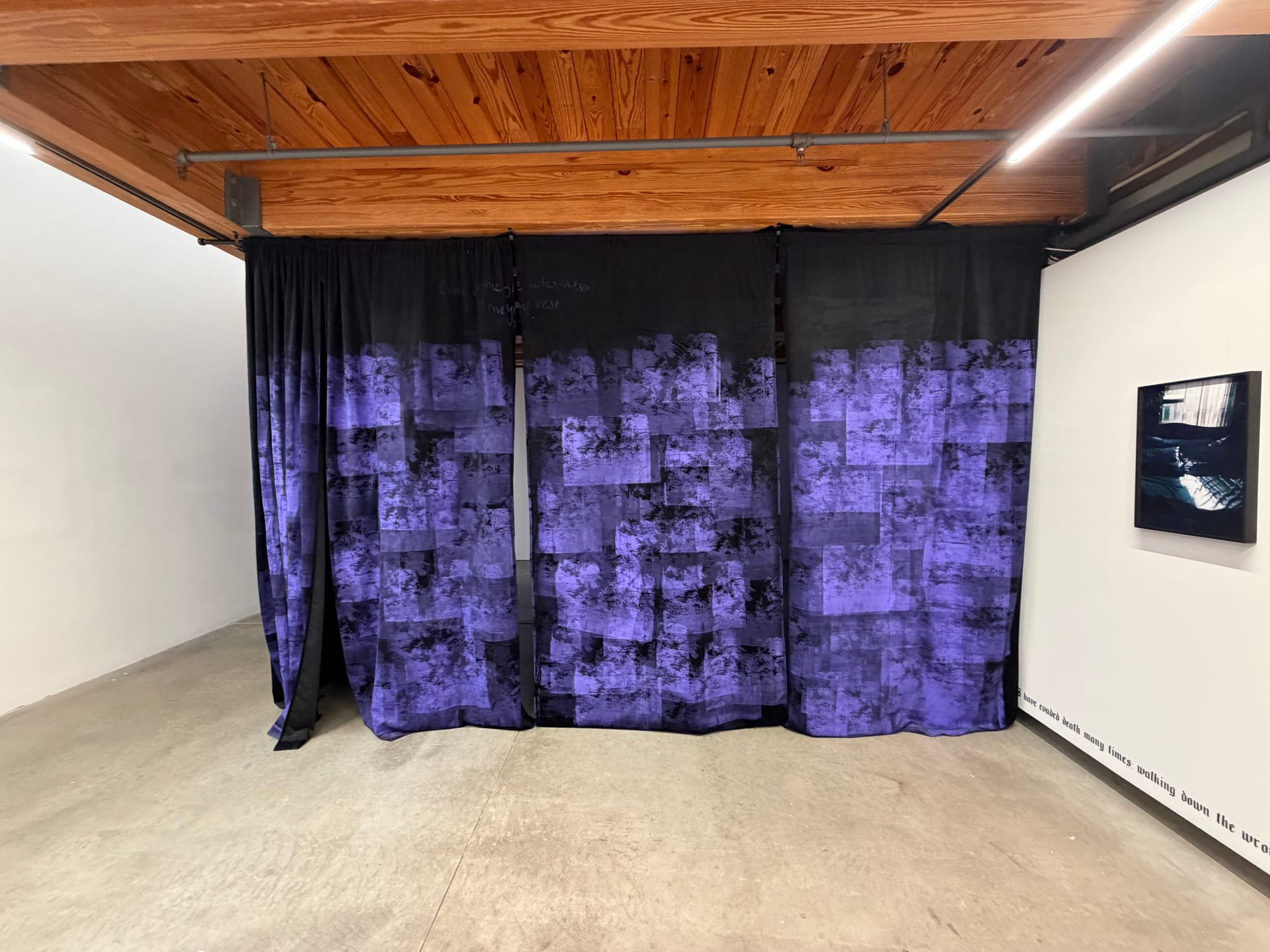
A literary tone persists in so much of E. Jane’s art, and here — across images, video, vinyl text, and a silkscreened curtain — they elaborate on that tendency while playing with the viewer’s conventional desire to know an artist and their persona. “For Aaliyah (I hope your spirit is free now)” (2023) is a beautiful work of abstraction that shows us their formalist leanings, while the video “Skinny Dipping” (2024) and its associated photographs expand on their interest in visceral emotionscapes that challenge perceptions of the Black femme artist in the United States. Jane often appears to lean into our expectations of an artist, only to elude them all in favor of a complex web of relationships that can feel itinerant, diasporic, and defiantly plural. —Hrag Vartanian, editor-at-large
The Lost Beauty of Humankind: Robert Bergman’s Portraits in the Hill Collection
Hill Art Foundation, 239 Tenth Avenue, Third Floor, Chelsea
Through April 11
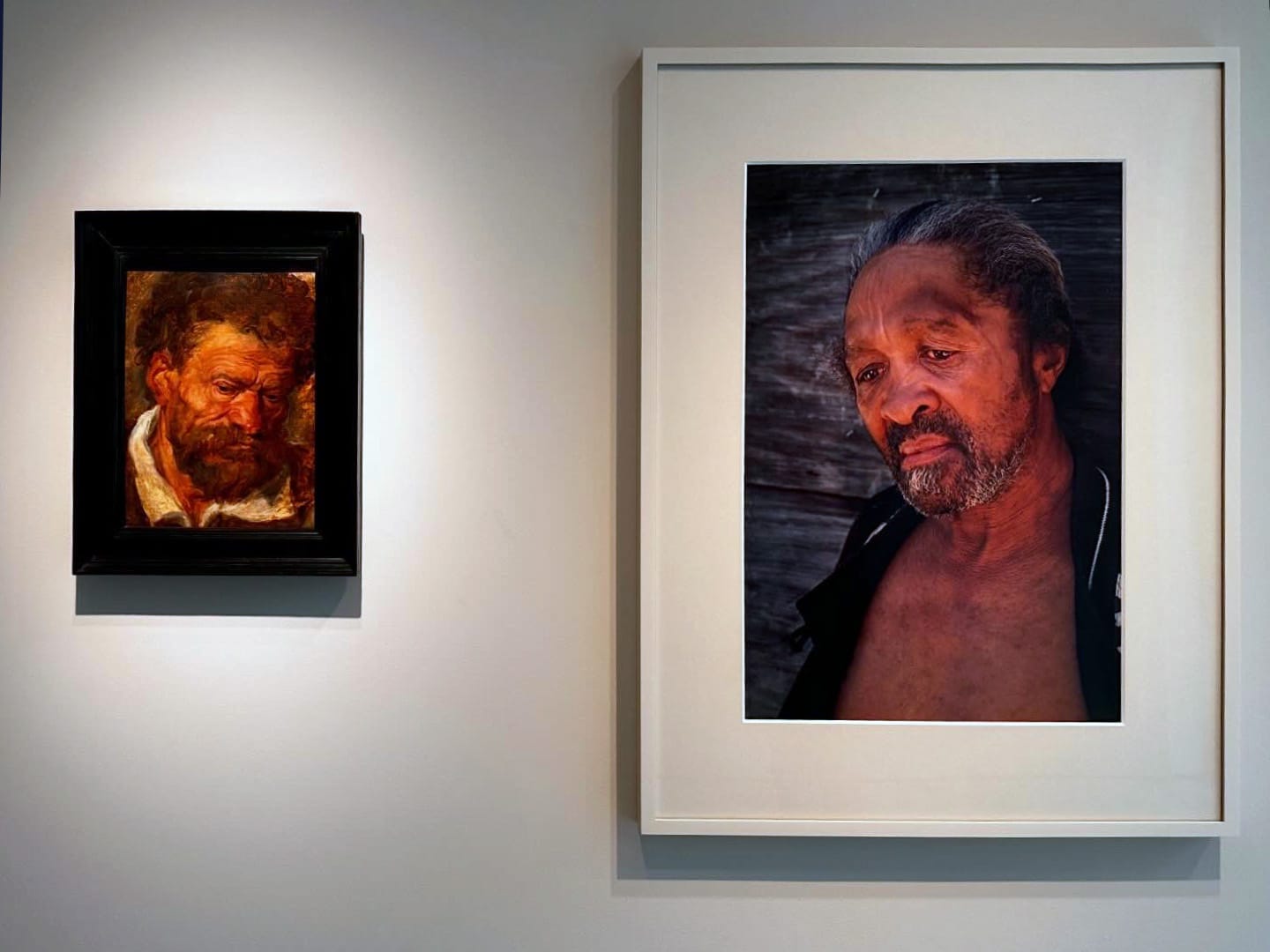
We live in an age of relentless idealization and incessant posturing for public approval. But here, in an exhibition curated by David Levi Strauss, we get close-up photos of odd human faces, people whom photographer Robert Bergman encountered on the street. These faces are quirky, unconventional, even peculiar. These images are sometimes paired with pre-modern European portrait paintings that echo Bergman's fascination with lives only partially revealed by their visages. I felt a fuller spectrum of humanity here, and because these views are so wide and varied, I could also see myself within them, flawed and yet touched with grace. —Seph Rodney
Kamrooz Aram: Infrequencies
Alexander Gray Associates, 384 Broadway, Tribeca, Manhattan
Through April 11
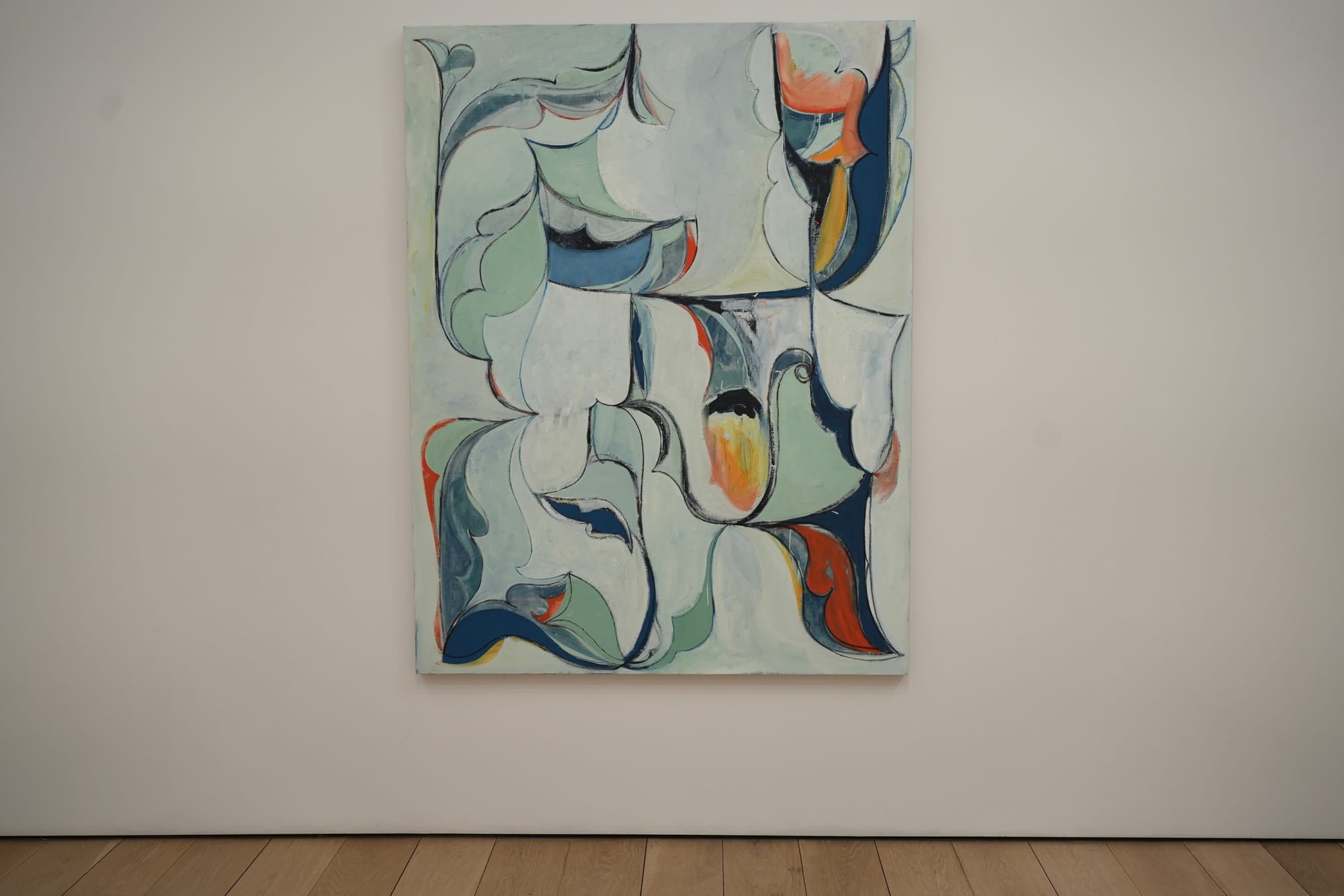
Kamrooz Aram is one of the most talented painters working today, and this exhibition at Alexander Gray reminds us that he is an aesthetic polyglot. Whether in his earliest psychedelic work, his delicate drawings of cosmic reimaginings, or his installations with objects that challenge how modernity constructed the "other," his art is always buttressed by strong conceptual frameworks while remaining arrestingly graphic. In this show, he channels his accumulated lessons with fresh eyes — seeing through Matisse, Gorky, Fra Angelico, and a wealth of design histories — and breathes new life into these human-scaled, energized compositions. Don't miss his works in the current Whitney Biennial, which places his art in direct dialogue with the museum and its taxonomies of display. —Hrag Vartanian
Pamela Sneed and Carlos Martiel: Sacred and Profane
Leslie-Lohman Museum of Art, 26 Wooster Street, Soho, Manhattan
Through April 12
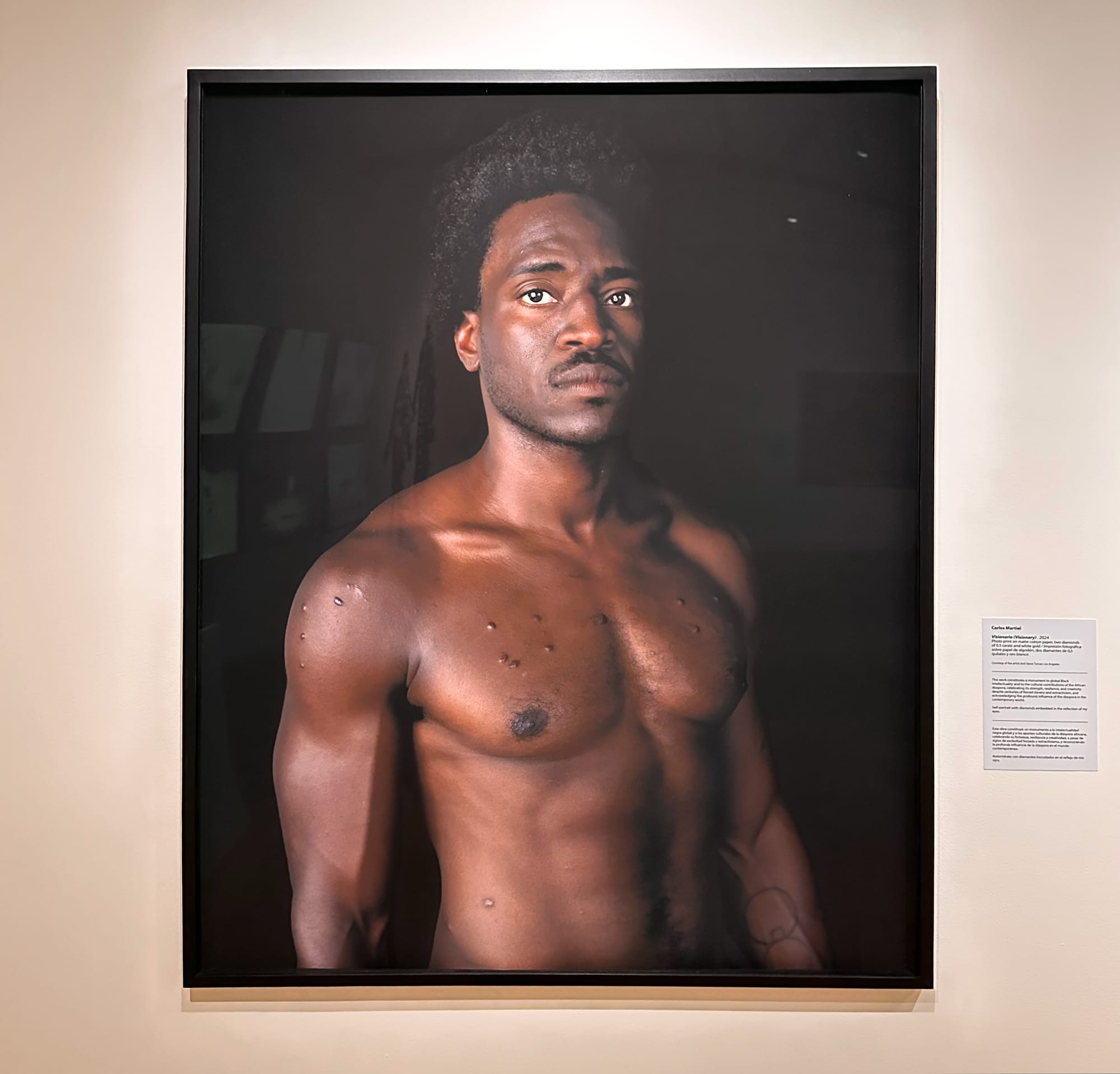
Both Sneed, a poet, and Martiel, a performance artist, completed BOFFO residencies on Fire Island and join energies here to explore the hidden history of Black people on the island. After discovering the history of slave pens there, Sneed uses mixed-media collages, poetic texts, and paintings to metaphorically refer to Black people’s presence. Martiel allows access to his own naked body to physicalize the risk his presence might pose. For example, in the video “Cuerpo” (2022), volunteers hold his weight off the ground while a noose is cinched around his neck. Both artists first acknowledge our bodies’ desecration in order to move toward veneration. —Seph Rodney
Judith Godwin: Flux and Form
Berry Campbell Gallery, 524 West 26th Street, Chelsea, Manhattan
Through April 18
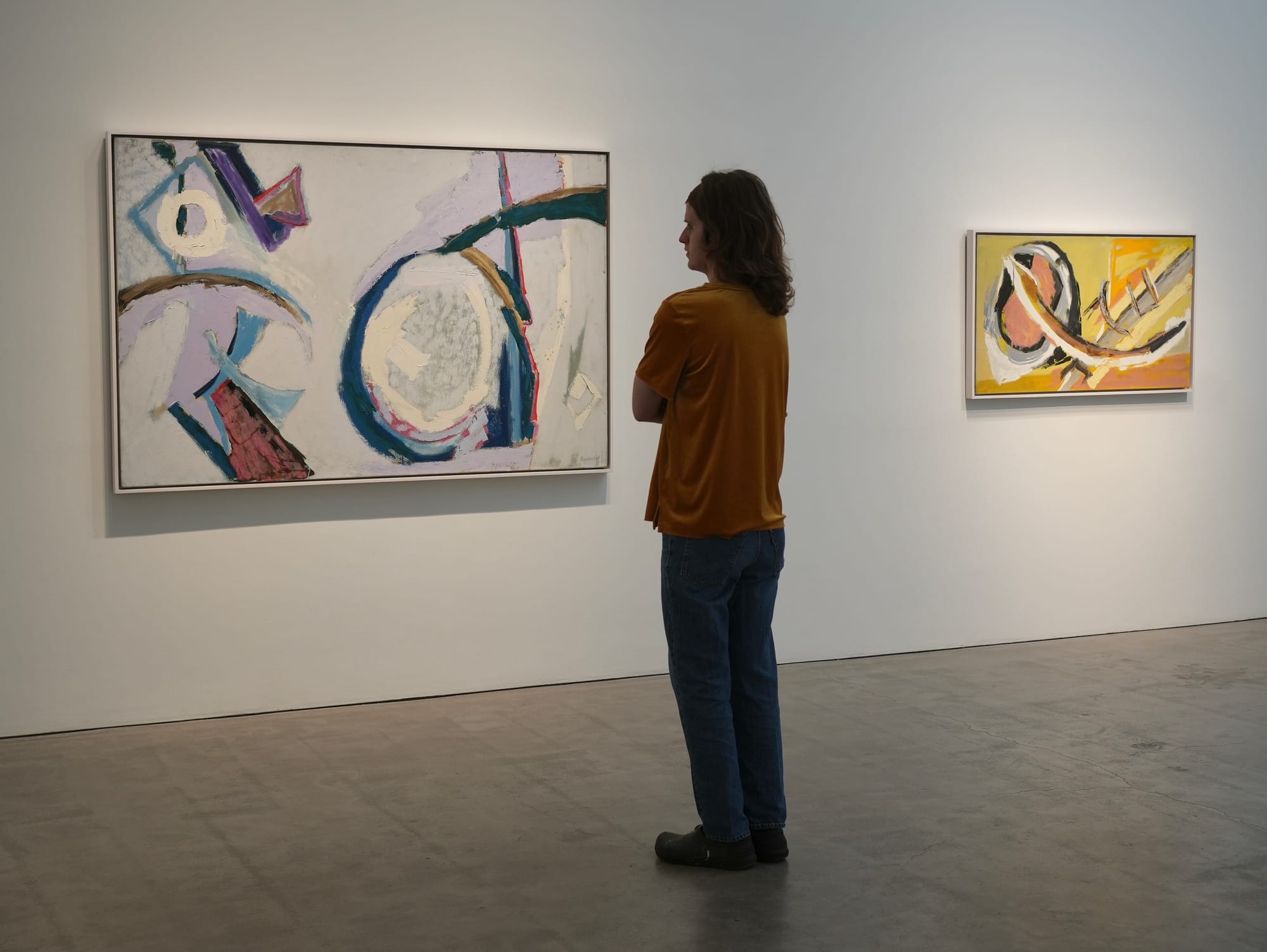
Judith Godwin, "Moonlake” (1988) and “Feathered Arrow” (c. 1978) on view at Berry Campbell Gallery (photo Hrag Vartanian/Hyperallergic)
Though Judith Godwin is often categorized as an Abstract Expressionist, this exhibition of her work from the 1970s and '80s makes the case that those decades (which she considered her peak period) are worth serious reconsideration. Drawing on Color Field painting, mid-century abstraction, and Pattern & Decoration, among other influences, these canvases feel less stylized and more individualistic, as she combines and transforms her sources into visual maelstroms. She often deploys white on the surface to challenge the eye, though in "In Circle/Encircle" (1985) she also incorporates a small textile fragment — a reminder that she was willing to push her art in unexpected directions. "Peach Bud" (c. 1985) is particularly powerful: She appears to have distilled a lifetime of lessons into a work of inexhaustible depth. And this Saturday, April 4, at 3pm, there will be an activation with the Martha Graham Company (RSVP here), as dancers perform “Lamentation” and “Ekstasis” as “a living counterpart to Godwin’s sweeping gestures.” —Hrag Vartanian
Wendy Red Star: One Blue Bead
Sargent's Daughters, 370 Broadway, Tribeca, Manhattan
Through April 18
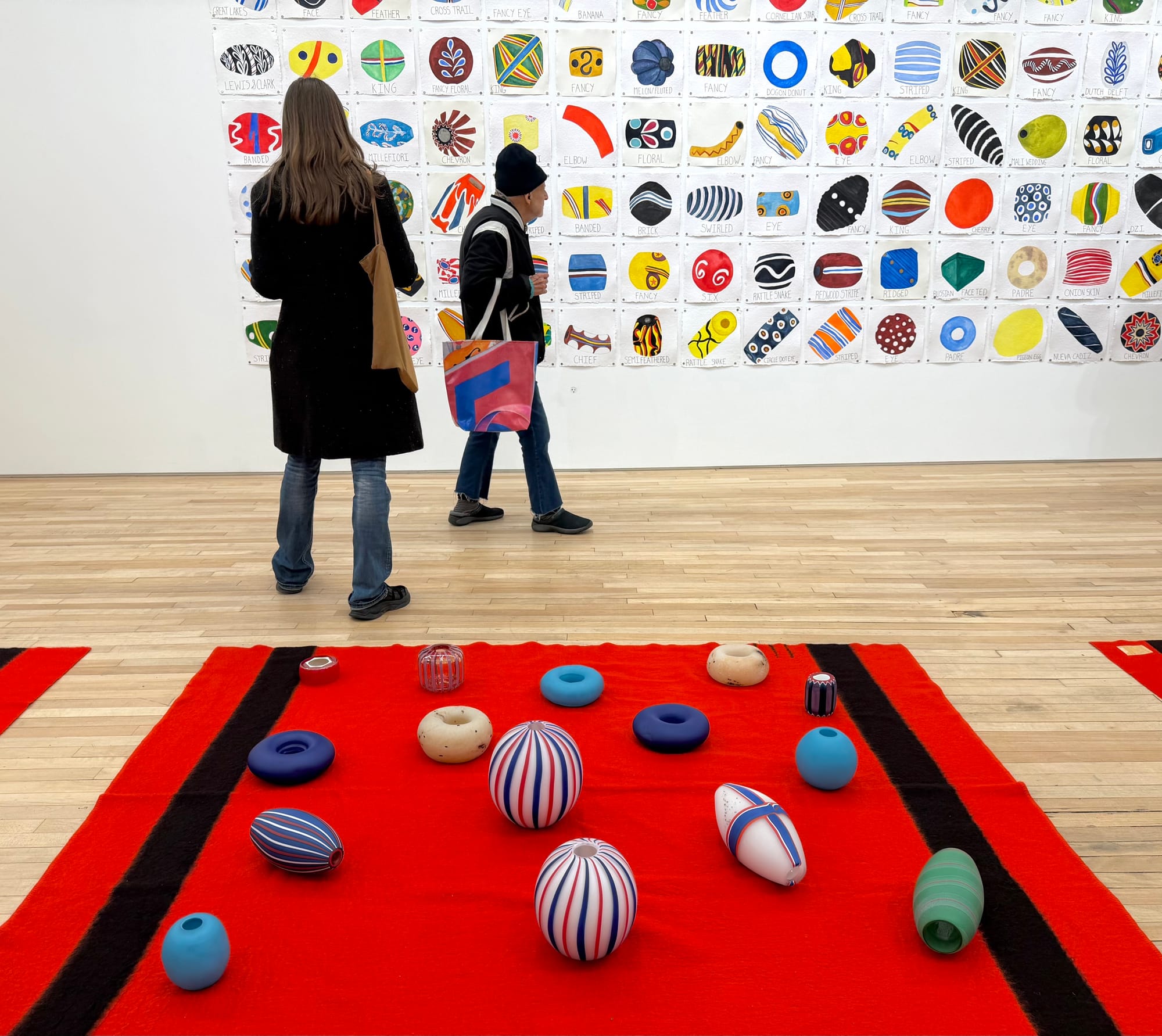
Focused on trade beads, Wendy Red Star's latest site-specific installation offers blankets of oversized glass sculptures that celebrate an aesthetic universe often dismissed or overlooked. This Tribeca show carries particular resonance for the Crow artist, as the legend that the Dutch purchased the island of Manhattan in 1626 from members of the Munsee tribe for a handful of beads persists to this day. Red Star isn't satisfied with the Dutch-only perspective on that supposed swindle, and since no historical records of such a trade exist, she has fashioned her own response — a celebration of cylindrical and oblong forms rendered in watercolor and glass that are almost interstellar in their beauty. Be sure to pick up a copy of One Blue Bead Exchange, a newspaper specially created for the exhibition. —Hrag Vartanian
The New Colossus
Lorimoto Gallery, 16-23 Hancock Street, Ridgewood, Queens
Through April 19
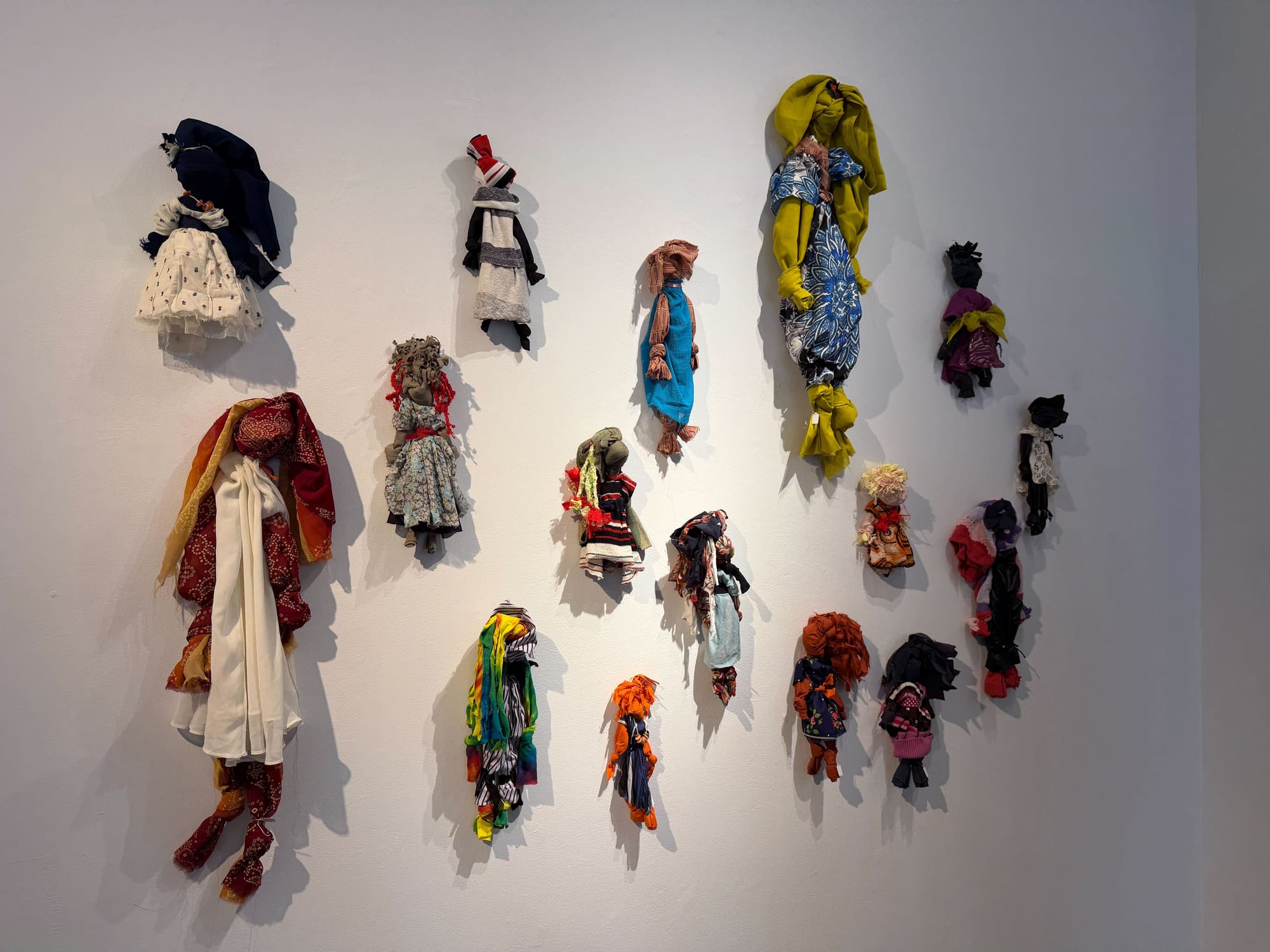
On a lovely spring weekend, I took a stroll in Ridgewood, Queens, where I happened upon Lorimoto Gallery for the first time. I was immediately charmed and impressed by what I saw. New Colossus, named after Emma Lazarus’s famous 1883 poem etched on the pedestal of the Statue of Liberty (the one with the line, “Give me your tired, your poor, your huddled masses yearning to breathe free”), is a group show composed solely of immigrant artists. Standouts include Anam Rani’s graphite prayer rug; Kristyna and Marek Mildes’ paper tree stump, made of a full year’s copies of the New York Times’s art section; and Cibele Vieira’s pandemic-era puppets, made of her old clothes. Vieira, who hails from Brazil, curated the show along with gallery director Nao Matsumoto, and the two deserve praise for the result. —Hakim Bishara, editor-in-chief
American Modernist works from the Estate of a New York private collector
Schoelkopf Gallery, 390 Broadway, Tribeca, Manhattan
Through April 24
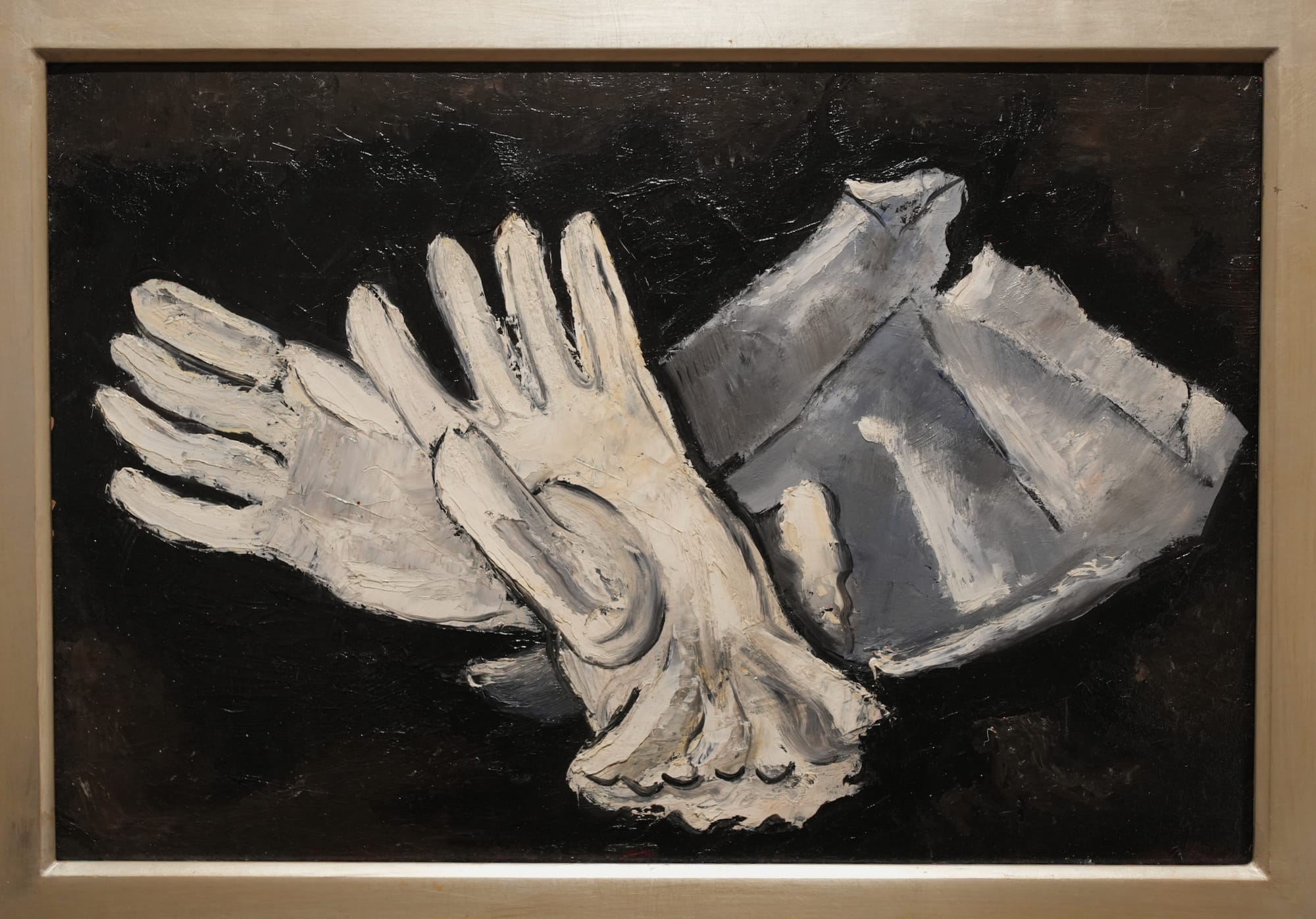
In the back gallery of this 20th-century American modern art gallery is a collection of four paintings by Marsden Hartley, the beloved gay modernist who forged a language of paint that was as surprising as it was formative to American art. All four works are from private collections, so this is a great opportunity to see a selection that demonstrates the artist's interest in quotidian objects (including two paintings of various types of gloves), landscape ("New Mexico Landscape," 1918–19), and abstract forms ("Movement No. 11," c. 1916). One of the works in the Hartley gallery is part of the same private collection that is on display in the other galleries. In those rooms, you'll find other worthwhile treasures, including a vibrant Stuart Davis ("Memo No. 2," 1956), a soothing Milton Avery seascape ("Rocky Shore," 1939), a signature Walt Kuhn figure ("Bareback Rider," 1926), and two drawings of very American-style homes — one by Edward Hopper ("House in Gloucester," 1922) and another by Charles Demuth ("Provincetown Rooftops," 1918). —Hrag Vartanian
Chris “Daze” Ellis: Orchid Rain on the Underground
PPOW, 392 Broadway, Tribeca, Manhattan
Through April 25
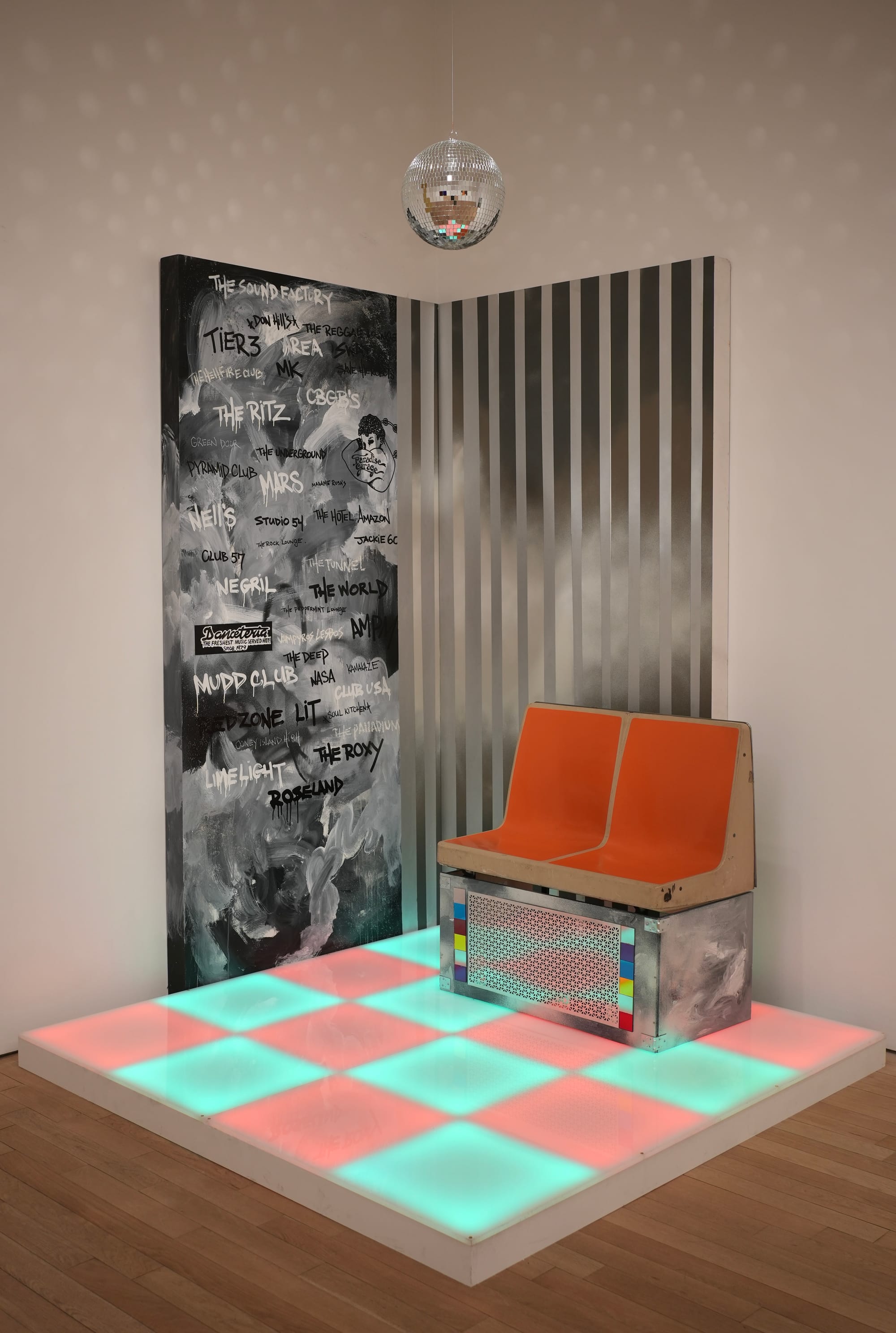
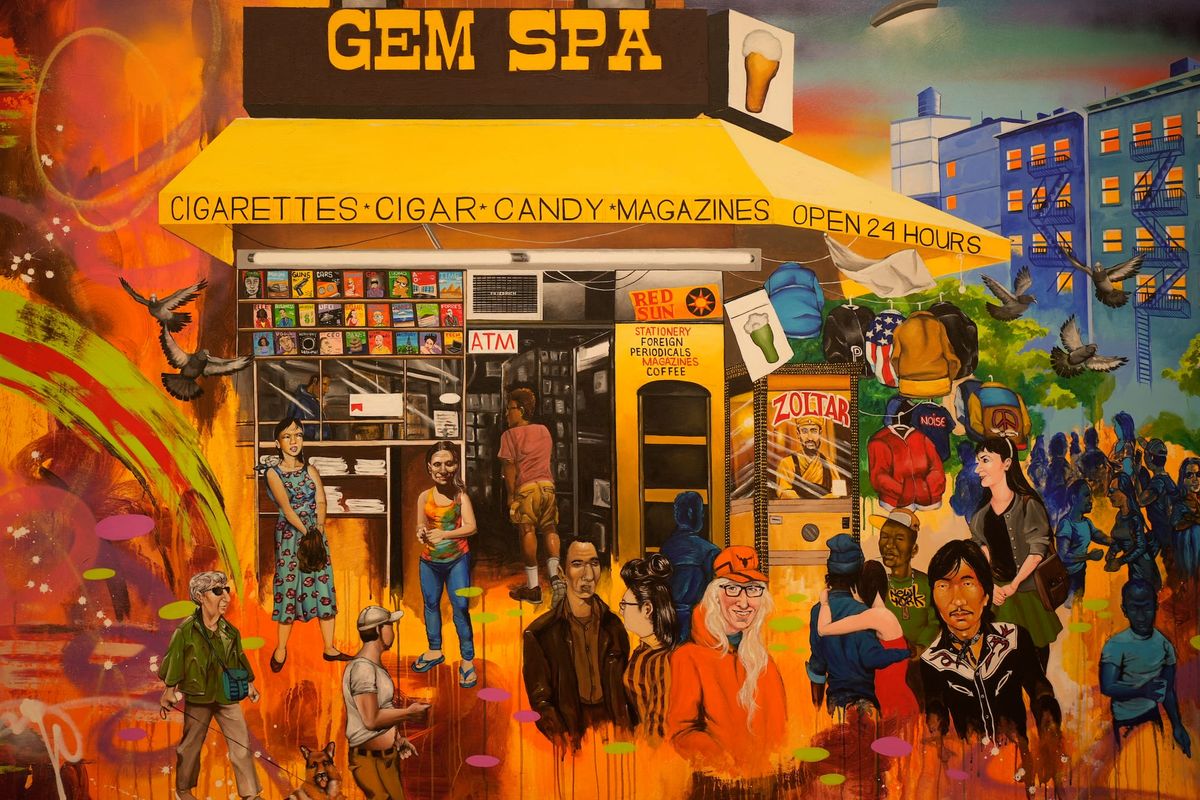
DAZE (aka Chris Ellis) continues to dazzle with his urban-infused canvases, installations, and a site-specific mural that celebrate aerosol culture from yesteryear with a floral flourish that updates them with a very contemporary feel. The installation “Soundtrack to the City” (2026) is particularly great, as it embodies the cultural fusion that drives his art, while expanding his artistic world with more decorative associations and dreamlike juxtapositions. The show emphasizes old-school nostalgia — some works populated by beloved figures, others given over to unpopulated cityscapes and subwayscapes — suggesting how memory continues to serve as fertile ground for new ideas to grow. The gallery is hosting a conversation between DAZE and art writer and curator Carlo McCormick (who is depicted in two of the artist’s canvases on display) that will take place on Thursday, April 9 at 6:30pm. The event does not require RSVP, and seating will be allocated on a first-come, first-served basis. —Hrag Vartanian
Arleene Correa Valencia
Fridman Gallery, 169 Bowery, Lower East Side, Manhattan
Through May 2
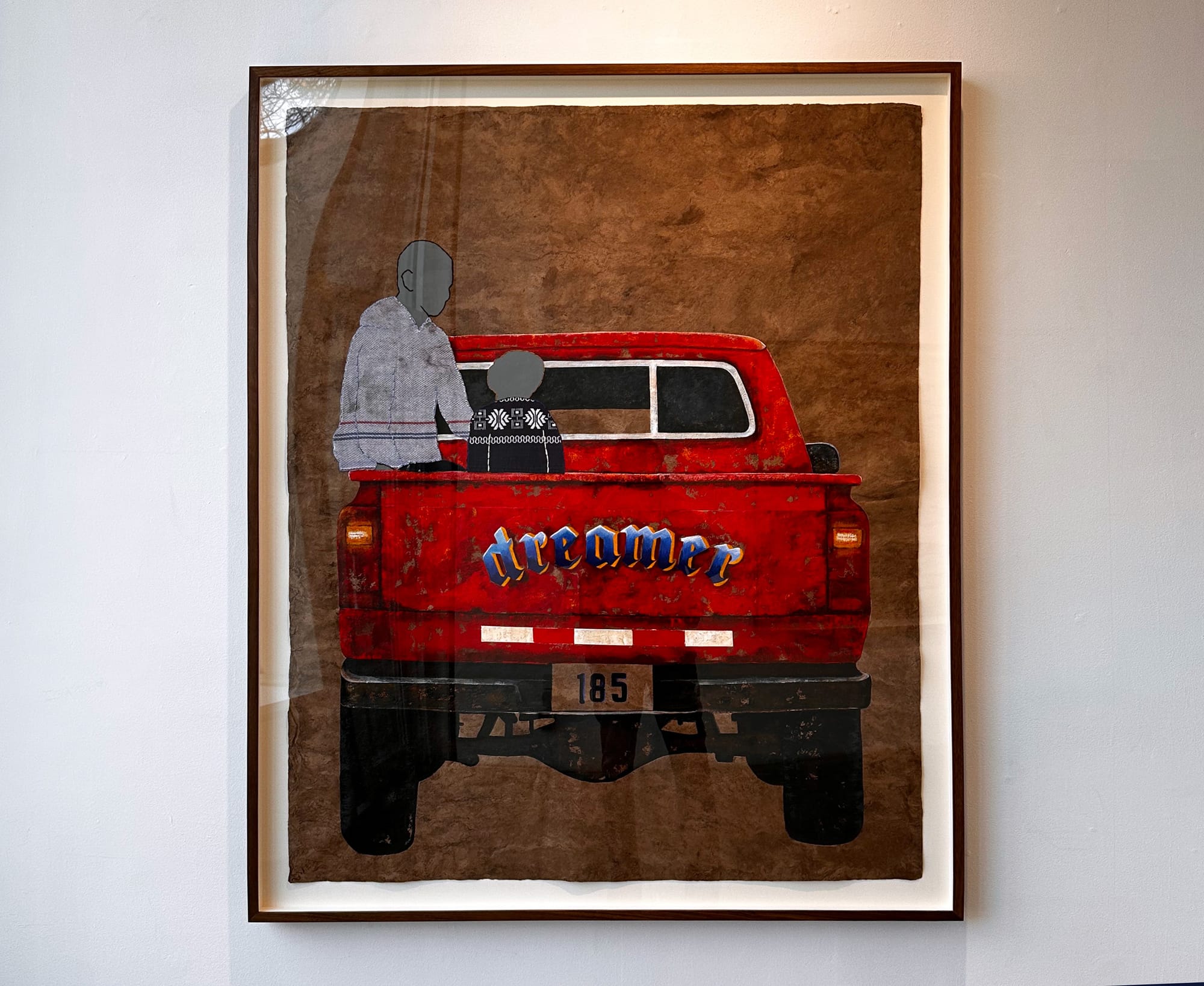
Valencia uses handmade amate paper sourced from San Pablito, Mexico (a video projected in a gallery back room shows the arduous production process) to materially represent the paradoxical nature of Mexican immigrant presence in the United States. In collaboration with her father, the artist, a DACA recipient, stitches textiles and paper to depict bodies that are faceless and featureless except for the clothing they wear and the vehicles that transport them from one precarious situation to another. These are lives lived on the edge of public awareness, not quite whole, almost ghost. —Seph Rodney
Nuits Balnéaires and François-Xavier Gbré: Latitudes
International Center of Photography, 84 Ludlow Street, Lower East Side, Manhattan
Through May 4
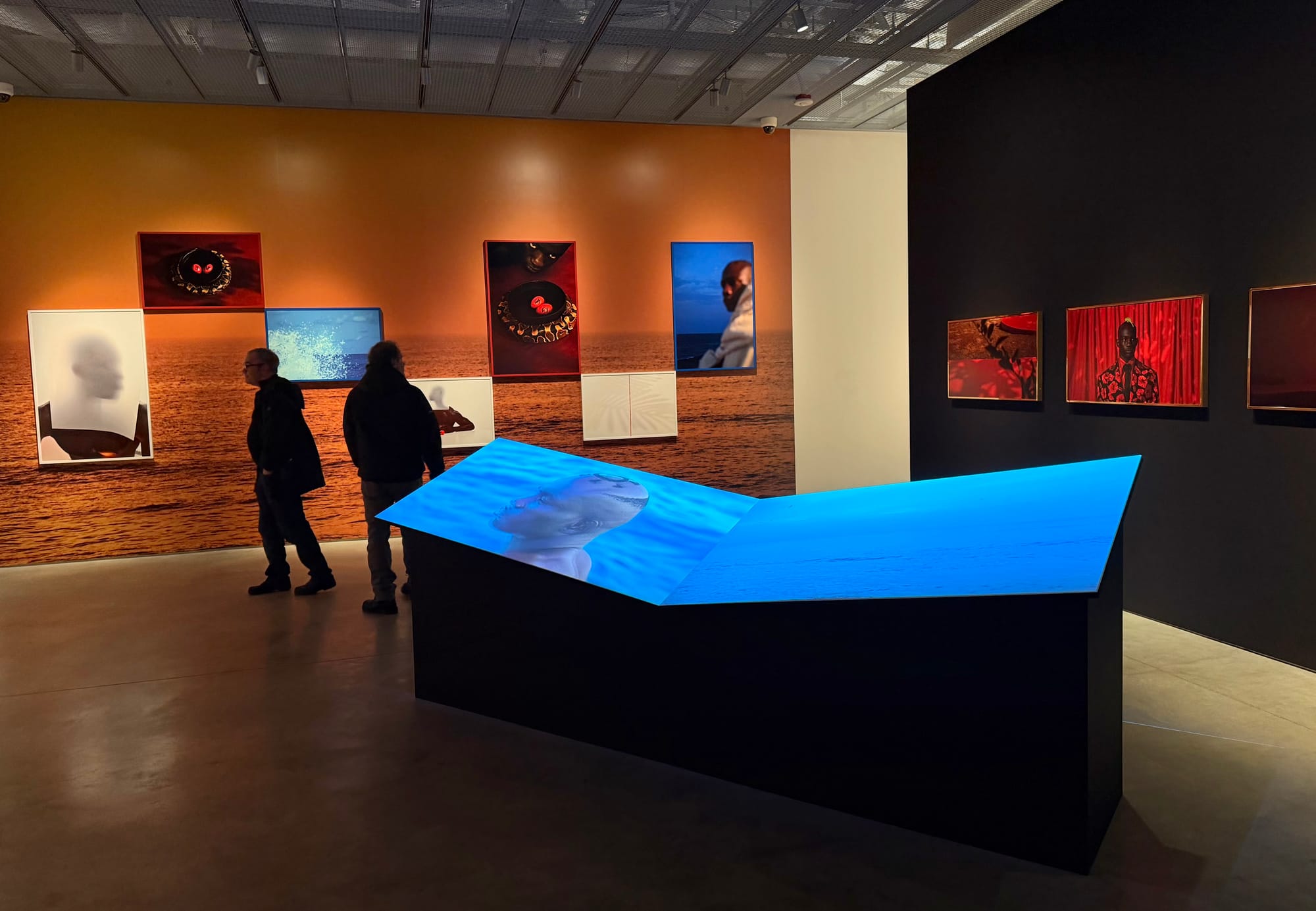
These two artists from Côte d'Ivoire deliver a visually riveting exhibition commissioned by the Fondation d'entreprise Hermès, developed in partnership with the Fondation Henri Cartier-Bresson in Paris and the International Center of Photography (ICP). Presented in a starkly graphic way, the images depict a way of seeing that blends design and image-making to conjure a world that feels both contemporary and dynamic. Color is deployed in an almost painterly fashion — space bending to form, compositions fading to or stepping off into a deep, ethereal black, red, and white. The installation is quietly stunning. —Hrag Vartanian
Eugène Atget: The Making of a Reputation
International Center of Photography, 84 Ludlow Street, Lower East Side, Manhattan
Through May 4
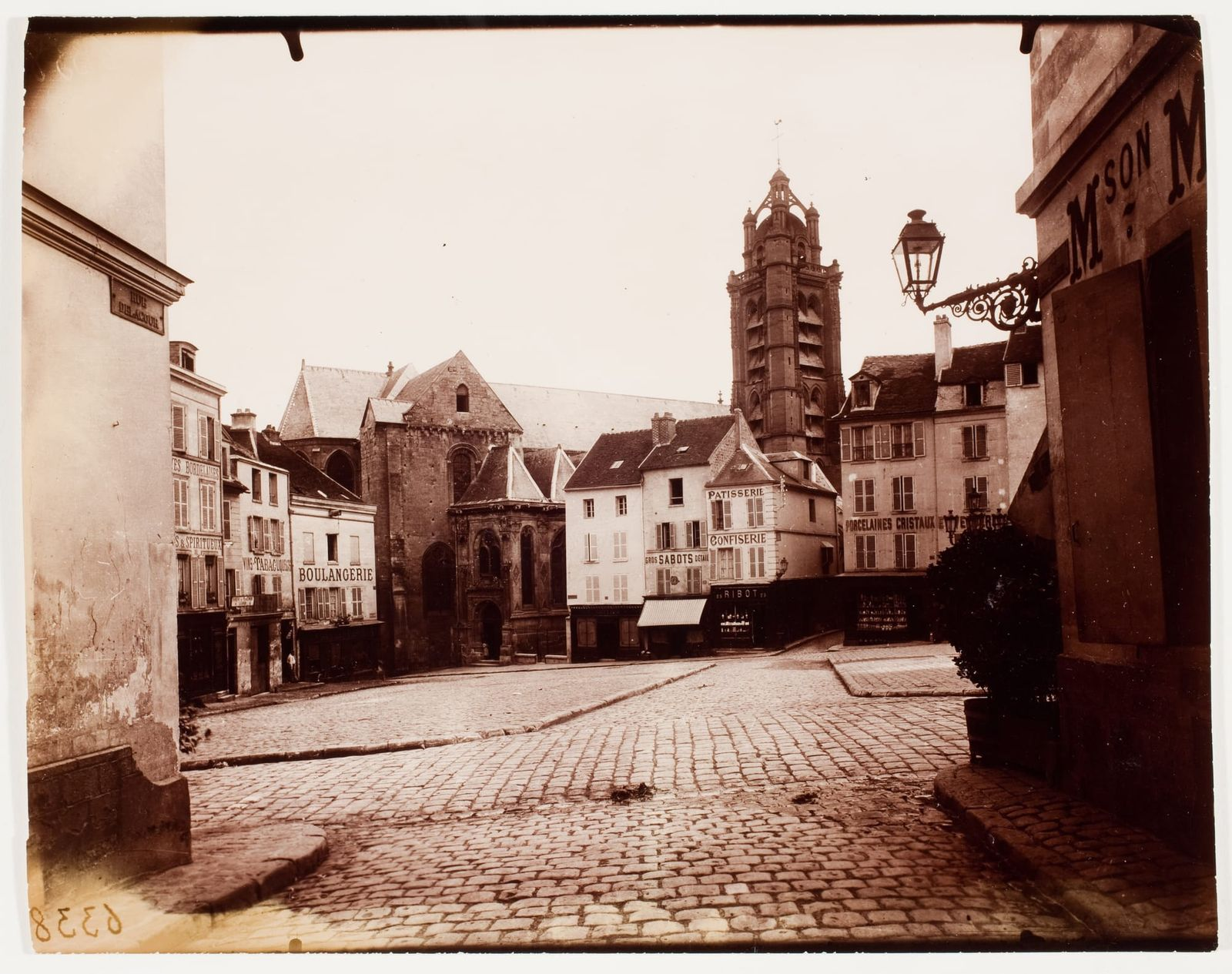
Come get lost in the sepia-toned world of Eugène Atget's Paris in a fascinating exhibition of images so iconic that you may have forgotten who took them. Atget never considered his photographs art, yet it's hard not to see them that way as you move through what feels like an almost endless catalog of a world that time and modernity erased (gentrification, no doubt, played its part too). As Julia Curl explains in her review from earlier this year, it was Berenice Abbott who was responsible for rebranding this picture-taker as an artist — and thank goodness she did. This is the romance of old-timey photography at its almost-clichéd best.
Margaret Curtis: 'S
Post Times, 29 Henry Street, Lower East Side, Manhattan
Through May 17
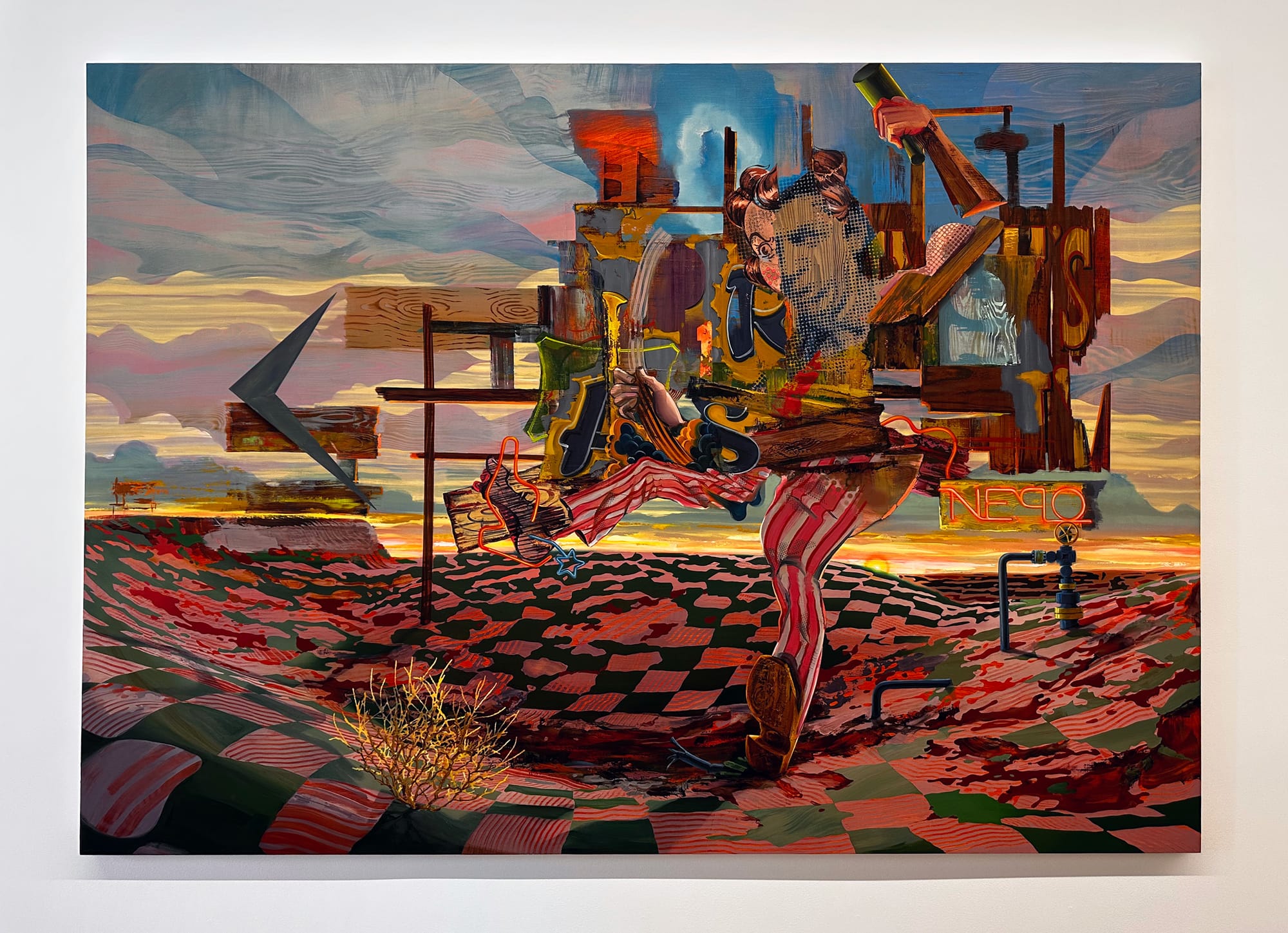
Curtis’s painting thrusts me into a desert landscape where disparate pieces of the American frontier mythology have been thrown together: a revolver, a sharp-edged boomerang, part of a neon sign, a cowboy hat, a jug of moonshine, a sheriff’s badge. These signifiers are combined with bits of bare wooden scaffolding of torn-down dwellings and piecemeal images of people’s disintegrating faces and errant limbs. All together they read as a deconstruction of that myth of the West that prized rugged individualism and heroicized men who “tamed” the landscape. It’s rare to see painting so buoyantly analytical and historically insightful. —Seph Rodney
RugLife
Pratt Manhattan Gallery, Greenwich Village, Manhattan
Through May 23
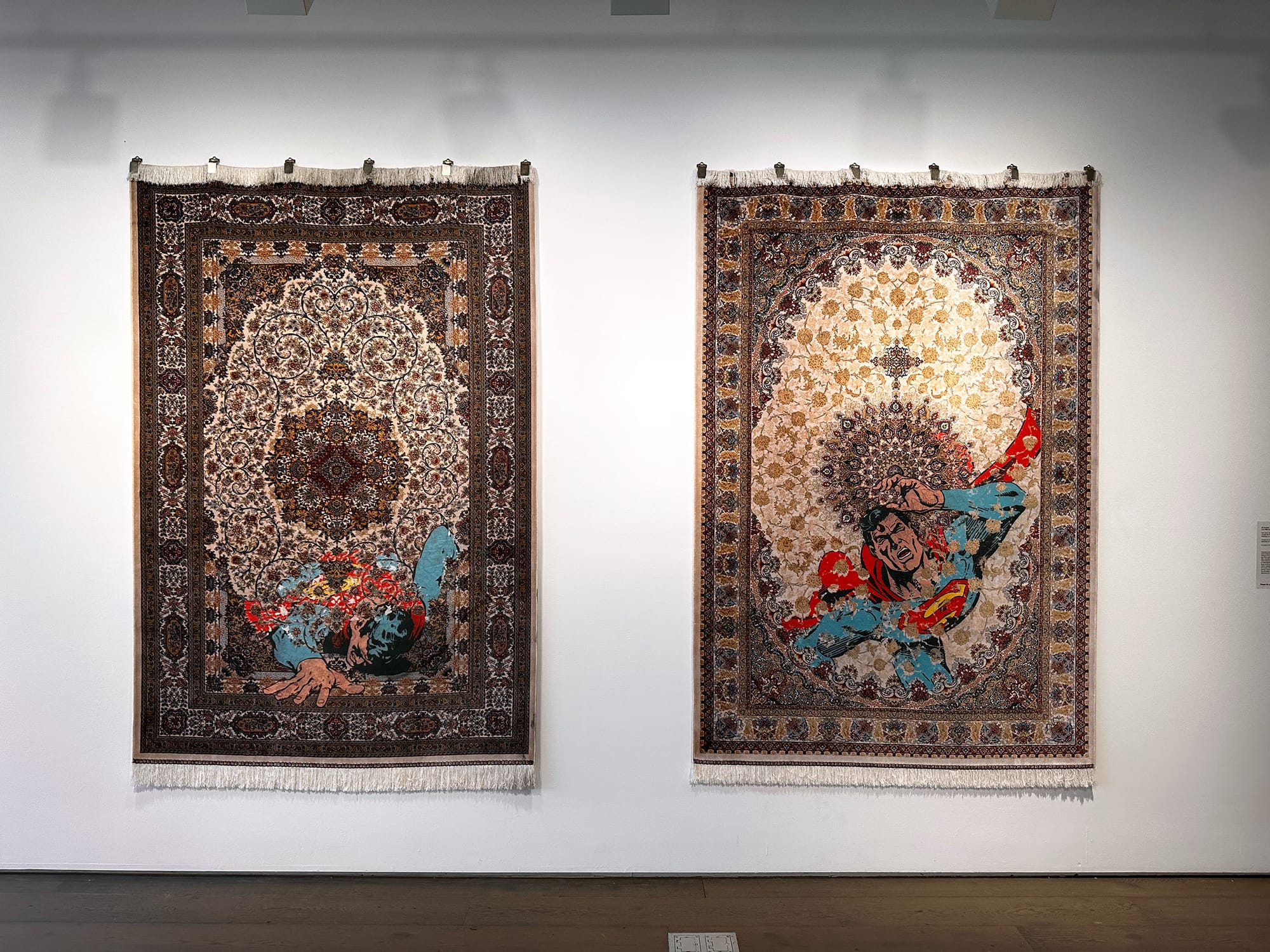
RugLife is clearly a means for the curators Ginger Gregg Duggan and Judith Hoos Fox to gather work that exultantly stretches the notion of what textiles as visual art can be and do. Among the wonderful pieces are Ali Cha’aban’s mashup of wildly different conventions — an image of the comic book Superman interwoven with a traditional Persian rug. Liselot Cobelens’s evocation of a desiccated landscape done in wool is amazing in its sumptuous textures. Though it’s alluring in its color scheme, Johannah Herr’s version of an assault rifle is a bitter reminder of the nation’s endemic violence, and Sonya Clark’s “Comb Carpet” (2008) is ingenious in its use of black, plastic combs to represent a textile field. —Seph Rodney
Naufus Ramírez-Figueroa: Lugar de Consuelo (Place of Solace)
Museum of Modern Art, 11 West 53rd Street, Midtown, Manhattan
Through May 25
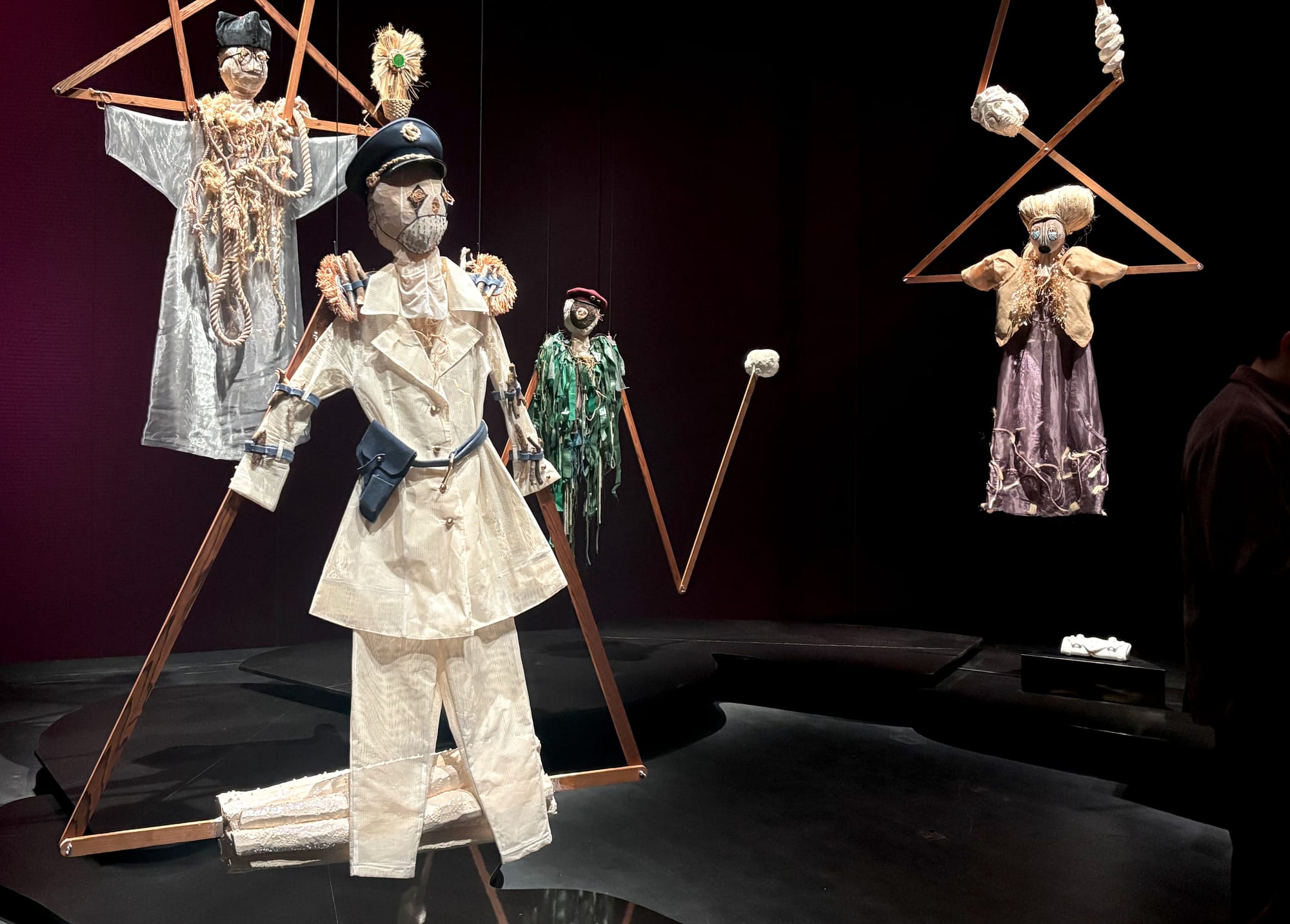
Arranged sparingly in a cavernous gallery bathed in inky light, the five suspended figures in Naufus Ramírez-Figueroa’s installation hover quietly as though in a haunting memory. Dressed in symbolic gauze, rope, and other materials, these personages are the imagined protagonists of Hugo Carrillo's 1962 El Corazón del espantapájaros (Heart of the Scarecrow), a play censored by the Guatemalan government when it was performed by university students during the nation’s civil war. Informed by archival research and the recollections of his uncle, who acted in the play, the artist set out to create drawings, etchings, and a performance reinterpreting Carrillo's play written with poet Wingston González. These myriad elements are displayed at MoMA alongside video documentation of the performance, which will also be staged throughout June in both English and Spanish; they are a reminder of censorship's past as it pushes violently into the present. — Valentina Di Liscia, senior editor