40 Years On, DC Artists Revisit Don Miller's MLK Mural
Since 1986, the 56-foot painting at the Martin Luther King Jr. Memorial Library has served as a visual portal into the civil rights leader’s life and legacy.

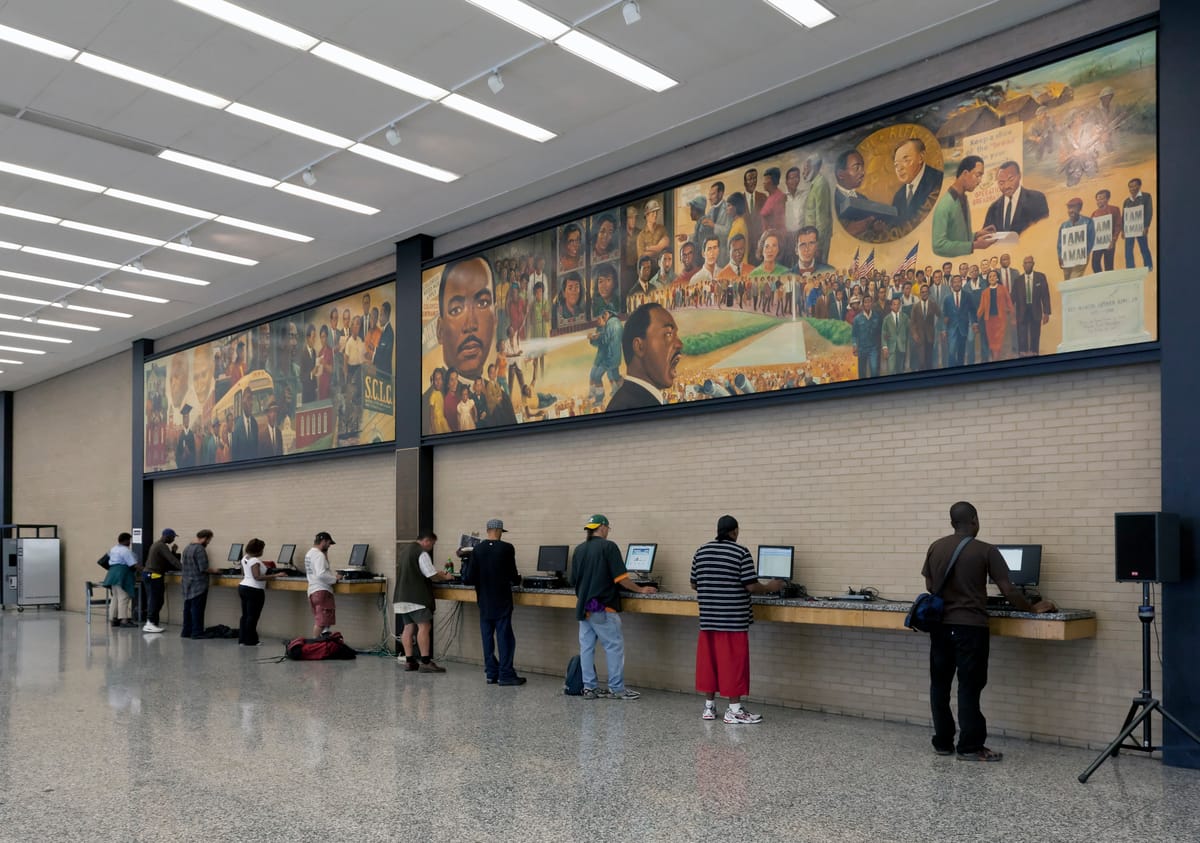
Washington, DC — Last month, DC-based artist Nia Keturah Calhoun waited in line inside the Martin Luther King Jr. Memorial Library in the city’s downtown. She stared up at the 56-by-7-foot-tall mural by Don Miller.
Calhoun, best known for her mural of Supreme Court Justice Ketanji Brown Jackson on 14th and S Streets NW, admired the piece while others passed by without a glance.
“Murals can be markers of time and significance,” Calhoun told Hyperallergic. “People live their lives by it and associate with their surroundings. I think everyday reminders of sacrifice and triumph are important. Painting political figures puts them in the place of people's minds and physical space.”
This Martin Luther King Jr. Day will mark the 40th anniversary of the “King Mural” unveiling. The work was preserved and restored to the library during massive renovations between 2017 and 2021. Since 1986, the painting has served as a visual portal into Martin Luther King Jr.’s life, painstakingly detailing a timeline from King’s childhood until his assassination in 1968. Depictions include King graduating from Morehouse College, King behind bars with Ralph Abernathy, leading a march, and speaking to a crowd with the Washington Monument in the background as a nod to his “I Have a Dream” speech.
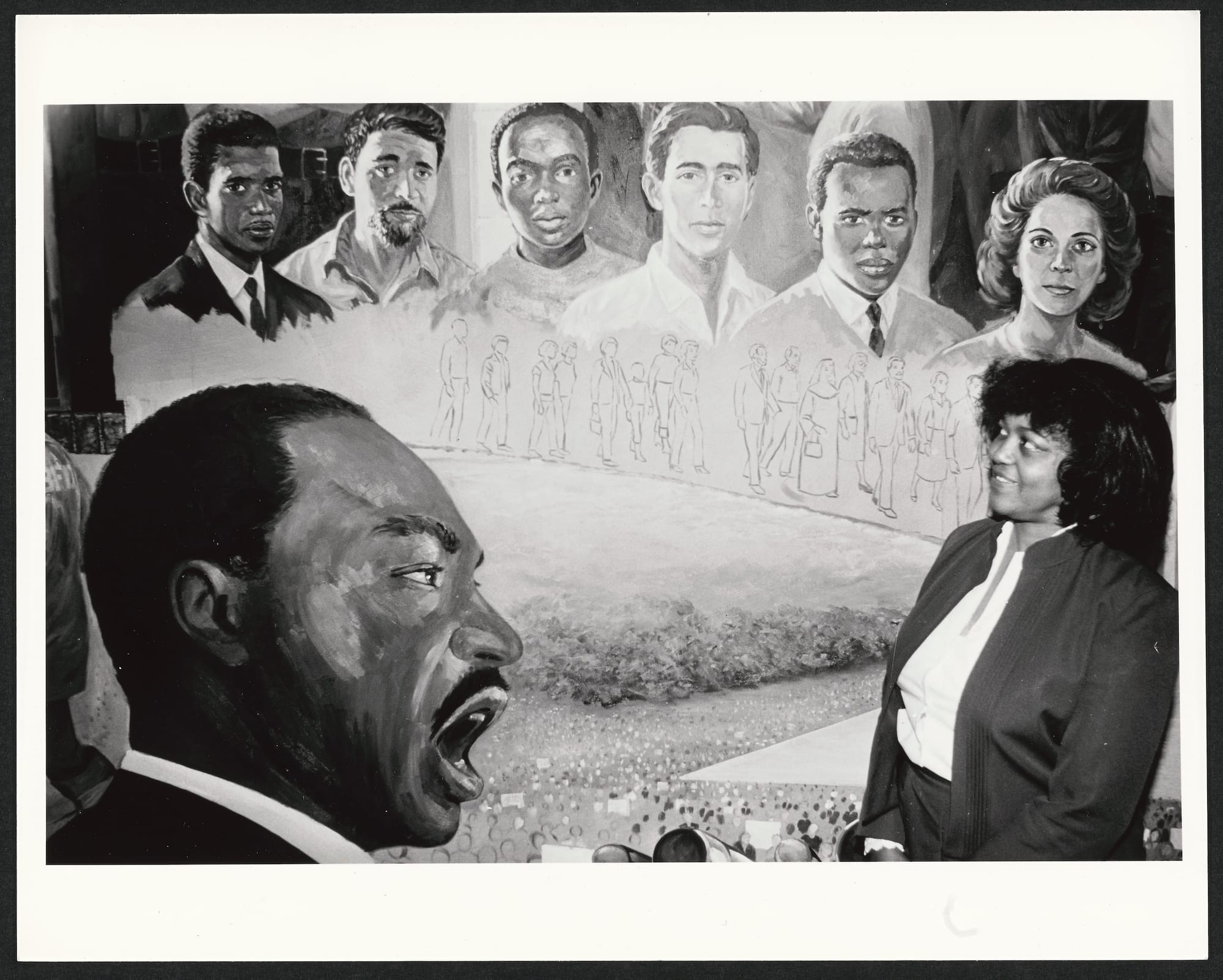
While the piece is dedicated to King, the mural honors other Civil Rights key figures, highlighting the often-overlooked leaders of the movement. The center of the mural is split. The right-center side shows a portrait of King, while the left-center depicts Southern Christian Leadership Conference leaders Andrew Young, Dorothy Cotton, Wyatt Tee Walker, Joseph E. Lowery, Septima P. Clark, Bayard Rustin, and Ella Baker speaking with King. Rosa Parks is prominently painted sitting on a Montgomery bus defying the segregation bus ordinance, which led to the 381-day bus boycott in 1955 and helped launch King as a significant leader in the movement. Several Civil Rights activists and the four girls killed in the 1963 Klan bombing of a church in Alabama are also memorialized with portraits.
On Monday, January 19, the Library will host a special program dedicated to the mural and MLK Day, featuring a musical performance by the Seasons of Love Ensemble of the Gay Men’s Chorus of Washington and remarks from members of Miller’s family.
According to the DC Public Library, Miller originally proposed the mural after visiting the library in the early 1980s and seeing lots of empty wall space. The Jamaican-born, New Jersey-raised WWII vet dedicated his art practice to honoring and documenting Black history. He saw the opportunity for a grand visual piece honoring the man the library was named after.
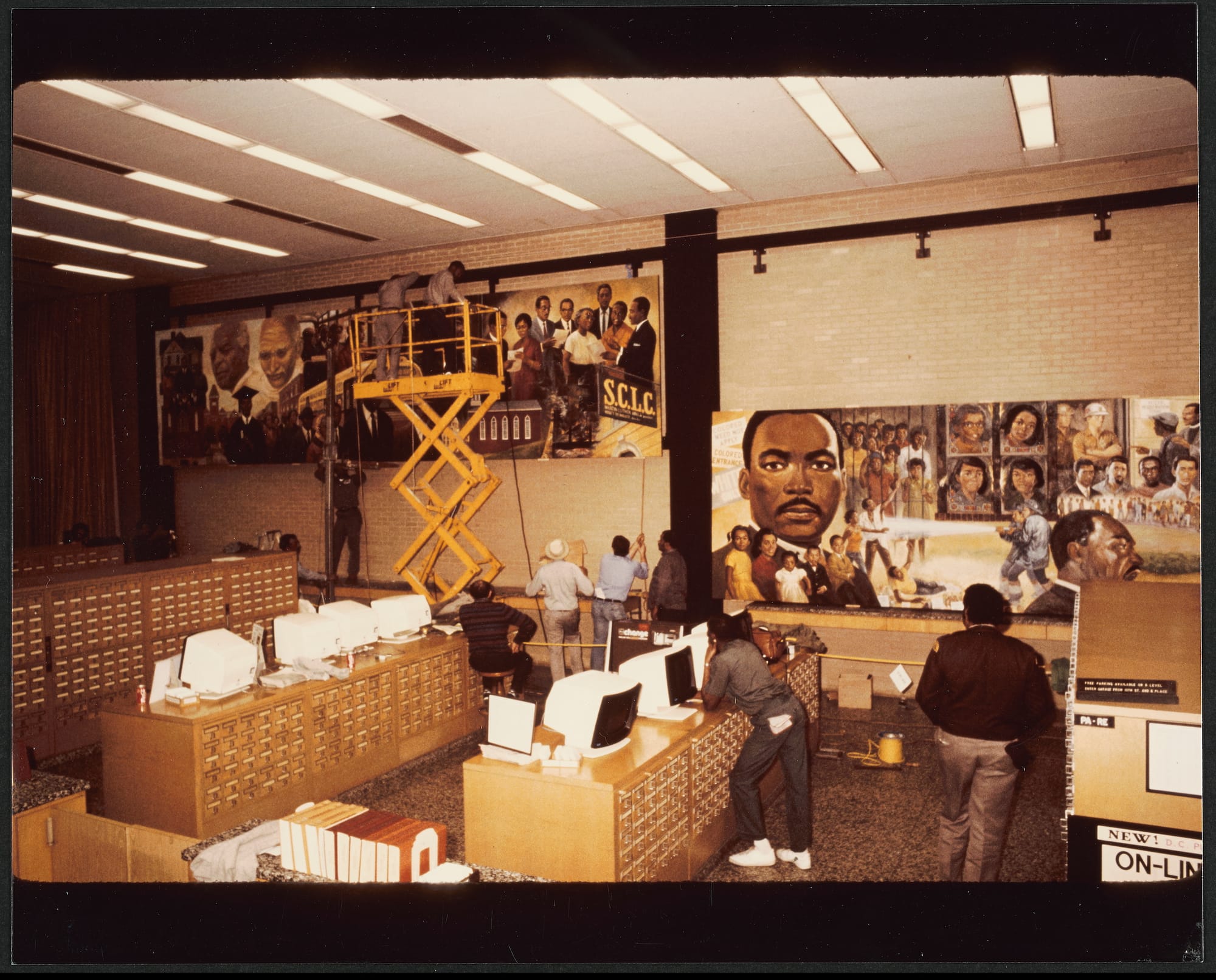
His proposal was approved in 1984. Miller then spent two years researching and creating the painting, talking with multiple civil rights leaders and surviving family members to get all the details right, like the exact bus route name from Parks when she visited Miller at his studio in Montclair. The Washington Post in 1986 reported that Miller slept in King’s former bed in Montgomery, Alabama, when visiting for research.
DC-based artist Nekisha Durrett can relate to Miller’s art ethos. Raised in Southern Maryland outside of DC, she was raised not far from where Harriet Tubman grew up, but did not learn this fact until near adulthood. The absence of this knowledge from her childhood education fueled Durrett, a former educator, to create art to highlight forgotten Black history.
Tubman has frequently been a muse for Durrett. Her latest piece, “The Hem of Heaven,” a 20-foot sculpture of Tubman’s shawl, will be unveiled at the Obama Presidential Center Library this year.
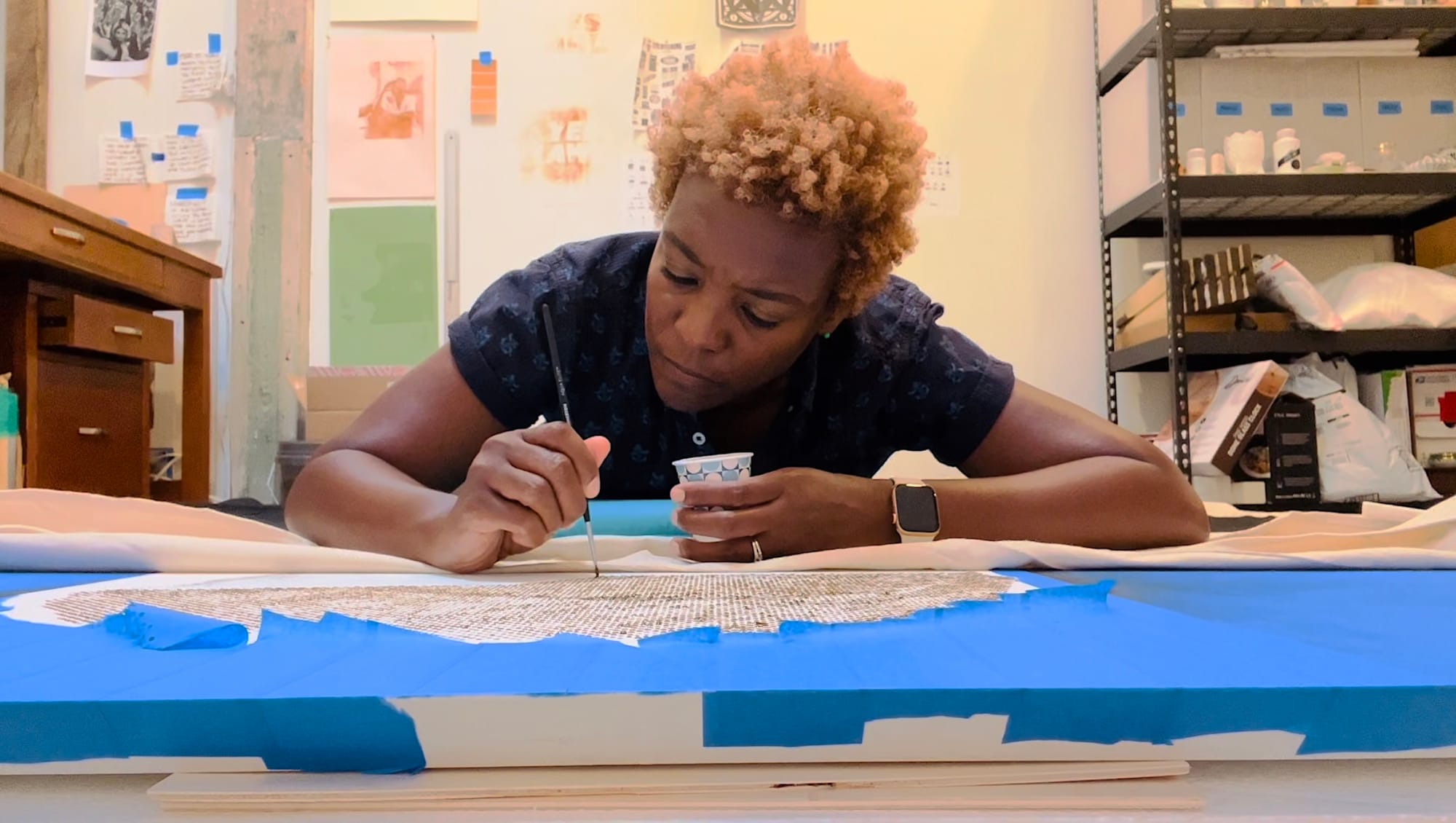
Durrett emphasized the importance of creating art in public spaces. “It’s the democratization of space,” Durrett told Hyperallergic. “Not everyone feels necessarily comfortable going into a museum, and I love that public space is just so accessible for everyone.”
After Miller passed in 1993 at the age of 69, his wife, Judith Miller, hosted a posthumous gallery exhibition honoring her husband in 1998, where she wrote in a pamphlet, “Don's dream was an artist's dream — that their work would continue to influence, inspire, and in his case instruct, long after they have departed.”
Miller’s impact with “King Mural” on audiences — from the local artists who appreciate it to the library-goers who encounter it as a constant presence — proves that his dream has been fulfilled.