Ani Boghiguian on Weaving Armenia
“The gift of being alive is developing a garden in oneself,” the Armenian-Egyptian artist told Hyperallergic, “and to move towards heaven.”

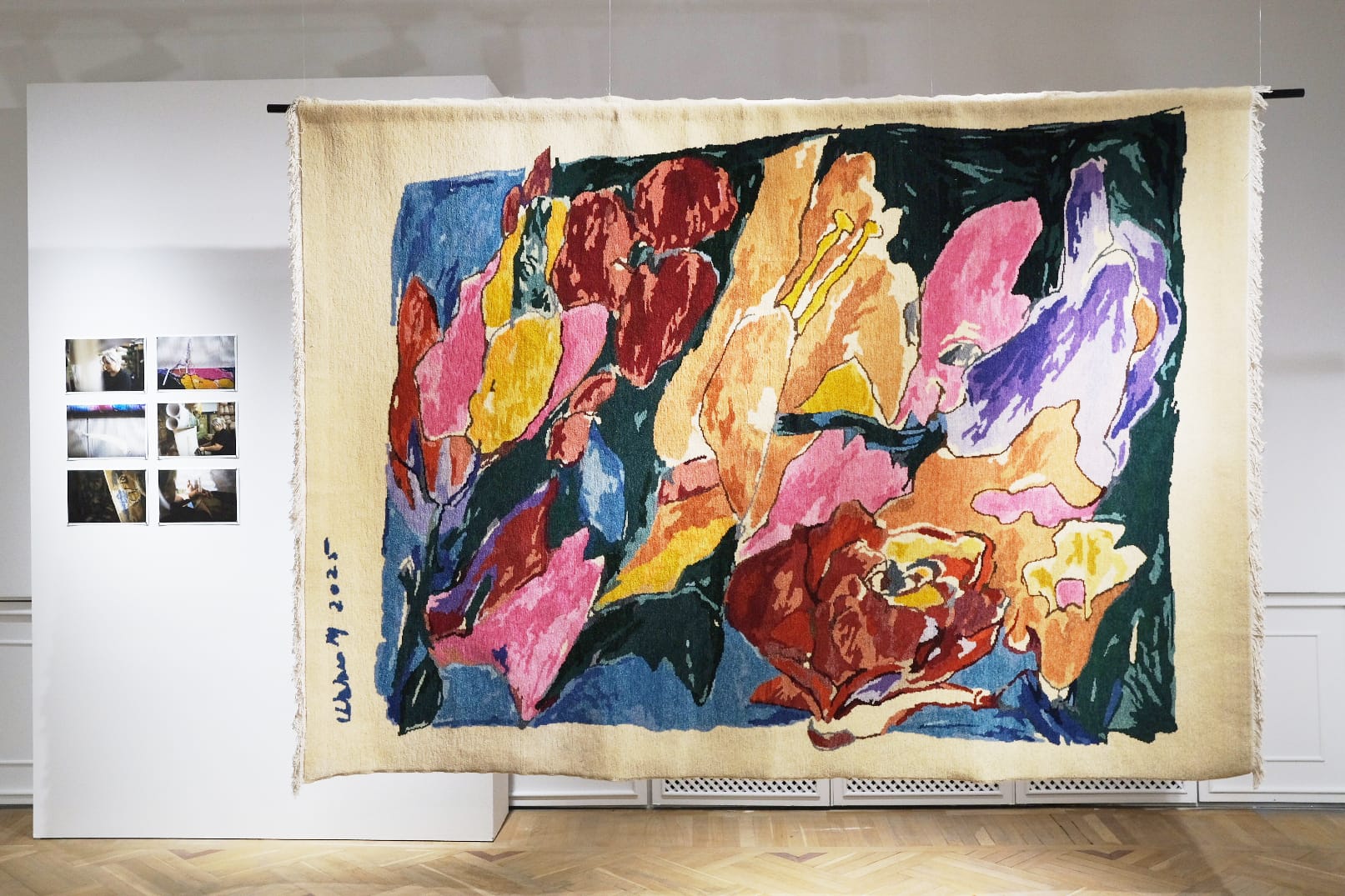
YEREVAN, Armenia — After half a century of traveling around the world, Armenian-Egyptian artist Anna Boghiguian brings her art to Yerevan, at the National Gallery of Armenia. Weaving Culture is a natural history of Armenia illustrated in carpet, with the occasional irruption of people or supernatural beings. Suns, stars, flowers, and animals populate the works, much like the motifs of traditional Armenian rugs.
Yet in traditional rugs, celestial bodies and creatures are encoded in smaller, geometric motifs, and are not always recognizable at first sight. In Boghiguian’s works, they become large and figurative, though often stylized, presences, set against expanses of pastel colors. In the words of curator Nairi Khatchadourian, Boghiguian’s project amounts to the invention of the watercolor carpet.
Anna Boghiguian: Weaving Culture tells its story in 37 rugs and three drawings, divided between three acts in contiguous halls. The first lays out the mountains of Armenia — massive, their tall peaks often tightly pressed against each other in a confusion of blues, browns, and purples. A huge red sun with yellow rays presides over a landscape bound by two red and grayish peaks separated by what looks like a valley.
The second act is the garden. Trees and plants with large, blooming, blood-red flowers dominate here. A human figure appears in “Man with Pomegranate and Snake” (all works 2025–26). Storks are as ubiquitous in these works as they are in Armenia. The large tapestry “The Sound of Nature is Music” portrays clearly discernible trees, mountains, and flowers, yet its sinuous lines and the jumble of colors and undulating shapes may carry a faint echo of Arshile Gorky’s landscapes.