Anish Kapoor Is a One-Trick Illusionist

What does the British artist have to offer beyond monumental scale and costly optical illusions?

Anish Kapoor Is a One-Trick Illusionist
Installation view of Anish Kapoor at Hayward Gallery, London (photo Dave Morgan, courtesy Hayward Gallery)

LONDON — Monumentality is a powerful tool for Anish Kapoor; his immense sculptures in his signature red and chrome palette inspire awe when dropped among, say, the grounds of Houghton Hall, Norfolk, or Millennium Park, Chicago, reducing viewers to mere ants. But at his show at the Hayward Gallery, his illusions of monumentality fall short.

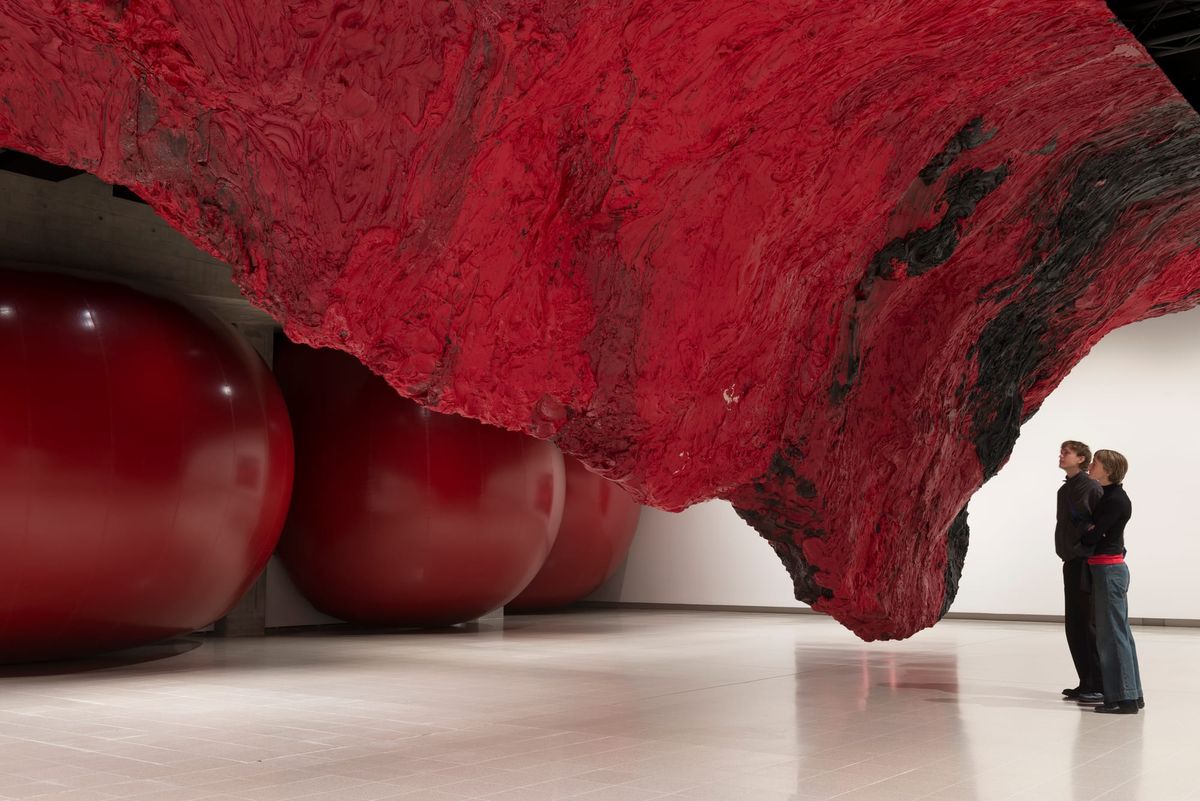
The most impressive piece, “All of Nothing” (2026), a giant red blood cell, inflates and fills the hangar-like space but somehow makes its surroundings feel small by comparison, foreshadowing what follows.

The following gallery displays the artist’s so-called greatest hits: clever one-trick illusions that hinge on creating optical confusion. On view are artworks from Kapoor’s controversial Vantablack series from the last thirty years, which inadvertently shows a decline in creativity over time. In “Untitled,” a tomb-like sandstone monolith is punctured by an inviting-but-not-black doorway, while “Descent into Limbo” (both 1992) emulates a cartoon-like hole in the floor. Nearby is another untitled work from 2026: a pseudo-rip in the wall, a half-baked thought that one could imagine was the curator’s solution to filling the gallery space. The wall text quotes Kapoor’s musings that a void is “a space full of what doesn’t exist” (well, quite) and “Perhaps the darkest black is the black we carry within ourselves.” In short, you paid to see this; you work it out.
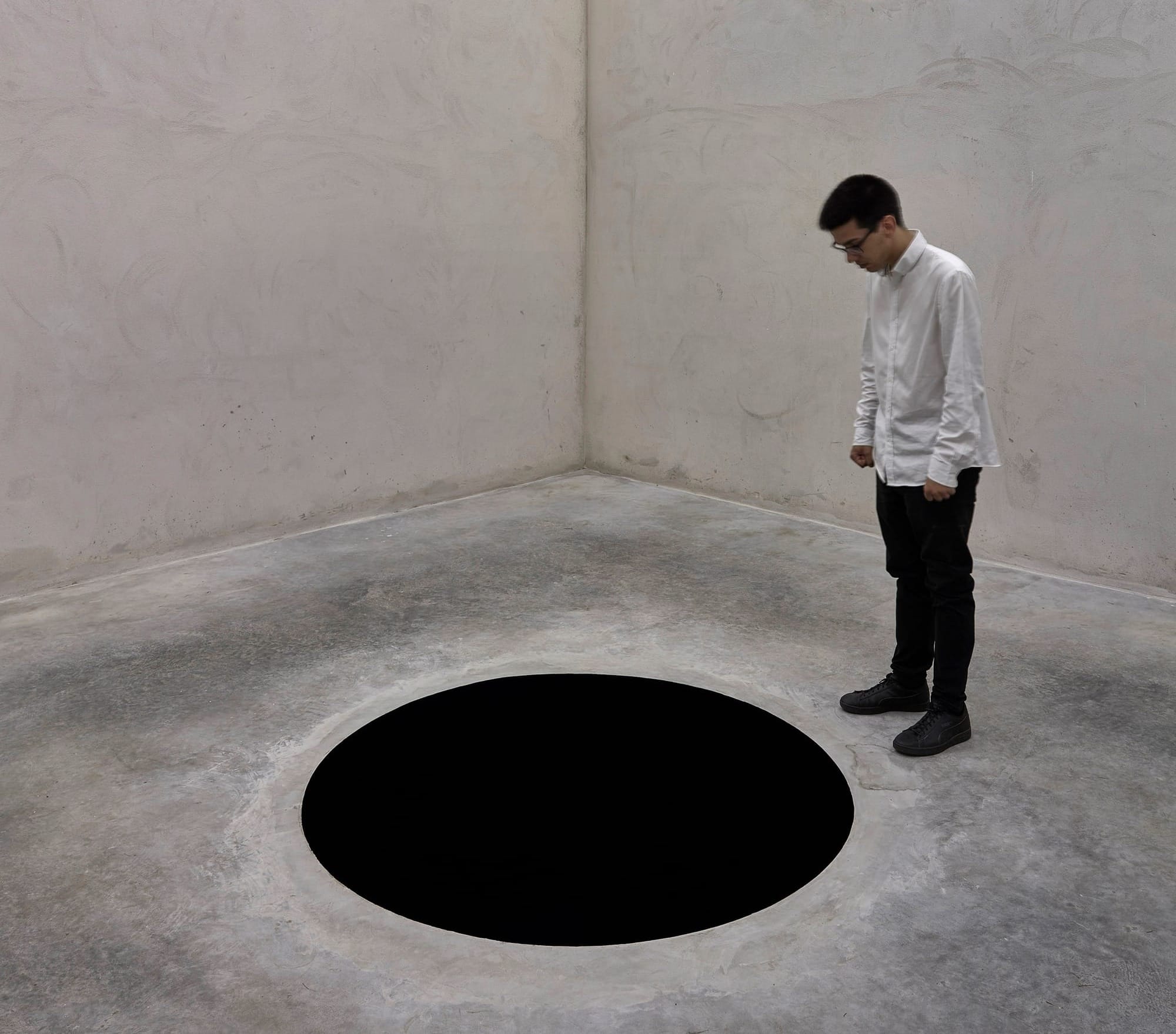
Anish Kapoor, "Descent into Limbo" (1992), mixed media, pigment (photo Filipe Braga, courtesy Hayward Gallery)

Punctuating the walls are reflective mirrors, a mainstay on the art fair circuit and the source of Kapoor’s financial success that has allowed him to create the large-scale work he’s known for (and gain exclusivity of the world’s darkest material). Outside on the veranda is “Tsunami III” (2025), a reflective stainless steel wibbly curve that required a crane to install, reminding us that big, shiny, and monochromatic are his bread and butter. 
Upstairs, otherworldly creations deviate from this formula. Massive red beans are wedged into the brutalist concrete pillars, while “Plastic Sacrifice I, II and III” (2026) is a series of what look like red-splattered entrails, wrapped in taut plastic sheeting. Their texture — somehow both stiff and fluffy — defies easy visual comprehension. The works resemble monstrous gummy bears, half-chewed and rolled in a mysterious fluffy substance, enticing and morgue-ish in equal measure. Bisecting the room is “Mount Moriah at the Gate of Ghetto” (2022), an inverted topographical, spine-like crest, articulated with feverish sculpted peaks of red and black wax. The work is unnerving enough without the overtly biblical and sacrificial connotations of its title, projecting downwards in an oppressive encroachment into visitors’ headspace.

Installation view of Anish Kapoor at Hayward Gallery, London (photo Dave Morgan, courtesy Hayward Gallery)

The further Kapoor strays from sculpture, the more his work suffers. A superfluous example on this floor is the digital print, “The Dark” (2021), which looks like a high school art student’s impression of a hellish chasm, somehow both waxy and grainy in its oil application. Elsewhere, imagery that should feel profound instead looks nicked from long-existing motifs. In some works on canvas, Kapoor quotes the Christian almond wound-slit straight from medieval manuscripts by simply dragging the paint down in a smear. 

Kapoor is like Jeff Koons: both command eye-watering prices at market, and use endless resources to push technological boundaries in creating art objects. They diverge, however, in their accountability: Koons is a born salesman pop artist whose claims to profundity are declared with knowing dishonesty. His shiny Rabbits, Balloon Dogs, and kitsch Michael Jackson and bubbles aren’t trying to convey grand ideas of life and death. When the wall captions tell us Kapoor’s work explores vague but all-encompassing concepts like the body, sacrifice, or religion, it fills an intellectual and emotional gap left by their overwhelmingly physical goal of spatial and optical effect. 

In this respect, the most affecting artwork in the building is the video art by fellow Indian-born artist Kulpreet Singh, shoved unceremoniously into the tiny leftover gallery space. “Indelible Black Marks” (2022–24) addresses specific and tangible real-world issues of climate change and agricultural crises. 

Anish Kapoor continues at Hayward Gallery (South Bank, London) through October 18. The exhibition was curated by Ralph Rugoff, Thomas Sutton, and Charlotte dos Santos.