Archaeologists Discover Mummy Buried With Lines From Homer’s Iliad
Found in Egypt, the papyrus confirms that Homer was everywhere in the ancient Mediterranean.

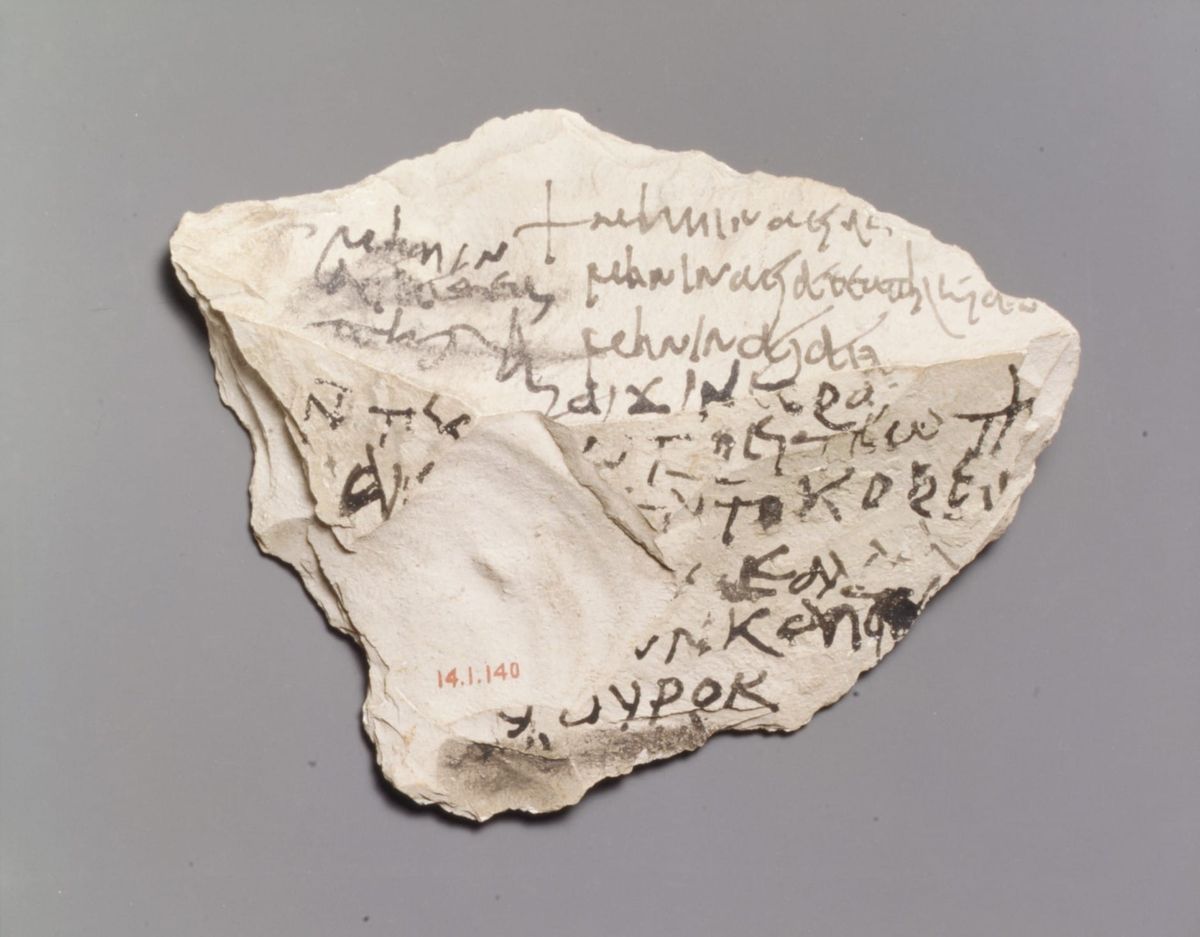
Archaeologists excavating at the Ancient Egyptian city of Oxyrhynchus, near modern El-Bahnasa, announced the discovery of a papyrus containing lines from Homer’s Iliad on the abdomen of a Roman-era mummy. The papyrus dates to the late Roman period, around the fifth century CE, about 1600 years ago. Over 1,500 papyri quoting Homer’s works survive today, but only an extremely small number were placed in burials. Why would a Romano-Egyptian want to take Homer with them to the afterlife?
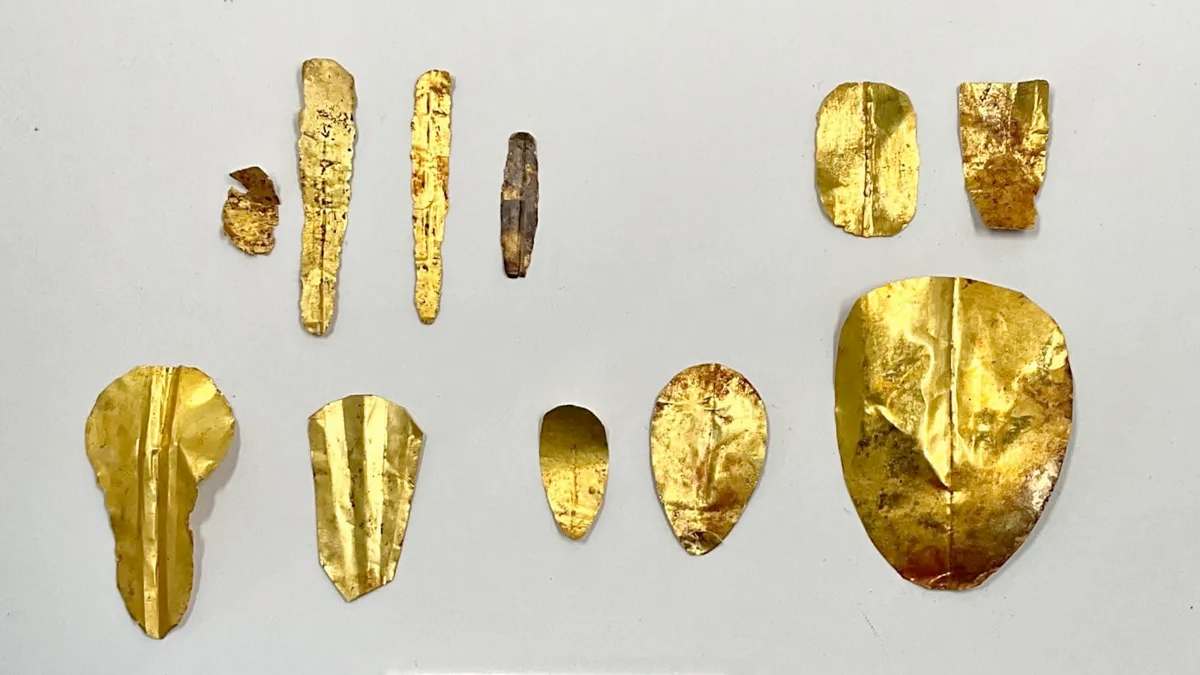
In November and December, the Spanish Archeological Mission of the University of Barcelona and the Institute of Ancient Near East Studies (IPOA), headed by Maite Mascort and Esther Ponce Milado, uncovered several Greek and Roman-era tombs at the site. The Ptolemaic era (305–30 BCE) tombs contained statuettes, paintings, nails, and 52 mummified remains, 13 of which had gold tongues. The gold tongues, totaling 16 at the site as of January, were likely believed to help the deceased speak with Osiris, the Egyptian god of the dead, afterlife, and resurrection.
Finds from the Roman-era tombs began to be further analyzed in January and February. A team led by conservator Margalida Munar, papyrologist Leah Mascia, and classical philologist Ignasi-Xavier Adiego, director of the Oxyrhynchus project, identified the text. Mascia’s reading determined that the papyrus transmitted the catalog of ships in the second book of Homer’s Iliad. Although likely recited in the 8th century BCE and later written down, both the Iliad and the Odyssey remained popular until the end of the Roman Empire in the sixth century CE and beyond. A pivotal reason we have so many Homeric papyri and ostraca is that Homer was often taught to schoolchildren, who copied and practiced Greek by learning lines from the epics.
But why did the papyrus get included within the burial process? In comments to Hyperallergic, Celsiana Warwick, a Homer scholar and assistant professor of Classics at the University of Iowa, noted the text’s ubiquity as one reason. “Homer was used as one of the texts that people were taught to read Greek with, so it had canonical status and was read by basically every person literate in Greek,” Warwick said.
In addition to the text's popularity, writing could acquire special powers in certain ancient contexts. We know of a number of magical papyri that were likely included as a way to protect the dead on their journey to the afterlife.
“There was an apocryphal tradition of reciting Homer to heal animals and people,” said Joel Christensen, an expert in the Iliad and Odyssey and the provost of the Graduate Center at the City University of New York (CUNY). “The passage from the catalog may have had ethnic or civic significance for either the family or the deceased: there may have been a special connection to the hero invoked or the city of origin.” In antiquity, Greeks and Romans also practiced a type of divination called bibliomancy. They used randomly chosen passages from Homer and Virgil in order to predict their future.
The papyri themselves appear to have been folded and placed in strategic places along the body. “These were folded papyri placed on top of deceased individuals (some of them were placed under their arms), which were nevertheless in a very fragmentary state,” papyrologist Leah Mascia told Hyperallergic, referring to how the Oxyrhynchus archaeologists recovered the Homer papyrus. A number of earlier mummified remains have papyri, such as the Book of the Dead, folded and placed on top of the body for aid in the afterlife.
In late April, the University of Hamburg issued a correction to earlier media reports that incorrectly stated that the fragments had been found inside the body. A majority of Egyptologists and papyrologists today adhere to a strict ethical code that prohibits the unwrapping of mummified remains. In the late 19th and early 20th centuries, Victorians often had parties to unwrap, display, and even ingest such remains.
Mascia clarified to Hyperallergic that the papyri “could be removed only because they were on top of individuals in a poor state of conservation.”
“The deceased were left intact in the necropolis. Furthermore, we only use non-destructive analytical techniques to study our papyri,” she continued. “In other words, we only studied those in a fragmentary state, while leaving untouched those still sealed.” Mascia added that the team has found 15 other papyri over the last few years, most of them preserving Greco-Egyptian magical texts.
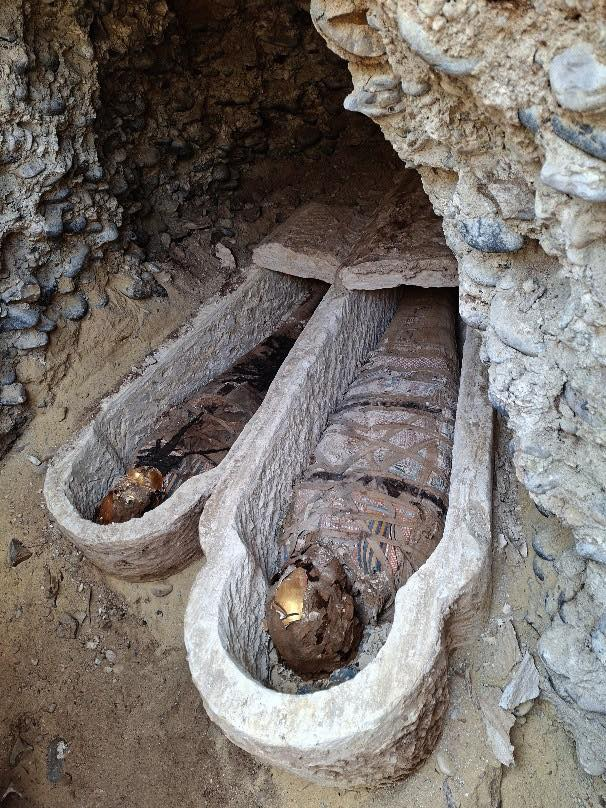
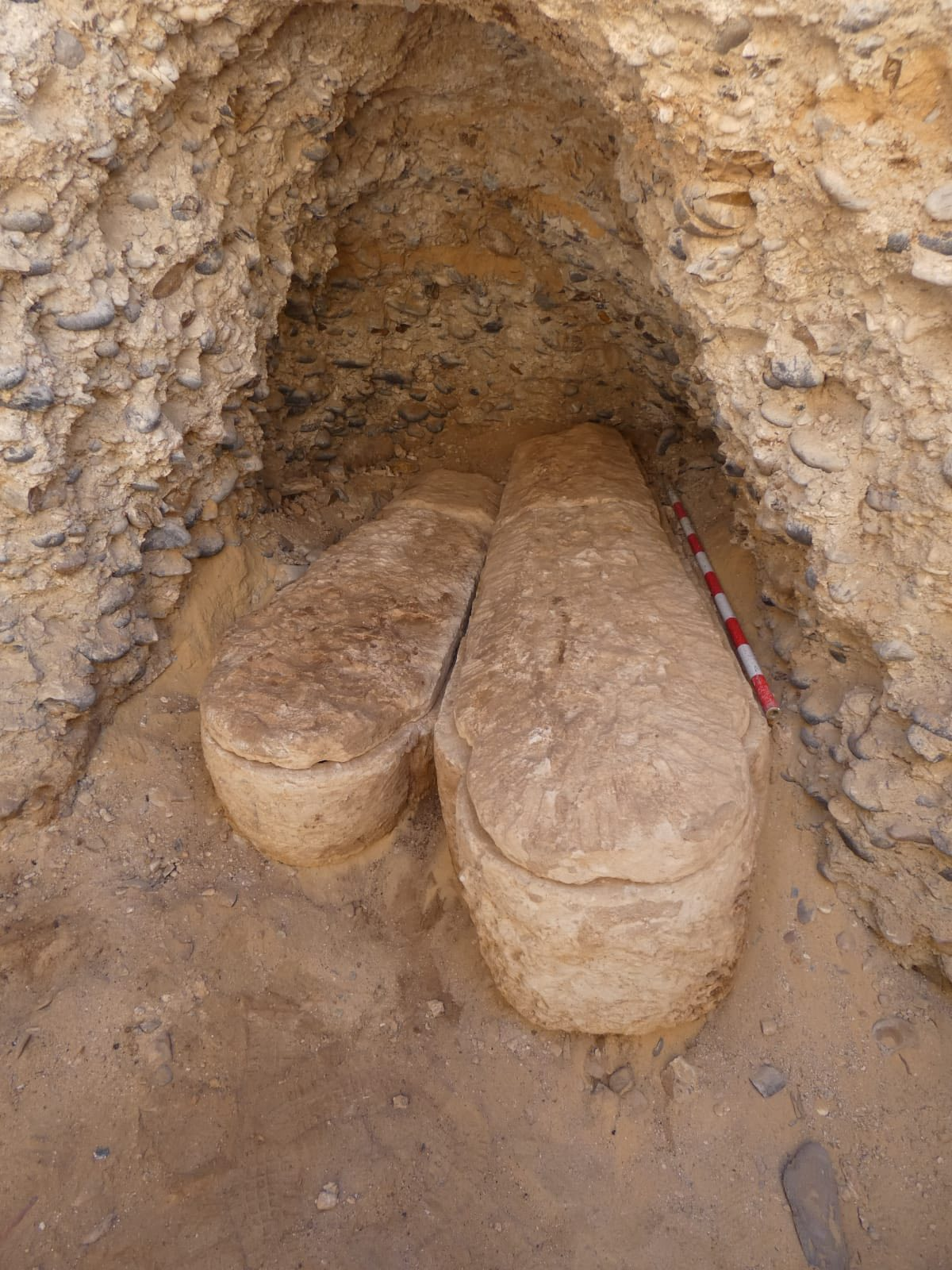
Two newly discovered mummies at Oxyrhynchus (image courtesy Egyptian Ministry of Tourism and Antiquities).
The discovery of a new papyrus recording Homer is indubitably exciting. However, emphasizing that it is the “first time” such texts have been found connected to the mummification process is a bit misleading. In comments to Hyperallergic, Roberta Mazza, a papyrologist at the University of Bologna, noted that there are other instances of Homer passages being buried with mummified persons — such as in the Egyptian Fayum, at the site of Hawara, where another section of Book II of the Iliad was found under the head of female mummified remains in 1888. The papyrus is dated to the second century CE and is kept in the Bodleian Library at Oxford. In her research on this papyrus and other 19th- and 20th-century papyrological discoveries, Mazza notes that “the necessity to publicize finds to attract economic support had a definite impact on the construction of discovery narratives.”
This is true of archaeological digs today as well, wherein important finds are perhaps oversensationalized in order to gain notoriety and funding, or for nationalistic aims.
While we should marvel at the finds, they cannot be fully detached from the long colonial history of this site and many others. A French scholar named Dominque Vivant Denon, an artist who accompanied Napoleon Bonaparte on his Egyptian campaign, was the first modern European to recognize Oxyrhynchus as an archaeological location. Formal excavations only commenced in 1896, under the direction of Englishmen Bernard P. Grenfell and Arthur S. Hunt. The myriad trash heaps that dotted the site have turned up over half a million papyri today, many of which are housed at the Egypt Exploration Society at Oxford University rather than in Egypt.
Though the motivation for including a quotation of Homer in the mummification process remains a mystery, the study of so many new tombs at Oxyrhynchus is striking. The new finds and diverse funerary methods documented at the site continue to shape our understanding of the many types of burials that existed in Greco-Roman Egypt. The discovery again confirms that Homer was everywhere among the people of the ancient Mediterranean: Poems were carried by the living to school, read by lamplight into the night, and, it seems, considered valuable enough to be taken into the afterlife for some epic reading in the great beyond.