Azerbaijan Destroys Armenian Holy Mother of God Church in Artsakh
Satellite imagery confirms that the regime demolished the church in Artsakh’s former capital city of Stepanakert.

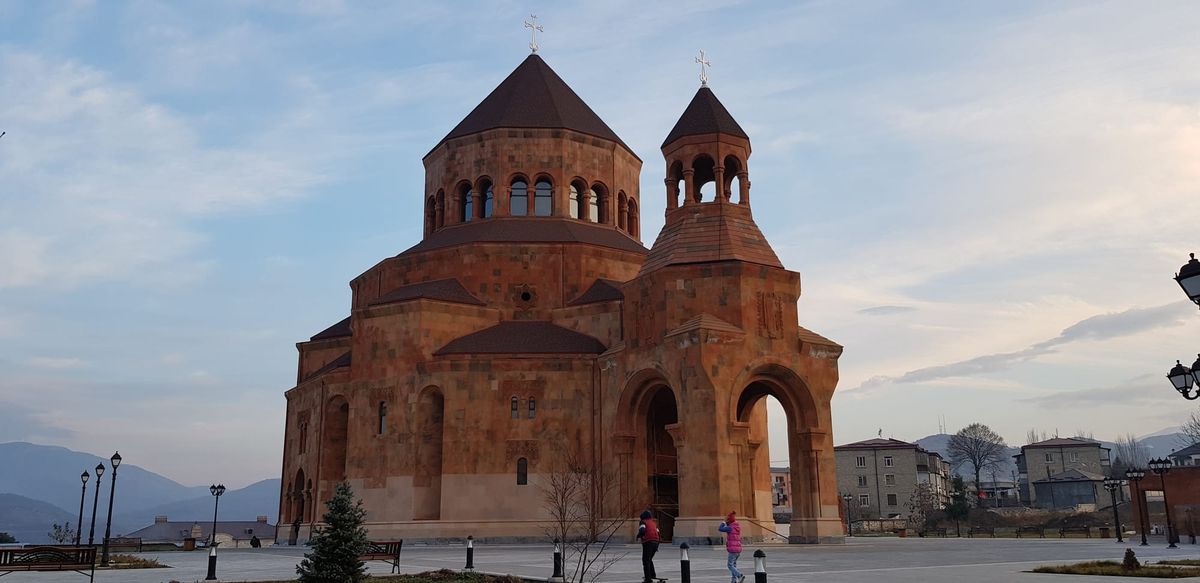
The sustained threats to Armenian religious and cultural heritage across Artsakh (also known as Nagorno-Karabakh) have reached a new level following reports that the Azerbaijani regime has razed another prominent church in the region.
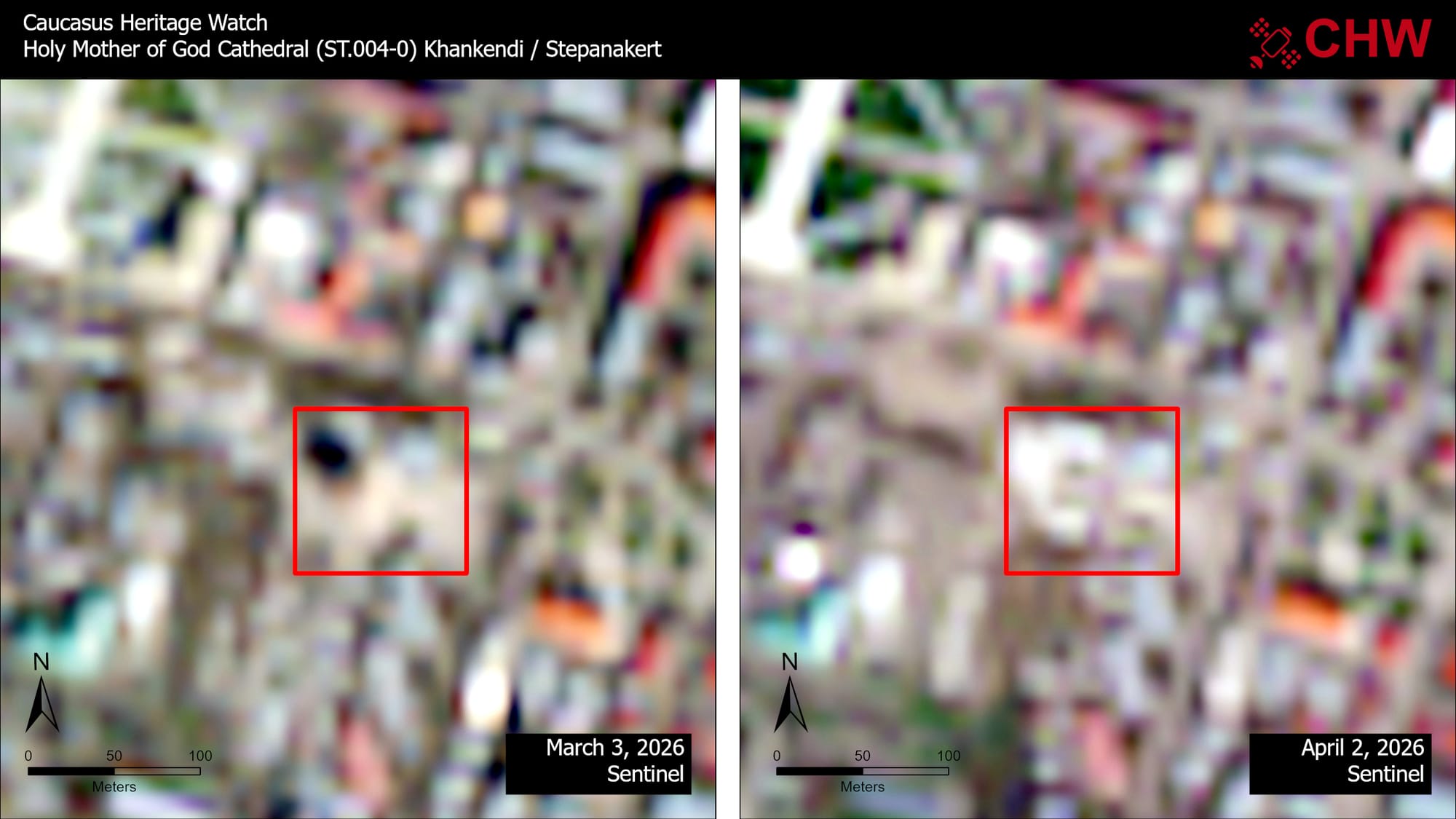
Satellite imagery obtained by Caucasus Heritage Watch (CHW) confirmed that the Holy Mother of God Church, which stood in the former capital city of Stepanakert, was demolished within the last eight weeks.
The Artsakh Tourism and Cultural Development Agency shared the news of the church's destruction on social media on Tuesday, April 21, only three days before the 111th anniversary of the Armenian Genocide. Though the agency did not share photos of the demolition in its notice, CHW's researchers were able to pinpoint supporting photographic evidence within a day by pulling images from the Sentinel-2 satellite from March 3 and April 2.
“Higher resolution imagery will provide a clearer picture in the coming weeks,” the group of scholars said in a statement. “CHW will also continue working with satellite image providers to try to provide greater resolution on the timing of the destruction.”
Unlike the centuries-old churches and burial grounds that have been damaged, appropriated, or destroyed by the Azerbaijani regime since the forced displacement of over 130,000 Armenians in September 2023, the Holy Mother of God Church was consecrated in 2019 after 12 years of construction. During the Second Nagorno-Karabakh War in 2020, the church served as a bomb shelter amid the Azerbaijani bombardment of Stepanakert.
Scholars have warned that Azerbaijan's targeted destruction of these sites, having accelerated since the swift and deadly 2023 takeover of the Artsakh region, amounts to “cultural genocide.”
News of the latest demolition comes shortly after the resignation of the Armenian Genocide Museum-Institute Director Edita Gzoyan at the request of Armenian Prime Minister Nikol Pashinyan. While accompanying United States Vice President JD Vance and his wife for a visit to the Tsitsernakaberd Memorial complex in Yerevan last February, Gzoyan reportedly presented Vance with a book about Artsakh, which Pashinyan interpreted as a “security issue.”
“On my instructions, yes, I asked her to write a resignation letter. I considered it a provocative act, contrary to the foreign policy pursued by the government,” Pashinyan reportedly said at a briefing.
In his campaign for reelection coming up on June 7, Pashinyan, who has long been blamed for the dissolution of the 33-year-old autonomous state, has repeatedly reiterated that further dialogue surrounding Artsakh threatens the 2025 peace agreement in which Armenia and Azerbaijan agreed to recognize each other's (newly established) territorial integrity. On April 20, Pashinyan most recently emphasized that the “Karabakh topic,” as in the push for negotiating the ethnic Armenian population's right of return to the region, has been closed for the sake of peacekeeping.
This Friday, April 24, institutions and individuals around the world will commemorate the victims of the Armenian Genocide, the mass killing of 1.5 million Armenians under the Ottoman Empire in 1915, which the governments of Turkey and Azerbaijan continue to deny to this day.