Beer With a Painter: Keith Mayerson
“I wanted to rip the mask off the signifier and just deal with the signified,” said the cartoonist-turned-painter who depicts a cosmology of American identity and activism.

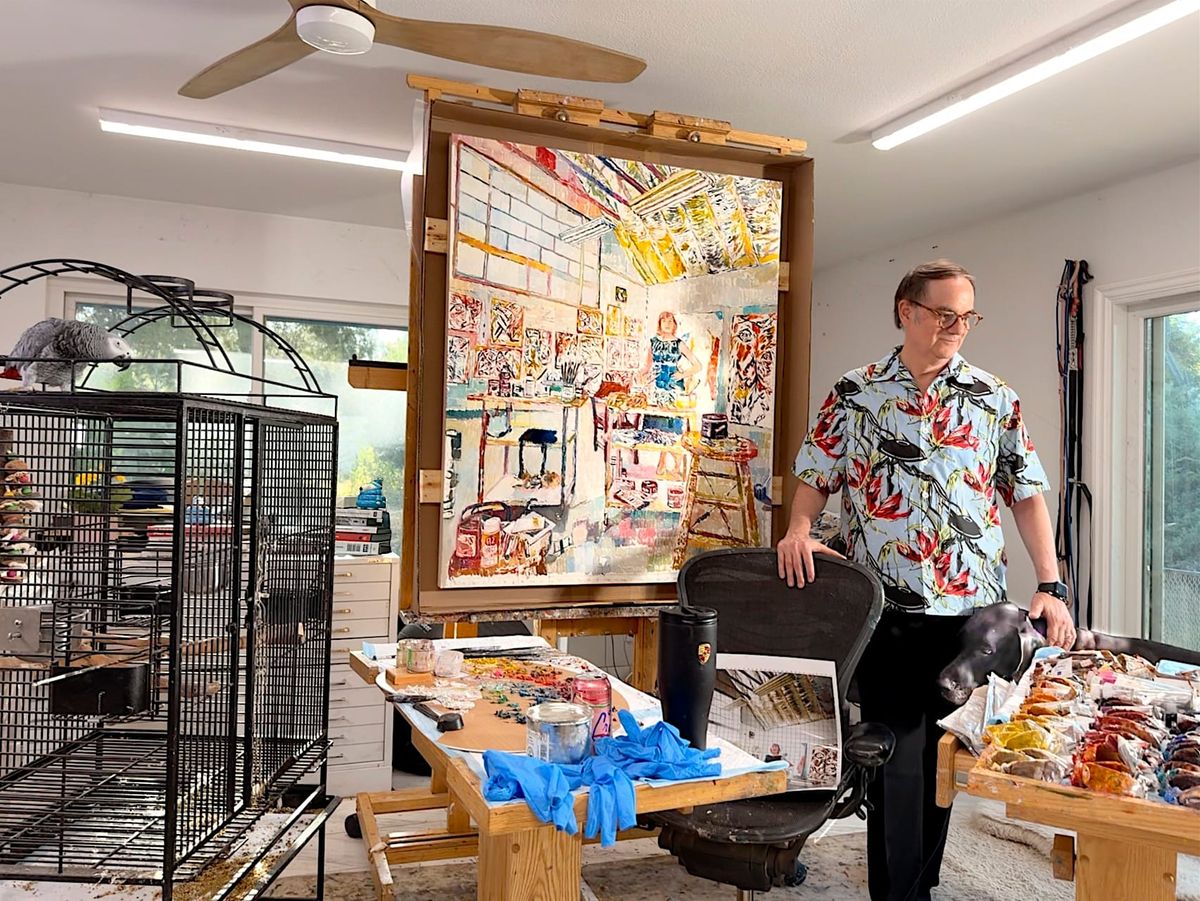
LOS ANGELES — Keith Mayerson drops into any conversation with intensity, referencing athletes, the Beach Boys, Roland Barthes, and Paul Cézanne in long breathless sentences. The Los Angeles-based artist is best known for his ongoing cosmology of paintings that make up the My American Dream series, often presented in “chapters” and drawing from a combination of his own photographs and found photography. Begun in the aftermath of 9/11, the paintings depict an omnivorous personal pantheon of heroes.
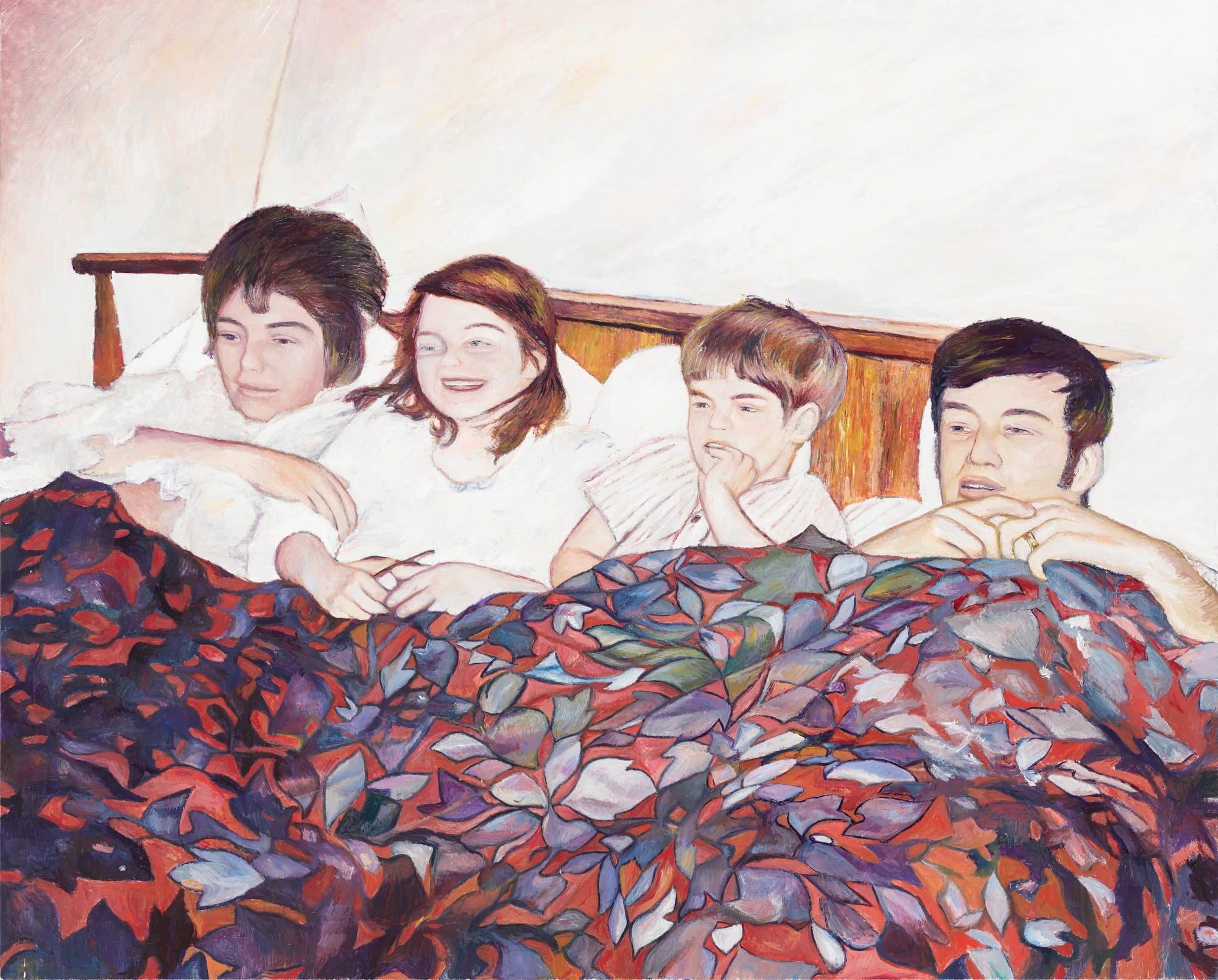
I recall his work in the 2014 Whitney Biennial: a salon-style, floor-to-ceiling corner installation at the Breuer building. Among the subjects were Martin Luther King Jr., Sitting Bull, Superman, Marvin Gaye, James Dean, Annie Oakley, Kermit the Frog, and Tintin, complete with a sparkling Castafiore emerald. Interspersed were a couple of abstractions, cityscapes of New York and Los Angeles, a view of Earth from outer space, and a double portrait of his husband and himself. “My Family,” (2013) showed his family of origin — Keith as a child with his sister, mother, and father — lying together under a patterned bedspread watching television. The patterns became a metaphor for interwoven networks of community and family.
Mayerson grew up near Denver, Colorado. He made his art-world debut with drawings from his thesis show, referencing comics and children's book illustrations, when they were presented in a group exhibition at the Drawing Center in New York. He also presented a queer Hamlet narrative in a salon-style installation at Derek Eller Gallery. Mayerson lived and worked in the city from the mid-1990s until 2016, when he moved full-time to Southern California.
Known for his figurative cosmology of American identity, activist history, and popular culture, Mayerson creates work distinguished by its humming, vibratory painting style: swirling, repeating brushmarks that pulse with life and feeling. These forms — which stand alone in what he calls his abstract “iconscapes” — provide an important counterpoint to the appropriated photographic sources he uses and his often acid-yellow underpainting. His work envisions an aspirational, enthusiastic now, as much as it speaks to a nostalgic, utopian past.
Mayerson was born in Cincinnati, Ohio, in 1966 and received a BA from Brown University and an MFA from the University of California (UC), Irvine. He lives in Riverside, California, and is a professor in the Roski School of Art and Architecture at the University of Southern California in Los Angeles. Two exhibitions of his work are currently on view: Keith Mayerson: My American Dream (Rocky Mountain High) at the Aspen Art Museum in Colorado and My American Dream: Capturing a Glimpse of Lee & Jackson, Elaine & Bill and Their Circle at the Pollock-Krasner House in East Hampton, New York.
Hyperallergic: I know you come from the cartooning world and grew up in Colorado. Can you tell me about early influences and exposure to art and artmaking?
Keith Mayerson: I grew up in the suburbs of Denver, Colorado, and I was fortunate to be able to spend the weekends in the mountains, skiing and hiking. My access to art as a kid was through comics. I was cartooning from kindergarten all the way through college. The books by Hunter S. Thompson, illustrated by cartoonist Ralph Steadman, were a huge influence on me — though I was too young to be reading them. I came of age at Red Rocks, and I was a tween Deadhead, the only gay Deadhead I knew.
The Muppets also affected me deeply. Jim Henson was a cultural creator who was working for the betterment of the world. Along with entertaining, he was educating in terms of promoting harmony between different people. As egocentric and wacky as the Muppets may be, they have compassion for one another and their community.
Charles Schulz is a total hero, for many of the same reasons. He was very spiritual, and he wanted to create a world where the different characters understood one another. There are the different archetypes: Linus, who was philosophical; Snoopy, representing a joie de vivre; and Charlie Brown, the everyman. Lucy and Peppermint Patty were strong female protagonists.

H: You studied at Brown University in Providence, Rhode Island, before coming to New York City. Can you tell me about that period of time?
KM: I was a semiotics and studio art major at Brown, thinking of being a New Yorker cartoonist. I also studied acting, playwriting, and directing. After school, I came to New York and started submitting 10 cartoons a week. One day, I brought a cartoon to Lee Lorenz, the art director and cartoon director at the New Yorker. I said, “You know, Mr. Lorenz, this is our silver anniversary. I just handed you my 100th cartoon, and thank you for your feedback.” He said, “Well, George Booth submitted 10 cartoons a week for 10 years before he got his first one in. I’m not saying it takes that many, but it helps!” I walked out with a heavy head, realizing being a cartoonist is just as hard as being a fine artist. I realized I was interested in bringing up aesthetic ideas, more than just making people laugh, so I decided to follow my interests and pursue fine art.
By then, I was working at the front desk at Robert Miller Gallery. They showed Lee Krasner, Joan Mitchell, Yayoi Kusama, Gilbert and George, and, importantly, Jean-Michel Basquiat and Robert Mapplethorpe, who were my heroes and had just died.

H: What was your experience like at the University of California, Irvine, where you got your MFA? I know the work from your thesis exhibition ended up traveling and being shown at galleries in San Francisco and New York. What was this early work about?
KM: I went back to school at UC Irvine, which was a great school. I had come out as a person, but I was still coming out intellectually. At UC Irvine in the early 1990s, the focus was on gender and identity politics, but there was also space for transcendence and beauty and feeling.
My thesis show was a project called Pinocchio the Big Fag. It was a series of drawings with a narrative — a parallel universe to the real Pinocchio. One of my professor’s friends was Rick Jacobsen, who was opening a gallery in San Francisco called Kiki, a tiny storefront space. My professor, Catherine Lord, had spoken about linear presentations being very straight, White, and patriarchal. So when I was invited to show the work at Kiki, I made it a big salon presentation, and have kept doing non-linear narrative installations ever since.

H: You also challenged the audience in early exhibitions when you showed abstractions alongside figurative work. Why did you decide to combine them? Can you talk about the significance of your abstract work?
KM: I had an early solo show at Jay Gorney, back when my mentor and teacher, Lari Pittman, was showing there. I showed paintings and drawings, mixing abstraction that I call “iconscapes” next to figurative paintings. By that time, I was appropriating different styles for content. I was reading the John Richardson biography of Picasso, and realizing that Picasso made a still life one day, a Cubist painting the next, and a portrait the next.
In the iconscapes, I wanted to get to the core of what was building the life of my paintings. I think there are sublimated icons in our unconscious. I wanted to try to bring them out in a more three-dimensional space.
Being the son of a psychoanalyst, I love the idea of Cézanne painting his landscapes of Mont Sainte-Victoire. I think about him, living on a trust fund, not focused on selling his paintings, hiking up the same hills to paint as he did with Émile Zola as a child and thinking, “I love my dad; I hate my dad; this painting is done; I’m on to my next one!” His subconscious was also mapping onto the landscapes. If you look at Cézanne’s paintings, in fragmented parts, you can find figures and even his face.
I think about the way that Brian Wilson, in his song “Caroline No,” makes a sound like a baby’s wail when he sings the word “cry.” The signified and signifier are fused together. With my iconscapes, I tried to get to the core. Like the Surrealist and Abstract Expressionist artists who desired to access and depict the unconscious, I wanted to rip the mask off the signifier and just deal with the signified.

H: How did you begin your project My American Dream, and how would you describe a project representing your personal heroes?
KM: My American Dream began after 9/11. I was living in New York and teaching at New York University (NYU) that morning. We all witnessed it and were in shock; obviously, it was deeply affecting. In the months that followed, I noticed some of my friends were making what I call “[George W.] Bush is Bad” paintings.
I began to realize that I wanted to make things that made me feel good — the positive aspects of life in our country. My husband, Andrew, is Latino and part Indigenous. I was thinking about our great civil rights leaders and heroes, cultural icons, as well as landscapes, family scenes, and environments. All of these helped shape our progressive political and cultural thinking. I was hoping that if I make work that brightens my spirit and elevates me, hopefully it will for the viewer, too. It is especially important right now, in this time when democracy is under threat. When I show the work, I think of it as one chapter in an ongoing narrative and collective whole.
H: One of your latest chapters is Rocky Mountain High, on view at the Aspen Art Museum. Does Aspen represent a homecoming for you?
KM: Aspen was sort of a Xanadu for us, growing up near Denver. It was expensive and far away. But there was something about the Aspen idea, which was a concept created by Elizabeth and Walter Paepcke, which we really felt. It was about mountain sports meeting philosophy and music, and the enrichment of the human and collective spirit.
I had taken photographs on the mountain during a blizzard, and was painting pictures that I thought were going to look like Caspar David Friedrichs. Because my mother had recently passed, I was listening to her favorite music, like Ella Fitzgerald. The paintings became light and heavenly. They felt like I was dancing with mom. Eyes and faces would appear in the skies, and I just let them be. When you're channeling those memories and spirits, something extra comes out.

H: You have also continued the project by representing the women of Abstract Expressionism in your current exhibition at the Pollock-Krasner House and your 2019 residency at the Elaine de Kooning House. Can you talk about the significance of Lee Krasner and Elaine de Kooning for you?
KM: I think the Abstract Expressionist movement was led by women. It would not have happened without Lee Krasner and Elaine de Kooning. They defied the conventions of the conservative times of the 1930s, ’40s, and ’50s. Lee Krasner was already a well-established artist before she met Pollock; she had been one of Hans Hofmann's best students. When it was totally uncool to do figurative painting, Elaine de Kooning was painting portraits of men. She called them her “gyroscope men.” She messed with their faces and painted their legs splayed open. They are vulnerable; she had power over their representation.
H: I heard you talk about the importance of love in painting during a panel discussion at Eric Firestone Gallery in New York, which made a big impression on me. How is love a central ingredient in your work?
KM: If you want to make a work that has a life of its own, love is an important component. When you have a meaningful connection with something that's ineffable, that is the secret sauce of alchemy. All of my images are like Proustian madeleines that send me into a reverie of meditation and mindfulness. Manet said that what painters have in our favor is memories. I think about Frankenstein’s monster. Sometimes, artists and creators make this thing that walks and talks and has a life of its own. I think that comes from love.
Jim Henson was able to alchemize Kermit, who's just a piece of cloth, with his hand sticking up its butt. Charles Schulz transcends into Snoopy to bring him to life. They were suturing into the avatar of these iconic characters. It spilled out into their creation, and gave it an amazing life that extends beyond themselves.
I am trying to humanize the people that I'm depicting. I think about marrying the cultural relevance of a Warhol with the qualities in Rembrandt’s portraits: empathy, compassion, warmth, and painterliness.

H: You published “The NeoIntegrity Manifesto,” an 11-point declaration on art, as part of the announcement for an exhibition you curated at Derek Eller Gallery in 2007. How does it connect to ideas about spirituality, which is also a theme running through your work?
KM: I wanted to invent an art movement called NeoIntegrity. I called my NYU seminar “NeoIntegrity: Icons and Iconography in Technocratic Commodity Culture.” In the manifesto, I wrote that a good work of art cannot be successfully reproduced or explained. That is ultimately the only reason why art is important in the age of corporate commodity culture. It has an aura that cannot be contained.
I teach the meditation of rendering for both comics and my fine art classes. I believe in the hand-mind connection when you're making art. Instead of skiing, which I did as a youth, I paint now. When you're skiing, you're thinking about the mechanics a little bit, but really you're in the meditation of rumination. You find your body just working. I like to go into that space.
I say to students, “Never let your pilot light go out.” For me, creating and making work enhances your spirit and what you're about. It is the pilot light that drives us. It's the battery operating in our engine. Making and experiencing art is the thing that keeps our spirits alive.