Beer With a Painter: Keltie Ferris
“I am playing with the building blocks of painting,” the artist told me at his studio in Woodstock, where he experiments with gestural compositions and monumental body prints.

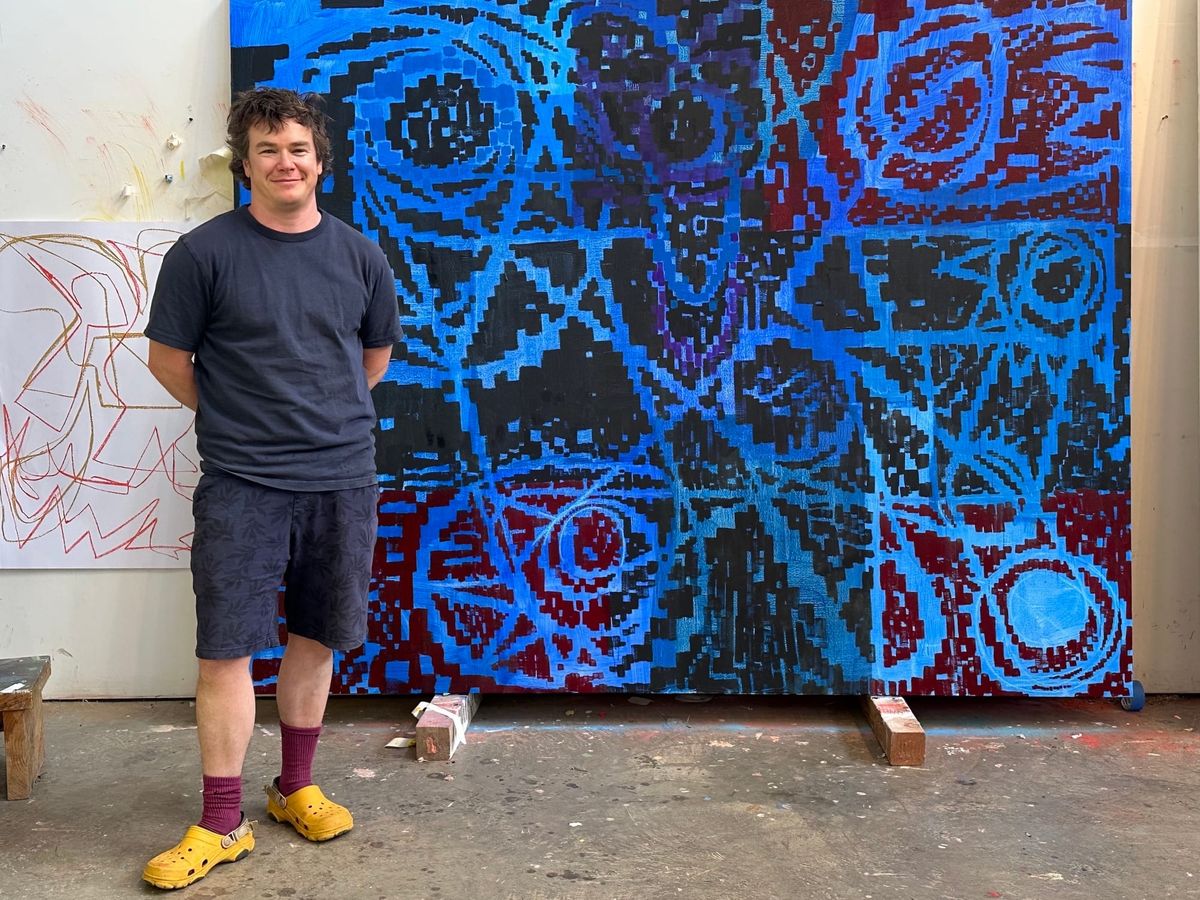
WOODSTOCK, New York — When I arrived at Keltie Ferris’s studio last month, he invited me first to see the home he shares with his wife and their child. “It’s important to situate yourself,” he says, allowing me a glimpse into the domestic side of his life, before we focus on the work. Then we walk back across the field toward the studio, and a loud scratching noise catches his attention. Ferris points toward a massive black bear clambering up the fence and out of his robust vegetable garden. It’s a dramatic, although not uncommon sighting in the Catskills, but it spikes my adrenaline level and reminds us that we are not alone. Ferris tells me, reassuringly, that they are gentle, shy creatures, as the bear disappears back into the woods.
Ferris’s abstract paintings are all about these contradictions. They teach us how to break down binaries by embodying both sides, literally and metaphorically: alone and together, presence and absence, hard and soft, opaque and transparent. Many paintings utilize a combination of multiple painting approaches — spray gun mists, direct brushwork, palette knife-carved hard edges, looping drawings in paint, and erasure with turpentine-soaked rags. They are simultaneously all-over paintings and grid-like, organized structures. The range of marks that Ferris uses, and his robust color, feels both urban and rural, digital and analog; historic and distinctly of our time.
In addition to his abstract paintings, Ferris makes prints by covering his clothed body with oil, pressing it against the paper, and then adding dry pigment that binds to the printed surface. These works, which Ferris began in the 2010s, were inspired initially by seeing Jasper Johns’s body prints. As indexical markers of presence, they have now subtly recorded Ferris’s gender transition.
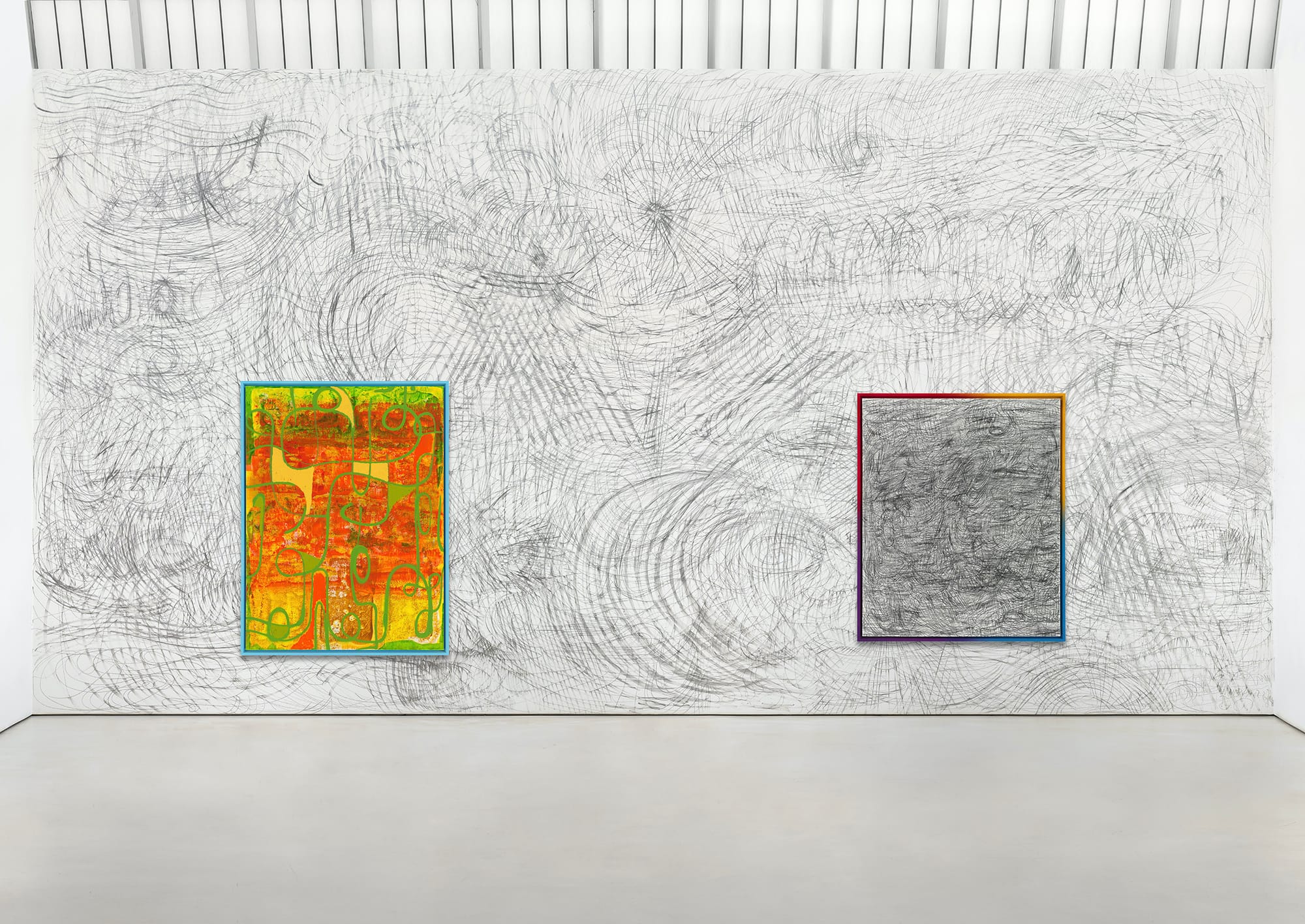
During the pandemic, I was struck by Ferris’s 2021 exhibition at Mitchell-Innes and Nash in New York, which included a monumental site-specific wall drawing, on top of which canvases were layered. Graphite drawings on canvas were presented in multi-colored artist frames, dissolving the boundaries between drawing and painting, between intense color and black and white. The exhibition became a singular magnanimous gesture, allowing us entry into the intimacy of his practice: intuitive, direct pencil marks on a large scale. Presented during the pandemic, when we were still wearing masks and socially distancing, it asserted the artist’s presence.
Keltie Ferris was born in 1977 in Louisville, Kentucky. He received a bachelor’s degree from Yale University, a BFA from the Nova Scotia College of Art and Design (NSCAD) in 2004, and his MFA from the Yale School of Art in 2006. After several years dividing his time between New York City and the Catskills, he now lives and works full-time in Woodstock, New York. In 2018, he was the subject of a survey exhibition at the Speed Museum of Art in Louisville, Kentucky.
Hyperallergic: You grew up in Louisville, Kentucky. Can you tell me about your exposure to art and artmaking during your childhood?
Keltie Ferris: There was not a ton of art to look at. There is the Speed Museum in Louisville, but mostly we just looked at books. I drew absentmindedly, but it wasn’t a serious thing. My brother and sister are both musicians, which I’ve realized over time has been a big influence.
When I was in middle school, my mother began to teach herself to paint. She became a landscape painter and showed her work in local venues. She would find communities of people who shared her interests in California Impressionism and the Canadian Group of Seven. She used “how-to” books, which were very prescriptive, and she would show us the work at dinner so we could critique it. She would ask us questions like whether the horizon line could be positioned at 60% from the bottom edge. There was an idea of formulas to unlock, to get the perfect painting. We would discuss these things. Sometimes we would watch art-making videos together, and I remember thinking, “I could never do this. This is so hard.”