Beer With a Painter: Samia Halaby
At her longtime studio in Tribeca, the Palestinian-American painter discussed her experimentation with color and how she “accidentally stepped into abstraction.”
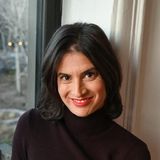
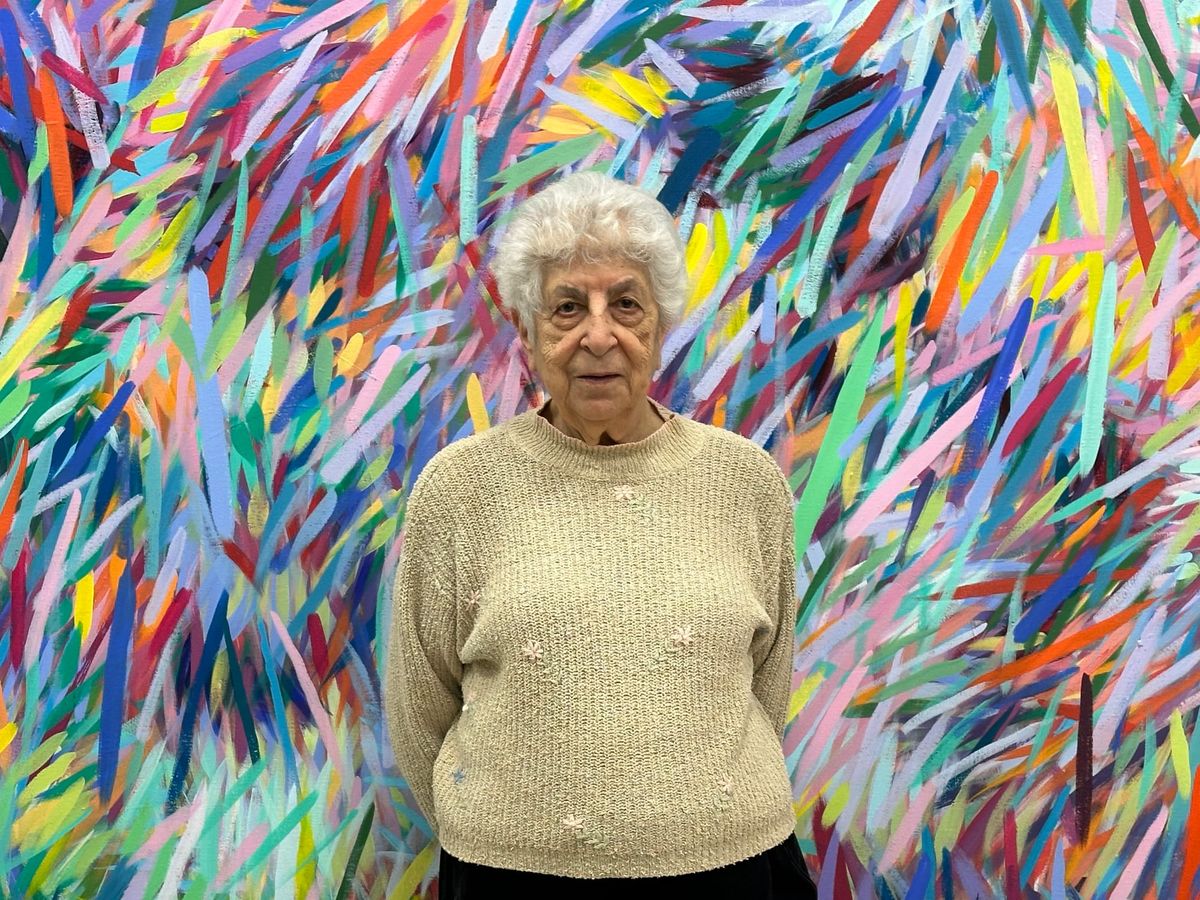
Over the past 70 years, pioneering abstract painter Samia Halaby has dedicated herself to examining how we see, how plants grow, how towns are organized, and how abstraction has developed across cultures. The Palestinian-American artist works, as she says, with “both eyes open, to glean principles from nature.” Her paintings are a reflection of this relentless investigation.
Halaby was born in Jerusalem in 1936 and lived as a child in Jaffa. During the Nakba of 1948, her family was among the hundreds of thousands of Palestinians displaced when the state of Israel was established. They lived in Beirut, Lebanon, for three years before moving to the United States in 1951. Halaby identifies with Marxist philosophy and reads art history through this lens; she has been organizing for causes concerning Palestinian rights, class, and race since the 1970s.
Her abstract paintings, which often reference medieval Arabic art and Palestinian culture, are characterized by their energy, movement, and optimism. Halaby expresses a vision of infinite space and growth, without barriers or boundaries. Vivid and intensely colored geometries overlap, and multiple textures collide. Over her decades-long career, Halaby’s paintings have evolved from constructed geometric still lifes to plotted helical forms with illusionistic metallic highlights to diagonal fields of color to kinetic, digital paintings, and back to pigment on canvas.
In 2024, her first museum survey exhibition was held at the Broad Art Museum of Michigan State University, East Lansing, and co-organized by the Eskenazi Museum of Art at Indiana University, Bloomington (where Halaby received her MA and MFA, respectively). However, Indiana University abruptly canceled its half of the show in what many consider a suppression of Palestinian voices. “If that were not their intention why not accept my offer to meet with them and clear matters?” Halaby told Hyperallergic at the time. “Why did they not speak up during the three long years of preparation?”
We met in her loft in Tribeca, Manhattan, where she has lived and worked since 1976. Like her paintings, it is a center of energy. Her kitchen backsplash is marked with squares of pure color — the wet paint from her brushes at the end of a work day (“less wasteful,” she tells me); her bedroom converts to an office space; and her studio is filled with new paintings in progress, paper drying racks, and her hanging acrylic-on-paper-maché sculptures. Over sage tea, we spoke about the history of dimensionality in art, abstractionist movements and their ties to social revolutions, and the development of her own work.
Halaby’s digital paintings are currently on view in the 2026 Whitney Biennial and were the subject of a 2026 exhibition at the San Francisco Museum of Modern Art. In 1972, Halaby became the first full-time female associate professor at the Yale School of Art, where she taught for a decade. She has also published three books: Liberation Art of Palestine (2002), Drawing the Kafr Qasem Massacre (2017), and Growing Shapes: Aesthetic Insights of an Abstract Painter (2017).
Hyperallergic: You were born in Jerusalem and your family moved to Jaffa when you were young, and then to Beirut. Did you have early experiences with art or art making that have stayed with you?
Samia Halaby: I was 11 when we left Palestine and 14 when we left Beirut, moving to the Midwest United States, to Cincinnati. In the Arab world as an adolescent, you don’t have much independence. However, I’ve discovered that the art of your ancestry comes to you somehow. Maybe it’s the way your mother sat on the sofa, the way she cooked, or the way your father talked to you. I don’t know how it happens, but it shows up.
My father had European paintings in the house. One painting represented the Biblical story of Lot and his wife, who was turned into a pillar of salt for looking back as they were fleeing. A column was in the large space between the background of houses and the two figures.
The art of the Arab world does not reside necessarily in paintings. It resides in carpets and inlaid marble and mother of pearl. I grew up Greek Orthodox. I wasn’t exposed to the art in the churches much, but when I saw it in adult life, I realized it was a pastiche of many different things. Muslim mosques, on the other hand, are harmonious, holistic, and very beautiful.

H: You have spoken about the influence of your experience studying at the University of Cincinnati from 1955 to ’59, particularly the discussions of Bauhaus principles. How did you arrive there, and what stands out to you about that time?
SH: My mother was the one who encouraged me to study art. But I wanted to be independent and earn my living, so I registered for design, not for painting.
My professors were a leftist, politically inclined group. They spoke about academic freedom. We had courses in materials, and Bauhaus principles were discussed. We studied the Munsell color system in depth and received demonstrations by a physics professor. He showed us how a sodium arc light emanating only yellow waves would create a black-and-white world, explained the physiology of the eye, and why autumn leaves looked more beautiful on the tree sharing their own reflected light. The teaching was something special: both practical and creative.
In 1959, I went to Michigan State University in East Lansing. At that time, we were supposed to be paying attention to these “heroic” visiting artists from New York. There was a lot of male chauvinism. It was not really education; it was about encouraging a certain attitude.
After a year of working in design, I decided to get an MFA to be able to teach painting at the university level. I went to Indiana University and studied with James McGarrell, and in my last year, with William Bailey, who later invited me to teach at Yale, which I did from 1972 to ’82. I wanted to be an abstract painter, and McGarrell was a painter of interiors. What I learned most there was from the art historians: Albert Elsen, who was teaching contemporary and 20th century, and Jack Wasserman, a Renaissance specialist.

H: How did you begin to explore working abstractly, and what were your inspirations?
SH: The earliest paintings in my late teens were figurative and the closest comparison I can make is to Indian art. They were contemplative and I represented myself from the back, facing remembered environments of my childhood.
Eventually, I stumbled onto something during my years at Michigan State University. I started using very heavy textures by scraping dry pigment from my palette and tried to make abstractions, like my painting “Lilac Bushes” (1960).
When I was teaching at the Kansas City Art Institute in the mid-1960s, I visited the museum [now the Nelson-Atkins], and saw the Petrus Christus painting “Virgin and Child in a Domestic Interior” (circa 1460–67). I noticed a beautifully shaded round volume, a fruit on the windowsill. It became a reason for me to run to the studio, excited to think about this sphere. I began to build geometric still life objects, collected bouncing balls, and composed a still life. I illuminated and painted from them. This was the beginning of my explorations of spheres.
H: How did your work evolve from there?
SH: After this, I shifted into working with graph paper, plotting shapes and volumes. I accidentally stepped into abstraction because the space stopped being measurable. You couldn’t tell if the volumes were small or huge. Is it the roundness of a rope, or a distant horizon, or an entire planet? In the early 1970s, I explored helices and reflectivity, using shading to create illusions of metallic surfaces.
This led to my Diagonal Flight series, with bands of color in graduated levels of light. I observed children playing and pretending to be airplanes. They usually favored their right side, which influenced my choice of diagonals leaning to the right. The painted space became air we might fly into. I felt that I had accomplished an aesthetic plan, inspired by Petrus Christus, that could continue in my work for the rest of my life. I tried my best to make it stay alive. I worked with diagonals and crosshatching, and there were interesting spatial effects, but I wasn’t moving forward. I was just making variations.

H: How did your Dome of the Rock series develop in the period that followed?
SH: In 1966, I had returned to Jerusalem, and my aunt took me to the Dome of the Rock. I was hypnotized by it. Suddenly I experienced the aesthetics of Islamic geometry, especially on the exterior panels that are about 11 feet tall. Medieval Arabic art is environmental, and this is misunderstood when we separate out panels and put them in museums. The calligraphy and the geometric abstraction are meant to be seen together.
In 1979 or ’80, I started my Dome of the Rock series, remembering my trip of 1966. The rectangle became the source of everything inside it. I was dividing the rectangle through the geometry emanating from the perimeter. The measurements were guided by the Fibonacci sequence, which has an Arab source. Then, I took guidance from inlaid marble. Each shape had a different texture. Slowly, things began to happen in 1980.
That’s when I left Yale. I was liberated. The best thing I got out of New Haven was the autumn leaves. My sketchbooks were loaded with cut and pressed leaves. I examined their structure, the way they dry, crumble, how they are eaten by worms, and what happens when rain hits them. I was asking myself how I could make something as beautiful as the leaf. I decided the leaf is beautiful because it grew. If I wanted the work to be as beautiful as the leaf, I had to grow the painting. Of course, I had no idea how to grow a painting. But it stayed in my mind, and I think now I am growing paintings.
H: Did the idea of growing paintings lead to the digital, coded paintings you made with the Commodore Amiga computer?
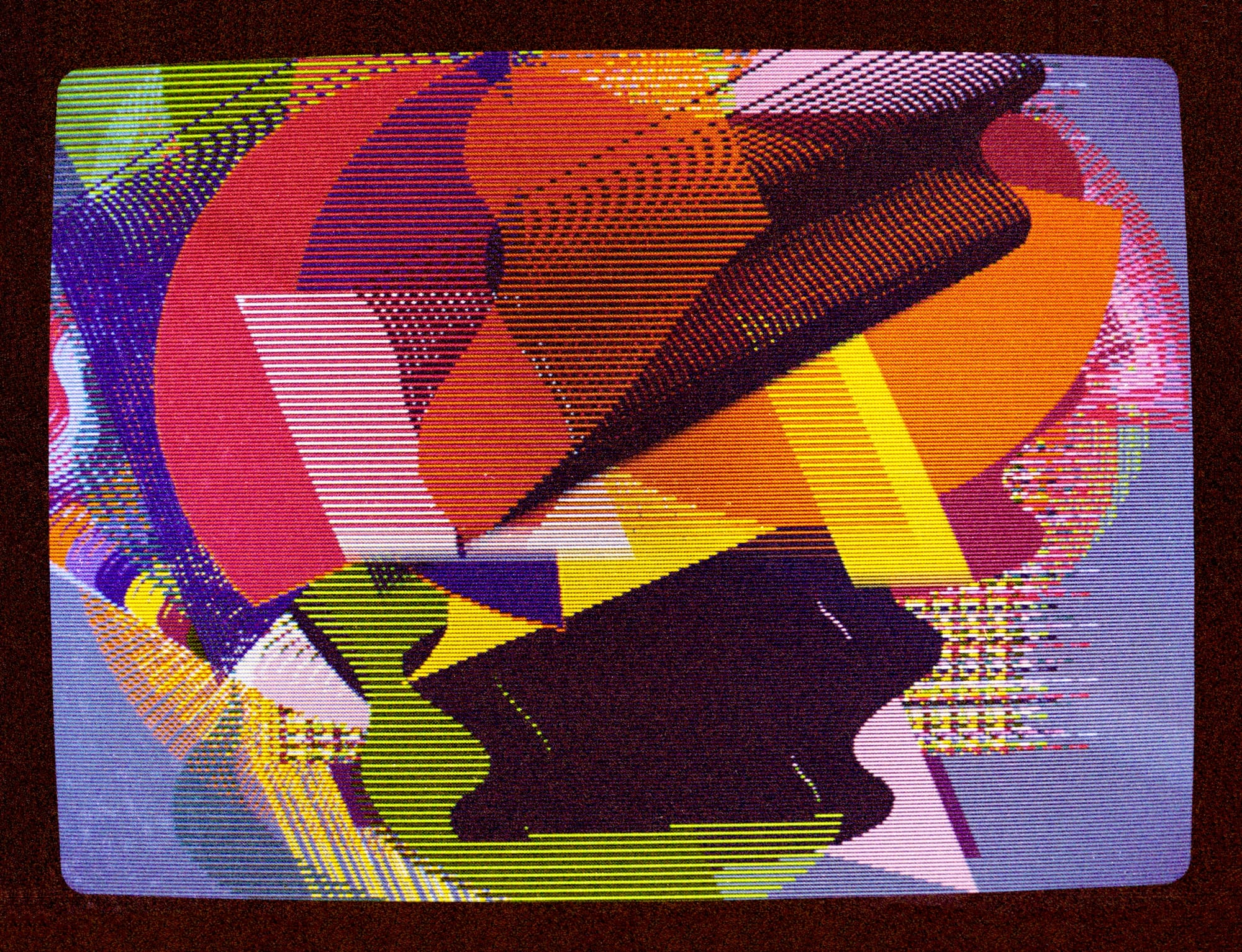
SH: I was always fascinated by computers, and I began thinking about how I could use the technology of our time. I went shopping and found an Amiga, and once I brought it home, I was lost in it. I was on it from morning until evening every day. I didn’t stop for anything. I had a friend who lived with me then, and he would fix dinner. I would eat and then go back to the computer. It was an immersive experience for about three years.
The computer is a machine, and we have to program it to execute. The minute I ran one command and saw it execute, I could feel something. I wanted to learn what the nature of the material was. This goes back to Bauhaus principles. It was almost instinctive. I did not want animation, even though the Amiga could do that. I only wanted to use the basic graphics commands. I wanted to play with geometry and motion. It was related to time-lapse photography. Things were growing and moving and overlapping.
I recognize that my coded paintings are a novelty. People are struck by the fact that they were made in 1986. Otherwise, I wouldn’t be in the Whitney Biennial. It’s not the age of painting, and I’m a painter. However, the digital pieces are paintings, paintings that move. They are material, not ghosts. They’re made of magnetized material, which is a technology that creates color.

H: There is a lot of new work in your studio. What are you working on and thinking about right now?
SH: I am analyzing a sketchbook and thinking about its relationship to my book, Growing Shapes: Aesthetic Insights of an Abstract Painter. It explores how abstraction is an imitation of reality. I describe shapes, lines, and paths of motion, and they are based on observing principles and algorithms in nature: generations of humanity, trees, days, and nights. I’m becoming more aware that this has permeated all of my work.
This is my primary investigation, and where I like to position myself. It’s a privilege; I choose to be on this explorative edge. I’m not interested in painting trees and houses and people, although I did make representational drawings for my book Drawing the Kafr Qasem Massacre. That project had a different goal.
What I am trying to do is work out of the languages of abstraction that developed during working-class revolutions in recent history, such as the Impressionists. People don’t think of it as working-class culture, but I do. The same is true of the Constructivists, the Supremacists, the Cubists, the Futurists, and the Abstract Expressionists. All of these abstractionists were building on something new in the language of pictures.

H: What is your relationship to that long tradition of making art during a revolution?
SH: When I see the work of Liubov Popova, I feel urgent rhythms. I want to run to the studio and work. There’s something in it that charges you. The lives of the Soviet artists come through. It must have been an incredible feeling to be at a place where society suddenly was moving in the same direction.
I’ve had rare opportunities to observe these revolutionary feelings. I was an observer from the outside when I interviewed the artists of the Intifada. I got a peek at it with the recent activism and student protests on college campuses. The young people were describing their experiences in amazing ways. They were so happy to be organizing with students who would normally be in different groups, from different backgrounds and areas. They were meeting one another and talking. That was another time when I heard the language and the attitudes of a future.
The revolutionary moments impact us as artists. I am part of the intelligentsia that follows the leadership of a revolutionary movement. I don’t cause it. I think anyone who says differently is misleading. I have chosen to place myself here, exploring an abstract language of the future. I do notice there are few other artists doing this, which is strange. In my study of art history, this usually happens at the time when things are changing, when there is a hopeful optimism about the future, or when there's a revolution. So, I am waiting for a revolution.