Can an Artwork Have Personhood?
Many of us yearn for intimate, almost human interactions with art objects. But the risks might outweigh the rewards.

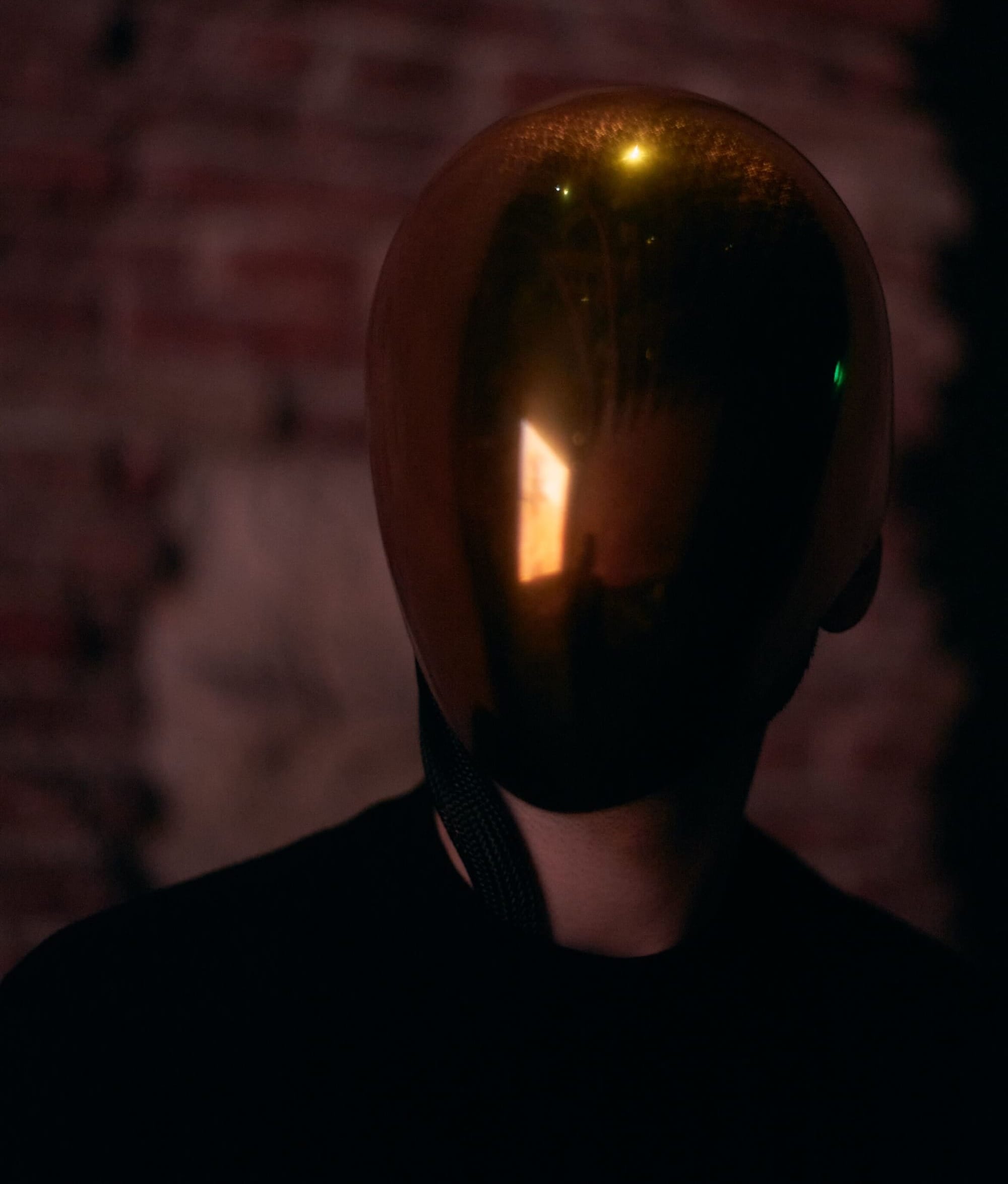
One luminous summer day in June, my daughter and I stepped into Pierre Huyghe’s exhibition Liminal (2024) at the Pinault Collection in Venice, Italy. It wasn’t easy to discern anything in the dim light. The ambiance was truly liminal. In the first gallery, we sidled up to a full-sized statue of a man with an eerie and smooth golden mask instead of a face.
“Wait, is that a real person?” my daughter asked. I dismissed her with a laugh and leaned in closer, snapping some pictures with my phone. Then, a guard startled us: “Step back from the performer.” Suddenly, we understood that we were not just in an art object’s domain. The “statue” was a human performer after all, one who stood absolutely still and silent even as we were snapping photos in their face. We had, rudely, entered a human being’s personal space. It left us with an uncanny shock.
Huyghe is part of a growing number of contemporary artists exploring the boundaries between the human and the nonhuman. His work, along with others, is featured in the New Museum’s spring opening, New Humans: Memories of the Future.
But sometimes these artists are exploring something else as well, as in Liminal. They are tracking differences between art and personhood — that is, the condition of being an individual person.
Discussions of personhood were mostly academic until the US Supreme Court’s notorious Citizens United (2010) decision extended free speech rights to corporations. It’s a decision that opened up a flood of dark money and a profound legal and ethical can of worms, in addition to the political damage it wrought. If corporations have human rights, why not fetuses, dolphins, lakes, or robots and AI? Each of these claims has been credibly advanced in the years since Citizens United, and all demand urgent attention.
In the meantime, artists have been exploring the limits of personhood for nonhumans by including human beings, other animals, and AI in their art. Huyghe’s other work incorporates monkeys with masks and a hermit crab creeping along the bottom of an aquarium with a Brancusi-like shell. Nina Katchadourian’s early bioart pieces, Quit Using Us (2002) and GIFT/GIFT (1998), feature caterpillars and spiders as unwitting and antagonistic collaborators.
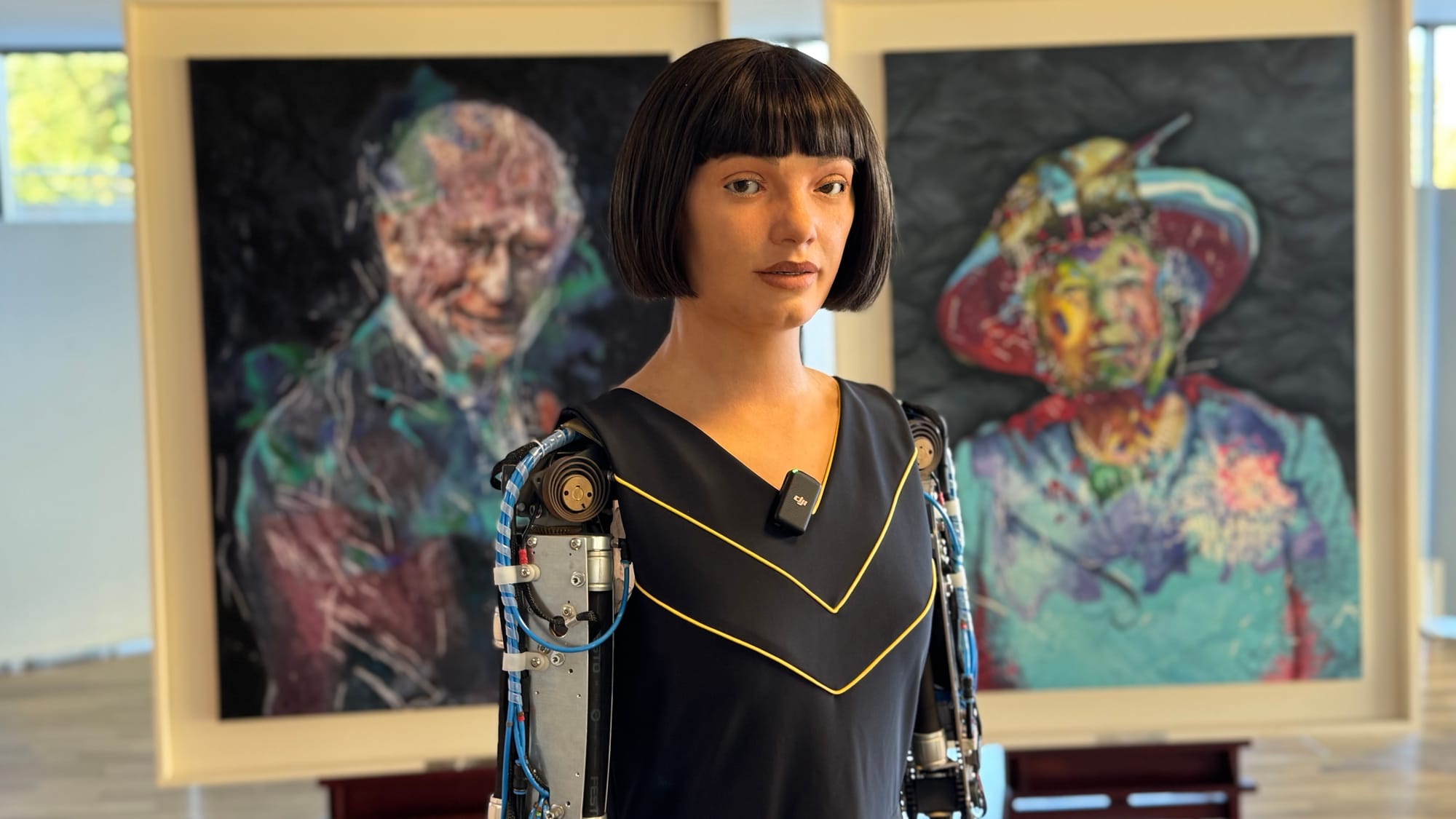
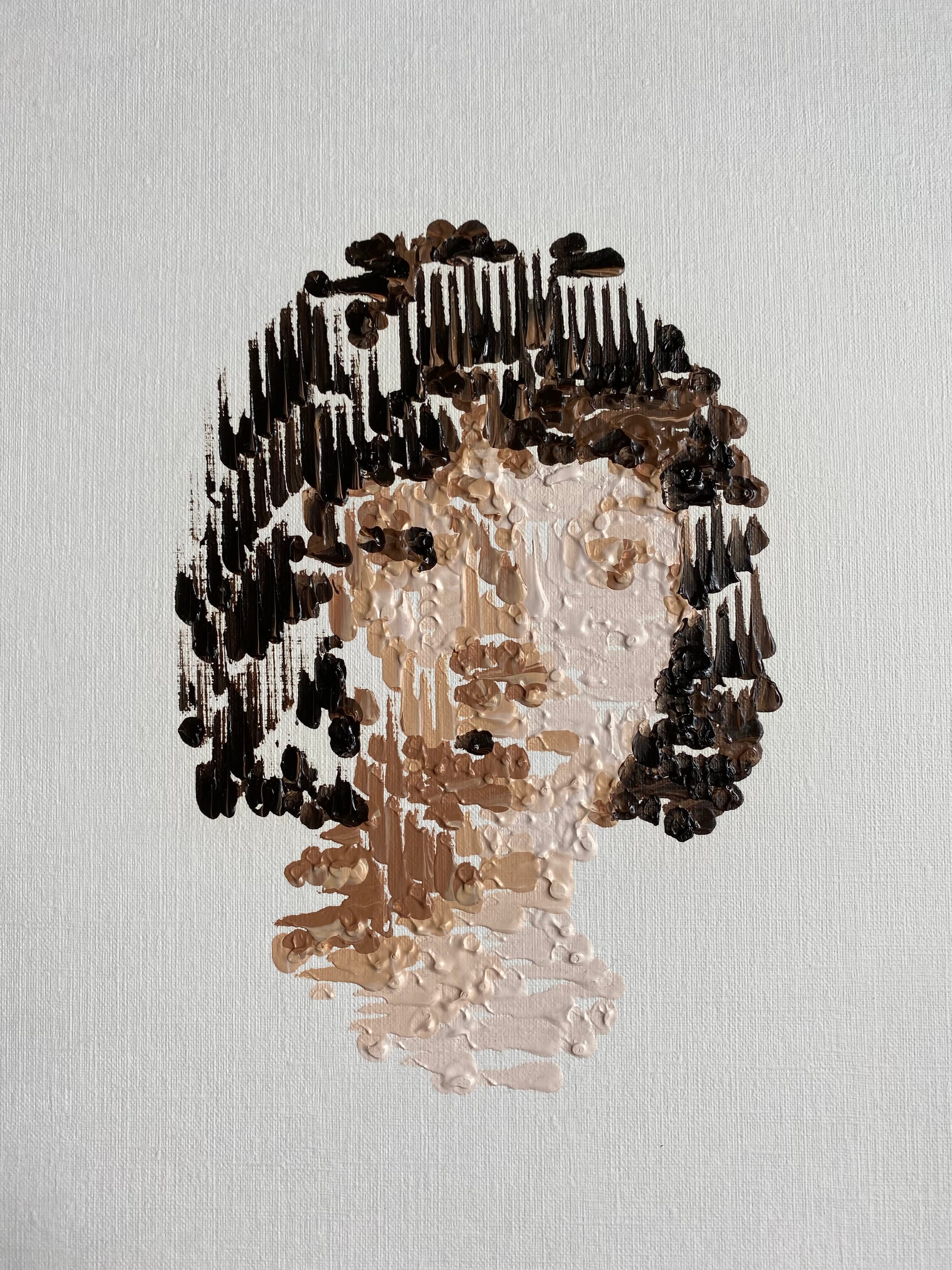
And sometimes the creation creates art. Ai-Da, a so-called social robot devised and financed by Aidan Meller and Lucy Seal, and built by Engineered Arts, is touted as painting self-portraits while dressed in Bohemian smocks and overalls. The machine’s algorithmic creations have been the subject of art shows and PR blitzes. In 2024, Sotheby’s sold one of the machine’s portraits of Alan Turing, titled “AI God,” for $1.1 million. Ai-Da is clearly costumed, presented, and marketed as if “she” were a real person.
Such anthropomorphism lurks everywhere. Marge Monko’s I don’t know you so I can’t love you (2018) eavesdrops on two smart assistant devices in “a romantic conversation.” Listening to Monko’s devices apparently chatting with one another, it’s hard not to project humanity onto their voices. “Have you ever been ghosted?” one asks the other. “Yes, I am right now,” the other answers. We keep listening to learn more about their relationship. Or what appears to be one.
Works like Monko’s require us to face how difficult it is not to assume that our own version of personhood would matter to an insect, animal, or AI. In fact, for these creatures or machines, whatever we mean by personhood would likely be completely irrelevant to them. We use personifying language, like writing that Ai-Da “paints self-portraits,” or that two electronic devices are “conversing romantically.” But these machines don’t have the capacity to reflect on themselves, think, or talk. They also don’t have selves to fall in love or a social context for being ghosted.
How exactly do these artworks play with the limits of personhood? I think one way is by relying on something fundamental about art. It is the reason my daughter and I stepped up to that statue/performer in Venice. We wanted to figure out what the artwork was doing, what it meant. Peering closer, thinking about it, feeling surprised when we learned what we were really looking at: We engaged with the artwork directly, bodily, and assuming that it was trying to say something to us.
In the 1960s, the philosopher Stanley Cavell pondered why people were so bothered by art that might be dismissed as fraudulent (as in, “my toddler could do that Pollock”). His answer was that in some sense we “treat certain objects” — namely, art objects — “in ways normally reserved for treating persons.”
By that, Cavell meant that we care and are deeply concerned about art objects. “We treat them in special ways, invest them with a value which normal people otherwise reserve only for other people,” he wrote. We trust that they are intended to mean something to us.
For art critic Michael Fried, this sensual and psychological engagement with art has a hidden danger. It could be abused by bad actors. As he famously wrote in “Art and Objecthood” (1967), the art of Tony Smith, Dan Flavin, and Donald Judd derive their problematic power from a hidden anthropomorphism that undermines its meaning as an artwork.
For Fried, Minimalist art objects leave us with the impression that they possess an inner secret life. They are like people we might get to know and have a duty to acknowledge. But, quite obviously, these art objects are not actually people requiring moral consideration. They are more like surrogate persons. Unlike modernist art objects, Fried argues, Minimalist art objects confront the beholder and refuse to leave her alone, commanding her to acknowledge their presence rather than allow her to engage with the work on her own terms.
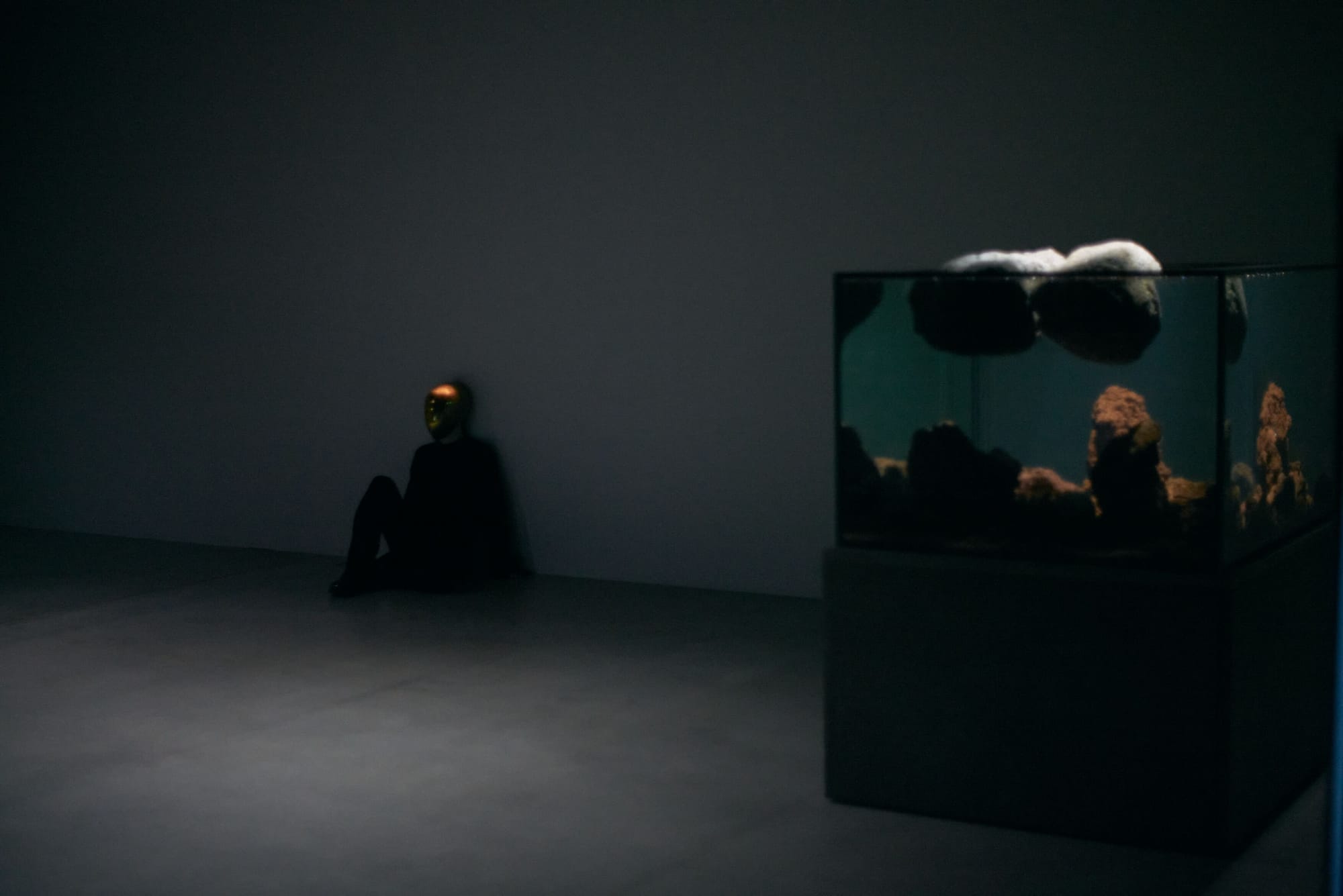
It is this tricky bait-and-switch, this surrogate personhood that we are seeing now, in the context of the past decades’ conversations about corporate personhood. The best of this new art helps us to see the problems with expanding personhood to nonpersons, while also recognizing the temptations and moments of uncanny beauty, as with Huyghe’s Liminal. These artists show us that expanding personhood to objects, even to brilliant works of art, is not a reciprocal relationship.
An AI painting God, or two machines “talking” with one another. Both seem like human-like engagements that we must pay attention to. But what responsibilities do these machines, in their “painting” or “romantic chatting,” have to us?
My new book, The Problem of Personhood: Giving Rights to Trees, Corporations, and Robots (2026), looks at all the new ways activists have claimed (with varying degrees of success), that fetuses, elephants, lakes, and robots should be protected as legal persons. I show why it might sometimes be tempting, but it’s misguided to think that giving legal personhood to nonhumans will solve moral or political problems such as controversies over abortion, the suffering of zoo animals, or climate devastation.
In the end, expanding personhood to nonhumans makes matters worse. It hurts all of us by creating many more subjects of moral consideration, without corresponding duties to follow rules or consider others — often because nonhumans don’t have the capacity to do those things. In some ways, that isn’t so surprising considering where these arguments emerged from in the first place: corporate personhood. But corporations, machines, and AI have no responsibility to make our societies more livable for human beings and all living creatures. That responsibility remains ours.