Every Dog Has Its Artist

A compassionate new book explores how canine companions across Western art history break down the emotional boundaries between species.

Every Dog Has Its Artist
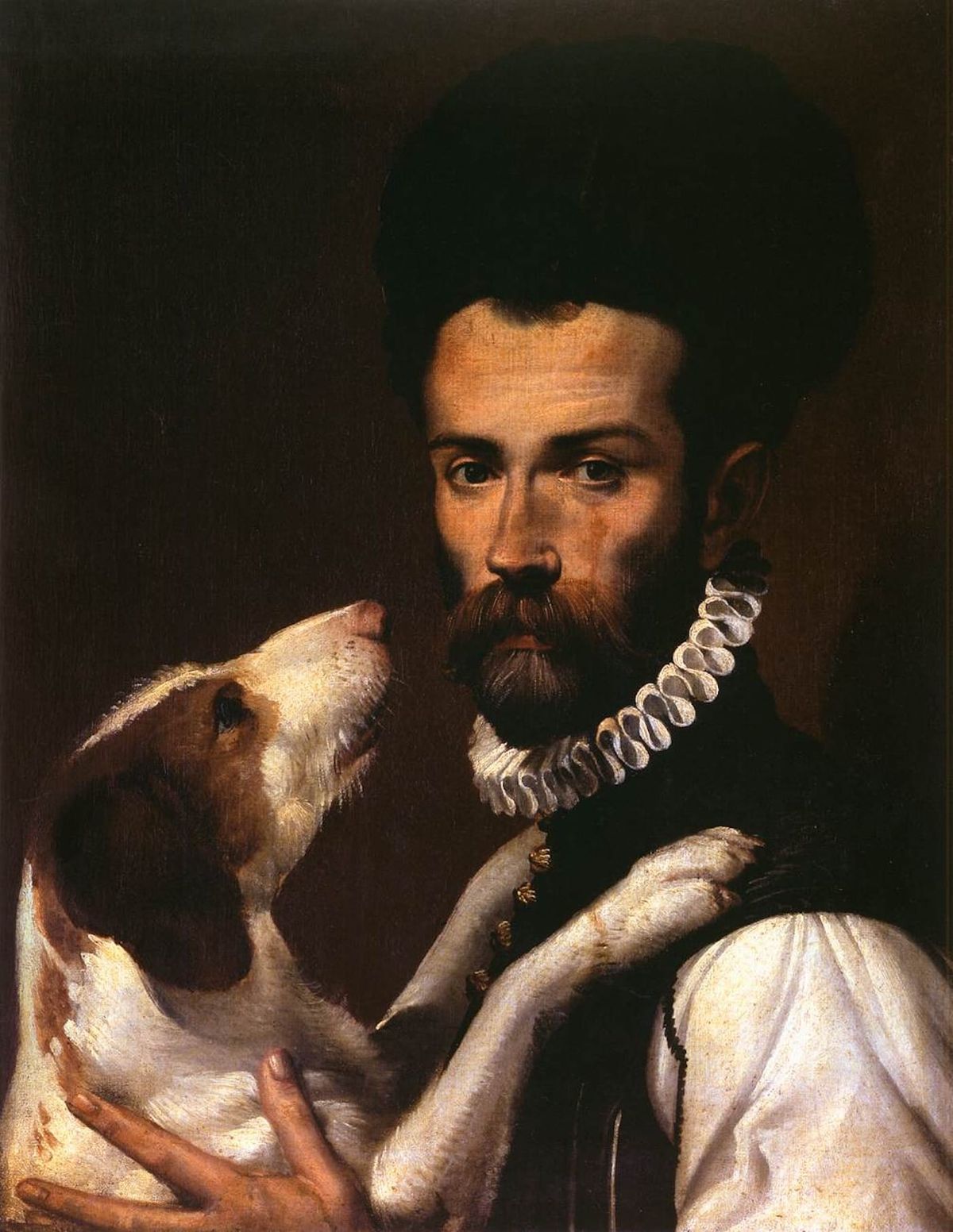
Bartolomeo Passarotti, "Portrait of a Man with a Dog" (1585–87), oil on canvas (image public domain United States via Wikimedia Commons)

About two months ago, footage of trembling beagles imprisoned at a biomedical research facility in Wisconsin, and of the tear-gassed activists who tried to rescue them, went viral. Photojournalists captured the dogs huddled together. They look into the cameras. They look at us — the humans who put them there. 

It feels dreadful to return the gaze, to acknowledge the intense pain one species can cause another. Yet, it is essential to do so, as Thomas W. Laqueur argues in a new book. 

The Dog's Gaze: A Visual History (2026) offers an expansive, accessible survey of canine presence in Western art from the Palaeolithic period onward. Brilliant, full-color reproductions of 250 artworks fill the book's pages as evidence of what Laqueur terms an "aesthetics of sociability." A dog, he contends, is an "animal that, because it sees with us, is uniquely gifted at breaching the bounds of species in art and perhaps also in life."
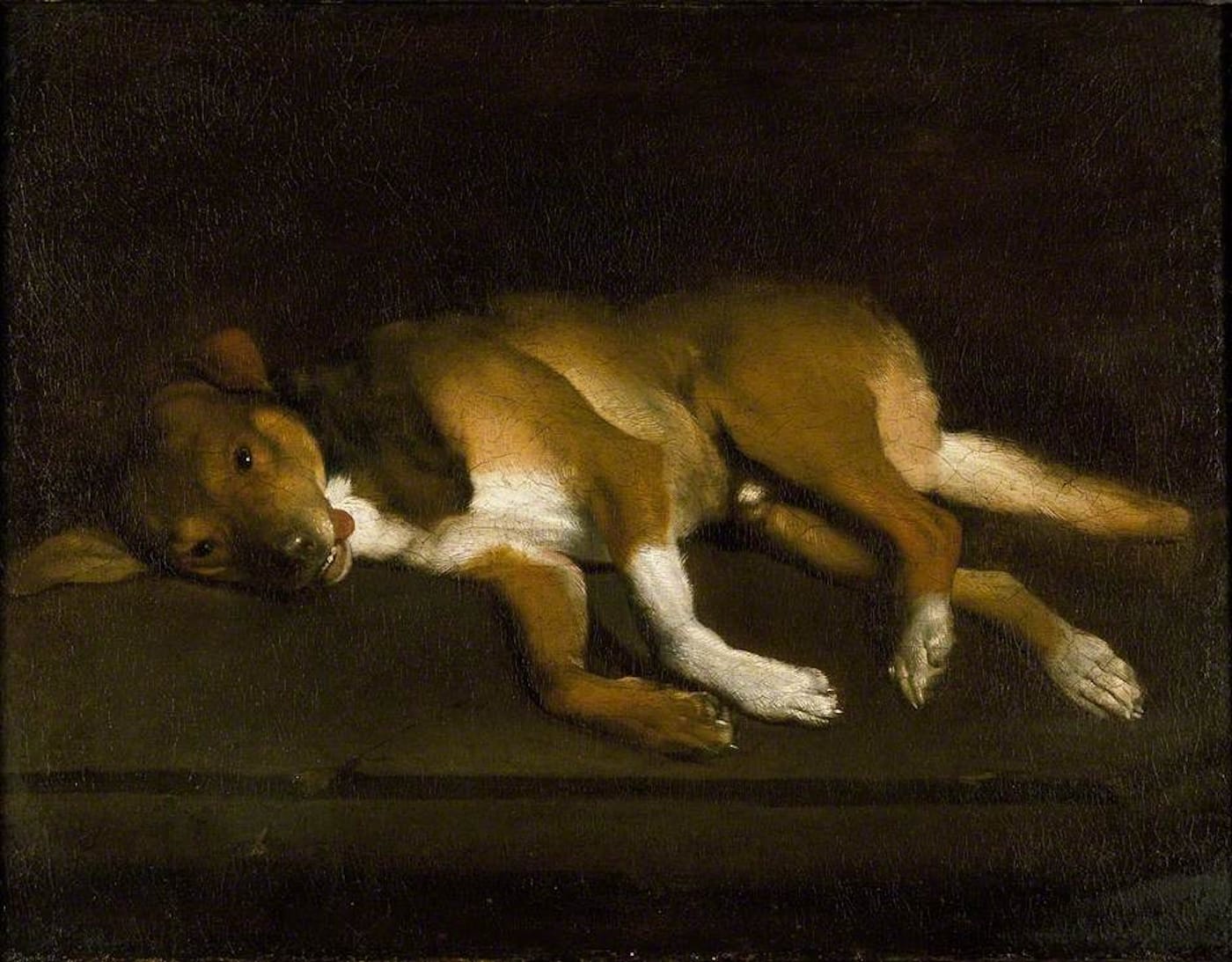
Unrecorded artist in Genoa, Italy, "A Dog lying on a Ledge" (c. 1650–80) (image public domain CC0 via Wikimedia Commons)

What might have been a straightforward, iconographic survey takes on a second, equally important role: It is a guidebook to understanding dogs as embedded figures in visual culture across time.

Laqueur applies his thesis to concerns of both form and content. Dogs across Vittore Carpaccio's oeuvre tend to establish structural axes of vision, as with the adorable, scruffy puppy in “St. Augustine in His Study” (1501–1505). In Edwin Landseer's tender painting “The Old Shepherd's Chief Mourner” (1837) and Antonio da Correggio's depiction of a kidnapping in Greek mythology in “Ganymede Abducted by the Eagle” (1531–32), a dog serves as the sole witness to a human’s suffering. Pierre-Auguste Renoir records a sociological milestone in “Madame Georges Charpentier and Her Children” (1878), with a reluctant but patient Border Collie acting as a chair for one of its human siblings: the moment when dogs became fundamental members of the familial unit, rather than mere pets.


Pierre-Auguste Renoir, "Madame Georges Charpentier (Marguerite-Louise Lemonnier, 1848–1904) and Her Children, Georgette-Berthe (1872–1945) and Paul-Emile-Charles (1875–1895)" (1878), oil on canvas (image public domain CC0 via the Metropolitan Museum of Art)

But The Dog's Gaze is not an animal-rights treatise, nor does it claim to be. Only a single section of a single chapter addresses the Wisconsin beagles' predecessors and the horrific imagery mobilized by 19th-century organizers in service of the anti-vivisection movement. Even that is done with a historian's (mostly) impartial eye. 

Throughout the book, in fact, Laqueur gives us the impression that he is restraining his scholarship from an "overly sentimentalized" approach. He distances himself from a painter like Landseer, for instance, when he argues that the latter's portrayal of dogs descends "into bathos from the purer heights of its more august predecessors.”

Gustave Caillebotte, "Richard Gallo and His Dog at Petit Gennevilliers" (1884), oil on canvas (image public domain CC0 via Wikimedia Commons)
"St. Augustine in His Study by Vittore Carpaccio" (1502) (image public domain CC0 via Wikimedia Commons)

Laqueur ventures into Landseer territory, though, when his lived relationships with dogs come to the forefront. The same analysis that he applies to a Picasso or a van Gogh, he applies to a commissioned photograph of his grandfather with his Doberman in 1920s Germany. Or to a digital photograph of his own dog, a Weimaraner named Rudi, asleep in his office — curled up like the skeletal dog in Albrecht Dürer's “Melencolia I” (1514) — as he, outside the frame, writes The Dog's Gaze

The outcome of Laqueur's scholarship is, in the end, a declaration of care and love for another species. Canis familiaris. And what's wrong with a little sentimentality? It's not ideal that we must see dogs as "humans in fur" (as he describes Landseer's dogs) to sympathize with them. But it's a start. Perhaps the "over-sentimentalization" of our relationships with dogs is exactly what we need right now, in art and in life.

Franz Marc, "Dog Lying in the Snow" (c. 1911), oil on canvas (image public domain CC0 via the Städel Museum)

The Dog's Gaze: A Visual History (2026) by Thomas W. Laqueur is published by Penguin Press and available online and through independent booksellers.