The 18th C. Food Pornographer at LACMA
Two weeks ago, I found myself in Los Angeles with an afternoon to kill. I ventured to the Los Angeles County Museum of Art and stumbled across a small exhibition by 18th C. Spanish still life painter Luis Meléndez. The exhibition, titled "Master of the Spanish Still Life," was a quaint two-room show

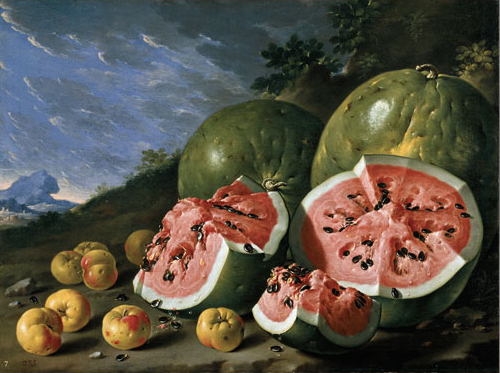
Two weeks ago, I found myself in Los Angeles with an afternoon to kill. I ventured to the Los Angeles County Museum of Art and stumbled across a small exhibition by 18th C. Spanish still life painter Luis Meléndez. The exhibition, titled “Master of the Spanish Still Life,” was a quaint two-room show decked out with bizarre gray stucco walls treated with a ragging technique that made it look like a display at a suburban home furnishings shop. Faux finishes aside, what immediately struck me as I perused the canvases were two works in particular that I would characterize as Rococo food porn — they were pretty hot.
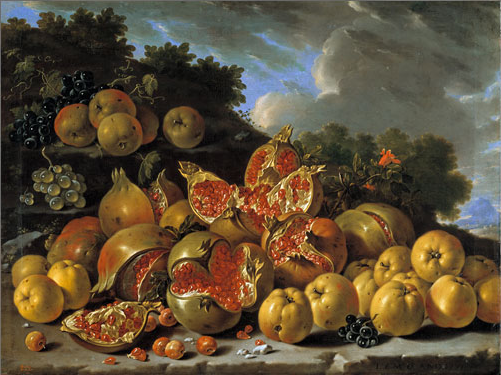
If Meléndez’s early works are awash with earth tones in homey settings his world drastically changes with an important Royal commission that allows him to explore the sensuality of fruit (I never thought I’d ever type that line).
This sexed up series began in 1771 and was created for the Prince of Asturias. In the canvases, Meléndez renders watermelons and pomegranates with eye-popping eroticism in outdoor settings. Droplets of water slide down cut watermelons and pomegranates split open to reveal suggestive openings. This is what a Bacchanalia looks like … with fruit (I swear I don’t have a fruit fetish). This man knows how to make fruit glisten in the same way that Playboy knows how to spritz their models for a “wet look.”
The Royal commission was a central event in the painter’s life but it was cancelled in 1776. After this fruity lovefest, the world of Meléndez shifts forever and his late works display a stiffened sense of artifice that was never there before — good things never last.
For those interested in the work of Meléndez, there’s an excellent online presentation of the exhibition on the National Gallery of Art website from which I’ve pulled this sad finale to his life:
Unfortunately, the [Royal] series was abruptly cancelled around Christmas 1776, and no paintings by the artist were signed and dated after that time. In June 1780, ill in bed, Meléndez declared himself a pauper and died the next month.
My guess is he died from a lack of fruit.
The exhibition was organized by the National Gallery in Washington, DC, and will close in Los Angeles on January 3, 2010, and then travel to Boston’s Museum of Fine Arts, where it will be on display from January 31 to May 9, 2010.