Genuflecting Before “Don Colossus”
Trump's new golden statue in Miami has been compared to the Golden Calf, but it's more akin to a Moloch idol.

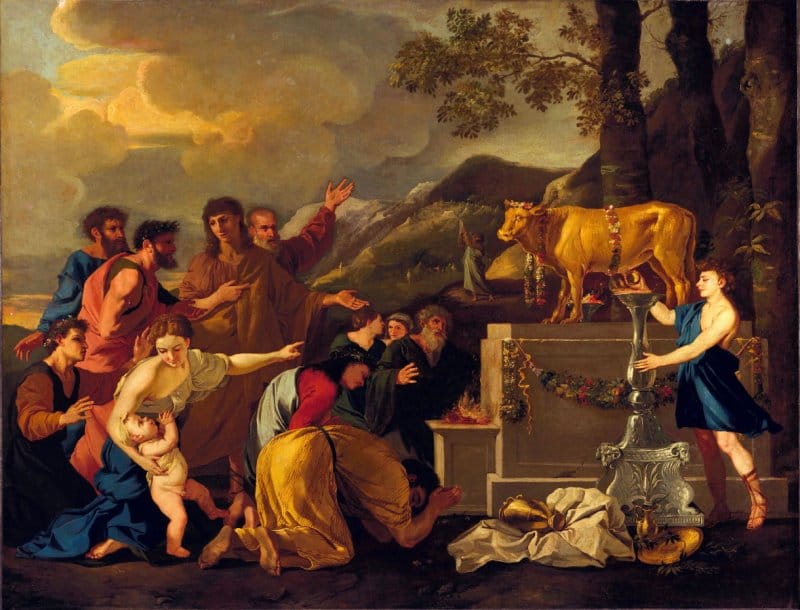
The Book of Exodus is unequivocal on the matter. During Moses’s 40-day-and-40-night sojourn atop Mount Sinai, wherein the prophet would receive the Ten Commandments from the Lord, the anxious Hebrews abandoned in the desert melted down their gold and fashioned a calf to whom they’d offer hosannas. Dancing about the idol, burning incense and offerings, the multitude praised not God, but rather this crude, wanton, and ostentatious object of their own crafting.
Dead in eye and dumb of ear, the Golden Calf diverted the Hebrews from genuine worship; a deadening of the ethical imperative that had guided their liberation from bondage in Egypt. Castigating their stiff-necked impudence, God tells Moses in Exodus 32:8 (the King James Version) that they “have turned aside quickly out of the way which I commanded them: they have made a molten calf, and have worshiped it.” Threatening to kill them all, Moses convinces the Lord to honor His end of the covenant, though the Hebrews have broken their own. Yet when the prophet returned to the encampment, he threw down the tablets of the law in a rage, demanding that the calf be immolated and the gold dust mixed in water be imbibed by all those who were guilty. “Oh, this people have sinned a great sin,” laments Moses in Exodus 31:32, “and have made them gods of gold.”
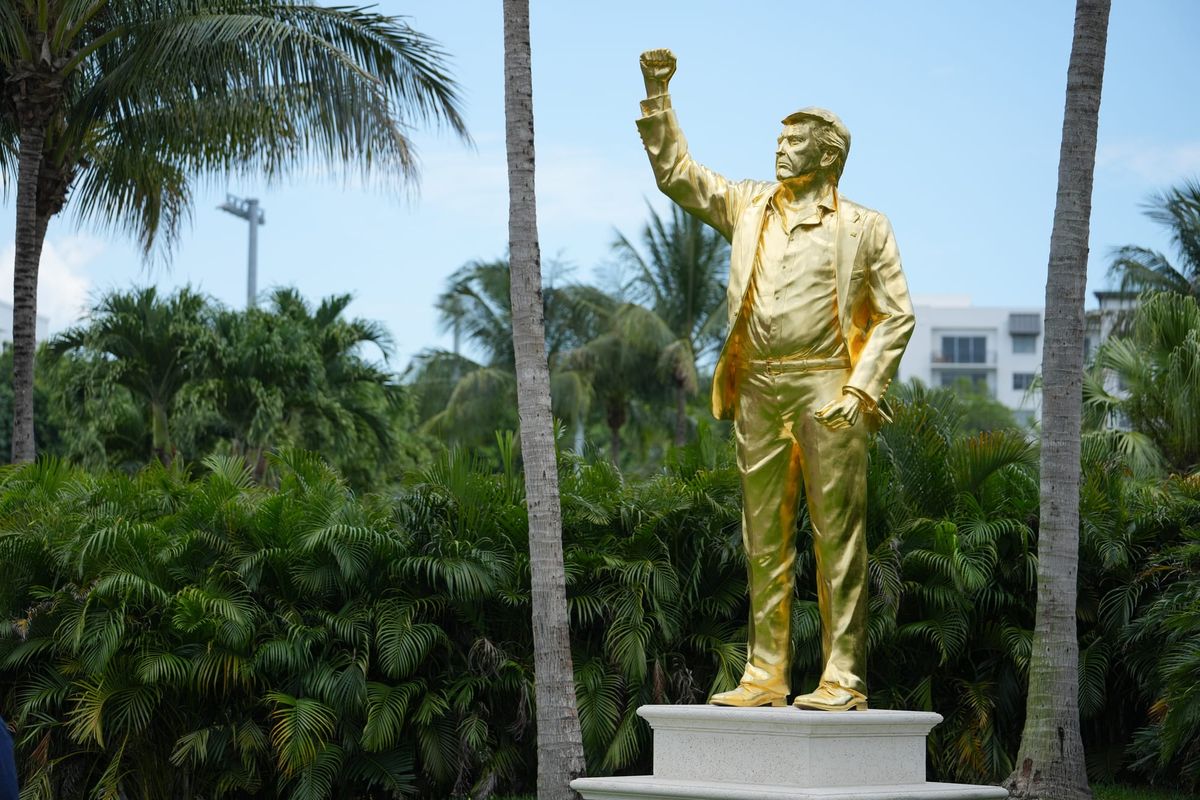
A rather different tack was taken when televangelist Mark Burns posted on X last Thursday that a 15-foot-tall bronze statue (22 feet with the pedestal) of Donald Trump at his golf course in Miami, gold-leafed and raising a triumphant fist, was “not a golden calf.” I mean, if you have to clarify…
When it came to the benediction of “Don Colossus” — the absurd piece’s actual name — with $450,000 raised by cryptocurrency moguls and sculpted by Alan Cottrill (who, before a change of profession, had built a fortune as the founder of the restaurant chain Four Star Pizza), Trump’s blasphemy is at least ecumenical.
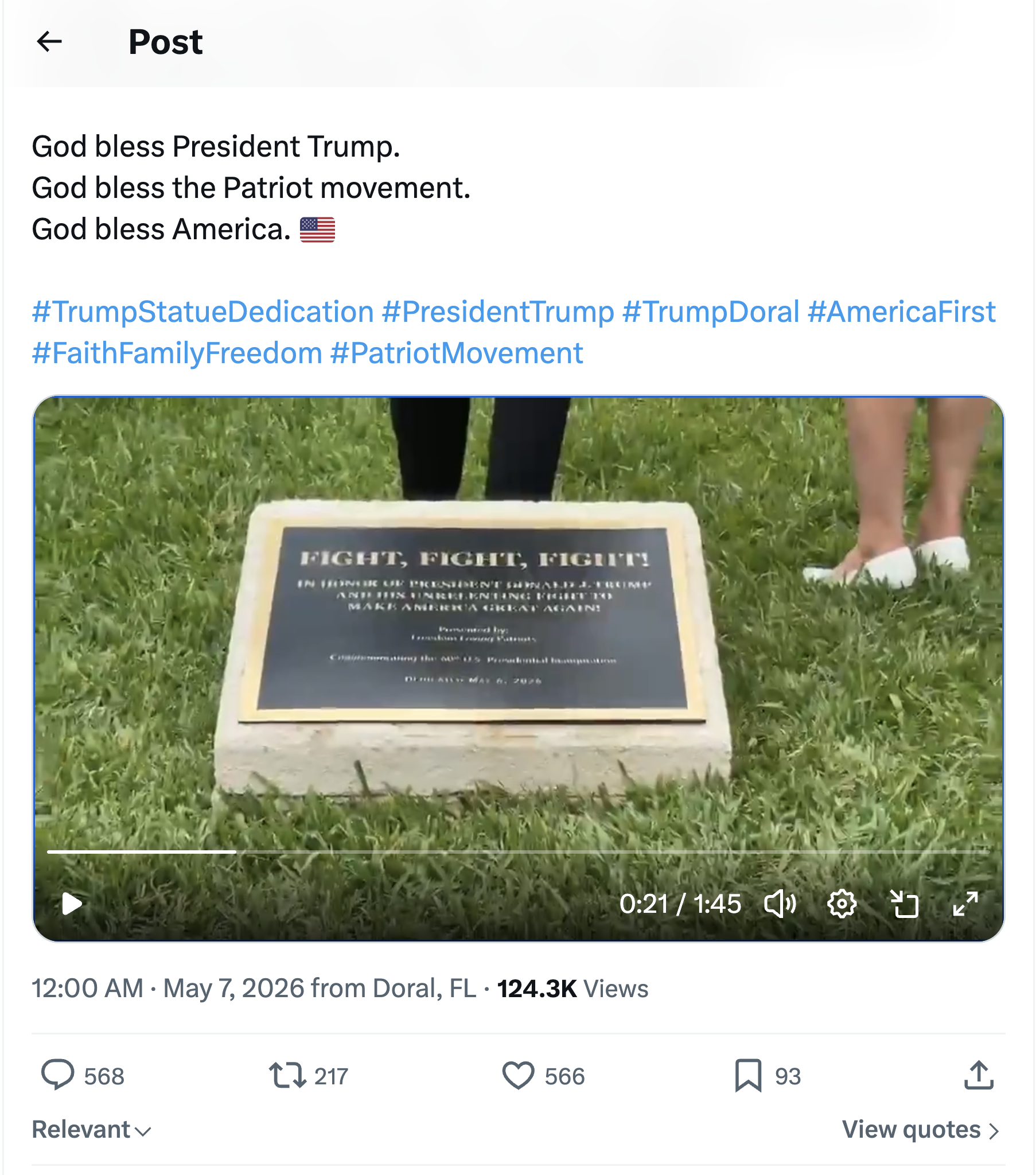
Unveiled in anticipation of the G20 summit, which is to be held at the golf course later this year, were not just a bevy of evangelical Christian leaders, but, according to some observers, a few Hassidic rabbis as well. Nonetheless, Burns (who is a leader in "Pastors for Trump") acted as the central organizer of the event, described by The Independent as believing that the president was “divinely appointed.” Such a brazen — almost comically obvious — act of sacrilege is merely the latest in Trump’s increasingly heretical pronouncements. On Easter Sunday, the president took to his Truth Social platform to threaten the entire nation of Iran with presumed nuclear obliteration, ending his missive with a sarcastic “Praise be to Allah.” A few weeks later, on Orthodox Easter, he shared an AI-generated image of himself as Jesus Christ, later claiming that he thought it was of himself as a doctor, an explanation even his own supporters notably didn’t believe. That same morning, he continued an ongoing series of attacks on Pope Leo XIV, which culminated this weekend when Southern Baptist leader Robert Jeffress claimed that the president understood the Bible better than the first American pontiff. Presumably, Trump’s bedrock evangelical supporters care little for offending Catholics, especially as even the conservative core of the American bishops has increasingly shown support for the beleaguered Pope as he defends Trump’s victims, but the obvious idolatry of a golden “calf” didn’t seem insurmountable for Pastor Burns.
Were this simply a bronze statue of Trump, I suspect that the criticism wouldn’t take the specific form that it has; the president’s envy of autocratic leaders who use their faces as civic decoration is already well known. Whether putting his face on currency, passports, or banners outside of the State Department, Trump appears to enjoy emulating Saddam Hussein or Kim Jong Un. Dismissing such objections, Burns is quoted in Newsweek as claiming that the statue was merely a “moment of gratitude, honor, and remembrance,” as well as a symbol of “resilience,” “patriotism,” and “courage,” while countering the claim that this was an exercise in idolatry with the fact that there are numerous monuments to presidents and other political figures throughout the United States. Ignoring the disingenuousness of that assertion, whereby the Lincoln Memorial wasn’t installed as tribute at the 16th president’s private golf course, and the fact that the vast majority of these memorials were installed long after their subjects were already dead and thus fit to be memorialized, all of that tacky gold-leaf emblazoned about Cottril’s statue puts the issue into a glowing perspective. Far from just being the material that Trump sartorially most prefers (even if his gilding comes from a spray-paint can), sociologist Gerardo Marti writes in his Substack that “Across religious traditions, gold signals the sacred,” whether in the foil delicately framing the halos of a saint in an Orthodox icon or the metal coating a Mahayana Buddha. As such, he writes, gold “marks what is set apart, worthy of contemplation, and beyond the ordinary. A bronze figure in business attire [… ] would be an ordinary monument. Covered in gold leaf and publicly consecrated by an evangelical pastor, it becomes something else.”
The Abrahamic religions all have a complicated relationship to the role of imagery in worship. Among the iconoclastic Jews and Muslims, depictions of human beings, or of divine figures, are to varying degrees regarded as respectively Avodah Zarah or Shirk, as in the worship of foreign, alien, and false gods. Christianity has historically had a laxer attitude towards divine imagery, though the Orthodox (perhaps inspired by Islam) had their own iconoclastic movement in the 8th and 9th centuries, ultimately interpreting “graven” to specifically mean that which is sculpted while developing a subtle theological explanation concerning the devotional use of icons. Roman Catholics, who, unlike their Eastern brethren, did not list the prohibition on imagery as a separate commandment but rather folded it into the second, tended towards a richer permissiveness regarding representation in worship, which was shared by Lutherans, though more radical Protestants during the Reformation could adhere to a fairly strict iconoclasm which rivaled that of Islam. While there were any number of disagreements and schisms between religions, denominations, and sects over the proper role of imagery, the defense of representational art always adhered to a justification that an object wasn’t worshiped but was rather an aid (sometimes even an intercessory one) in prayer and devotion. A notable similarity was that what worshipers used in devotion was explicitly intended to represent the sacred rather than the profane. What agreed-upon instances of idolatry in both the Biblical and historical record evidence isn’t merely the presence of representation, but genuflection specifically before power.
In The Forbidden Image: An Intellectual History of Iconoclasm (2009), Alain Besançon explains how much of Jewish and early Christian wariness surrounded the cult worship of the emperor, a clear example of idolatry. He writes that an imperial theology was constructed during the early Common Era, with the emperor becoming a “delegate of the supreme God […] the ‘living law’.” This is the context of “Don Colossus,” a shoddy statue sculpted by a pizza magnate that scarcely deserves to be called “art,” much less “sacred.” Augustus, Commodus, Caligula, Domitian, and Nero reveled in seeing their gilded faces staring out from Roman coins, on triumphal arches, and celebrated within the Pantheon. Nero, notably, was credibly the inspiration for the figure of the Antichrist as alluded to (though not specifically mentioned) in the biblical book of Revelation, his desire for genuflection configuring him — and those who kneeled before him — as being in opposition to Christ. There are any number of almost comically obvious signs that somebody could use to identify Trump as the Antichrist — his “boastful” mouth (Rev. 13:5), the “Mark of the Beast” on followers’ foreheads in the form of the MAGA hat (Rev. 13:16), a seemingly miraculously healed head wound (Rev. 13:3). That Trump, the most powerful man on earth, so abundantly fulfills these kinds of prophecies has a dark irony about it in that after decades of bloviating about the Antichrist so many evangelical leaders should veritably worship him; that when the Devil came to earth, they bought (an upside down) Bible from him.
Personally, I don’t believe in a literal Antichrist that Trump — or anyone else — could actually be, but if not the Antichrist, then Trump is certainly anti-Christian, not least of all evidenced by the abject idolatry that he so clearly glories in. If there is idolatry in anything, it’s in the worship of avarice, cruelty, and power, which Trump abundantly exhibits (with some satisfaction, Cottrill himself has predictably not been paid yet for his work).
There is something easy and dangerous in indulging the “No True Scotsman Fallacy” as concerns the pastors who saw fit to dedicate “Don Colossus”, a way of obscuring the beam in all of our eyes. At the same time, perhaps it is worth considering whether or not the Trumpist turn in evangelicalism doesn’t signify the emergence of a beastly new faith which rejects that which the gospels preach.
“MAGA is essentially a religious movement,” writes French historian Joël E. Schnapp at the blog of George Washington University’s Institute for European, Russian, and Eurasian Studies. Schnapp describes how a “mutation of MAGA in the direction of a […] religion would hardly be surprising,” citing the emergence of “ritual practice,” to which we could include the bizarre ceremony that blessed a tacky idol on a golf course. If such a religion is emerging, it’s hardly a new one, simply the same faith that saw Romans kneel before Augustus of Prima Porta. The Egyptians regarded their Pharaohs as gods. The Hebrews violated their liberation from bondage by dancing in front of an idol that recalled the bulls worshiped by the Canaanites, Samarians, and Mycenaeans. Idolatry always focuses on devotion to power, but that can also contain a darker impulse to pray towards cruelty as well. In that regard, “Don Colossus” recalls not just the Golden Calf, but another bovine idol worshiped by the ancient Carthaginians.
“There was in their city a bronze image,” writes the Greek historian Diodorus Siculus of the Carthaginians in his first-century BCE Library of History, “extending its hands, palms up and sloping towards the ground, so that each of the children when placed thereon rolled down and fell into a sort of gaping fit pilled with fire.” As a site of child sacrifice, the idol of the god Moloch was dedicated to cruelty and death. After the 1.2 million Americans who died by COVID, the tens of thousands of Gazans killed by Israel, the thousands of Iranians murdered in an illegal US-Israeli war, and the nearly 750,000 deaths that are predicted to have occurred due to DODGE’s gleeful cutting of USAID, with an additional 14 million (four million under the age of five) predicted by 2030, the Moloch idol is perhaps a more apt comparison to the Trump statue than the Golden Calf.
All civil authorities have blood on their hands, as indeed so do all presidents (though obviously more so some than others), which is precisely why there is such a vociferous condemnation of kneeling before them. In “Don Colossus,” we simply see the reemergence of a perennial dark faith which in ascribing divinity to one small man denies humanity to the rest of us.