How the Children’s Art Carnival in Harlem Nurtured Generations

Nearly six decades since its founding, the legacy of the beloved program is explored in an exhibition at Columbia University’s Wallach Art Gallery.

How the Children’s Art Carnival in Harlem Nurtured Generations
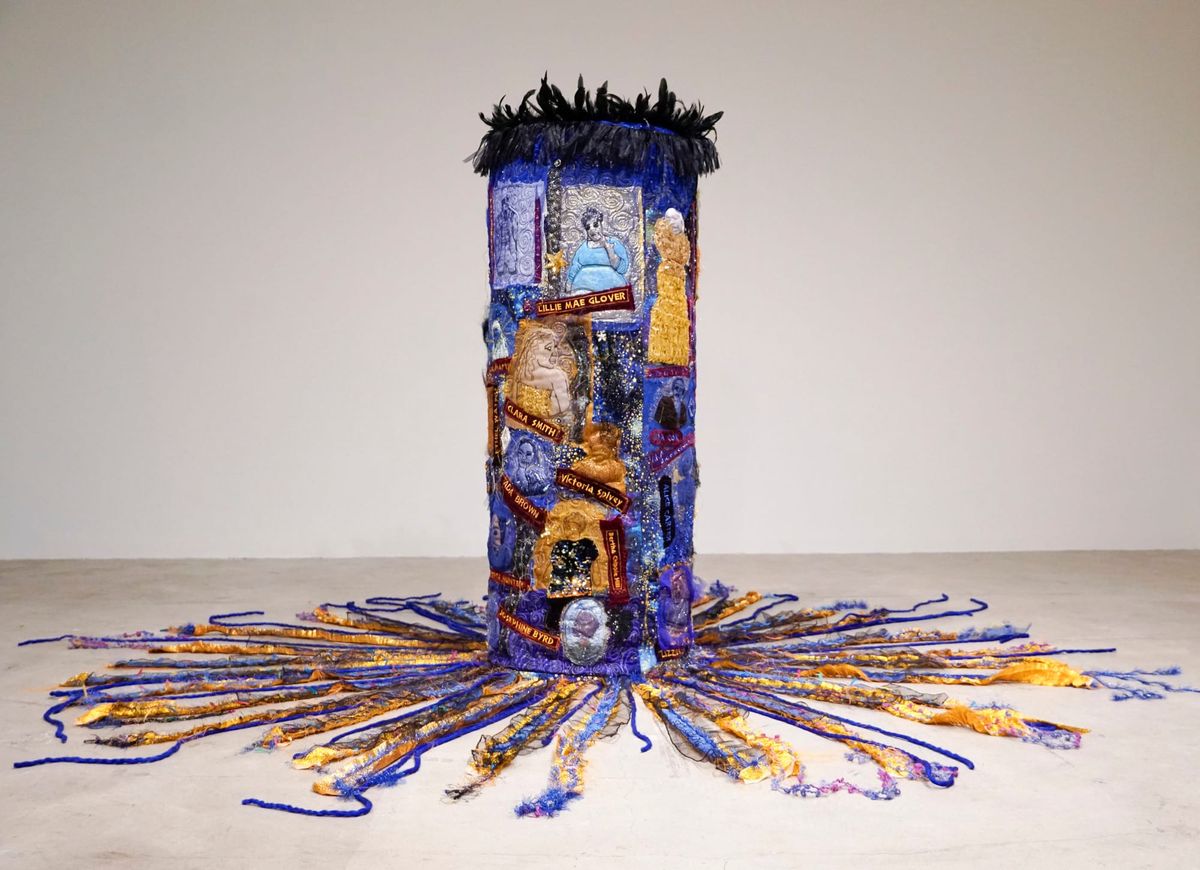
Dindga McCannon's "Blues Queens" (2021) is included in Children’s Art Carnival in Harlem: The Making of Contemporary Artists at Columbia University’s Wallach Art Gallery. (courtesy the artist and Fridman Gallery)

In March 1969, at the first-ever Children’s Art Carnival in Harlem, artist, activist, and educator Betty Blayton-Taylor looked on as groups of children painted at easels and strung objects together to make hanging sculptures. Held in a garage provided by the Harlem School of the Arts, the event engaged artists to conduct workshops for local kids. “Children can just as well use their energy to be creative as destructive,” Blayton-Taylor told the New York Times in a 1969 interview. “They’re having fun and that’s what we want.” 

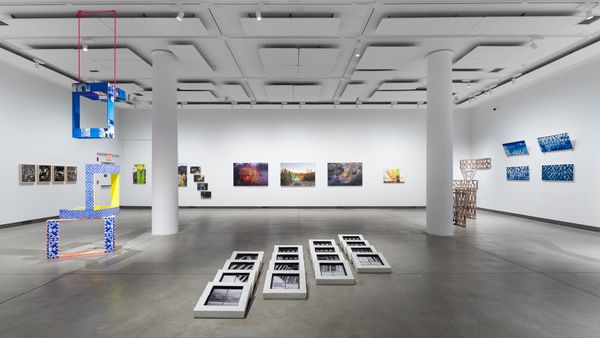
Nearly six decades later, the legacy forged by Blayton-Taylor as the carnival’s co-founder and executive director is now on view in an exhibition at Columbia University’s Wallach Art Gallery. Organized by independent curator Souleo, Children’s Art Carnival in Harlem: The Making of Contemporary Artists doubles as the fourth edition of the Uptown Triennial, which showcases the work of artists from Harlem, El Barrio, Washington Heights, and other Upper Manhattan neighborhoods.
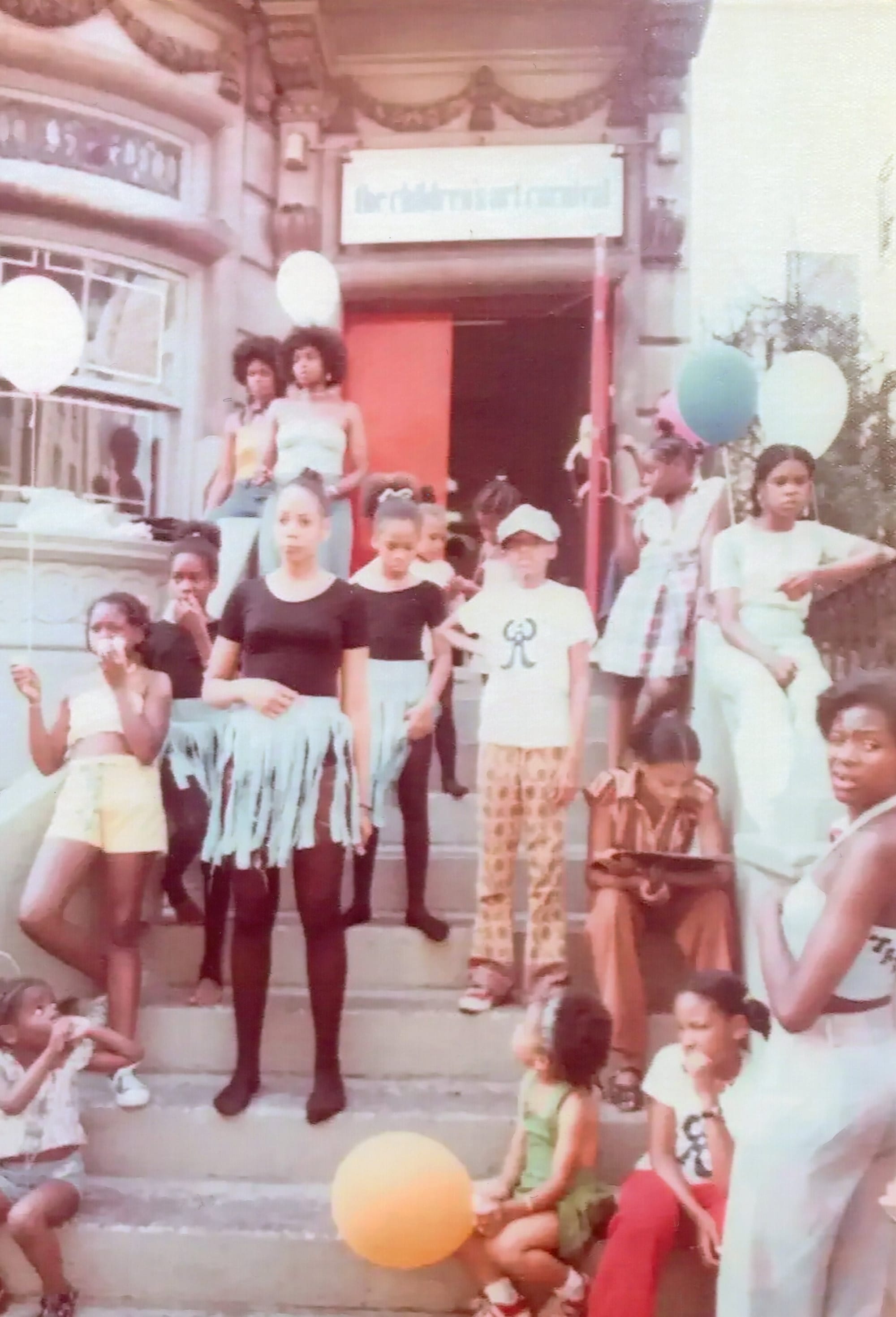
Young participants on the front steps of the Children’s Art Carnival in Harlem (photo unknown, courtesy the Children’s Art Carnival)

Blayton-Taylor’s brother, Oscar Blayton, first suggested the idea for an exhibition about the carnival to Souleo in 2023. “Betty [Blayton-Taylor] always wanted the art educators and the art students that did well to get recognition,” Blayton said to Hyperallergic.

While Souleo was already familiar with Blayton-Taylor’s work and had even curated a show of her art in 2017, he said that he developed a much deeper appreciation for the carnival while conducting research and interviewing artists for the current exhibition. In addition to recounting the carnival’s history, the curator wanted to foreground its impact on generations of artists who participated as instructors, students, or staff. 

The exhibition is anchored around the idea that art can nurture a child's creativity, and that the teaching artist, in turn, can benefit from engaging with a child’s imagination. On opening night, Donna M. Jones, co-chair of the carnival’s board of trustees, said that whenever children came to the carnival, “they were met with love, they were provided with snacks, and they were told that ‘you matter.’”
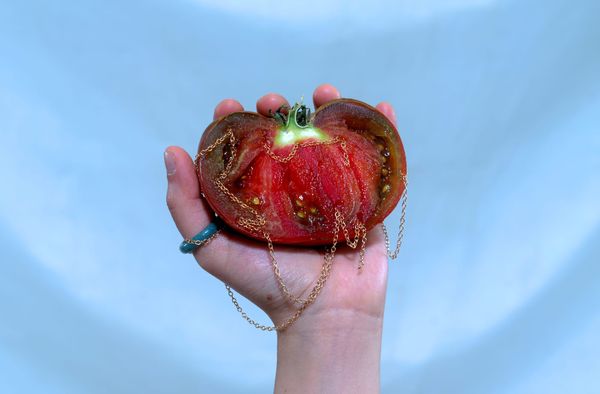
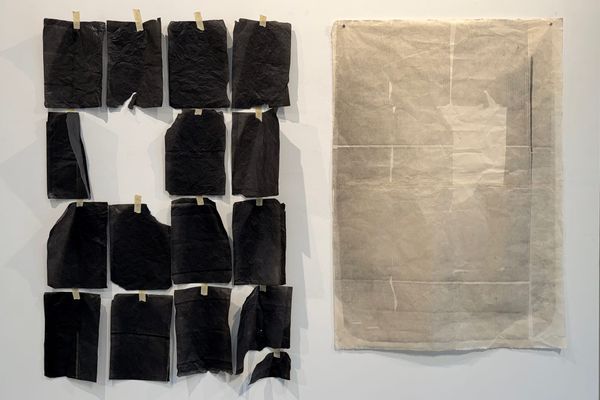
Installation view of works by Jean-Michel Basquiat, who interned at the Children's Art Carnival in the 1970s (photo Jerry Elengical/Hyperallergic)

The show features artists including Jean-Michel Basquiat, who produced silkscreen prints inspired by the frenzied visual style that he observed children gravitating toward during his internship at the carnival in the 1970s. The iconic downtown artist’s three works on view in the gallery transmit this energy, and feature fragmented compositions and the iconic three-point crown motif that would become his trademark. 

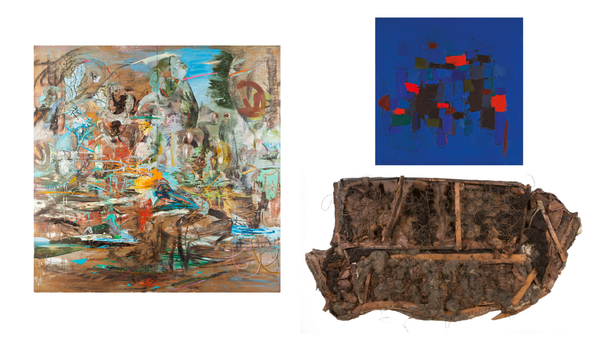
Harlem’s changing urban, social, political, and cultural landscape is a recurring theme in the exhibition. In Carmen L. de Jesús’s photographs of the Million Youth March, which took place on Malcolm X Boulevard (Lenox Avenue) in 1998, thousands are seen rallying against systemic racism and police brutality toward Black people. Armando Alleyne’s brightly colored 2000 portrait of Thelonious Monk points to the birth of bebop, the up-tempo jazz subgenre that Monk helped develop at Minton’s Playhouse in Harlem. Tschabalala Self’s mixed-media triptych “12pm on 145th” (2022) superimposes silhouetted and collaged figures based on Hamilton Heights residents onto red-brick walls associated with the neighborhood's housing infrastructure. 

“I see the Children’s Art Carnival as a home,” Self, who was once a student at the carnival, said to Hyperallergic. “A home for Black artists — a home in the literal sense as well, because the school was built inside a brownstone on the very historical block of Hamilton Terrace. A home in a metaphorical sense because the Art Carnival fostered the development of so many children.” 

Among the current list of teaching artists and staff at the carnival are brothers Dionis and José Ortiz, who once started out as students there. 

The carnival’s approach to art education encouraged both children and teaching artists to innovate and push boundaries. "Betty [Blayton-Taylor] was intrigued by the children's use of color and sense of freedom and experimentation,” Souleo said. “And so that pushed her to add more color in her work, pushed artists like Beverly Semmes to add more color and to not be afraid of working with unconventional materials, found materials.” 

This experimental spirit is evident in the sculptures of Michael Kelly Williams, which evoke steampunk aesthetics and question notions of symbolic value and reuse. One of Williams’s pieces, “Samta” (2017), consists of a sitar affixed to a watermelon. The watermelon holds many meanings as a symbol of resistance, including its longstanding associations with the cause of Palestinian liberation. The fruit was also a source of economic independence for emancipated Black farmers in the post-Civil War era, which led to its eventual weaponization in racist stereotypes about Black Americans in the media

Michael Kelly Williams, "Samta" (2017) (photo Jerry Elengical/Hyperallergic)

Tomie Arai’s “Stories from La Colonia China” (2003) uses silkscreen prints transferred onto wood to narrate the stories of Afro-Asian immigrants who came to the United States from Caribbean nations.  This sensitivity is also foundational to Élan Cadiz’s mixed-media work “America” (2023–25), which explores the experiences of marginalized communities in the U.S., who both face discrimination domestically and have to confront the impact of American imperialism abroad. 

While the carnival has been rooted in a brownstone at 62 Hamilton Terrace for the past 52 years, it originally began as an annual event at the Museum of Modern Art in 1942. The brainchild of the institution’s founding Director of Education Victor D’Amico, it then traveled abroad to Europe and India in the early 1960s — a history that is narrated through a visual timeline at the gallery’s entrance.

Blayton-Taylor got involved in the carnival while working at MoMA, and spearheaded its move to Harlem. In 1974, five years after its relocation, the carnival became an independent entity, moved into its current premises, and was registered as a nonprofit.

The exhibition features a visual timeline documenting the carnival's history. (photo Jerry Elengical/Hyperallergic)

A wall near the gallery’s entrance features Blayton-Taylor’s own work, a trio of circular canvases. Further inside, a glass display case contains a notebook documenting the behind-the-scenes work she undertook, from contacting artists to bookkeeping and balancing budgets. Next to the notebook are photos of Stevie Wonder and Romare Bearden visiting the carnival in the 1970s.

After school teachers began reporting that the carnival was having a positive impact on children’s behavior and attentiveness, Blayton-Taylor also established a reading program, which ran from 1973 to 1995, to improve literacy rates in public schools.  

It has not always been smooth sailing for the Children’s Art Carnival, which shut down in 2011 amid financial difficulties. But after some restructuring and planning, it reopened in 2018, just two years after Blayton-Taylor’s passing. 

Glass display case showcasing Blayton-Taylor's notebook and images of Stevie Wonder and Romare Bearden at the carnival (photo Jerry Elengical/Hyperallergic)

Souleo hopes that the exhibition will illuminate how community-focused art initiatives can improve the lives of children at a time when arts organizations are struggling in the wake of the Trump administration’s gutting of federal grant programs and attacks on Diversity, Equity, and Inclusion initiatives.

“I absolutely hope that this brings further attention and spotlights the carnival, because it continues to exist,” Souleo said. 

Even though art is the medium, the goal behind the carnival has always been to mold children into better individuals. One of the glass cases displaying archival documents and photographs from past editions of the carnival houses a vocabulary assignment completed by a past student. For their definition of “humanity,” the child listed four words: love, caring, kindness, and compassion.