Hundreds Protest in Colombia After Far-Right President Removes Works From National Museum
In a Trumpian move, the government of Abelardo de la Espriella took down works referencing LGBTQ+ and women’s rights and political violence.

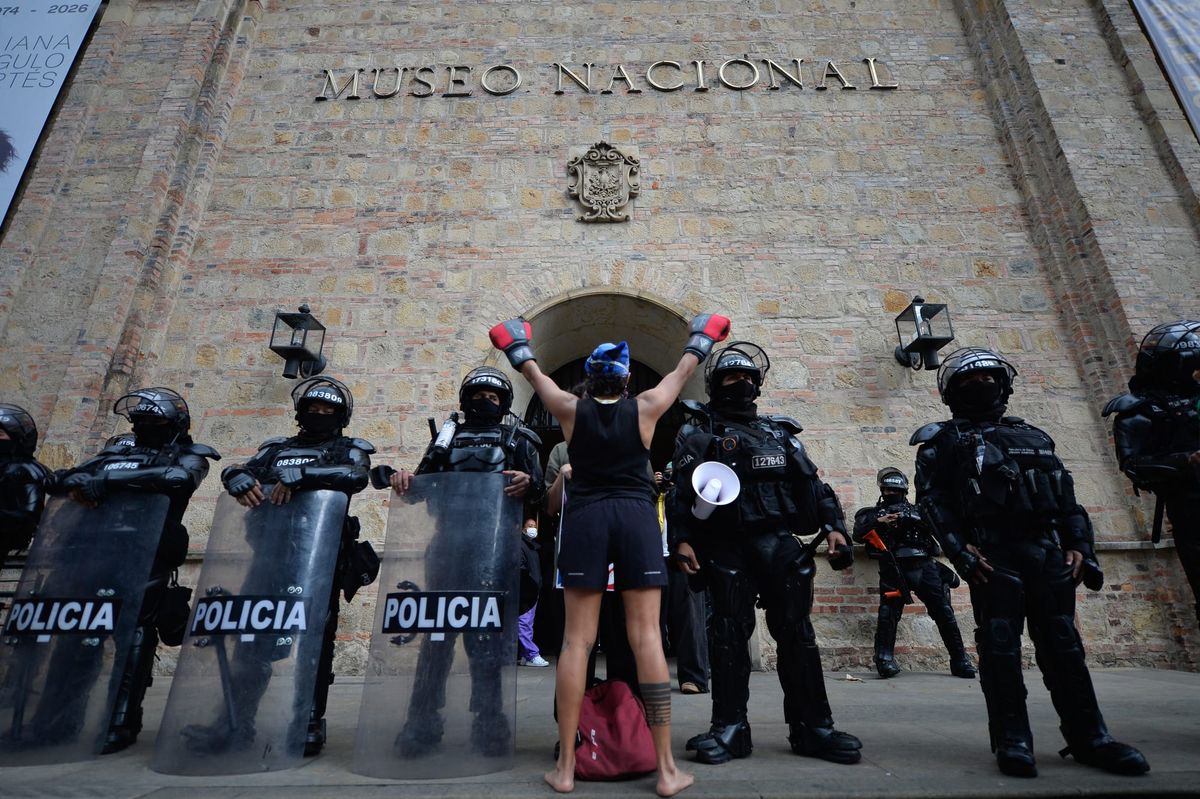
Hundreds protested at Colombia’s national museum in Bogotá this weekend, days after the country’s far-right government ordered the removal of objects addressing political violence, women’s rights, and LGBTQ+ history — including a rainbow Pride Flag — in a move straight out of the Trumpian playbook.
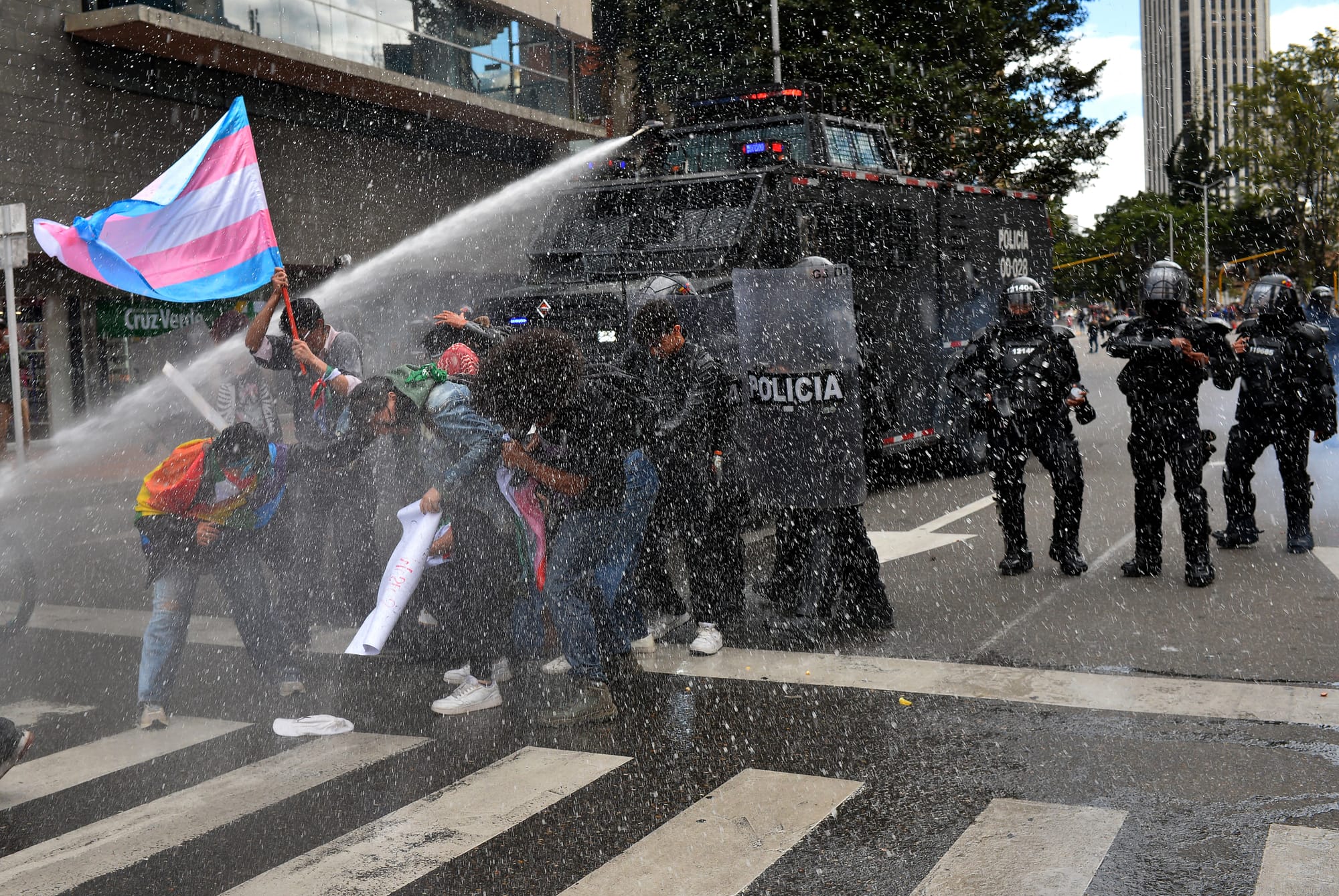
Inside the museum, images taken by locals showed stripped-down gallery walls bearing the haunting silhouettes of dismantled pamphlets and photographs; at the entrance, rows of police in riot gear stood at the ready to suppress demonstrators with water cannons and stun grenades.
Under the order of President Abelardo De La Espriella, approximately 30 artworks referencing LGBTQ+ and feminist movements, victims of state violence, and the “Acuerdo de Paz,” the 2016 peace negotiations between the Revolutionary Armed Forces of Colombia (FARC) and the government, were removed from display at the Museo Nacional de Colombia last week.
De La Espriella said he had instructed Minister of Culture Paola Holguín to ensure that “all those odes to terrorism featuring Pizarro and the other terrorists are removed from public places,” invoking the name of Carlos Pizarro Leongómez, a former guerrilla commander and one of three presidential candidates assassinated in 1990.
Among the withdrawn works were a Humberto Rincón Perfetti photograph from an LGBTQ+ rights march, a Pride Flag that belonged to activist Elizabeth Castillo, and a pamphlet on women's reproductive rights. Also removed were ephemera addressing the assassinations of Pizarro Leongómez and leftist leader Bernardo Jaramillo Ossa of the Patriotic Union Party, as well as a pen made out of a bullet that was used to sign the 2016 agreement with the FARC. Crafted by the Ministry of Education under then-President Juan Manuel Santos, the pen was inscribed with the phrase, “Bullets wrote our past, education will write our future.”
De La Espriella’s directive drew widespread and immediate condemnation from members of Colombia’s arts community. Over the weekend, leaders at six modern art museums across the country penned a joint declaration expressing "deep concern" over the works’ withdrawal and calling on the culture minister to reverse the decision.
“Museums have the responsibility of allowing us to know the complexity of our history, including that which makes us uncomfortable, confronts us, or is difficult for us to acknowledge,” read the statement, signed by the directors of modern art museums in Medellín, Bogotá, Cartagena, Barranquilla, and El Tolima, as well as the Museo El Rayo.
Beatriz López, co-founder and artistic director of Instituto de Visión gallery in Bogotá and New York, denounced the silencing of voices that “long occupied the margins of the official narrative” in a statement shared with Hyperallergic.
“May the objects return to a place where they can recover their voice, and may the museum once again be a space where history is not dictated but researched, shared, and kept open to questioning,” López wrote.
Reached for comment, a representative for the Museo Nacional directed all press inquiries to the Ministry of Culture. The latter referred Hyperallergic to Culture Minister Holguín’s posts on X, in which she states that the museum may not serve as “an instrument of political indoctrination” or “a hub for spreading biased versions of our history.”
Echoing President Donald Trump’s crackdown on the Smithsonian Institution and exhibits that grapple with slavery, civil rights movements, and diversity, most of the objects targeted by De La Espriella’s officials were in a gallery dedicated to Colombian social and political history. Inaugurated in 2019, the “Making Society” gallery examines “processes of coexistence, resistance, and revindication,” according to a museum description.
Other items were displayed in a section devoted to socially engaged printmaking and photography of the 1950s and ’60s. Among the targeted pieces were works by late artists Antonio Caro, known for his subversive interventions into mass-media symbols like the Coca-Cola logo, and Luis Caballero, celebrated for his paintings of the male nude.
De La Espriella, a former criminal defense lawyer, was sworn in this August after defeating leftist senator Iván Cepeda by the narrowest margin in the country’s recent history. He campaigned on a conservative “antiwoke” agenda redolent of the right-wing rhetoric taking hold across Latin America, with El Salvador’s Nayib Bukele and Argentina’s Javier Milei.
Bogotá-based independent curator Jaime Cerón, who curated the city's 2025 biennial, told Hyperallergic that removing works from the national museum is in line with the administration’s broader attacks on the arts. In September, the Culture Ministry suspended a long-running federal stimulus program for artists and creative workers, drawing backlash.
“The changes the Colombian government has made overall represent a setback for the cultural rights of communities that, throughout history, have been rendered invisible, marginalized, or censored,” Cerón said.
But Cerón also said he believes De La Espriella’s will backfire spectacularly. He cited the 2025 case of “Las cuchas tienen razón” (“The mothers were right”), a Medellín mural honoring the women searching for their disappeared children during a period of violent paramilitary conflict. After the city’s mayor had the mural whitewashed, artists quickly repainted it, and the titular phrase subsequently spread to walls and fences across the country with unprecedented fervor.
“Acts of censorship have become the most effective way to make what one wants to erase omnipresent and ultra-visible,” Cerón said.
Medellín-based artist Pablo A. Medina shared a similar sentiment.
“This goes beyond a shameless act of censorship,” Medina told Hyperallergic. “It's also an attempt to erase a history and culture that are an undeniable part of this country. But what they don't realize is that what you try to erase only becomes stronger.”