It’s Gabriele Münter’s World, We’re Just Living in It
It is her home, her landscape, her family and friends, portrayed in these images that feel miles away from her contemporaries’ modernist abstraction.

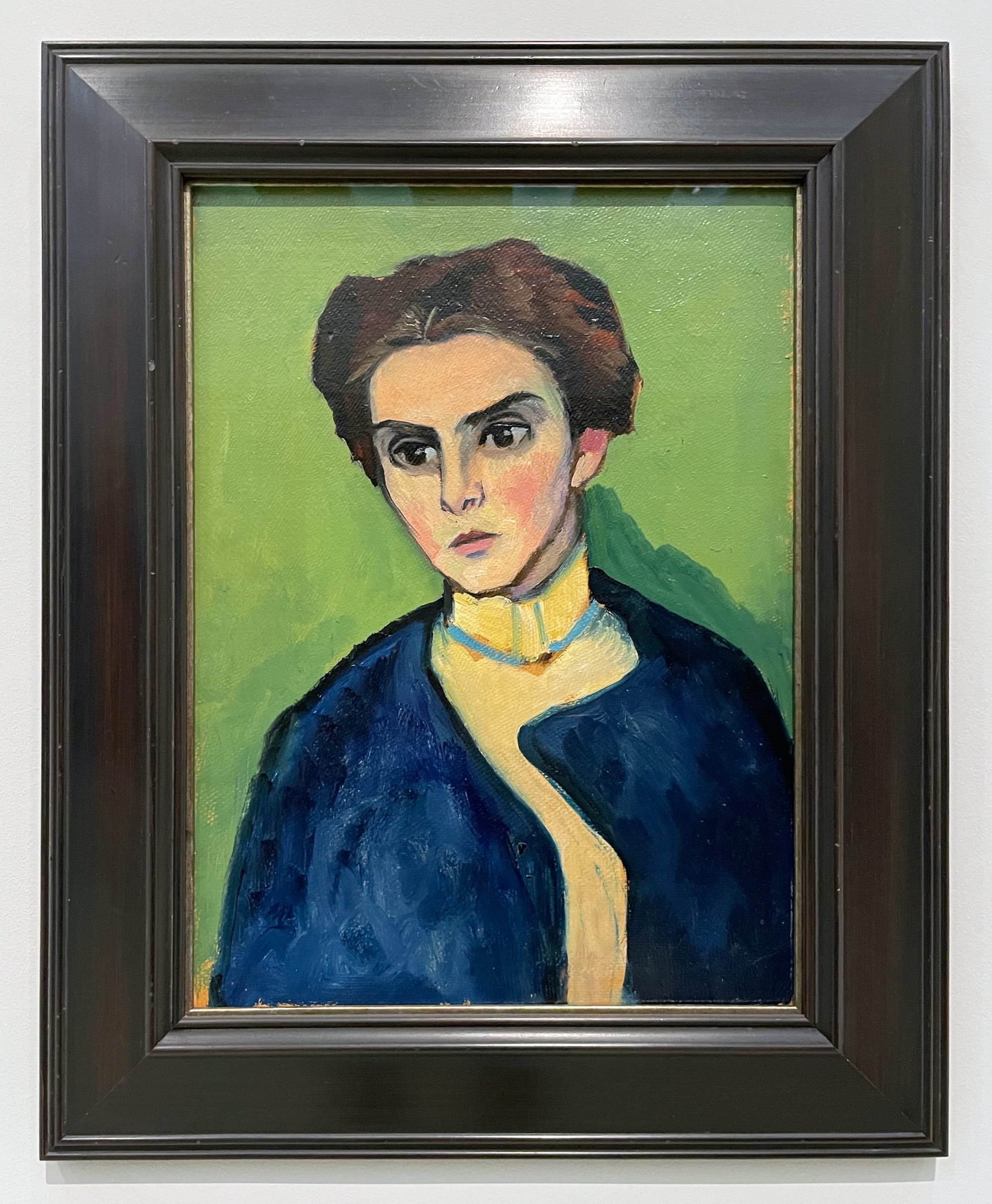
When a woman artist is among a milieu of more successful men, the comments often go like this: “She’s just as good as them.” Or, for an artist couple, “she was his inspiration.” Gabriele Münter, the Berlin-born modernist who co-founded the German Expressionist group The Blue Rider (Der Blaue Reiter) in 1911, isn’t exactly overlooked; she’s had multiple institutional surveys, and her former home in Murnau, Germany, is now a museum. Yet in the United States, she lacks the name recognition of her male contemporaries, in particular her partner of 10 years, Wassily Kandinsky.
In fact, Kandinsky is a phantom presence in the Guggenheim’s current Münter retrospective, Contours of a World. Not only is he in some of her paintings, but the museum’s founding collection includes over 150 of his works and only one of hers — a gift, not a purchase. We can chalk that up to a single, powerful person who overlooked her: Solomon R. Guggenheim.
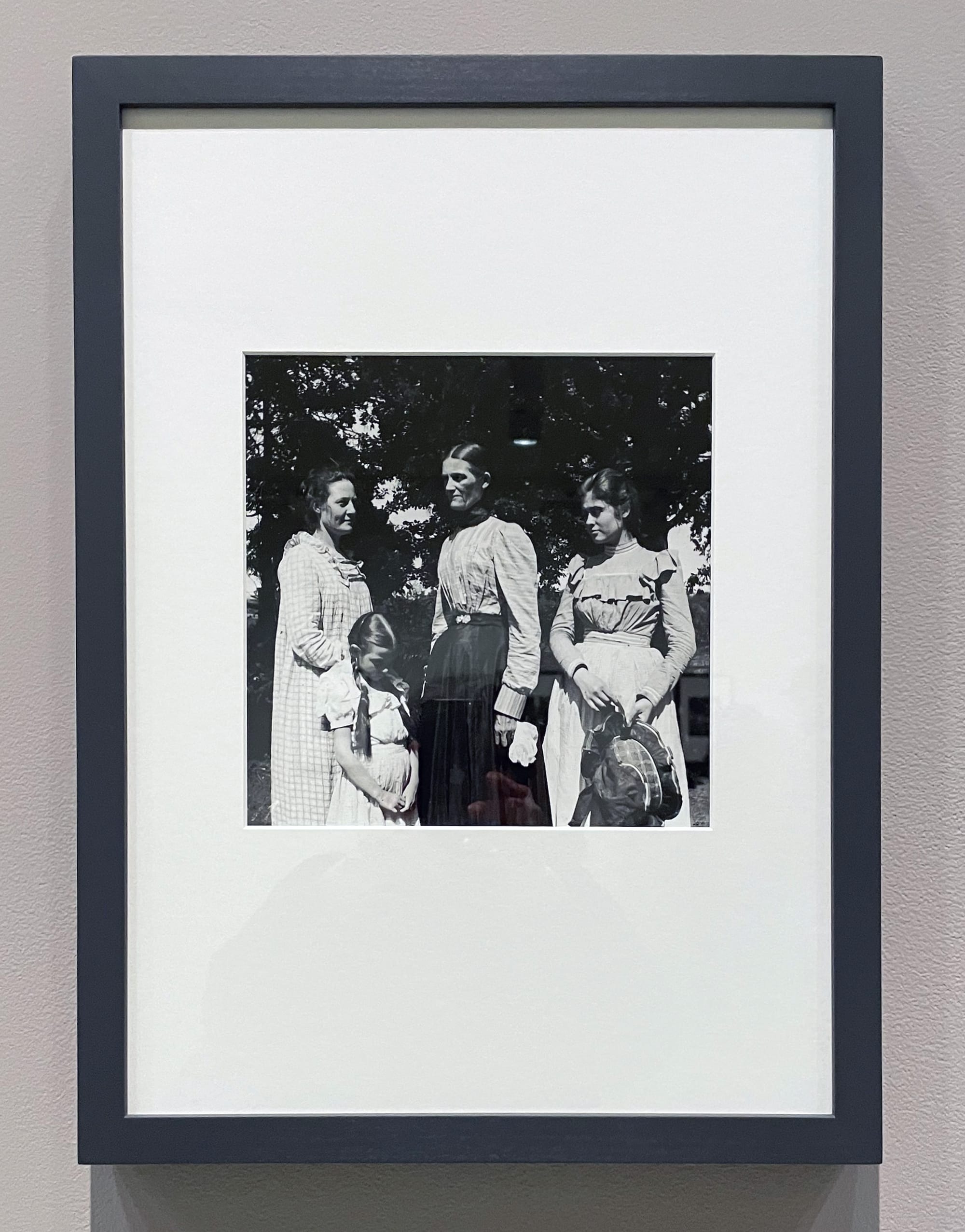
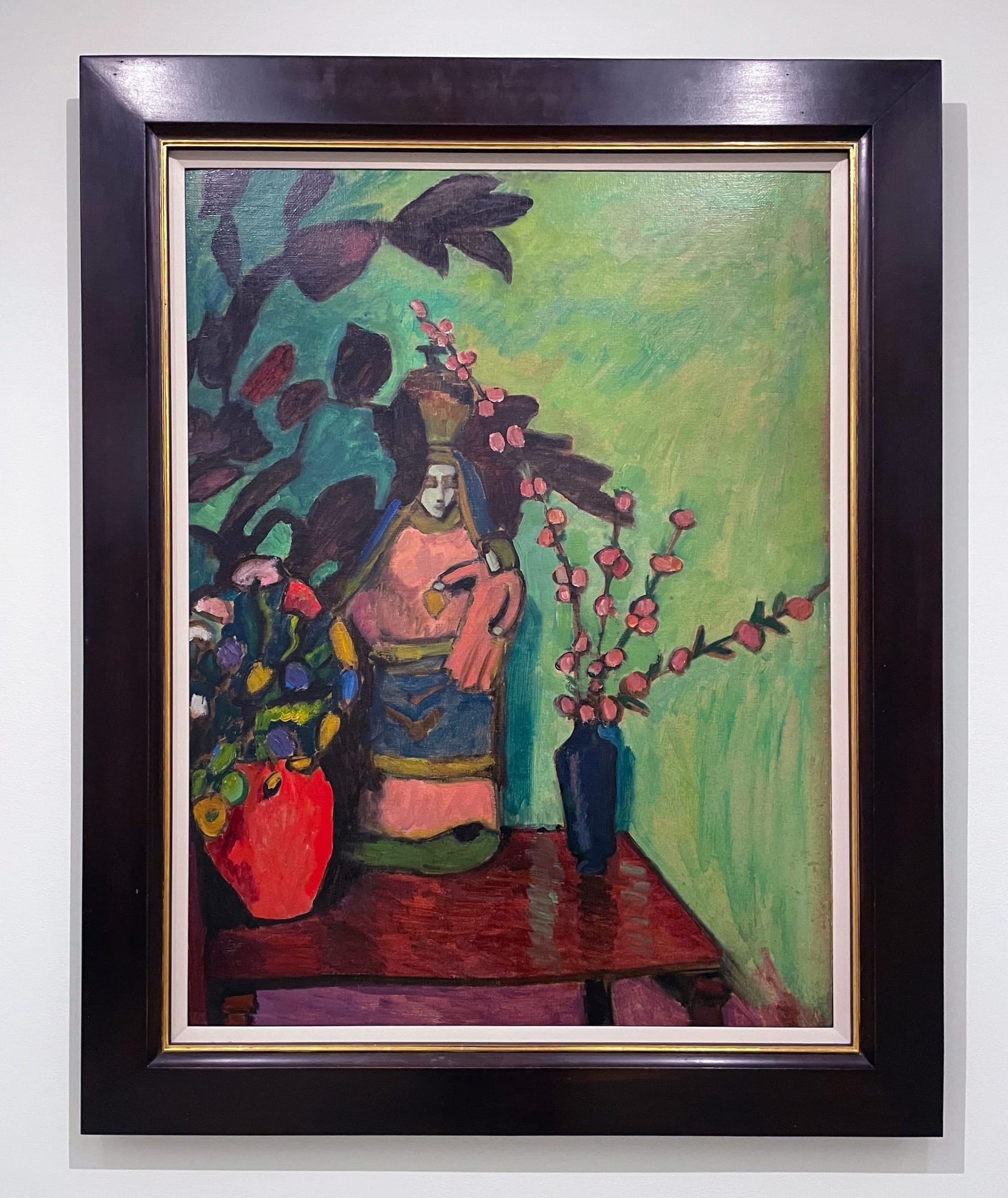
Left: Gabriele Münter, “Annie (Scheuber) Smith with young girl [probably Allie May Smith], Mary (Bruce Scheuber) Allen, and Jerusha Allen, Marshall, Texas” (July 1900, printed 2006/7), gelatin silver print; right: Gabriele Münter, "Still Life with Madonna” (1911), oil on board
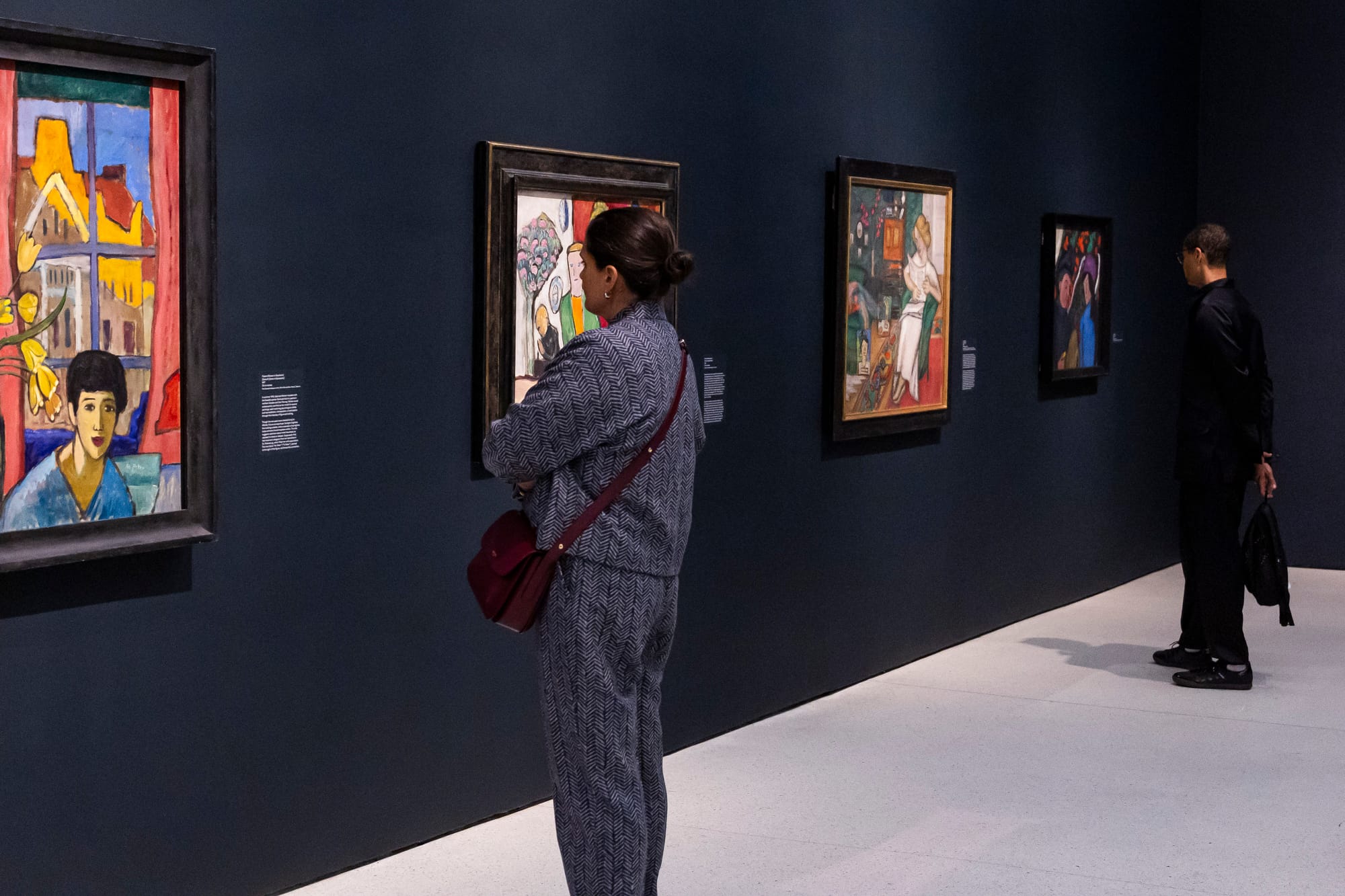
This line of thought crossed my mind when I visited Contours of a World, a beautiful tour through Münter’s creative life installed in the museum’s fourth- and fifth-floor side galleries rather than its majestic ramp. I heard at least one “she’s as good as them” while I was there. I’d counter that she more than equaled her celebrated counterparts. As a driving force of The Blue Rider, her timeless talent arguably surmounted the other members’ formal innovations.
The title comes from Münter’s explanation of her process (quoted in the wall texts): “The forms gather in outlines, the colors become fields, and contours — images — of the world emerge.” And it is her world: her home, her landscape, her family and friends, portrayed in figurative images that can feel miles away from her contemporaries’ modernist abstraction. What she accomplished is more radical than the subject matter suggests. Münter’s art is a masterclass in the phenomenological experience of seeing. Her images are windows into a scene, but her visual strategies redefine the static act of viewing art as something dynamic, as if her world is moving around us, demanding our perception to focus and refocus.
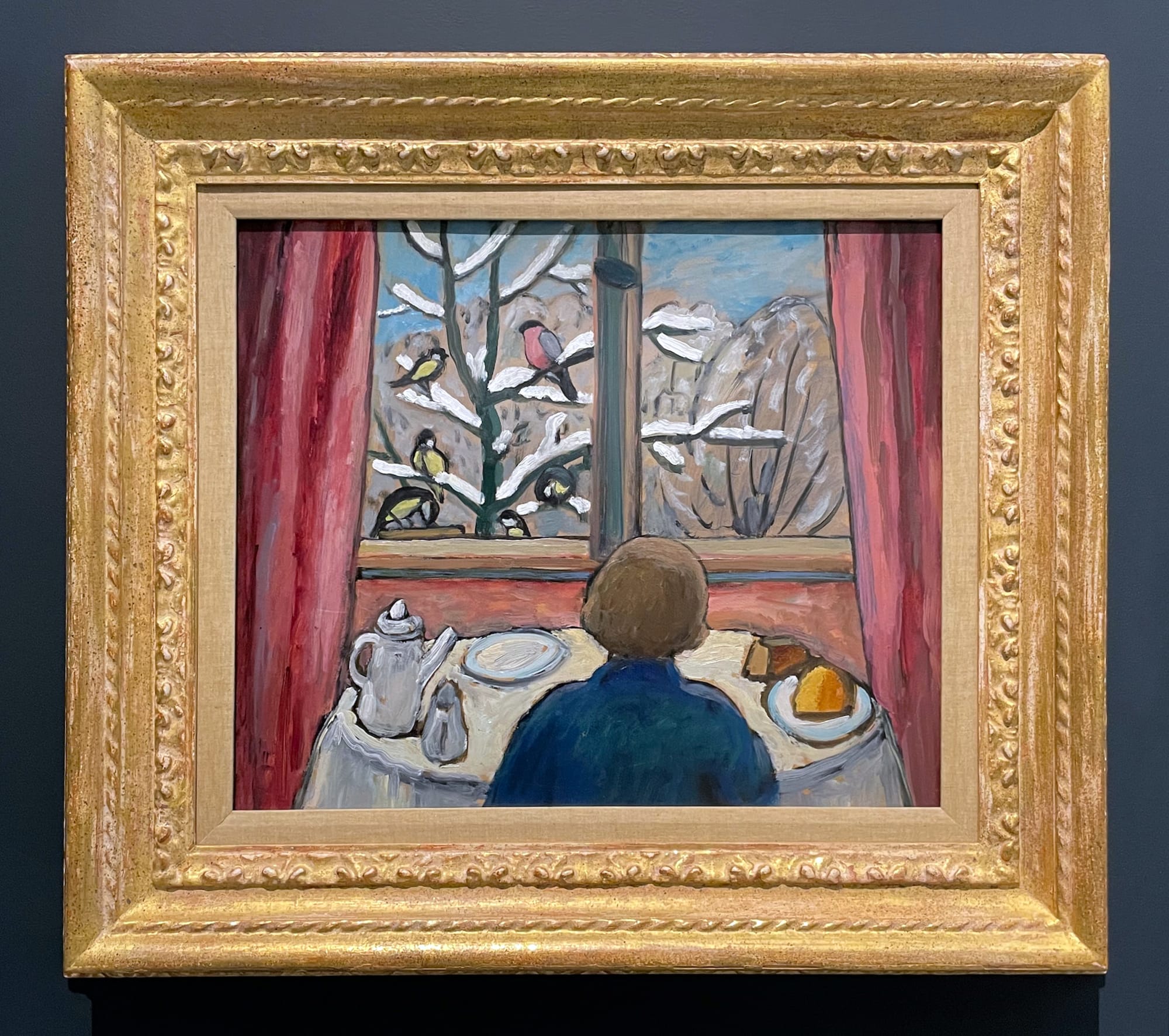
That act of viewing structures the gorgeous “Breakfast of the Birds” (1934). A figure seen from behind (probably the artist) sits at a table in front of a window that looks out onto a wintry, bird-lined tree. The sitter is a version of the Rückenfigur, a stand-in for the spectator. The device was made famous by Caspar David Friedrich, who wanted audiences to contemplate the sublime vistas he recorded. Münter trades Friedrich’s grandeur for intimacy and warmth; we’re contemplating a table with what I like to think is tea and a slice of gugelhupf, and a glimpse of nature dominated by resting birds on a spindly tree. Diverging from Romanticism’s open space and dramatic lighting, she creates depth by layering elements: The centered figure sits lowest in the pictorial space, in front of the table, followed by the wall and then the tree. The composition positions the museum-goer as another element in the sequence, while curtains framing the window evoke a theatrical stage, as if we’re watching a play.
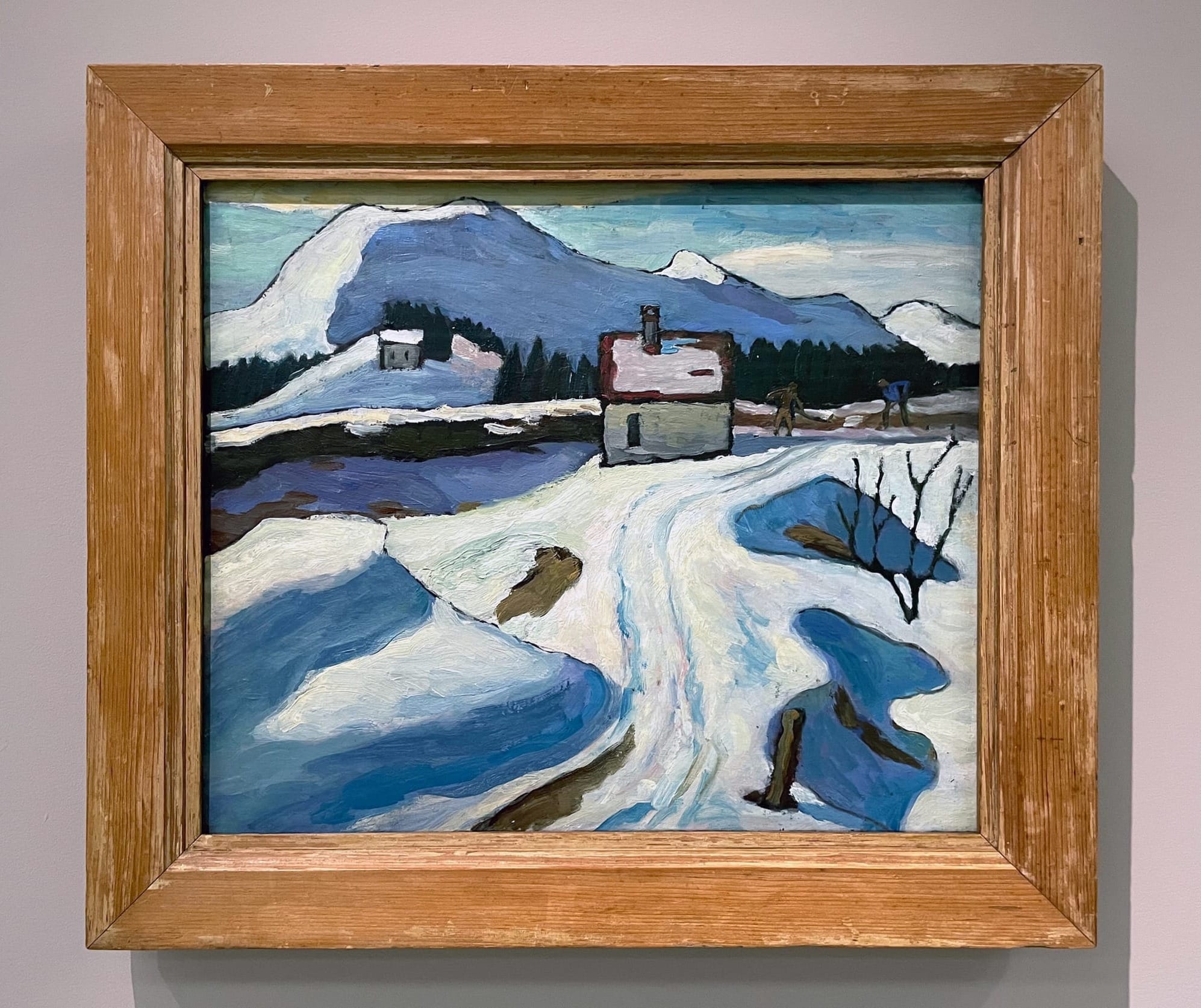
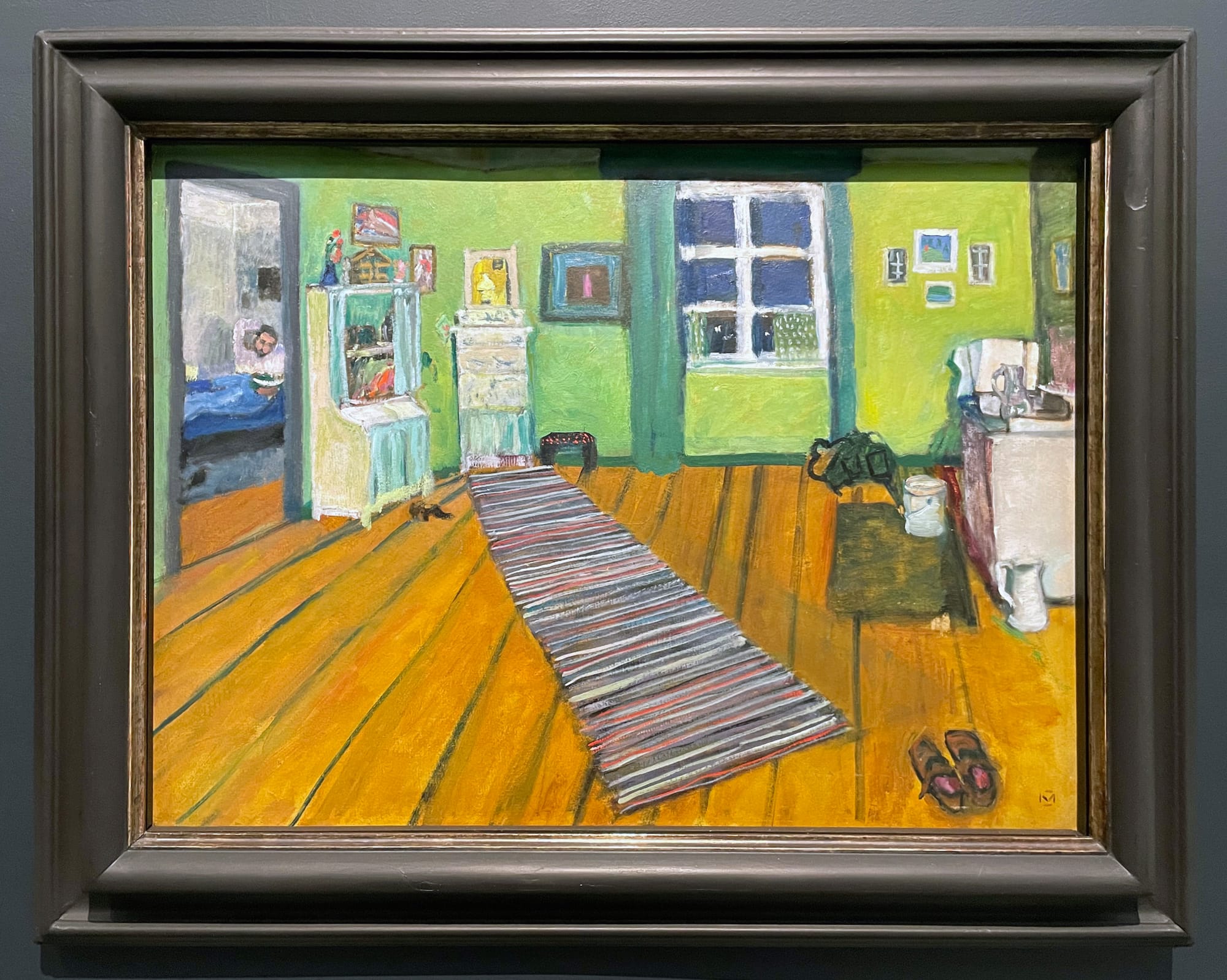
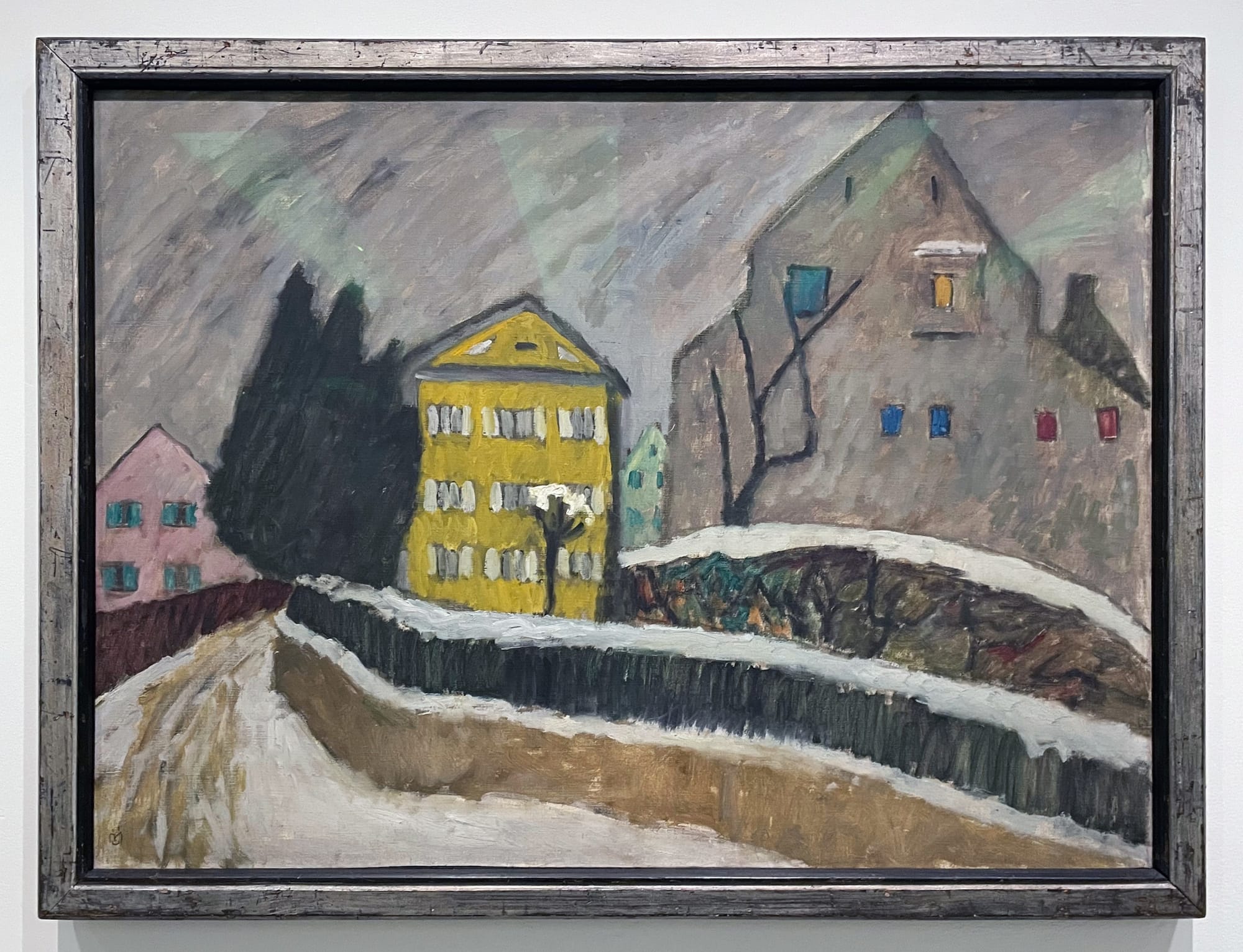
Münter’s landscapes can be more dizzying. “House with Fir Trees in the Snow” (c. 1938) crowds vertical elements — thin trees in the top half, two posts bookending two boulders at the bottom — into a vertical canvas. A house just below the center sits on a slightly diagonal horizon line. Its gabled roof reflects the shape of both the boulders and the white lines of snow on the trees. The whole feels vertiginous, as if Münter is stretching our gaze upward, while the boulders have a Rückenfigur effect, heightened by the house’s windows that look back at us like eyes. Another winter scene, “Snowy Landscape with a Red-Roofed House” (1935), seems like it’s about to slip off the canvas, its curving diagonal lines cutting through the snow and rushing out toward us. Meanwhile, the showstopper “Living Room in Murnau (Interieur)” (1910) turns an unoccupied room into a cacophony of saturated lime green and ocher, sharp angles, and bold diagonal lines; on the far left, a figure — Kandinsky — reclines in the flattened space of an improbably small bedroom. It all somehow feels both small and large. (I’ve been there and my memory of it is as skewed as the painting’s geometry.) Looking at the image made me feel like I was in motion.
Münter’s colors are spectacular — vibrant, contrasting, some so luscious you could almost eat them. (The crimson coat in “Portrait of a Young Woman in a Large Hat” from 1909 is practically visceral.) For this reason, her art is often compared with that of the Fauves and the Nabis, and a year spent in France when she was 20 (1907–8) certainly influenced her aesthetic. However, a gallery of her black and white photographs predating the paintings, from a two-year visit to the United States (1898–1900), bear out the visual logic of her later work. The photographs and paintings share the artist’s attention to contrasting tones and dynamic compositions. More significantly, the immediacy of photography grounded Münter’s artistic maturation in active perception, as opposed to the stillness of painting. Embodied sight is embedded in her creative vision.
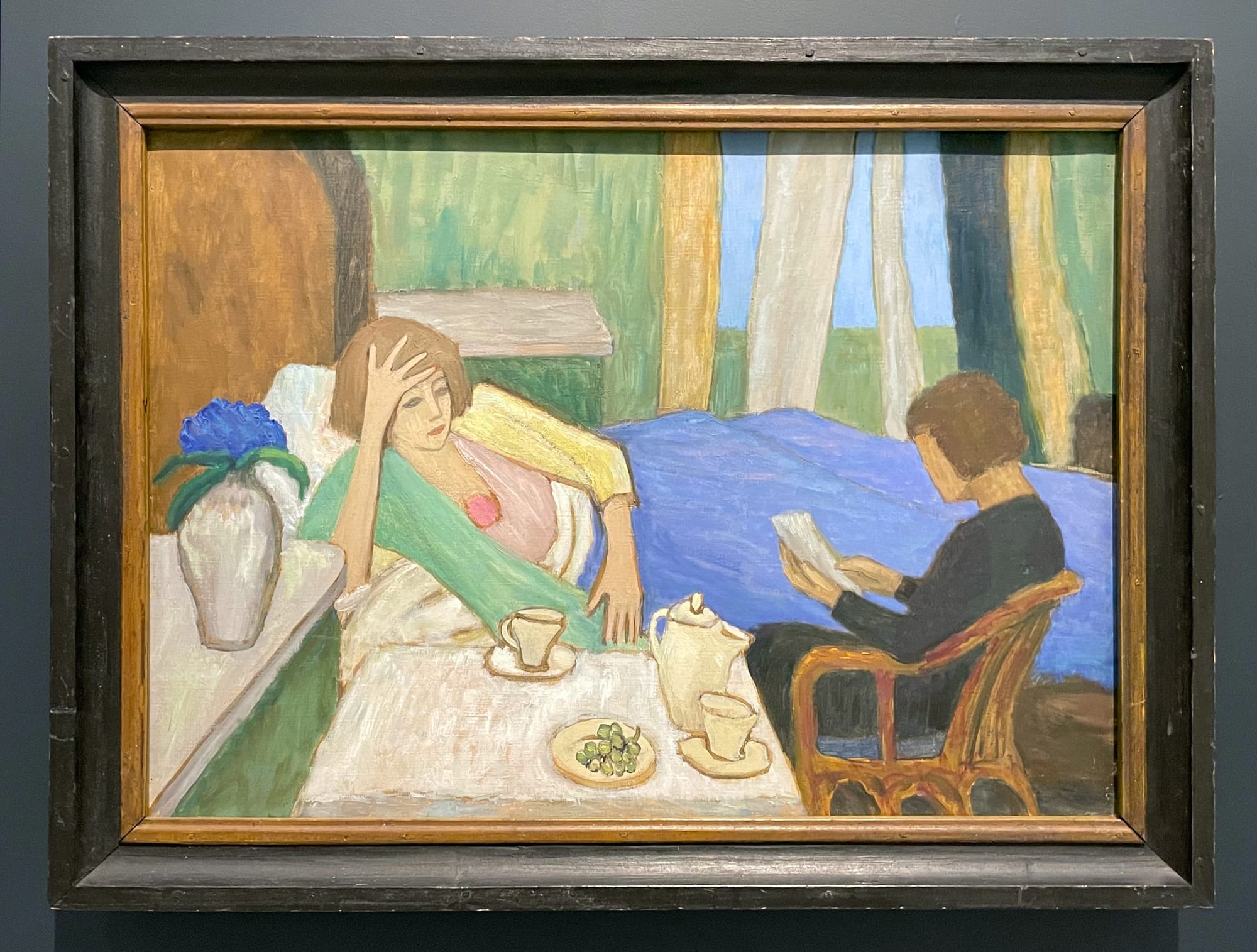
“The Letter” (1930) is among the show’s subtler works, rendered in soft floral hues, but it fuses photography’s time-based principles and painting’s image-based ones into an exceptionally elegant whole. The layered composition depicts a reading woman in a chair, turned away from us, adjacent to another woman lying in bed with her head propped up, facing us; behind them, we see a grass-green wall and white curtains moving with the breeze from an open window. The motion of nature and people, oceanic color, shifting focal points, and fluid brushwork cohere into a moment in time, soon past. It is a graceful testament to Münter’s brilliance, and an invitation into her world.
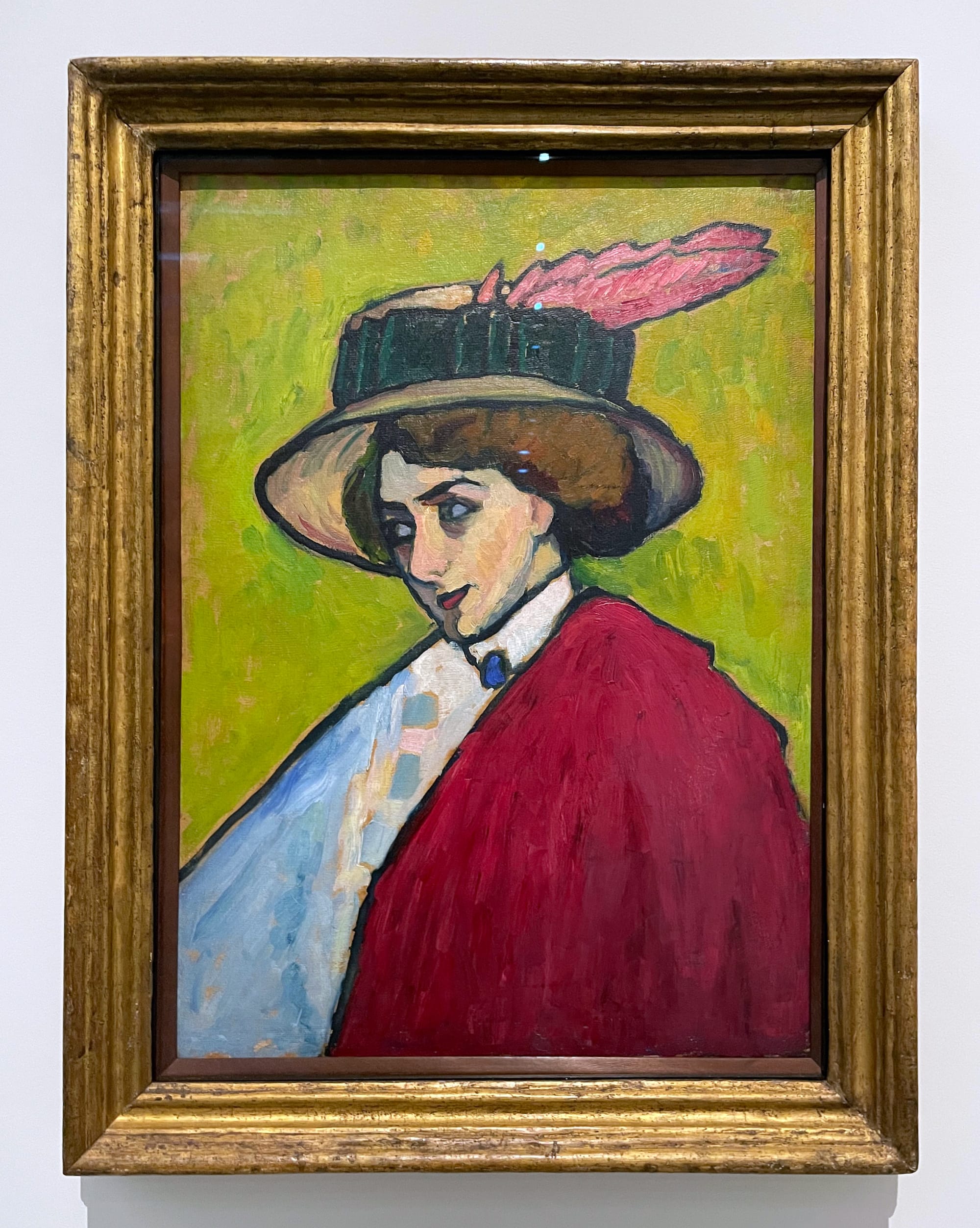
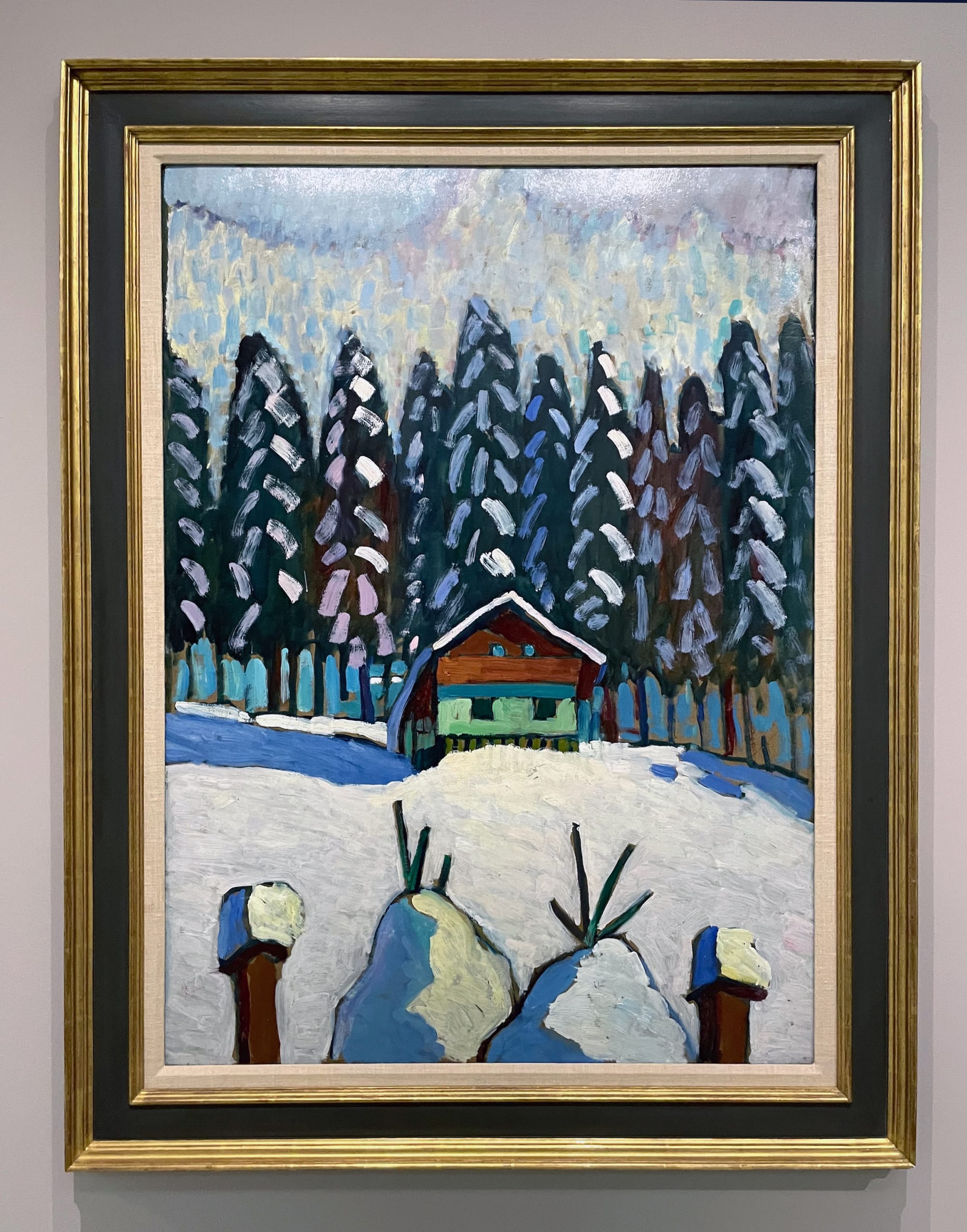
Left: Gabriele Münter, “Portrait of a Young Woman in a Large Hat” (1909); right: Gabriele Münter, “House with Fir Trees in the Snow” (c. 1938), oil on board
Gabriele Münter: Contours of a World continues at the Guggenheim Museum (1071 Fifth Avenue, Upper East Side, Manhattan) through April 26. The exhibition was curated by Megan Fontanella; the photography section was curated by Victoria Horrocks.