Jean Shin’s Living Memorial to the Trees of Green-Wood Cemetery
Inspired by Korean funerary practices, the artist's new works examine how ritual and reflection mark the cycles of time.

Cemeteries are spaces where ritual and reflection converge, where commemorations of life co-exist with contemplations of human mortality. In Brooklyn’s Green-Wood Cemetery, a new pair of installations by artist Jean Shin question how ritual and reflection mark cycles of time, shaping what we carry with us and what we choose to leave behind.
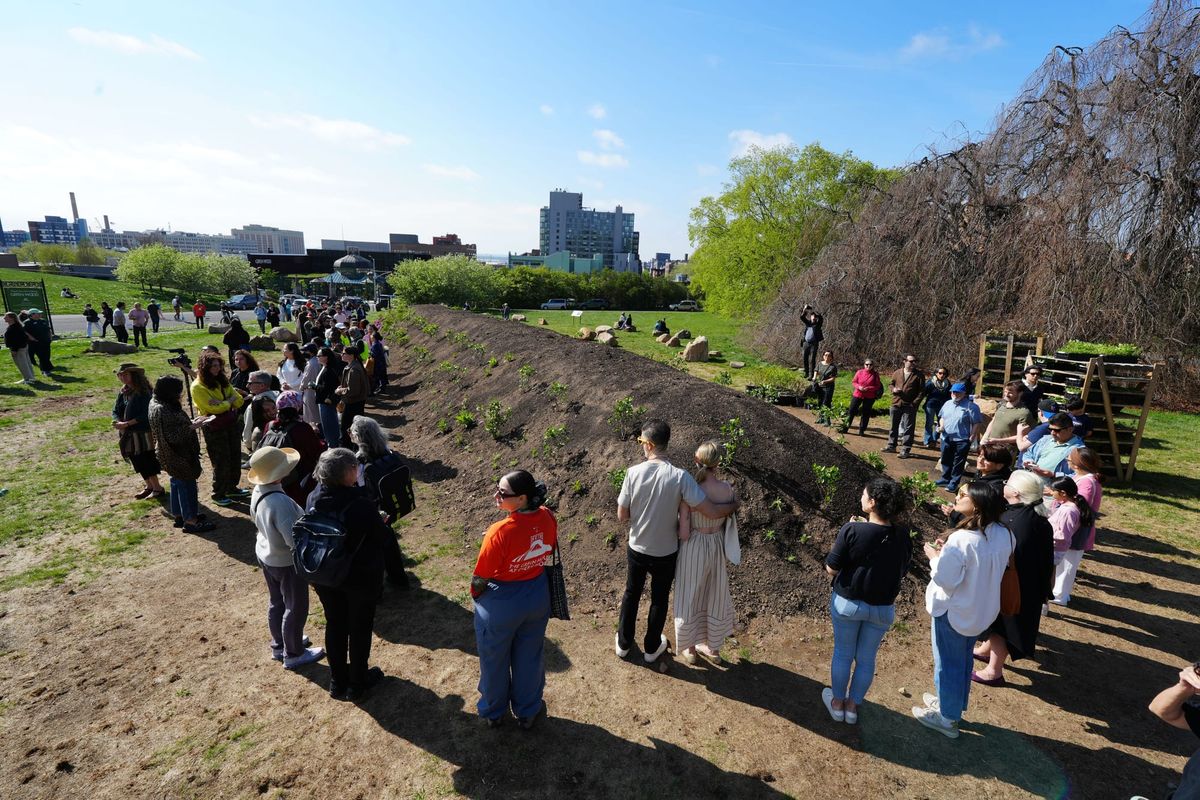
Situated in a meadow facing the cemetery’s brownstone Gothic Revival gates, “Offering” (2026), unveiled to the public on April 18, is a site-specific regenerative earthwork that pays tribute to trees that have spent their entire lives at Green-Wood. The installation was informed by tumuli, artificial burial mounds of earth and stone found all over the world. Shin was particularly inspired by the kinds of rounded, hill-like tumulus mounds seen in traditional Korean funerary practices, which she told Hyperallergic are “so distinctively different than when you walk around in an American cemetery.”
Green-Wood’s vice president of education and public programs, Harry Weil, said he enlisted Shin for an installation at the meadow because of her practice of using found materials. “I really wanted to think about ways where we could challenge ourselves as an institution to create something large-scale — for us, at least — while also using and being inspired by the raw materials of the cemetery,” he told Hyperallergic.
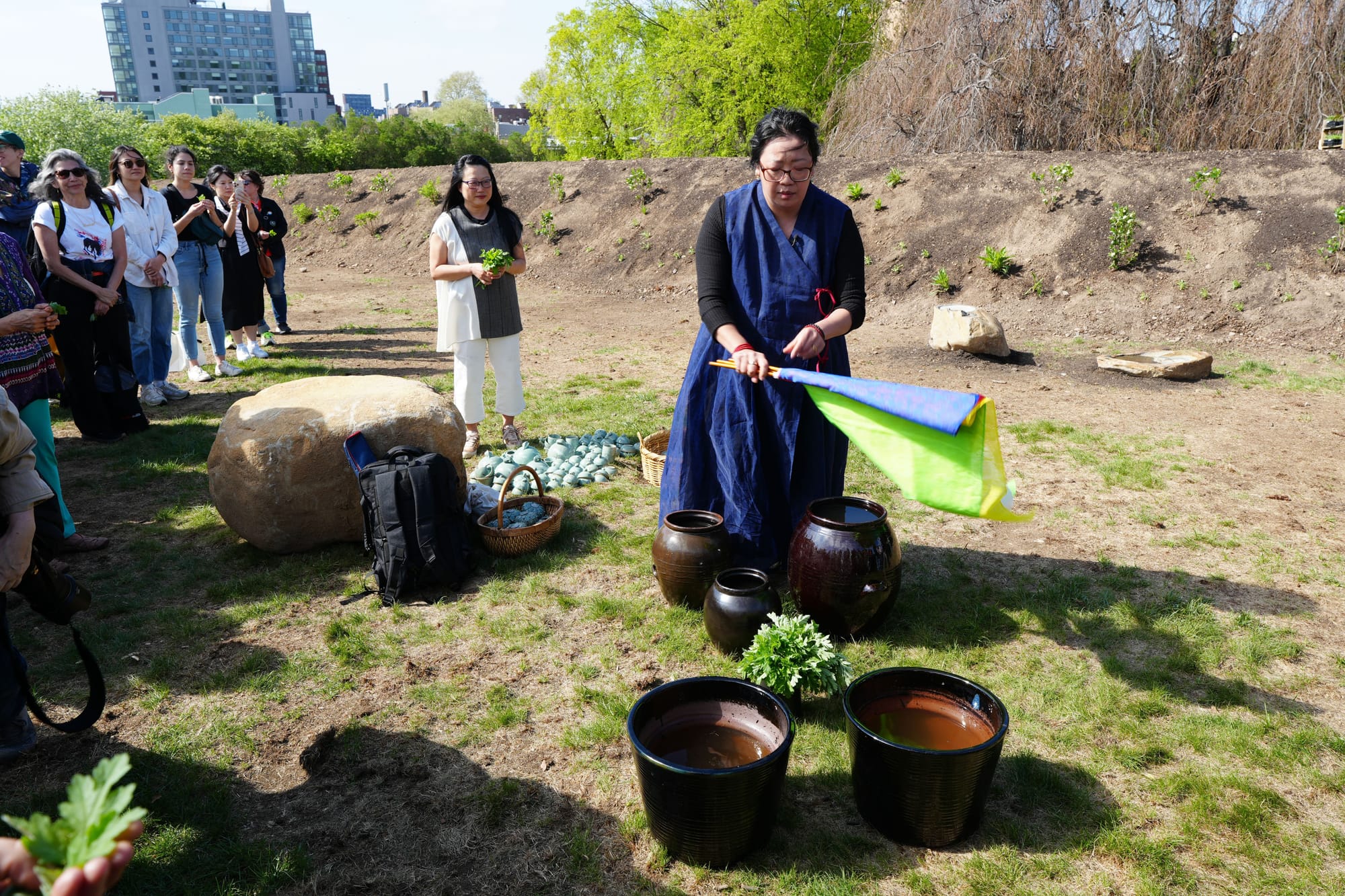
When she first visited the site after being commissioned, Shin said she saw a set of “elder trees” — a red oak and a pin oak — that had to be taken down near the end of their lives, because they were either too damaged or had structural defects that posed risks for visitor safety. This inspired her to “honor them and give them a proper burial,” she said. A similar spirit was behind her earlier work, “Fallen” (2021), at the Olana State Historic Site, where she laid a felled hemlock tree to rest in a leather burial shroud.
“I just wanted everything to have ceremony,” said Shin, adding that the work presents a way to celebrate the trees “as part of our lineage, as opposed to treating them like some other thing that is no longer useful.”
With “Offering,” Shin also attempted to translate the sense of ritual embedded in burial practices into a permaculture methodology. In the meadow, the artist worked with the cemetery’s gravediggers to carve out a long trench for the tree, which stretched over a hundred feet, and emphasized “the magnitude of their volumes and their bodies,” said Shin. She also harnessed materials such as fallen leaves and branches to bury them alongside the tree trunks. Near the end of last year, Shin worked with Dannielle Tegeder of Hilma’s Ghost to organize a ritual around the in-process installation, which by then was blanketed in snow.
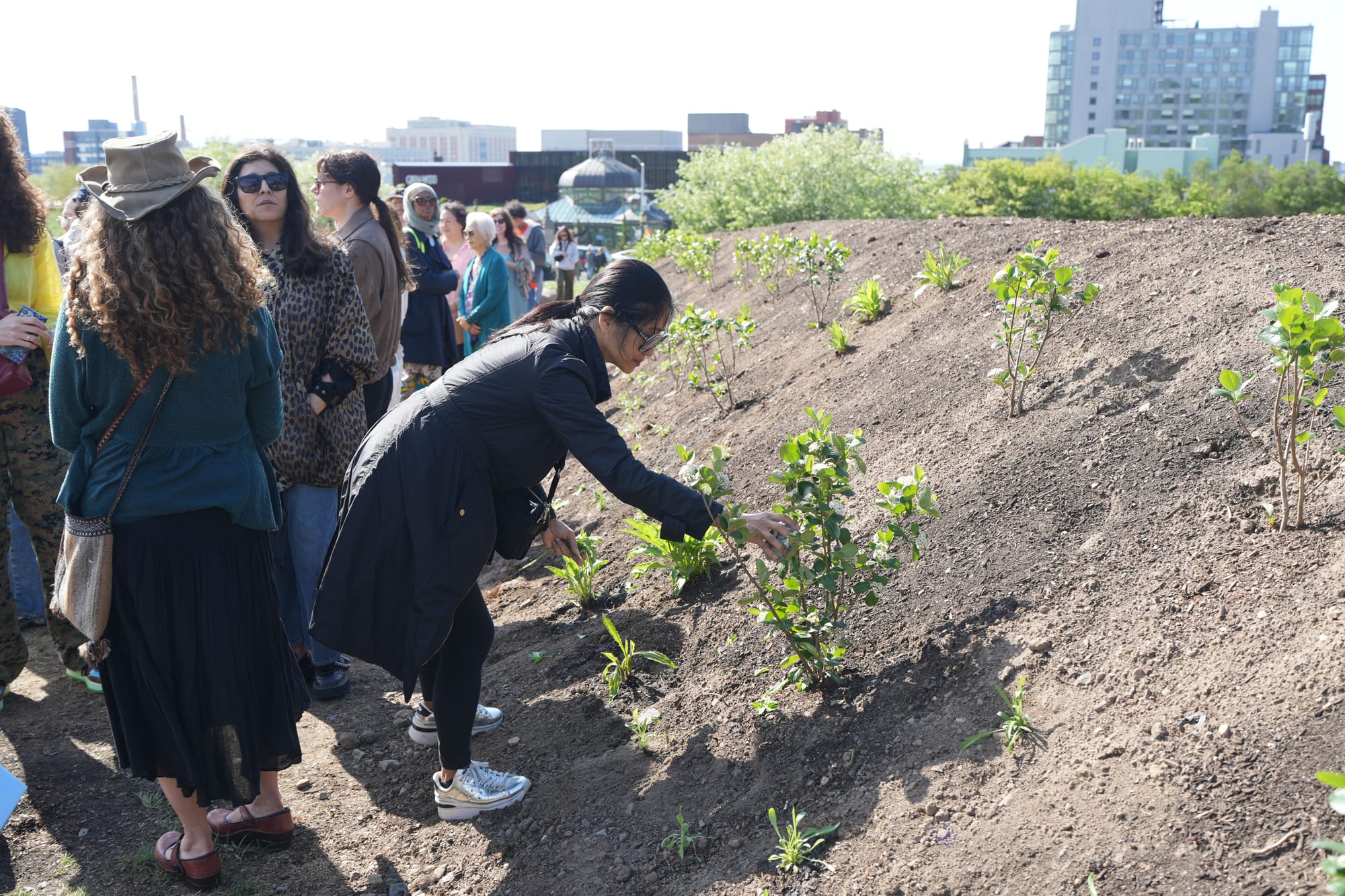
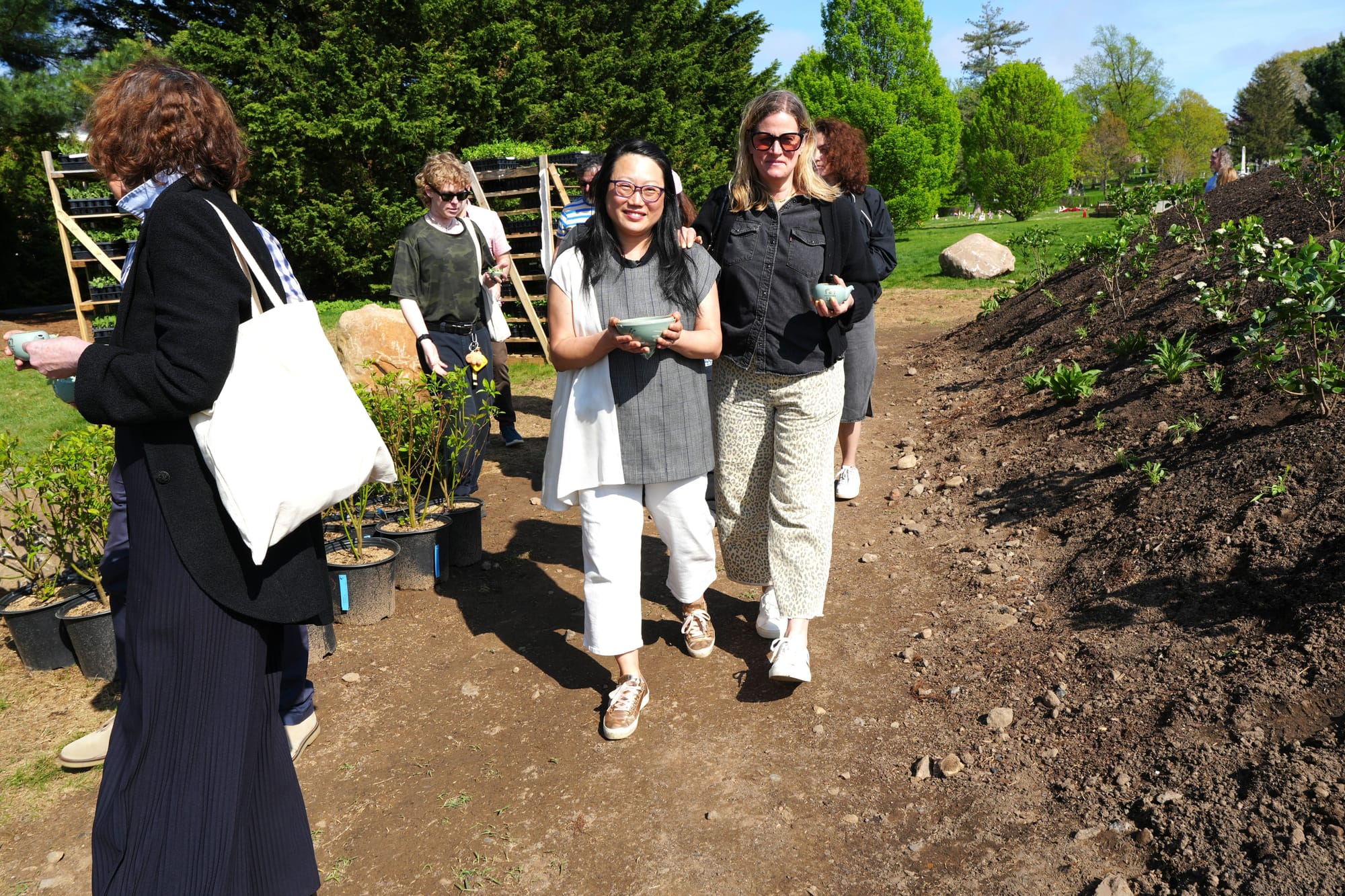
At the time of the press preview on April 16, an excavator had buried the trees under a long, sloping, oval-shaped mound of soil. During the event, which featured a community ritual led by Korean shaman Mudang Jenn, a group of volunteers planted wildflowers and shrubs atop the mound, festooning it in shades of pink and green. As trees in the trench decompose, they will enrich the soil, nourish microbes, and create two interconnected ecosystems that support the plants above, turning the installation into a living memorial.
“It's like trying to imagine that death is not the ending, but really just the beginning,” said Shin.
Rebirth is a prevailing theme this spring at Green-Wood, since “Offering” also accompanies the reopening of the historic Weir Greenhouse, a Victorian-era landmark at the corner of Fifth Avenue and 25th Street. Now, why does the Green-Wood Cemetery have a greenhouse? “We didn't,” explained Lisa Alpert, Green-Wood’s senior vice president of development and programming, during a press tour in late March. “So it was part of what I like to call the ecosystem around any large cemetery, which is funeral homes, monument makers, flower shops.”
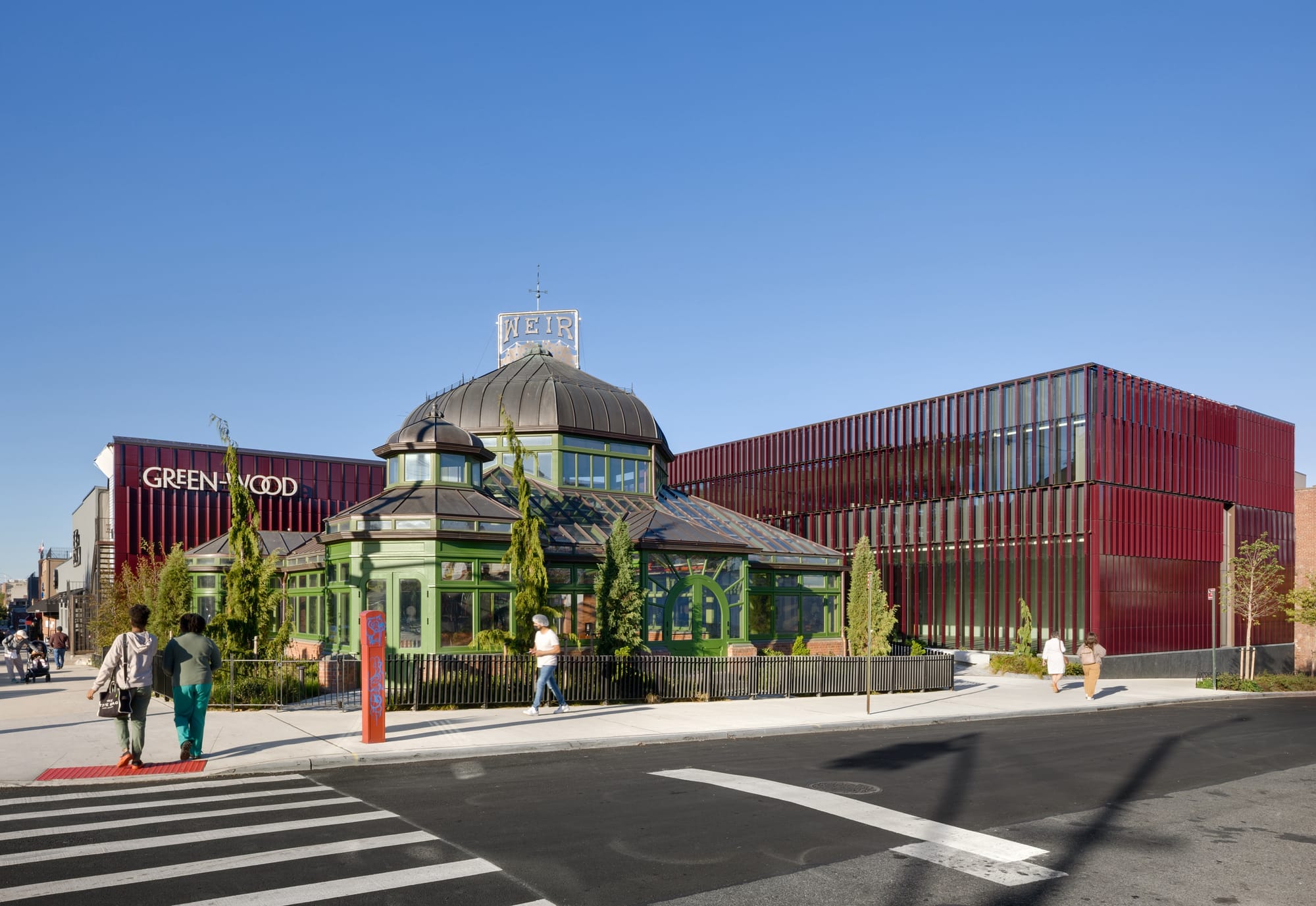
Originally built in 1880 and modified to its current form in 1895, the Weir Greenhouse is one of the oldest surviving commercial greenhouses in New York City. The copper-domed structure was designated a city landmark in 1982, but fell into disrepair by the early 2010s. In 2012, the cemetery purchased the greenhouse from McGovern Florists, a Brooklyn-based business that owned the structure for over four decades. Green-Wood then embarked on a $43 million restoration and transformation of the greenhouse and its surroundings, initially spearheaded by Page Ayres Cowley Architecture and Walter B. Melvin Architects, and later by Architecture Research Office (ARO) and Michael Van Valkenburgh Associates.
Eventually, the project expanded to include a new L-shaped building covered in glazed terracotta fins, located behind the greenhouse.
“We recognized that there was a big gulf between what we as an institution knew and would impart through our programming, and what the public knew about us,” Alpert told Hyperallergic. And so, Green-Wood worked with ARO to create a visitor center. The design was finally greenlit by the Landmarks Preservation Commission in 2021, after earlier proposals failed to make the cut. The new building consolidates multiple functions that used to be spread out across the cemetery’s grounds, ranging from gallery spaces to archives to offices for Green-Wood’s staff.
The structure also includes a permanent exhibition space that recounts Green-Wood’s past, as well as an adjoining white cube gallery for art installations.
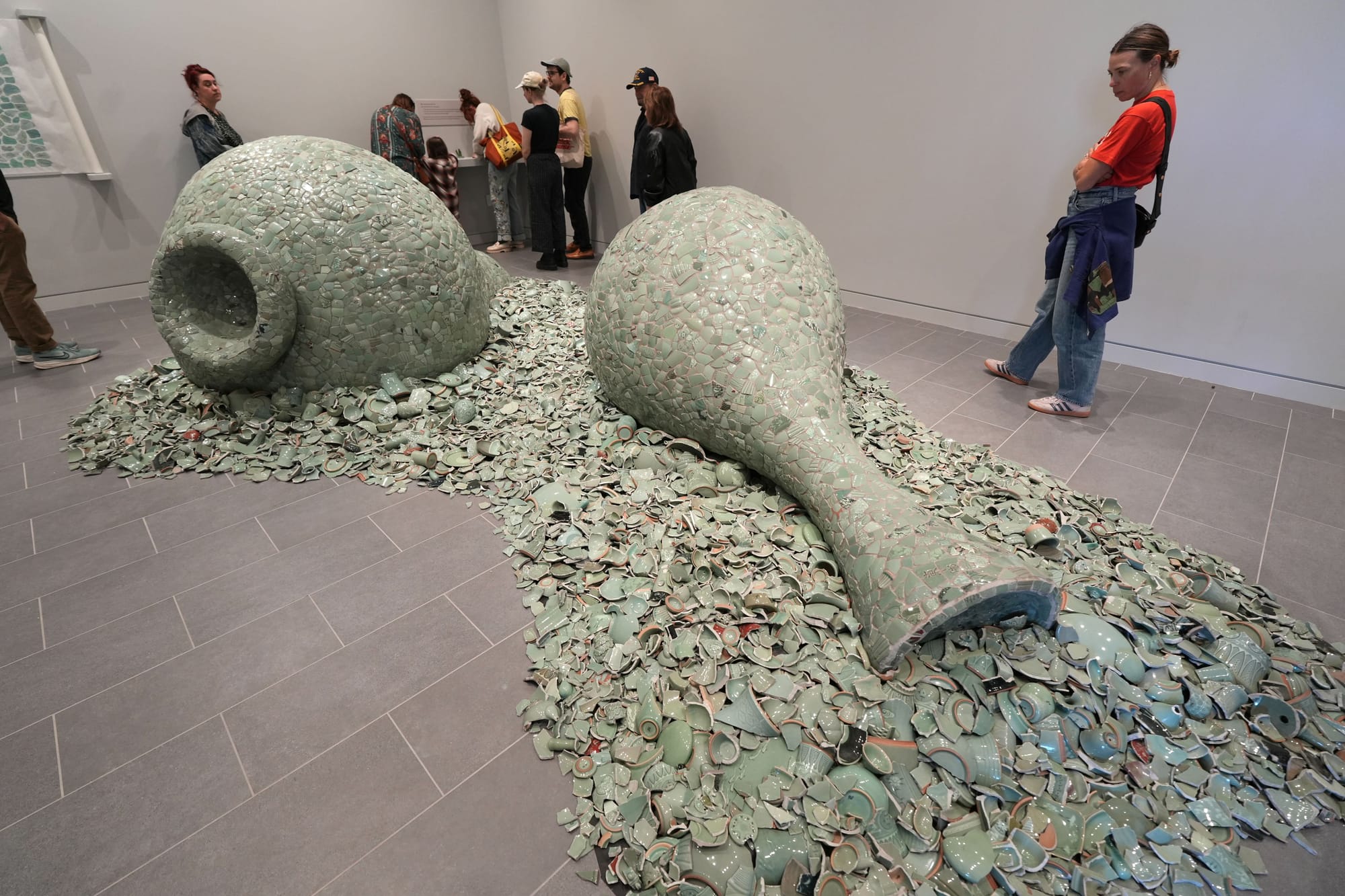
The latter space houses Shin’s “Celadon Landscape” (2015–2019), which was previously on view at the Crow Museum of Asian Art in Dallas and at the Sarasota Art Museum. The installation comprises two monumental mosaic vases, pieced together out of discarded pale blue-green ceramic shards, submerged in a pool of ceramic fragments on the gallery floor.
Shin said that she discovered piles of such shards while visiting Korea and meeting ceramic artists in their studios. “I got very excited and inspired by this mound of what I thought were still treasures, [even though] they rejected them because they weren't perfect,” she explained. The installation consists of shards that were included in an almost two-ton shipment Shin sourced from Icheon, South Korea, for her earlier work on an installation at the Long Island Rail Road station in Flushing, Queens.
Once part of something larger but now separated from their origins, Shin sees the shards as a metaphor for the Korean diaspora.
“The diaspora community, like myself, have somehow been broken away from our birthplace and yet in all the displacement and the distance, we're still Korean, even though our context, language, and customs have shifted,” said Shin.
Like “Offering,” this installation also has elements of ritual and participation that will transform it over time while it is on display until January next year. On pieces of mulberry paper, visitors are invited to write down the names of loved ones and respond to the prompt: “Who do we carry with us?” Shin plans to take these fragments and collage them on a large scroll to be installed in the gallery.
The piece is meant to spark a sense of belonging, which, for Shin, is what drives people to persist, to go on in the face of a shared reality that is just as fragmented as the broken ceramic shards of “Celadon Landscape.” She added: “Today, as we experience such brutal realities — war, death, everything else — that sense of remembrance and what we hold onto is really critical.”