John Altoon’s Fever Dream Drawings
After a stint in 1950s New York, the LA-based artist abandoned abstraction and painting in favor of dreamlike, sexually charged drawings.

I first saw John Altoon’s paintings in 1984 at the now-defunct Edward Thorp Gallery. Since then, I have learned as much about him as possible, by both looking at his work and talking with people who knew him — particularly the poet Robert Creeley, who collaborated with him on an artist’s book and portfolio titled About Women (1966), and the dealer Nicholas Wilder, who first exhibited his work in 1965. I have long wondered why Altoon, a brilliant and beloved maverick in the Los Angeles art scene of the 1950s and ’60s, who died at age 43 in 1969, has generally flown under the radar outside of California. John Altoon: Drawings, a small, thoughtful exhibition at Franklin Parrasch Gallery, offered some clues.
While he lived in New York in the early 1950s and was in contact with the Abstract Expressionists, he returned to LA and eventually abandoned abstraction and painting in favor of dreamlike, sexually charged drawings. On this path, Altoon rejected the formalist belief that drawing hindered the evolvement of modern art, which was prevalent at the time. He further set himself apart by flouting decorum and working from dreams and imagination.
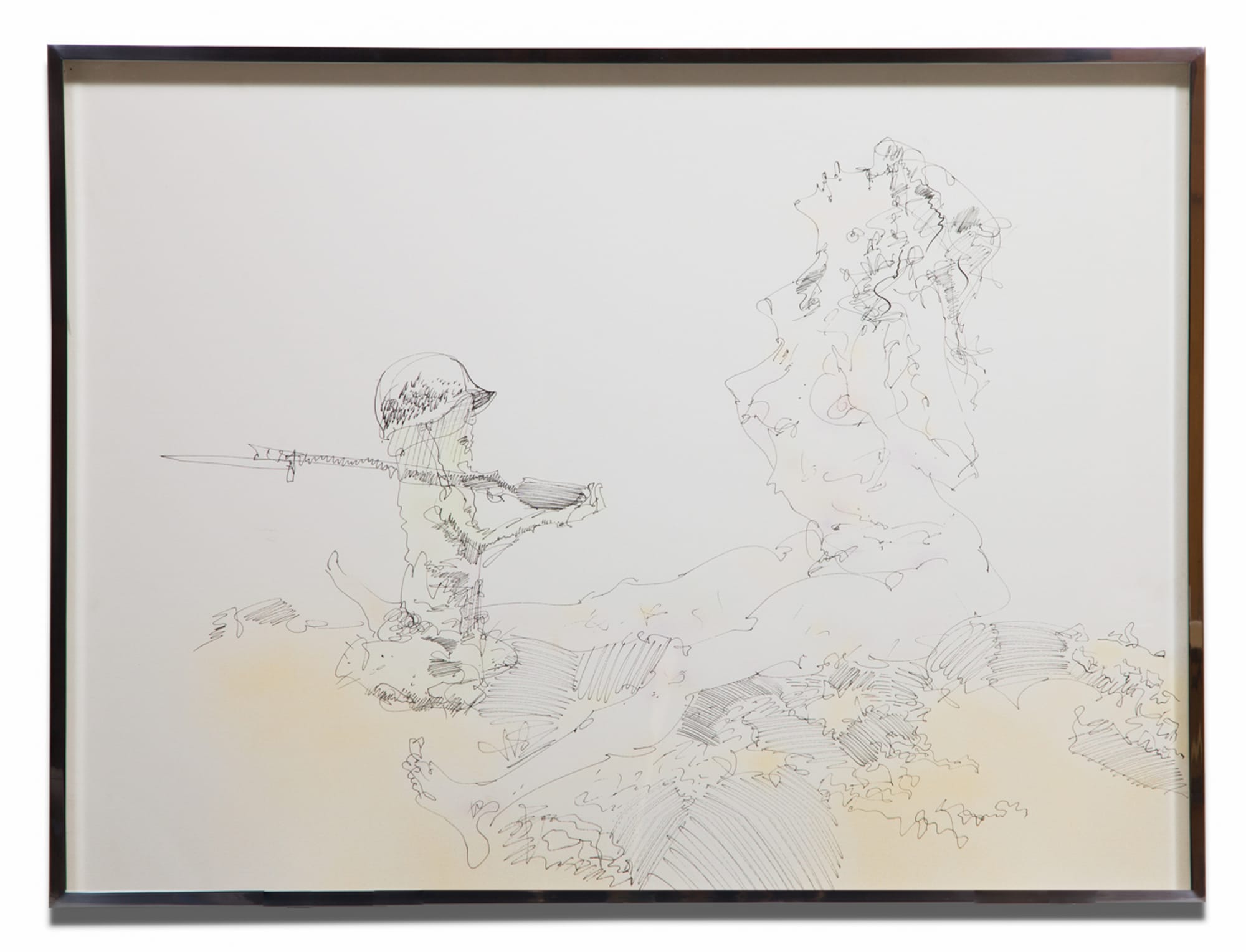
The exhibition’s seven works, all done between 1963 and ’68, speak to the range of Altoon’s drawing practice and use of diverse materials. There are the linear, feverish, sexual figure drawings done in ink and graphite that still cause consternation among some viewers and institutions (even museums with works by Hans Bellmer in their collection).
The women in Altoon’s drawings are often larger than the men. They’re not vying for male attention, and often seem to be looking inward. The men, all seemingly uniform and undistinguished figures, come across as helpless dweebs. Altoon does not provide a context, which would help locate the drawing in the realm of the imagination. His frenetic line work, resulting in an image that is not immediately decipherable, makes us conscious of our looking — he confronts us with our voyeurism, anticipating the internet and private chatrooms. His infusion of humor into the erotic adds a note of absurdity to it all.
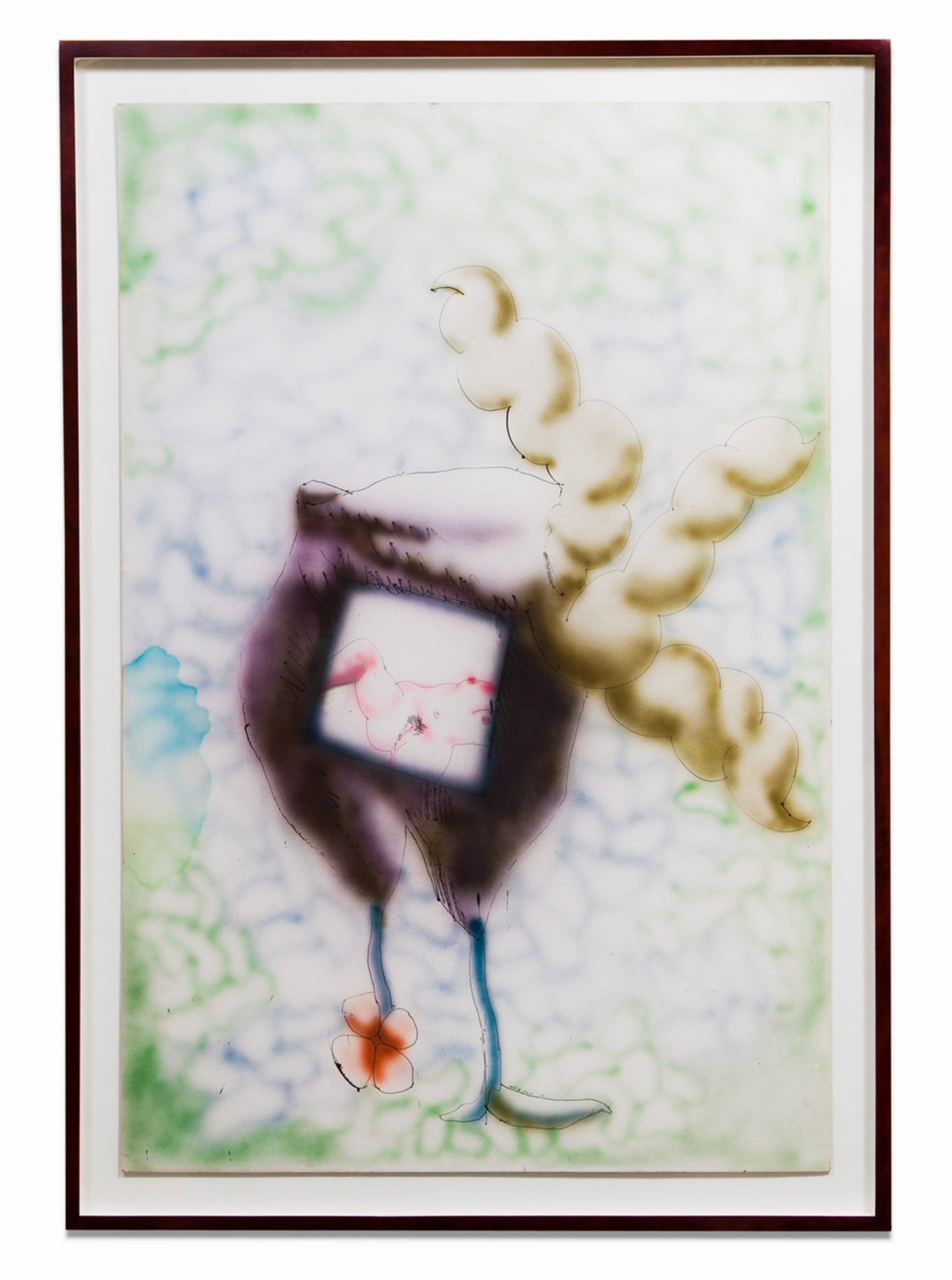
In “Untitled (ABS-81A)” (1966), Altoon depicts, in dark violet, a form that looks like the bottom half of an ostrich floating on a mottled ground of faint blue and green circles. Three bulbous, tan-inflected plumes radiate from the central form while a square in the middle of it, which we read as a screen, shows a red, linear nude whose pose recalls Gustave Courbet’s infamous “Origin of the World” (1866) and Marcel Duchamp’s unsettling nude in “Étant donnés” (1946–66). Seeing this on what could be a bird’s backside sends a jolt of weird humor through the drawing. Are we to focus on the whole image or the nude? It’s a question also raised by Courbet and Duchamp.
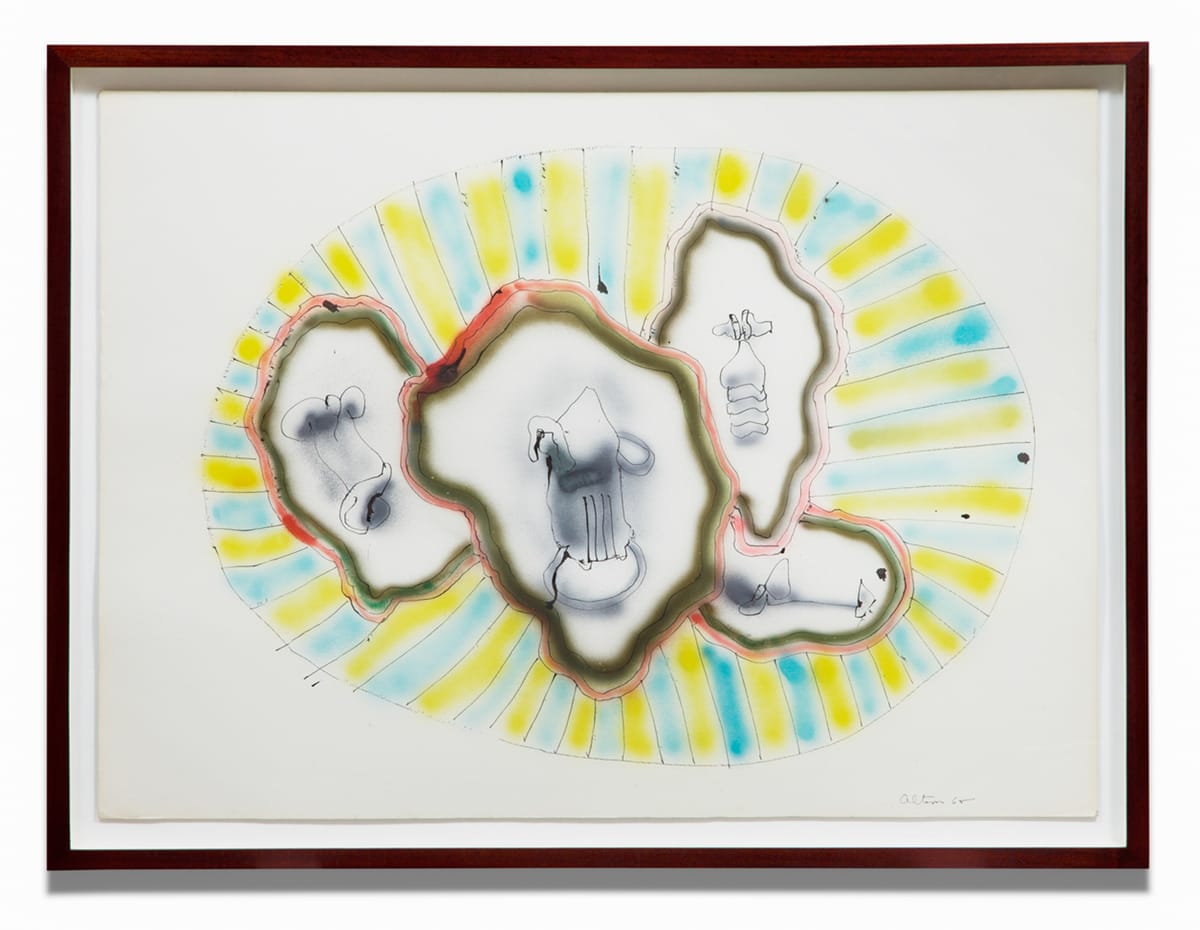
Altoon composed the more abstract “Untitled (ABS-52)” (1965) using an airbrush, pastel, and ink. Four overlapping, amorphous shapes outlined in red and khaki green sit atop a sunburst composed of blue and yellow rays. In each of the outlined shapes, he drew something that is palpable but still remains beyond comprehension — an invented thing.
When Altoon died, he was just coming into the height of his powers. He had mastered drawing and color, worked in different media, including pastel and airbrush, and developed a constantly morphing vocabulary. His openness to dreams and imagination made his work unpredictable (as in the drawing of an ostrich’s backside as the container for a screen). This is what drawing makes possible. Altoon believed that it could still be inventive after Pablo Picasso, Joan Miró, and Arshile Gorky. I love that he was right.
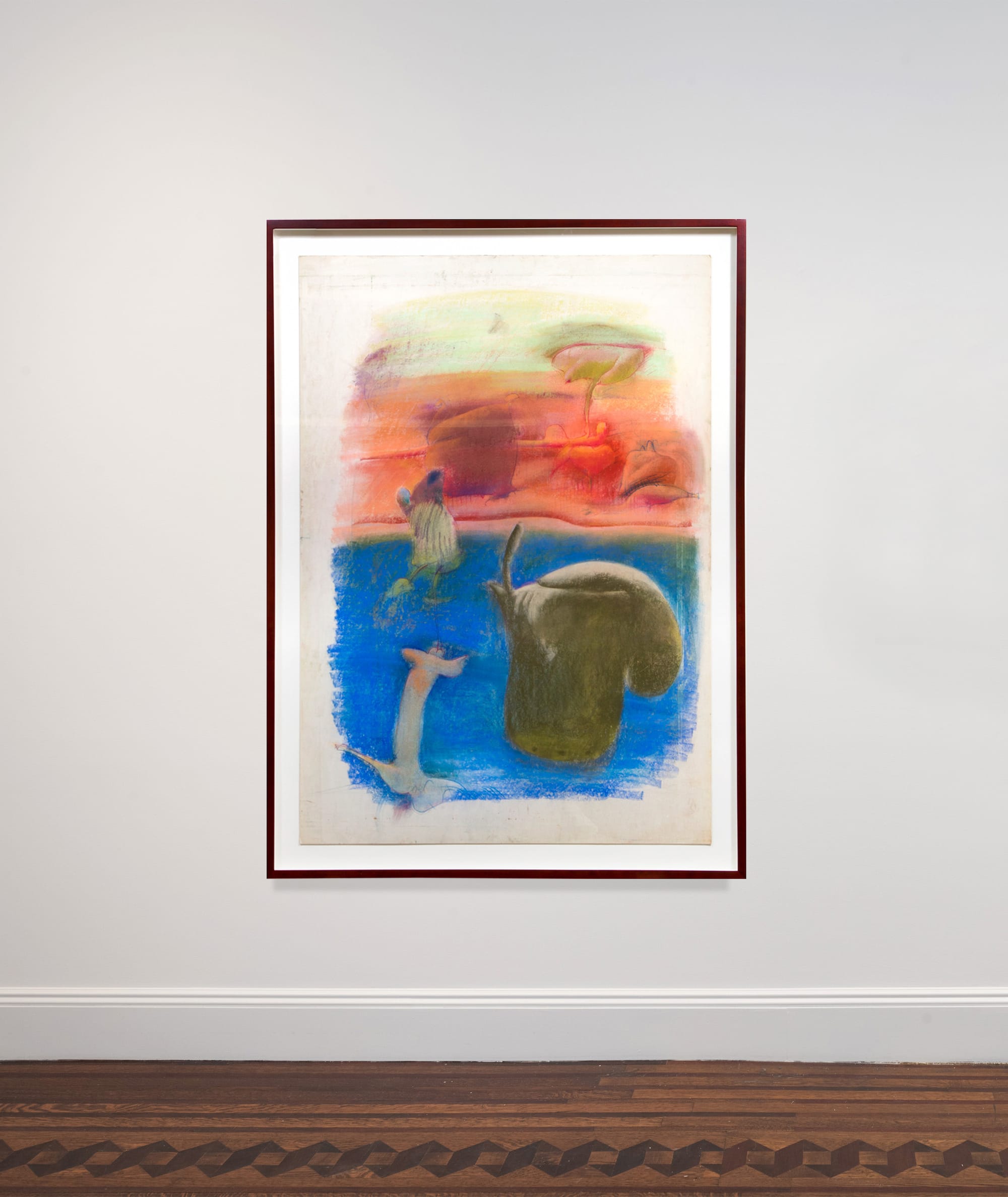
John Altoon: Drawings continues at Franklin Parrasch Gallery (19 East 66th Street, Floor Three, Lenox Hill, Manhattan) through February 27. The exhibition was organized by the gallery.