Joyce Kozloff Reveals Herself as Guerrilla Girls Founding Member
After decades of anonymity, the feminist artist and activist disclosed in an interview that she is the woman behind the mask of “Liubov Popova.”

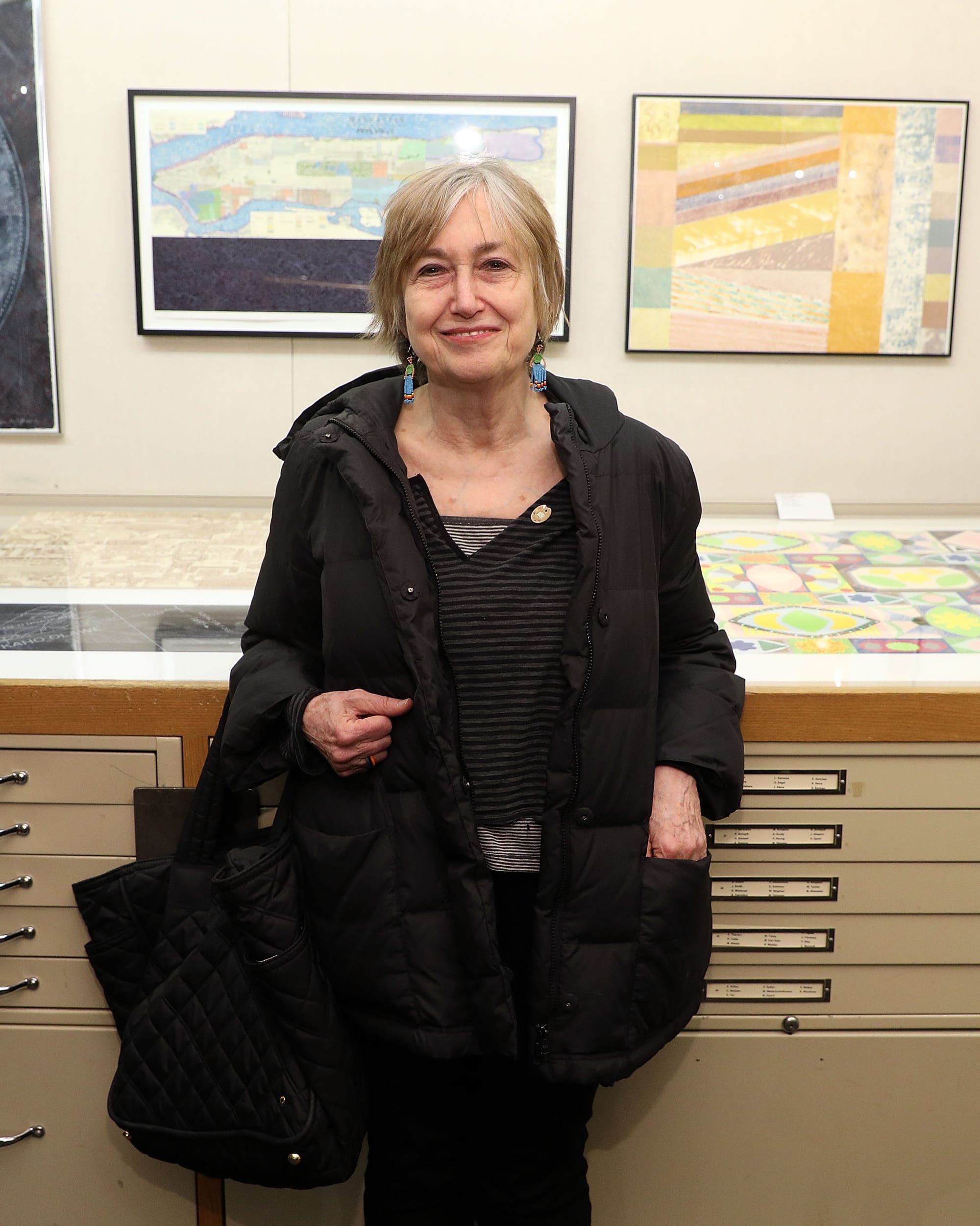
Artist and activist Joyce Kozloff has taken off the mask after 41 years, disclosing in a new interview with Art Journal Open that she was among the founding members of the Guerrilla Girls.
She also revealed that “Liubov Popova” was her assigned pseudonym within the collective, whose members took the names of late women artists to maintain their own anonymity. In 2016, she published a (sneaky) biographical essay in Hyperallergic that both examined and lauded the Russian artist's creative evolution and career milestones throughout her unfortunately short life.
“Remaining anonymous was an important Guerrilla Girls decision,” Kozloff explained to curators Maura Reilly and Helena Reckitt during her tell-all in the American magazine's Feminist Interview Project. “People thought this was to avoid art world reprisals. For me, that was never the reason. I argued for anonymity because I didn’t want attention to be on us as individuals, I wanted it to remain on the issues.”
The artist said that she and two others were among the seven inaugural Guerrilla Girls who had lived through the women's movement in the 1970s, and that the younger women in the collective proclaimed that people had become disinterested with feminism, outlining a need for updated language and visuals.
Having moved to Los Angeles when her husband Max began teaching at the California Institute of the Arts, Kozloff joined a feminist “consciousness raising” group that quickly radicalized her in 1971. This experience gave way to her role in co-organizing the Los Angeles Council of Women Artists (LACWA) that protested the paucity of female representation at the Los Angeles County Museum of Art.
Kozloff's role in the feminist art movement expanded upon her return to New York in the early '70s — she was among the inaugural members of the Heresies Collective, and her art practice and shift to public art bolstered the emerging Pattern and Decoration movement.
LACWA's data-driven protest model laid the basic framework for the Guerrilla Girls, which got its name after a new member misunderstood the title and brought a (now signature) gorilla mask to a meeting. Among the group's debut interventions was an ad campaign calling out the disparity between the number of women artists shown at the Metropolitan Museum of Art versus the number of displayed artworks depicting nude women.
The group's confrontational wheat-pasted posters directly named and shamed institutions, galleries, and collectors that maintained sexist and racist hierarchies, drawing immense publicity and curiosity about the Guerrilla Girls' identities.
“People were pissed and wanted to out us,” Kozloff told Reckitt and Reilly, adding that she was affiliated with the Guerrilla Girls until 1991.

The artist also revealed her hand in developing one of the collective's most iconic poster campaigns — “The Advantages of Being a Woman Artist” (1988). She told Art Journal Open that the project was born from her time in a residency house she shared with married male artists who had brought their younger affair partners along as homemakers and unpaid studio assistants.
“When I got back, I wrote a rough draft, 'The Disadvantages of Being a Woman Artist,'” Kozloff explained. “Until then, our posters always had verifiable statistics, so this was a stretch. But then, our clever members turned it around to 'Advantages,' and it worked!”
Four decades on, Kozloff thinks that there has been enormous progress in the representation of women in the arts sphere. But, she said, “I'm very much more concerned about the current threats to women’s progress in the larger political realm,” citing the overturning of Roe v. Wade, the far-right push to keep women at home, and the beauty industry's invasive emphasis on youthful appearances.
“But we can’t tell the next generation what to do, they will find their own ways,” she left off.