Designed to Move: Newson as Art at Gagosian
The latest exhibition by designer Marc Newson, titled Transport, at Gagosian Gallery raises some interesting questions about the future of design. Namely, is design art? Where design exhibitions are normally bogged down by oodles of information and panels of educational materials explaining curatori


The latest exhibition by designer Marc Newson, titled Transport, at Gagosian Gallery raises some interesting questions about the future of design. Namely, is design art?
Where design exhibitions are normally bogged down by oodles of information and panels of educational materials explaining curatorial choices the experience at Transport is vastly different. Here the design objects stand apart to emphasize their sculptural qualities. We’re obviously meant to approach them with a degree of veneration, and the spatial language suggests you are in the midst of the future … and luxury … and you should buy now.
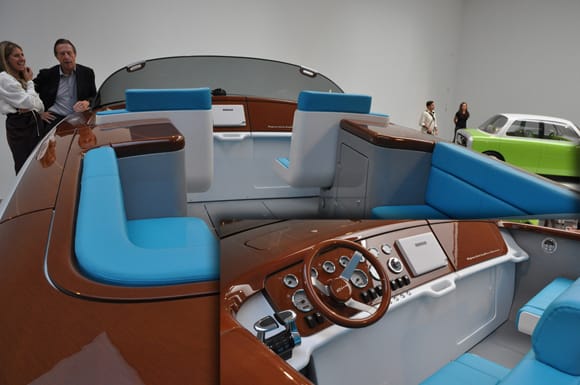
This is Newson’s third show at Gagosian and the first to focus on his transportation vehicles (plane, bicycle, boat, surfboard, sneaker … ). If the main attraction of this exhibition is the new limited edition “Aquariva by Marc Newson,” which is Newson’s take on what is being hailed (by their PR anyway) as a classic Italian icon, it is surprisingly the least interesting object on display. Sure its baby blue interior looks alluring but the shape or components don’t feel remarkable, original, or futuristic, all words easily applied to Newson’s more successful objects.
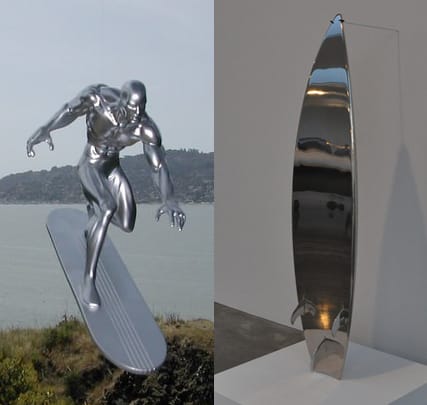
But beside a rather unremarkable boat there is a very stunning surfboard that made me want to learn to surf, “Nickel Surfer” (2006). Part futuristic mirror, part pop culture icon (anyone who has read Silver Surfer comics will understand), the object made a somewhat compelling case for a consideration of design as art since functionality seemed beside the point. In fact, I felt so confused by this totem of perfectly formed nickel — it is “grown” nickel I am told — that I felt the need to ask Newson if it was indeed a real-life usable object since it didn’t resemble any surfboard I had ever seen. He assured me it was, it was designed for 50-foot waves, and he even referred me to a catalogue that illustrated the fact. I was wow’d.
So, what do designers like Newson need or want from the contemporary art gallery that they don’t already have?
I asked Newson if he considered what he did art or design or if he even cared. “I have always shown my work in galleries … that project there [points at “Kelvin40” (2004)] was designed for the Cartier Foundation in Paris, and it was designed as an art work, although it could fly,” he said.

Does he feel the pressure of the market when he creates his objects? Does he worry if something doesn’t sell or is it even a consideration? “Sometimes it is, but sometimes it isn’t,” he said. “Something like that [he points to “Kelvin40” (2004) aircraft again] which was designed for the Cartier Foundation wasn’t designed to be a commercial project. The car, which was designed for Ford, 12 years ago now, was not designed to be a commercial project. A lot of these things have different [goals], people have different intentions for them.”
For a more extensive answer to the art or design predicament, I referred to Newson’s 2007 Gagosian catalogue, where he tackled the same question — using the same example — but with a little more elaboration:
‘Art or design?’ is as much a question of context as anything else. My work involves a constant process of ‘relocating.’ For example, I presented my plane “Kelvin40” (2004) at a cultural institution … instead of at an air show. That’s what gave the work its life. Similarly, presenting the current works in an art gallery releases them from standard interpretation.
So, Newson seems to be using his one commission by an visual art institution as a justification for his claim to “art” rather than “design.” It’s a strange assertion that isn’t very convincing, since isn’t intention more important than patron anyway?
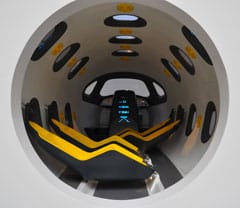
While the boat let me down, the plane didn’t move me, and the board confused me while offering a whack to my imagination, it was objects like his “Ford 021C” urban concept car (1999) and his “EADS Astrium Space Plane” prototype (2007) that made the case to view Newson as more than a conventional designer.
In the rather cramped spaces of a space plane and a compact car Newson was able to apply his particular brand of organic kidney-shaped forms in a manner that made them feel both luxurious and spacious. They are a wonder of perceptual manipulation. Seats pivot and turn in new and exciting ways, the materials look surprisingly warm and inviting, and he has made the future look simultaneously optimistic and comfortable. The fact that they may not be comfortable is beside the point as they fool you into believing they can or may be, which I believe is a feat of art (perception) rather than design (reality).
Marc Newson’s Transport will be on view at the Gagosian Gallery (522 West 21st Street, Manhattan) until October 16, 2010. For more photos from the show, visit my photoset on Flickr.