"Marina" Dares You to Laugh at Technology
Julio Torres and Martine Gutierrez's new performance is a grotesque parade of visual delights that defangs our toxic relationship to our screens.


Artistic attempts to contend with technology’s ever-tightening grip on our attention, institutions, and social abilities too often take the form of post-human fever dreams of the Black Mirror school — works that, while intended to be critical, easily devolve into discursive, cyborg-filled feedback loops. Julio Torres and Martine Gutierrez’s Marina, which premiered at Manhattan’s Little Island last week as part of the 2026 Whitney Biennial program, opts for a radically different tack: laughing at technology instead of fearing it, and winning our hearts rather than rotting our brains.
The air is humid with a storm that never materialized as audience members stream into The Amph, Little Island’s open-air amphitheater, on Thursday, August 26. Onstage, a figure in a burgundy pinstripe suit mouths wordlessly into a payphone set on a wooden dock suspended above a vaguely apocalyptic underwater mise-en-scène. Framed video screens playing water-wave patterns rise from coral outcroppings encrusted with rubber-tire bits, junk, and debris.
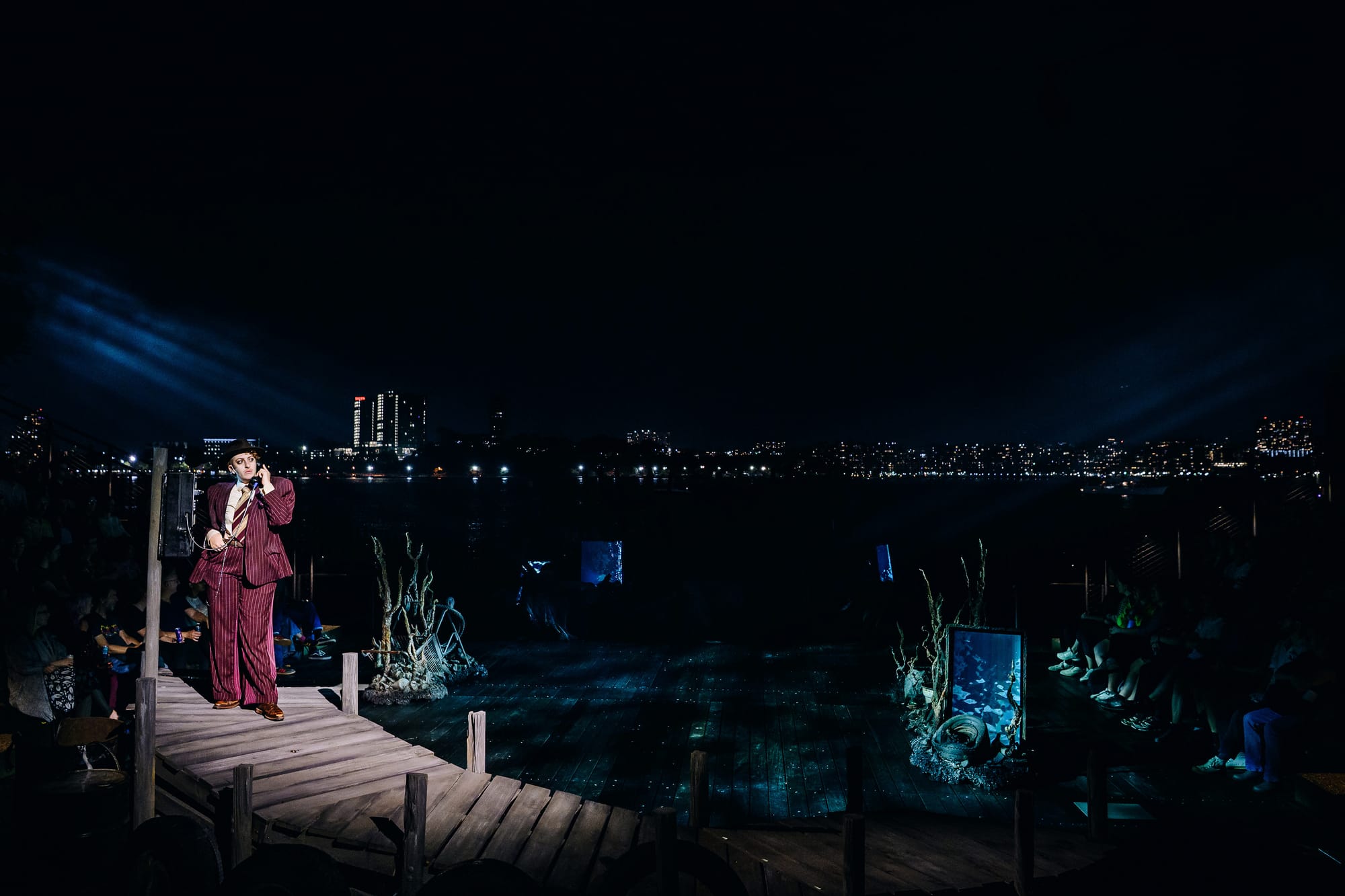
Down in the murky waters of the Gowanus Canal, we learn, reside a sea wench named Marina (played by Gutierrez), her overprotective older sister, and an anglerfish named Nano. They lead a parasitic existence, accruing the trash that sinks to the floor to reinforce their shells. No one seems to question their lifestyle until a distracted construction worker, barking his insecurities to his AI girlfriend while pacing the dock above them, drops his smartphone into the water. (“Is this a rectangle?” Nano asks, unironically.) Entranced by the device, Marina is drawn into a world of endless scrolls and highlight reels, where influencers peddle the familiar doctrine that a woman can find self-worth only through a man's validation. If this is all sounding very truth-universally-acknowledged so far, that’s because the plot of Marina is Frankensteined from paradigmatic tales of women scorned, from Homer’s Odyssey to Euripides’s Medea to Jennifer’s Body (2009).
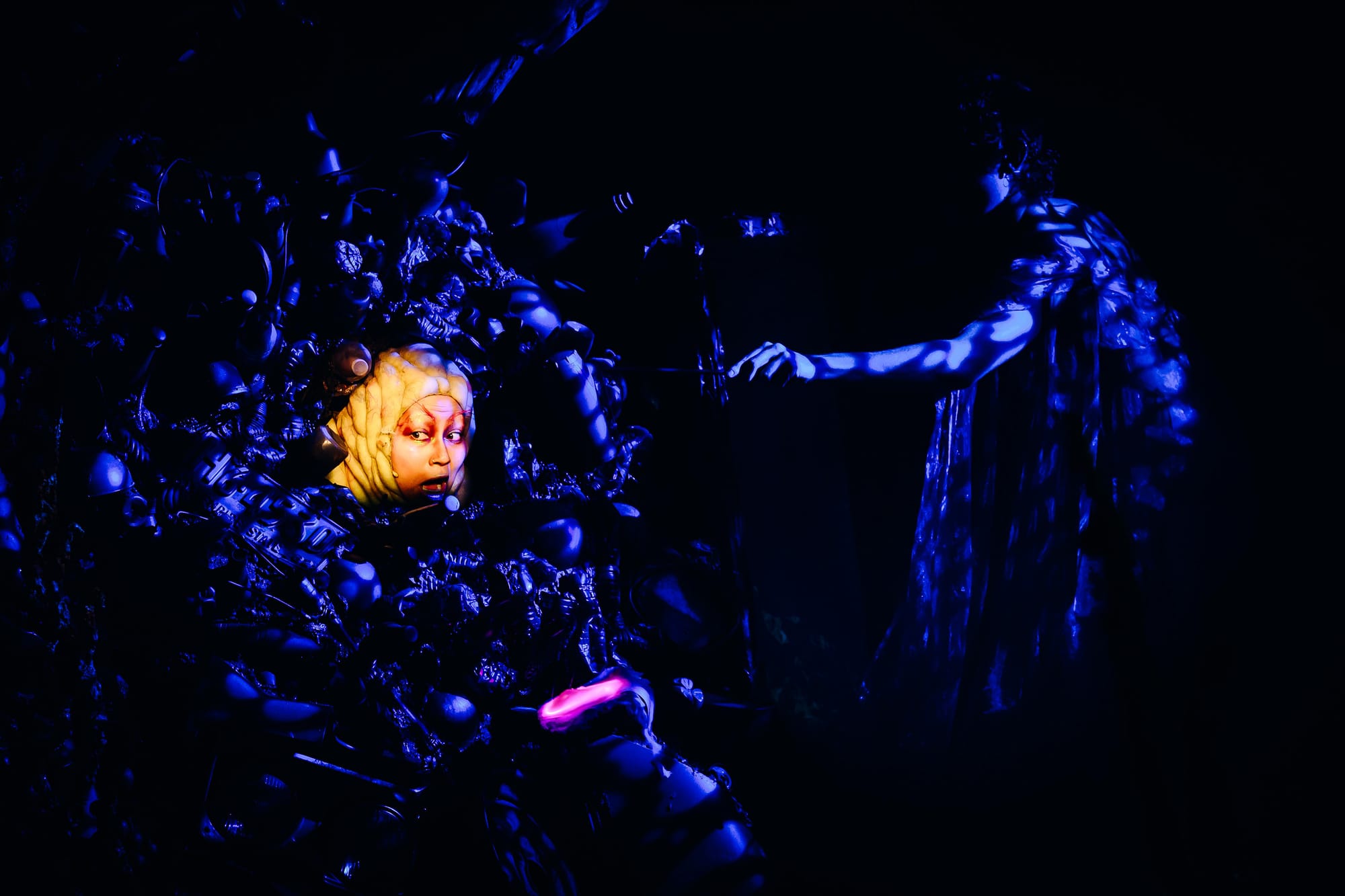
Our protagonist sets out with good intentions at first, snapping a candid selfie atop her garbage pile and uploading it to OkCupid, a platform that feels as dated a reference as the payphone. But no one swipes right, so she does what we all do online, to some degree or another: She pretends to be someone else. Marina finds her perfect alter-ego in a more conventionally attractive sea dweller, Ariel of Disney’s The Little Mermaid (1989), whose wide eyes and frizz-free red mane lure thirsty suitors like Jared, a “man of faith” who swears he’s 6’5 and a CEO but “will not be tasked with the emotional labor of dealing with your trauma.” In other words, they are not exactly a catch. When they realize they’ve quite literally been catfished and grow aggressive, they face the homicidal ire of Marina, their Apple Watches and motorcycle jackets becoming absorbed into her ever-growing junkyard ecology.
Back on terra firma, our pinstriped narrator, a detective, is determined to crack the case of the fuckboys going missing down below. She recruits a randy garbageman named Dino to go undercover (“I’ll make it worth your while, but not by a lot — I’m solving this case on spec,” she tells him.) But as the saying goes, there’s a lid for every pot, and in a twist of fate, Marina turns out to be exactly Dino’s type: large claws, “kinky,” no interest in deodorant.
Throughout this journey, Marina is faced with one of the greatest challenges of becoming oneself. She must learn to locate a sense of identity in her own existence, not in the men she kills or in the man she falls in love with, and certainly not in the carefully constructed chaos of the screen.