Nancy Shaver's Beloved Store in Hudson to Close After 30 Years
For many, Henry is a lot more than just another Upstate New York antiques shop.

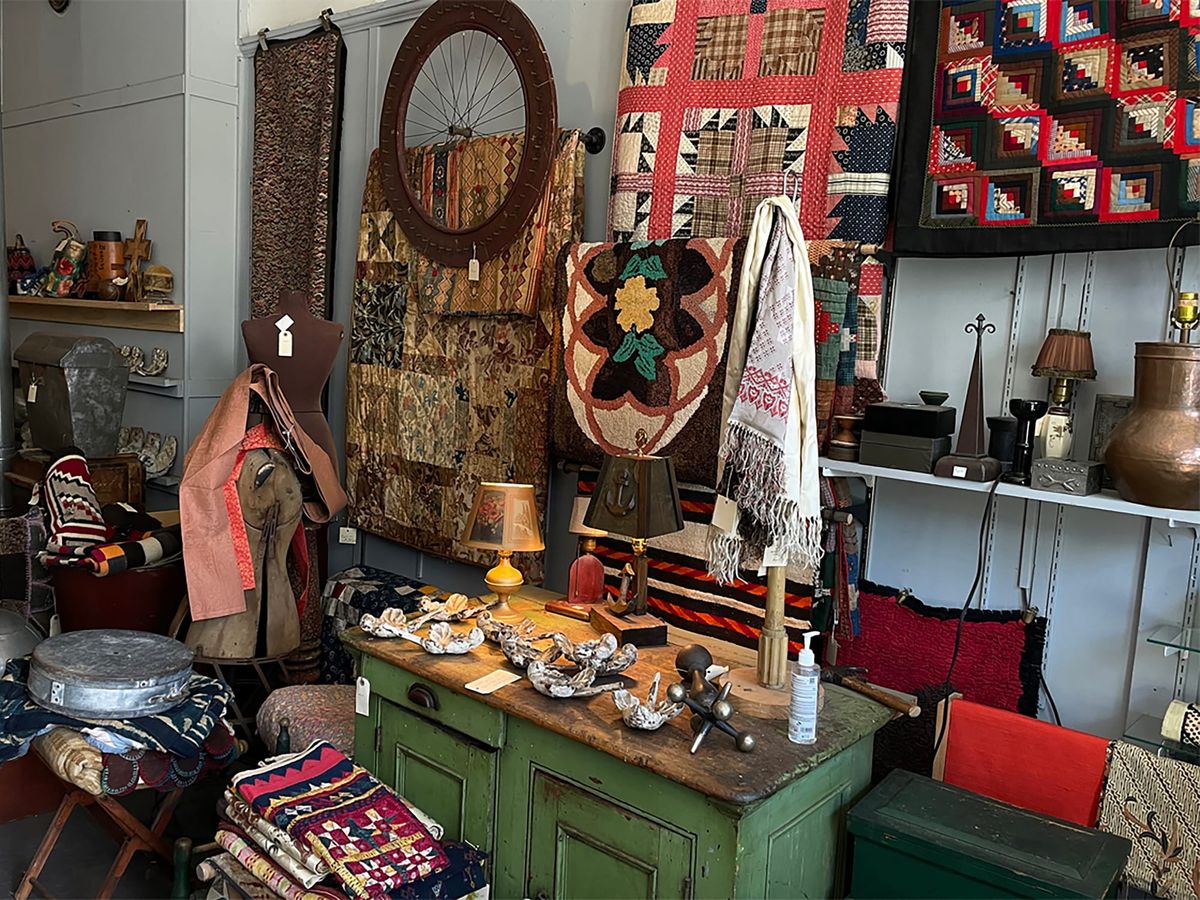
The artist Nancy Shaver’s store Henry, a beloved fixture of the antique world in Hudson, New York, for the past 25 years, is closing in mid-July. Henry is not just a store but a crucible for Shaver’s art-making. Her husband, the sculptor John Jackson, describes it as “a cornucopia of odd objects, shapes, and colors, a mirror of Nancy’s sculptural practice.”
Shaver, who considers Henry “my right arm, my left leg, my eye,” is philosophical about its closing, the result of her landlord’s needing his space back. “Small businesses are flowers of democracy,” she says. “And Henry has been my social life, my connection to the street. But change is part of an artist’s life, and Henry will be reinvented here and there as concise pop-ups, hopefully at art venues to remind the viewer that art is important at all levels.”
With its exuberance of objects and textiles, Henry flattens hierarchies between art and retail, and engages its shoppers —whether buyers or not — in demanding visual experiences. The first two pop-ups after the store closes will be at Pidgin in Oak Hill, New York, in October and at Parker Gallery in Los Angeles in November. In what follows, various friends of the store offer reflections on being there.

Kostas Anagnopoulos (poet, Rensselaerville, NY, and Jackson Heights): "Nancy’s Henry is suspended between an artist’s studio and an antique shop. Humility pulses through its objects, carrying a steady, unnameable weight: essential, uncertain in our gaze. Nancy’s form of “junking” is an uncompromising practice of attention — objects as extensions of her eye. Henry was formative to me, tempering my interest in provenance with a deeper attention to the thing itself: shape, color, texture, feeling. Henry is a kaleidoscopic theater for the useless (the highest praise) and the tasteless (her word), which shift through placement and care. And then you and the thing you’ve chosen are released back into the world, not for ownership, but for love."
Jean-Philippe Antoine (artist, art historian, writer, Paris, France): "I see Nancy’s shop, with its myriad constellations of objects and fabrics, as an extension of her sculptural work, with one important distinction: by buying objects, shoppers participate in the periodic movement and reordering of the installations she designs, according to a rhythm that depends haphazardly on sales and the taste of clients. This results in a mobile, shimmering and ever-provisional environment. To buy an object at Henry is to enter a small collaboration with Nancy's installation practices, while taking home the trace of that encounter."
Jared Buckheister (artist, New York): "Entering Henry, I switch from being motivated purely by impulse, to a more alert, questioning attitude: What are these objects and what is behind my desire for them? I’m standing there, looking everywhere, thinking about material, surface, production, and function, before asking: Will this suit my home? In most retail situations, it’s the other way around: value is organized around the lure of attraction, beyond taste and function. So, at Henry, it’s disorienting and wonderful to be placed under an implied demand from Nancy to trust my own taste and discernment. Then, suddenly, I find a lamp that’s perfect for my bedside."

Dawn Cerny (artist, Seattle, WA): "Like a Bonnard, there is color, texture, and scumbled, ambient chunks pushing up against one another, with no ceremonial empty space to rest. Narrow pathways lead you through ever-shifting layers of rows and piles: textiles, toys, notions, decorative handicrafts, and fantastical objects whose purposes have been lost to time. Most people take five steps into Henry, look around, grow overwhelmed, and politely turn to leave. For a loyal few, however, Henry is a pilgrimage: a rollicking material study collection that demands hours of rigorous looking, snacks, and all your money."
Mónica de la Torre (poet, Long Island City): "If poetry prolongs meaning, art prolongs seeing. On a recent visit to Henry, I could sense the gradual unfolding of vision in real time: my eyes recalibrating and adjusting to the shop’s dark interior, the tugging of the objects in the room on my attention. Once my gaze lingered on an item, the transformative effect of spotlighting it in my mind’s eye became palpable. Take a set of ceramic bowls fired in Vallauris, of Picasso fame, their glaze evoking swirling lava. Chance had given each a unique shape and pattern, a personality of its own. I couldn’t not have them."
Robert Gober (artist, New York and Maine): "I couldn’t go often or as much as I liked, but each time I walked in the door I saw things rich and irreplaceable. It isn’t the last store like this, but look at how the world is unfolding. In all its excess and confusion, Nancy taught me how to pay attention. And it wasn’t really a store. I mean, yes…it aimed to make money, but it was more like a vocation or a calling and will be remembered."

Richard Klein (artist, independent curator, writer, Norwalk, CT): "Usually, the roots of an artist’s aesthetic are revealed through written statements, critical investigations, or the artist’s spoken words. In Nancy’s case, all you need is to walk through the door at Henry. Yes, Henry is a retail shop, but it’s also an archive of honest, handmade, vernacular culture – presenting the art, craft, and design of mostly anonymous individuals, working outside the realm of high art. These objects and textiles represent the true cultural democracy that is the foundation of our increasingly stratified society."
Ann Lauterbach (poet, Germantown, NY): "At Henry, or in Henry, or about Henry, fact is there isn’t an adequate preposition for the immersive, beguiling, surprising encounters with (with!) the environment Nancy invented to traverse and complicate the mercantile exchanges between art, craft, use, and vision animating her Henry gathering of things. Nothing else compares. In the early days, there wasn’t a price tag, so she seemed to guess the price. Ask her for the provenance of a thing and you might or might not get an answer, since she mostly made her choices, her finds, by way of an impeccable eye for the anonymity of authenticity."
George Liu (artist, Hudson, NY): "For the past few years, I’ve helped Nancy rearrange Henry over and over. The wild and precise arrangements come out of necessity (these are the objects and space we have) and desire (how much seeing can we pack into each square inch). Henry brings forward the neglected edges of seeing — when my eyes leap, pause, glaze, avert, wander, question, fail, explode. These moments are given the same importance as when my eyes triumph. Henry insists on an experience of continuous seeing, every nook and cranny of it made synonymous with beauty."

Sarah Passino (poet, Queens): "Seeing at Henry made from words Nancy said or someone said to Nancy then Nancy said: Good morning, Sarah! Regarding rearranging, I’m on page 96, you? Open the door, use the fans. I’m offering Louie L’Amour, Marx. And how to respond to this — this combination of discretion, showmanship — without overdoing things? A perfect box. You get to decide. How the language melds with the painting. Angie stood in the doorway with a double-barrel shotgun. Angie stood in the doorway with a double-barrel shotgun. From both ends, feel this wool, modernism, tradition, carrying this fabric around learning from it. What was imagined? Unexpectedly: having stumbled in, syntax on the wall, abacus 95$. I trust my eye. Treacherous, alluring. The sun hung gold, red…So what? She opened your naive painting book, her daughter’s sparkling necklace of plastic. Look, each thing so full of language, color. Hi! You’re holding my favorite thing in the store."
Nora Peck (writer, Hudson, NY): "When I bought a house in Hudson in 2004, I became obsessed with Henry, a shop that inhabited a world of its own. Initially attracted to the comforting reminders of my mid-century childhood — mostly small, colorful 1950s plastic toys and objects — soon the larger things surrounding them caught my attention. I found myself drawn to what I’d never considered — primitive wooden plant stands, a perfectly faded wool quilt made from natural dyes, a pair of delicate milk-glass lamps. At Henry, I found not just goods but inspiration that made my house a home."