New School Faculty React to Plans to Lay Off 15% of Workforce
"There's an air of anxiety," Carrie Hawks, an assistant professor of illustration, told Hyperallergic of the newly announced cuts.

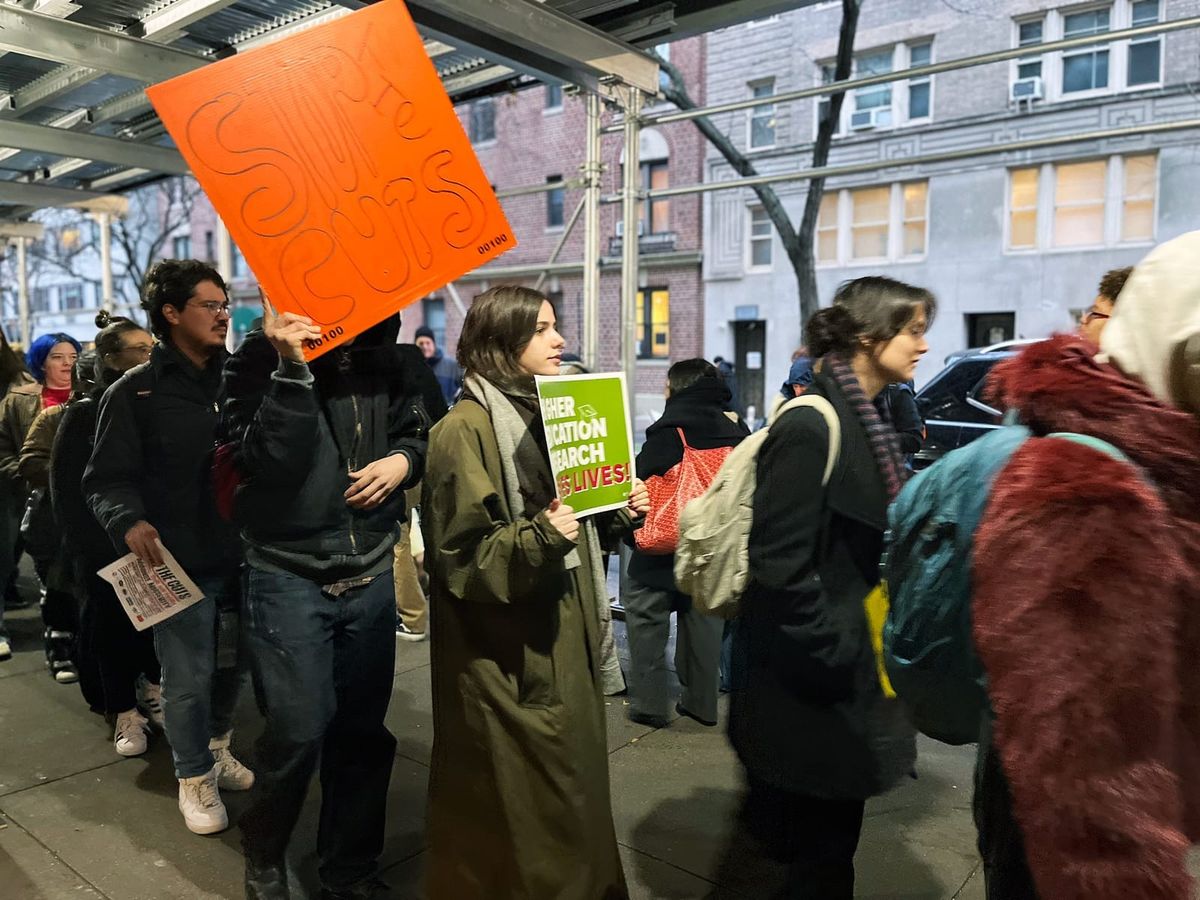
The New School plans to lay off 15% of the university’s full-time faculty and staff by mid-June, Provost Richard Kessler and Executive Vice President Fransico Pineda announced in a faculty-wide email on March 13, the Friday before the university’s spring break.
Amid a projected $48 million deficit largely attributed to enrollment decline, the New School’s upcoming layoffs come as the newest development in the university’s sprawling workforce reduction saga, which the American Association of University Professors (AAUP) called the “largest attempted firing of faculty currently taking place in the nation.”
In December, buyouts characterized as “voluntary separation packages” and “early retirement packages” were offered to 40% of full-time faculty and subsequently to Local 1205P and C unions, which represent clerical and professional staff working in student accounts, respectively, in February and early March. The buyouts made a 7% dent in workforce reductions, but administrators are looking to trim staff and faculty in alignment with a 20% drop in student enrollment since 2021.
“There’s an air of anxiety. Everybody’s waiting for the other shoe to drop,” Carrie Hawks, an assistant professor of illustration at the New School, told Hyperallergic. Hawks is on a four-year contract known as a renewable term appointment, up for renewal at the end of the current spring semester.
“There’s this messaging that many programs in Parsons are ‘safe,’ but we all feel this atmosphere of uncertainty, and lack of safety and instability,” said assistant professor of fine arts and BFA program director Catherine Telford Keough, who is also a working artist. The Parsons School of Design offers the majority of the New School’s programs in visual arts, design, and fashion.
In a statement to Hyperallergic, a spokesperson for the New School said the university, like other higher education institutions in the US, has experienced “enrollment declines due to shifting demographics, restrictions on international students, tuition costs, and other financial pressures.”
“Over the last year we developed a plan, working with many faculty and staff, to bring the university to a balanced budget by the 2027-28 academic year,” the statement said.
“Reductions among our faculty and staff are, unfortunately, a necessary part of this vital work, as 60 percent of our budget is allocated to personnel costs. We are aware of the heavy impact this will have on our colleagues and their families, and we are doing all we can to support our community through this time,” the statement continued.
The spokesperson noted that after voluntary retirements and separations, the New School will eliminate unfilled roles and make “further calibrated reductions,” and aims to reach its new operational size by the fall.
The range of the impending layoffs is unpredictable, but the reduction will fluctuate across departments, guided by restructuring efforts — the other measure the New School is taking to stabilize its tuition-dependent budget model. Beginning this fall, Parsons will merge with the College of Performing Arts, and the Eugene Lang College of Liberal Arts will join the New School for Social Research (NSSR).
While administrators Kessler and Pineda claim in the faculty-wide email that the two-college merger will “mirror the often-interdisciplinary nature of contemporary practice and scholarship,” the full-time faculty layoffs will disproportionately affect colleges with more significant program consolidation, like NSSR and Lang, which are shouldering the bulk of major merging and discontinued majors and minors.
Parsons is receiving the least program cuts and consolidation, and will most likely be the least affected faculty body, but “the suggestion that Parsons’ faculty should feel reassured because the cuts are landing on our colleagues is not really reassurance,” Keogh told Hyperallergic.
“One of the most damaging aspects of this process has been that the administration frames investment in Parsons as contingent on the divestment of other colleges, specifically NSSR and Lang,” said Keough. “When you hollow out NSSR and Lang, you hollow out what Parsons students really come here for.”
The restructuring efforts and consequential layoffs adhere to enrollment data suggesting that Parsons is the institution’s golden goose. Not only does this polarize disciplines at the level of administration, but it also is “a really destructive way of positioning fine arts education [as] somehow disconnected from thinking and research.” Keough continued.
For now, Hawks and other full-time faculty across the New School are focusing their efforts on organizing.
“We aren’t sure what’s happening right now, and that’s why we’re trying to unionize,” the assistant professor said.
Hawks is a part of a full-time faculty union organizing committee originally formed in May 2025 that is urging members to sign digital union authorization cards. Keogh has signed one.
“We’re hoping that more full-time faculty join us in this effort. The part-time faculty have some protections with their contracts, but I think it’d be better if all the faculty who are working with students have similar protections, so that we can all work together,” Hawks said.
Editor's note 3/27/26 11:30am ET: This article was updated with a statement from the New School.