Paint Isn’t Just Paint at the New York Studio School
This exhibition of painters Brenda Goodman, Steve DiBenedetto, and Bendix Harms pushed me out of my comfort zone.


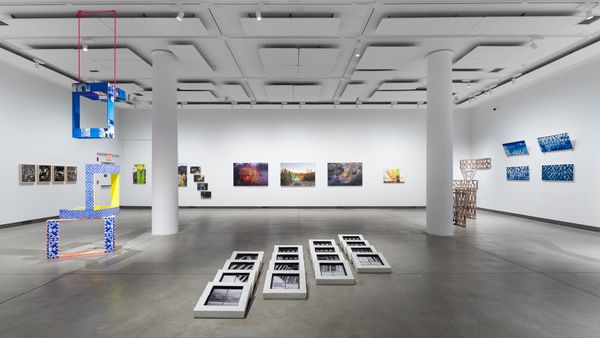
I went to This Heat at the New York Studio School, curated by Jacob Brooks and spread across two galleries now twice the size after recent renovations, to see the works of Brenda Goodman and Steve DiBenedetto, and learn about those of Bendix Harms. I have followed and written about the first two for many years; I knew nothing about the last.
I was intrigued by the exhibition announcement because it paired two longtime veterans of the New York art world with someone unknown to me. Was there a formal connection between these artists, and what was it? I have long felt there was a complex and nuanced dialogue within contemporary art about the relationship between abstraction and figuration, opacity and transparency, as seen in Goodman and DiBenedetto's work. I also believe that neither has settled into a signature style nor succumbed to the pressures to be simultaneously socially relevant and self-serving, our current Scylla and Charybdis that few contemporary artists have successfully navigated. They have not turned their back on the world; they have addressed it in unexpected and disarming ways, with humor and imagination. How would Harms’s work add to this dialogue, and did it have to? There was something off-kilter and unscholarly about this grouping, which we need more of in curating.
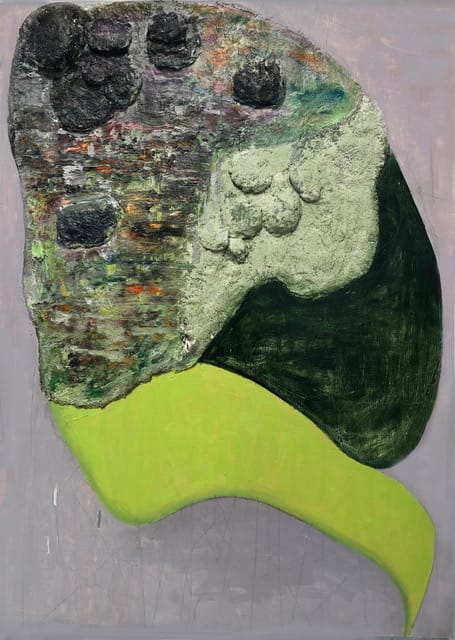
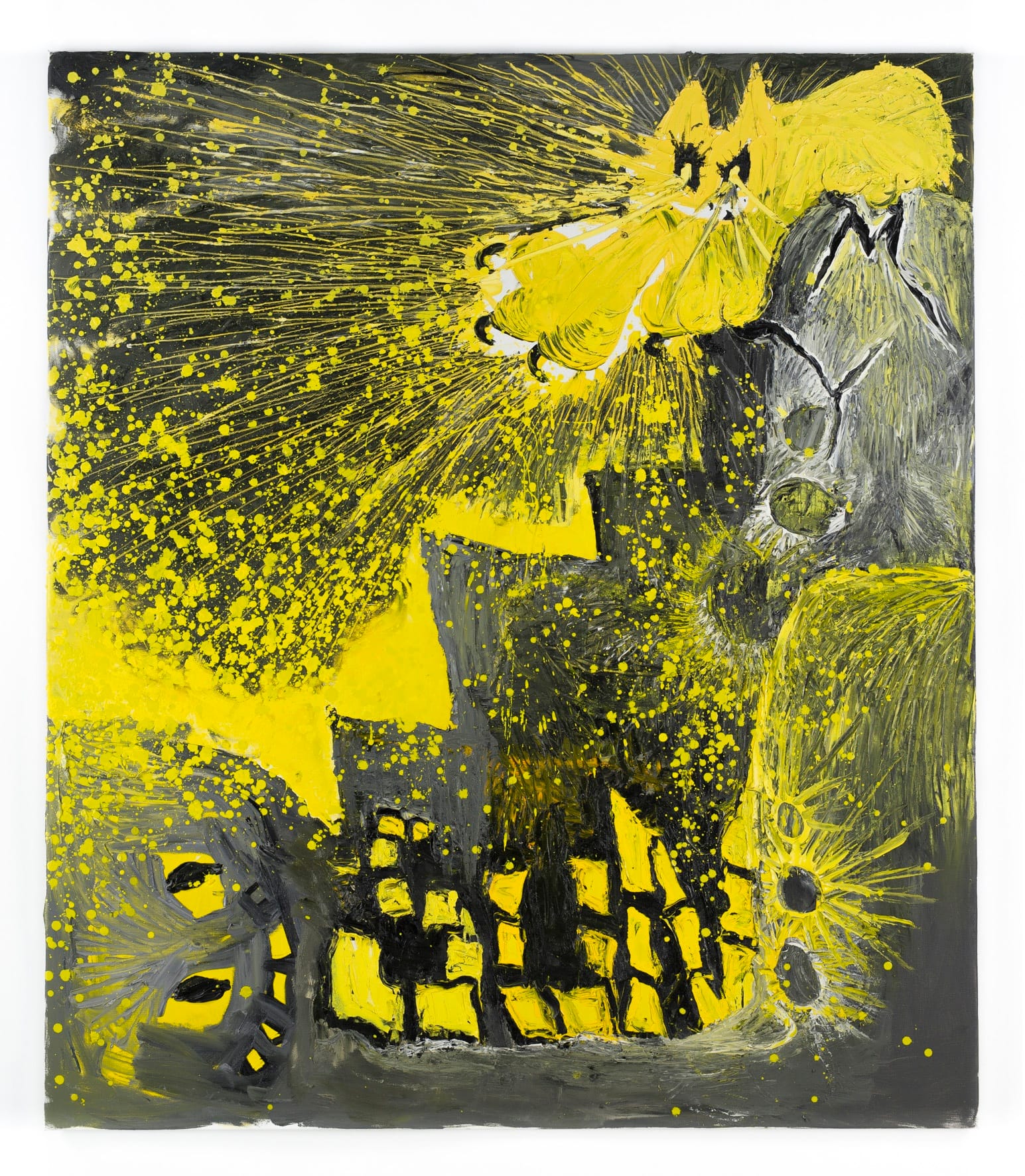
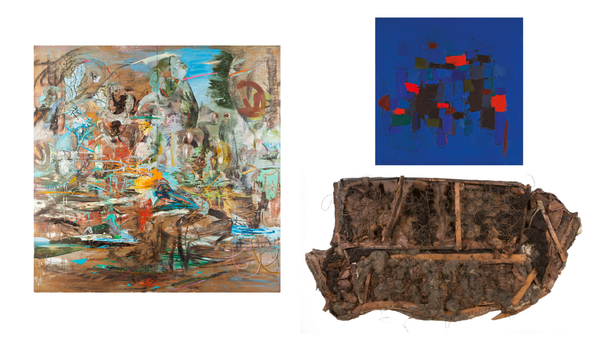
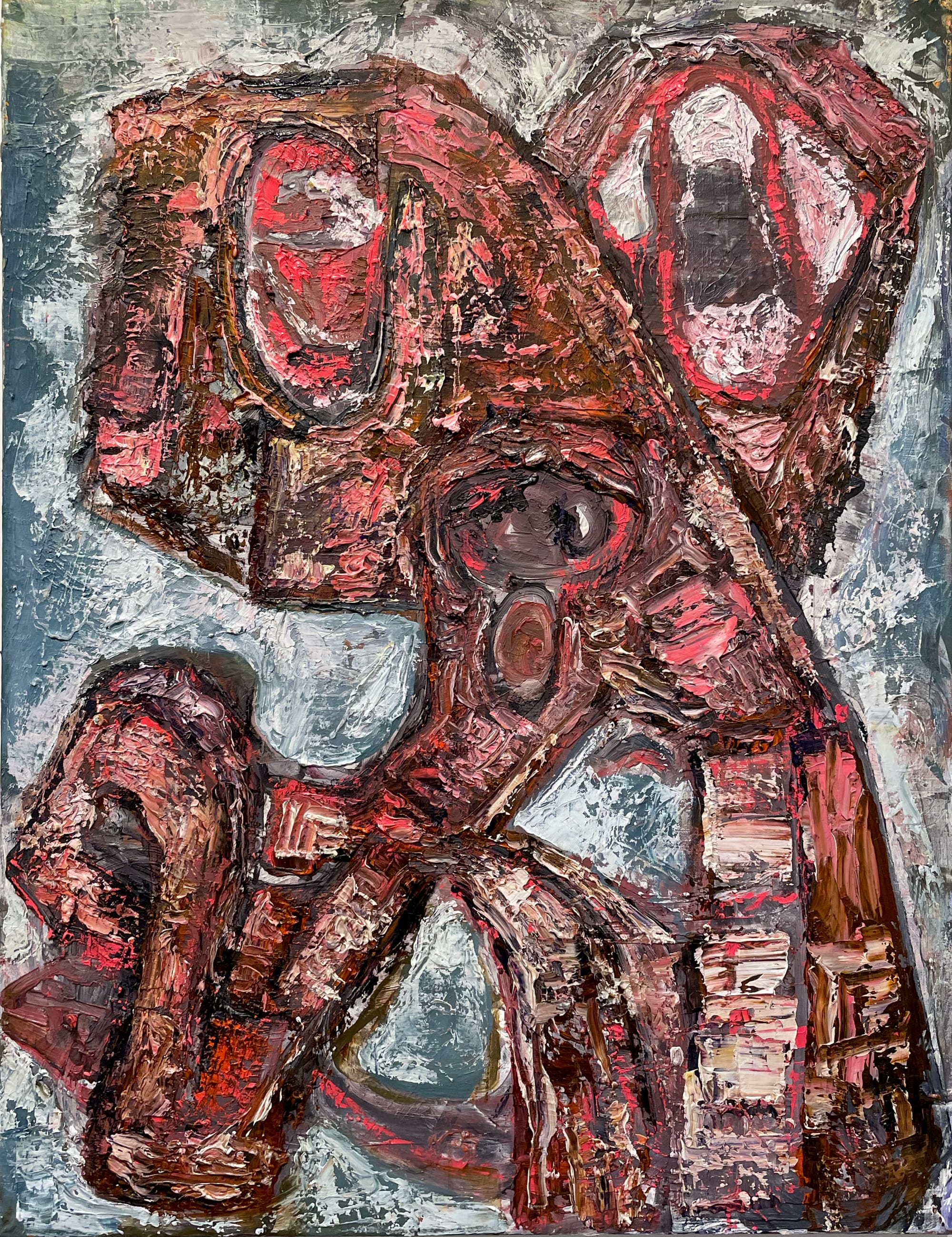
Left: Brenda Goodman, "Covid 5" (2020), oil, mixed materials on wood; right: Bendix Harms, "My Sun" (2018), oil on canvas
There are 17 works in the exhibition. Three are by Harms, with the remaining 14 evenly divided between Goodman and DiBenedetto. This imbalance required this viewer, at least, to keep changing my focus to see what was strong about each artist individually, to consider the ways they were and were not in conversation with each other, and to try and downplay this consideration to see the works for themselves. This presented an unexpected but not unwelcome challenge, pushing me out of my comfort zone.
I decided that comparing the work of these artists was a dead end. Together, Harms’s work consisted of less than one-third of the exhibition, though having a non-New York artist was a great intervention because the New York Studio School has often struck me as an insular atmosphere whose pedagogy was based on a narrow idea about art. After leaving the show, I sat in the school’s reception area and read the brochure Brooks wrote, learning that Harms is inspired by his immediate circumstances and paints directly on canvas using a palette knife. I decided to dig deeper and learned that he is a 59-year-old German artist living on a remote farm in northern Denmark.
In “Tears of No Return” (2020), we see a flattened, layered space occupied by two large birds (one green and the other blue) with puffed-up chests, a black cat with yellow pupils and lines of blood dripping from its mouth, and a large turquoise green face with one eye visible, crying. A turquoise arm and hand hover protectively above the green bird, which has four red claw marks embedded in its chest. The comically grotesque view conveys the violence of a world occupied by predatory cats and defenseless birds. The man’s tears emphasize his inability to ensure that harmony prevails. What’s he supposed to do? Punish the cat and deny its natural instincts?
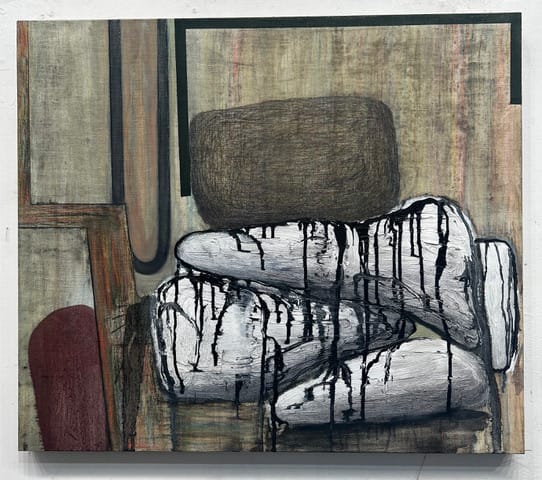
Harms’s humor inflects the work of Goodman and DiBenedetto in unexpected ways. Goodman has stated that her work is about “pain and sadness.” Done between 2020 and 2026, the six paintings of varying sizes and one intimately scaled work on paper include titles such as “Covid 3” (2021), “Covid 5” (2021), and “Not That Again” (2024). Moving between abstraction and figuration, and across different mediums, Goodman roots her paintings in personal experience but never quite becomes narrative. In “Mounting Thoughts” (2024), a painting I kept returning to, I could not tell exactly what I was looking at. Three conical shapes lie in a pile on a table, which tilts up toward the picture plane.
The brown shape on the left and behind the pile could be the tops of one-piece chair backs. We seem to be viewing a gloomy room. Does the pile of grayish-white cones refer to the mounting thoughts alluded to in the title? What is the black oozing out of the spaces between the forms, and where do they come from? Throughout her seven-decade career, Goodman has moved back and forth between the explicit and enigmatic without losing any power. “Mounting Thoughts” falls on the side of the opaque. I did not expect the oddball absurdity of the painting, which became more apparent because of the proximity of Harms’s weirdly cheerful, brightly colored paintings.
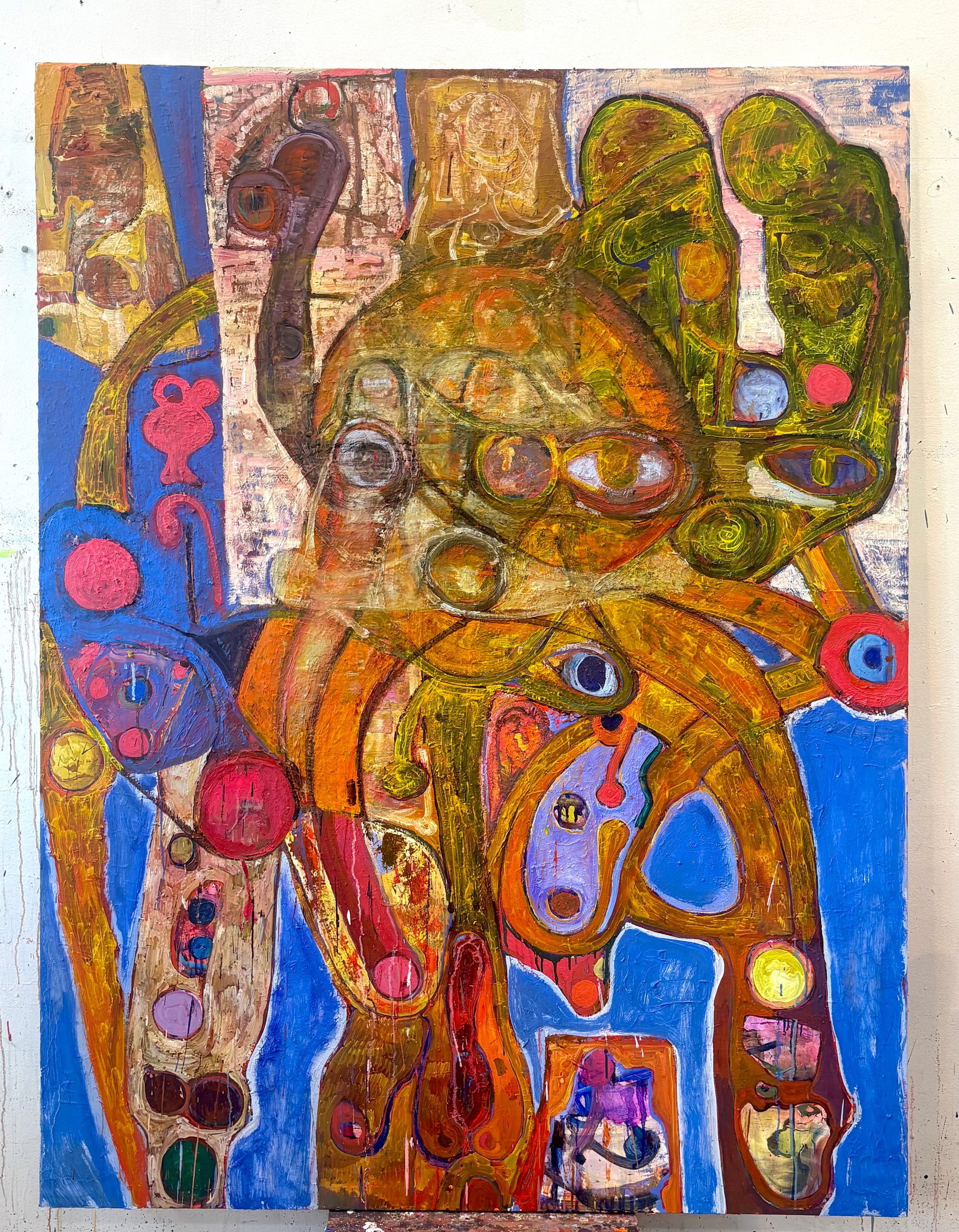
Many of DiBenedetto’s paintings strike as a weird combination of the grotesque and comic, like an armless creature trying to apply lipstick with its nose. That humor, which I see as arising out of anger, despair, and tenderness, marked by a commitment to exploring altered states, infuses these process-driven paintings with figural presences that seem both primordial and post-apocalyptic. Like Goodman, I always feel like I am looking at something that exists — a lifeform — but cannot name. In “Isotope Plus" (2026), the largest painting of the seven DiBenedetto works in the exhibition, a flattened, multi-limbed form takes up much of the luminous blue ground. The latest incarnation of the artist’s long preoccupation with octopi, this form seems like a body turned inside out; there are vacuoles of color (or are they eyes?) dispersed across the orange and brown surface.
While I have been looking and writing about DiBenedetto’s paintings for a long time, it never occurred to me before that the paint could be seen as an ectoplasm, a spiritual substance or energy excreted by a body in a trance state. Psychical researcher Gustav Geley’s description of the material as "very variable in appearance, being sometimes vaporous, sometimes a plastic paste, sometimes a bundle of fine threads, or a membrane with swellings or fringes, or a fine fabric-like tissue" echoes DiBenedetto’s paint surfaces. Paint is not just paint.
The feeling that paint is more than just a physical medium comes through clearly in the work, connecting him with artists as diverse as Alfred Jensen and Antonin Artaud, who believed art could open the viewer’s consciousness to a higher order. At the same time, with titles such as “Lettuce Leaf Control Panel” (2026) and “Your Problem is Obvious” (2026), DiBenedetto associates the artist with the shaman trickster. That tension between serious and self-mocking, cosmic and comic, is a much-needed breath of fresh air in this narcissistic world.
This Heat: Brenda Goodman, Steve DiBenedetto, and Bendix Harms continues at New York Studio School (8 West 8th Street, Greenwich Village, Manhattan) through October 18. The exhibition was curated by Jacob Brooks.