Painter David Hockney, Who Made the Everyday Otherworldly, Dies at 88
His work over a prolific six decades ranged from psychologically precise portraits to luminous depictions of California pool sides.

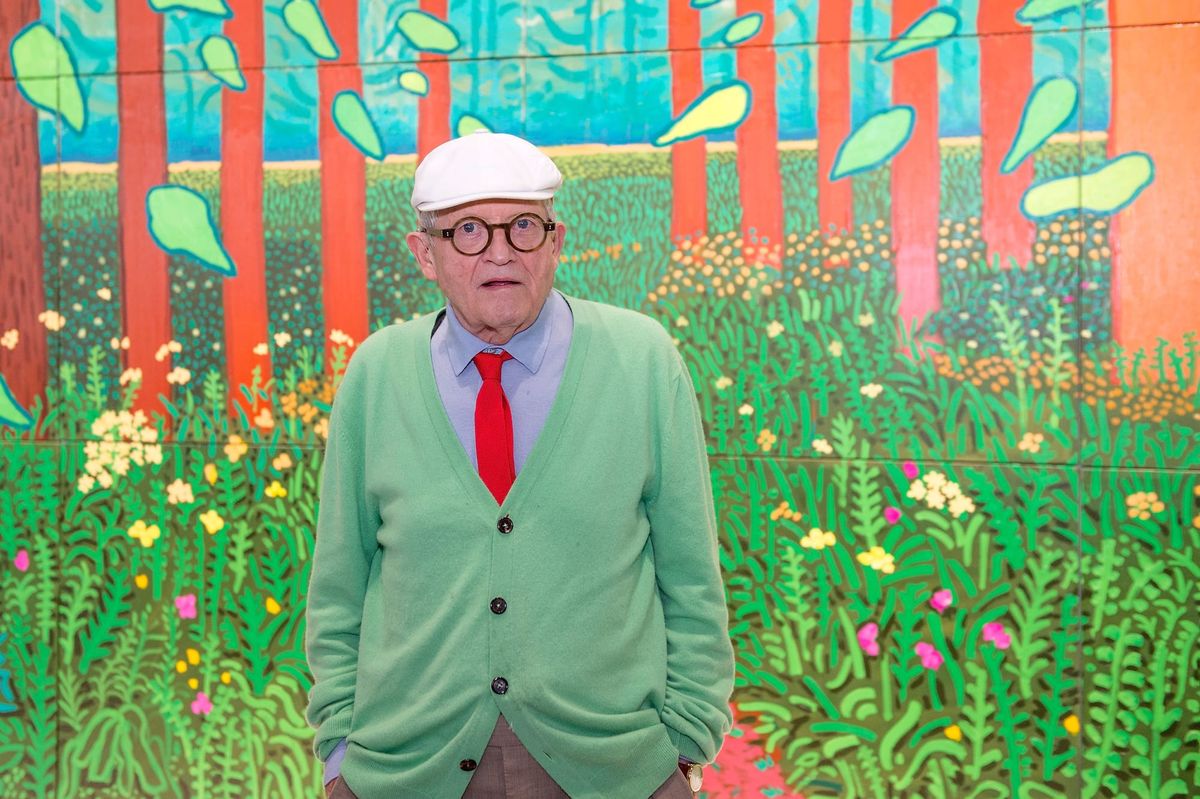
David Hockney, long regarded as one of Britain’s greatest contemporary painters, died yesterday, June 11, at his home in London, aged 88. His survivors include his partner, Jean-Pierre Gonçalves de Lima, and his brothers, John and Philip Hockney. His death was announced by his publicist.
Best known for paintings that imbued the everyday with an otherworldly stillness, psychologically precise portraits, and crystalline pool scenes, Hockney also explored printmaking, photography — even stage design for ballet and opera — across his prolific career of more than half a century. He was a restless experimenter, using computer graphics in his work as early as the 1980s and exploring digital painting on his iPad late in life. He was a pioneer of LGBTQ+ rights — one of the first popular artists to create work depicting gay relationships, and one of the few to publicly denounce censorship of queer imagery.
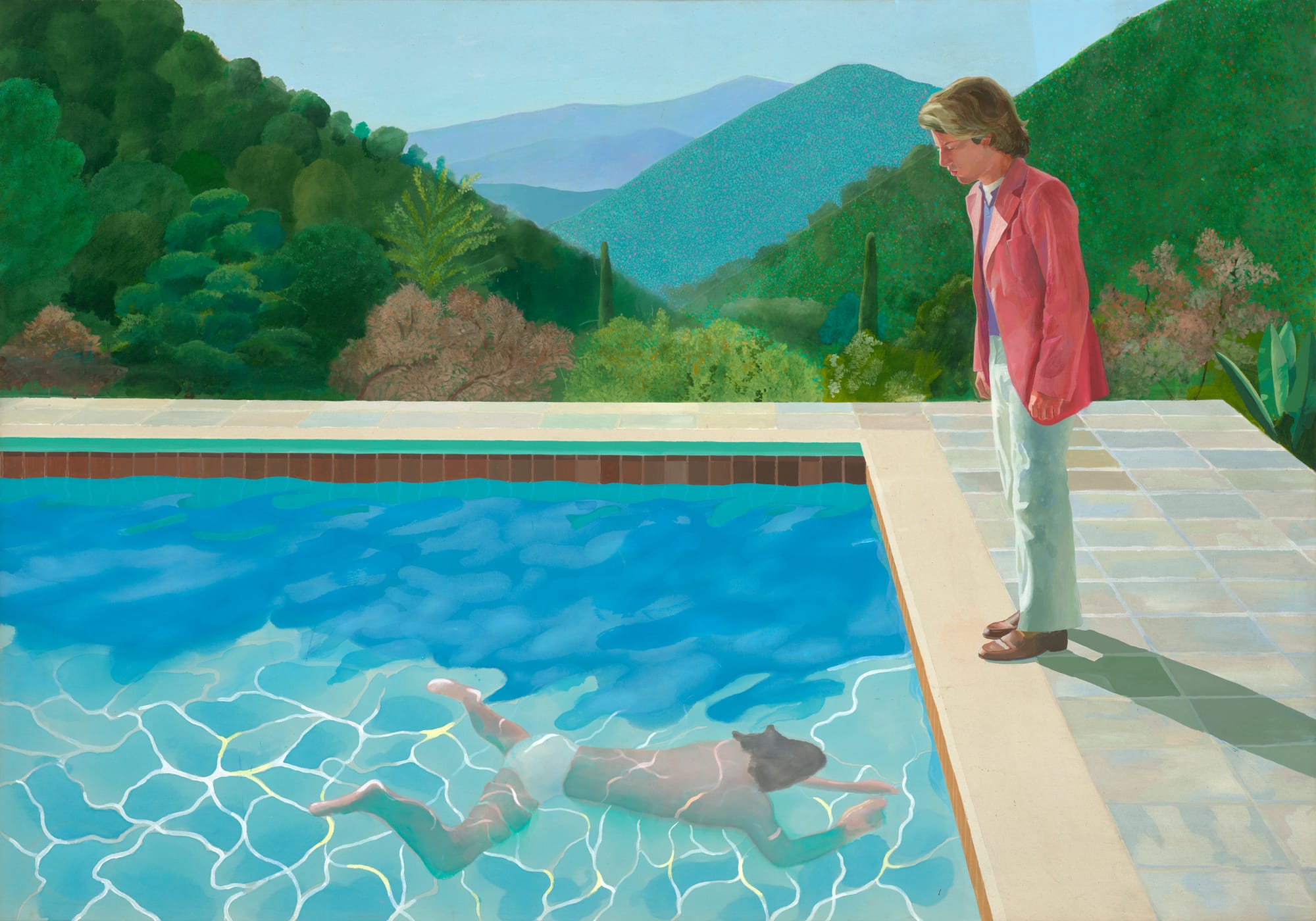
His colorful, stark paintings of sunny California poolsides captured a distinctive 1960s cool — simultaneously carefree and erotic, with darkness and yearning lurking beneath those pristine blue surfaces. “Portrait of an Artist (Pool with Two Figures)” (1972) — one of his most iconic paintings, which broke auction records when it sold for $90.3 million in 2018 — depicts a man in a pink jacket, lush greenery behind, looking down into the light-streaked pool, where another hovers underwater.
Born in 1937 in Bradford, England, Hockney was raised in a working-class family as one of five siblings. His father restored baby carriages and campaigned against nuclear arms, passing down to his son a pacifist streak and Labour Party loyalty, while his mother became a frequent subject of his paintings. In 1953, he won a scholarship to the local Bradford School of Art, studying there through 1957. In 1954, at age 17, he made a self-portrait in collaged newsprint, scrutinizing himself with sober, ferocious intensity. His talent was apparent: “The colors are already promising — or threatening — to blaze out of control,” critic Michael Glover wrote in a review for this magazine, “to shape and define the emotional temperature of the whole.”
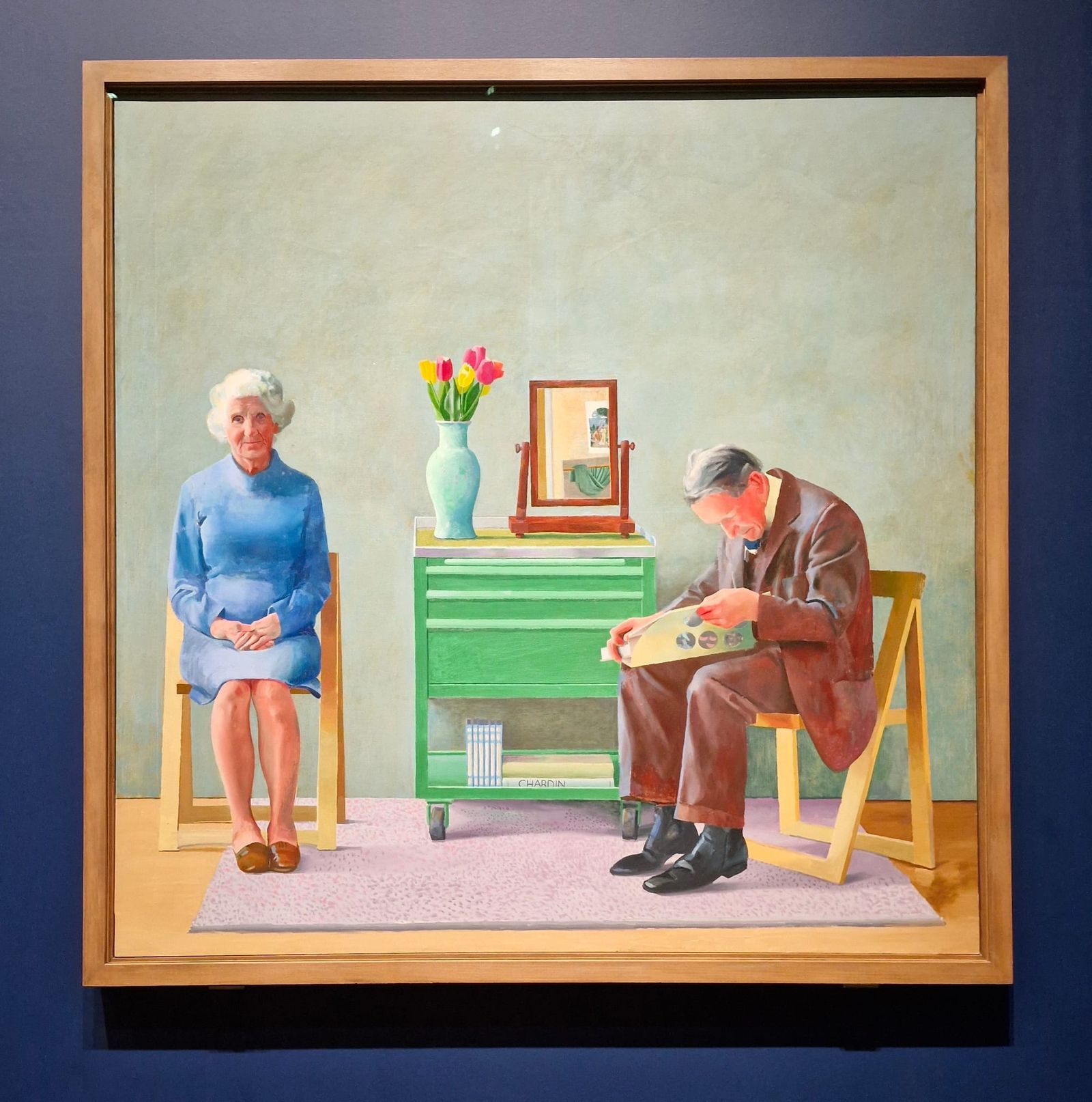
Between 1959 and '62, Hockney attended the Royal College of Art in London, where he sharpened already formidable draftsmanship skills and tried out and discarded various styles, from Hogarth-inspired perspective to Picasso-esque figuration. He began the first of many visits to the United States in 1961, drawn by what he perceived as a less sexually repressive environment than the United Kingdom. He went on to split his time between the two countries and teach at colleges in the US between 1964 and '67, including in Iowa, Colorado, and California.
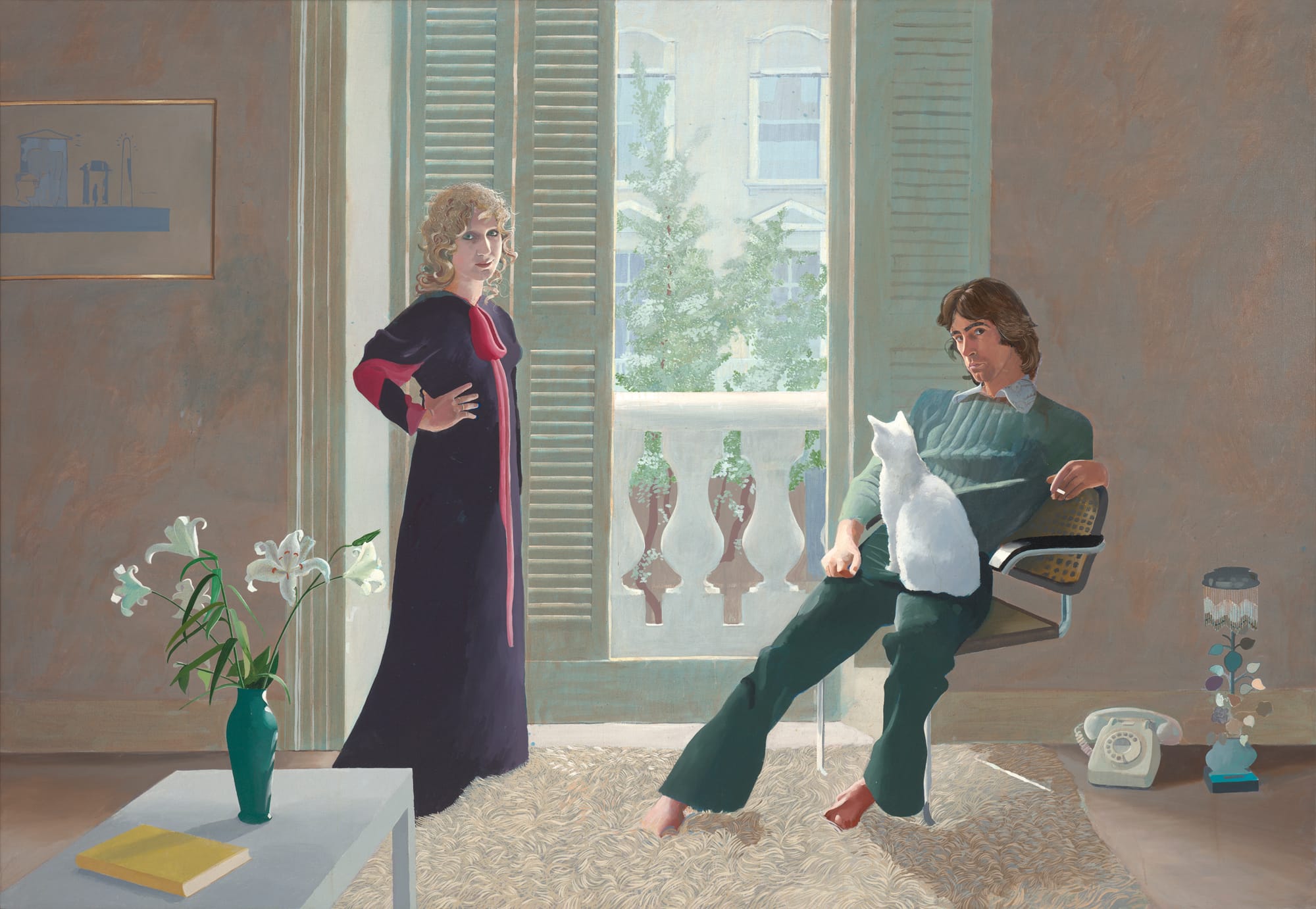
Hockney often captured the same people — his once-lover Peter Schlesinger, assistant Mo McDermott, gallerist John Kasmin, fashion illustrator Celia Birtwell — over and over again in psychologically sharp portraits over decades, chronicling them as they aged from fresh-faced youth to hard-weathered maturity in styles academic, loose, and experimental. In “Mr. and Mrs. Clark and Percy” (1970–71), one of the many double portraits he made, Birtwell stands proudly before the closed shutter of a balcony window in a royal-purple robe, while designer Ossie Clark lounges before the open side, his bare feet buried in a shag carpet.
He first visited California in 1964, where he met Schlesinger, one of his most enduring subjects, as seen in “Portrait of an Artist (Pool with Two Figures)” and "Peter Getting Out of Nick's Pool," which earned him the John Moores prize in 1967, the same year the British government decriminalized homosexuality. Jack Hazan’s semi-fictionalized documentary, A Bigger Splash (1974) — which Hockney initially recoiled at before coming to appreciate — dramatized and chronicled their break-up. In 1978, Hockney settled in Los Angeles, where he would live for several decades.
“I thought I was a hedonist at the time, but when I look back I was always working," Hockney told the Guardian in a 2015 interview. "I am always working."
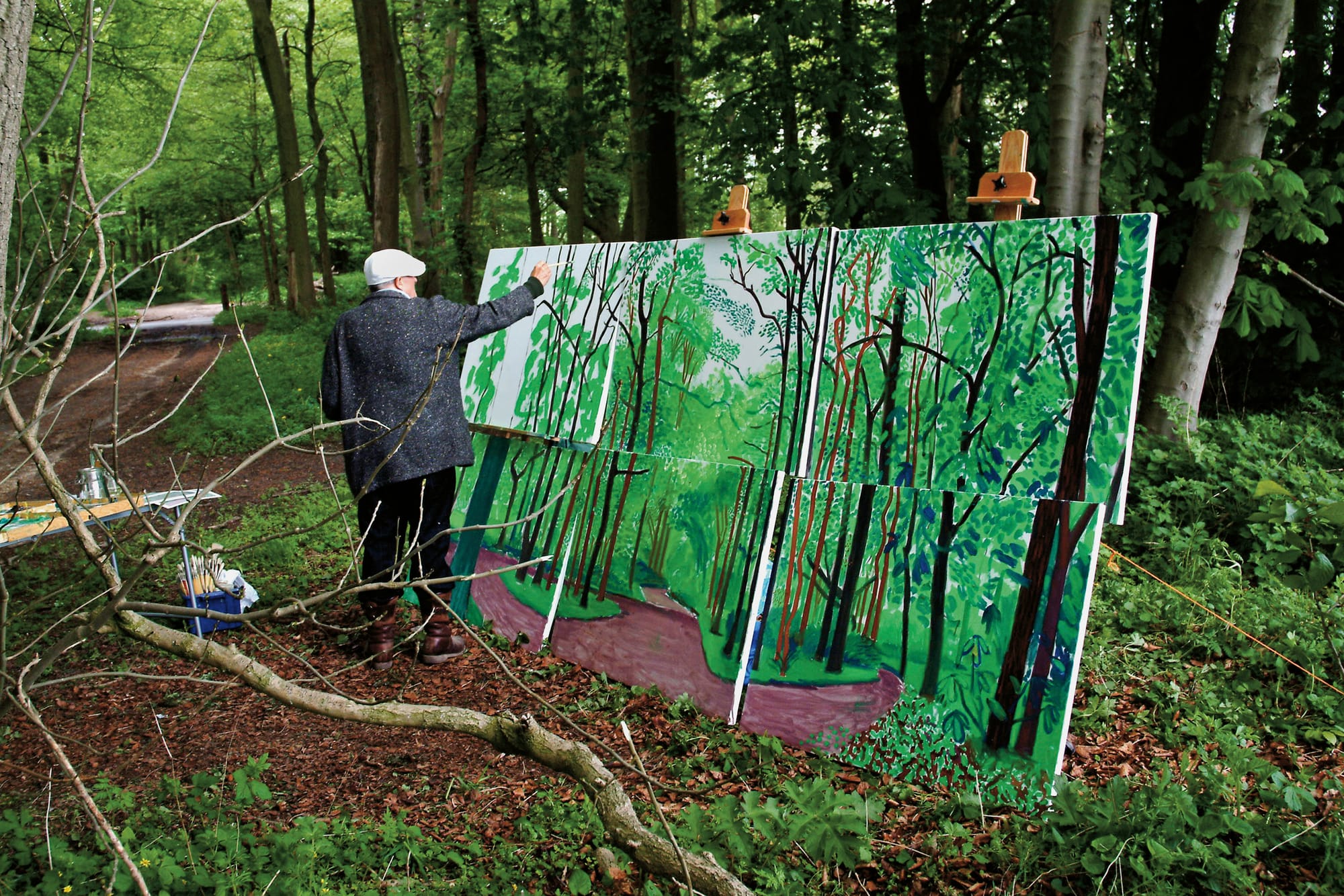
In the 1970s, Hockney started incorporating photographs — which he had long used as reference images for his paintings — into collages. He continued his experiments with one-point perspective into the 1980s, creating intricate images out of many Polaroid pictures arranged in a grid. One work from 1982 depicts his mother in a rainy graveyard, his own feet visible in the foreground, a moving portrait of widowhood. In the 1990s, Hockney turned his attention toward abstract landscapes and returned to his hometown of Yorkshire in the 2000s, where he began to chronicle the English countryside.
Eventually, Hockney became a household name. He painted a portrait of British pop star Harry Styles in 2022 for a show at the National Portrait Gallery that opened in 2023 after delays due to COVID-19. In 2024, the National Gallery of Art in London paired Hockney with 15th-century painter Piero della Francesca, an homage both to the institution’s 200th birthday and Hockney’s longtime love and use of the collection.
Hockney received numerous honors and accolades, turning down British knighthood in the 1990s and receiving the Order of Merit, the nation’s highest royal award in the arts, in 2012. He was the subject of major solo exhibitions at the Whitechapel Art Gallery in 1970, when he was in his early 30s; the Musée des Arts Décoratifs in Paris in 1974; and the Los Angeles County Museum of Art, the Metropolitan Museum of Art, and the Tate in 1988. In celebration of his 80th birthday in 2017, a retrospective traveled to The Met, Centre Pompidou, and Tate Britain — where it became the institution's most-visited to date. A blockbuster exhibition consisting of more than 400 works at the Louis Vuitton Foundation in Paris closed less than a year ago.
"He was always completely and courageously himself, both in his work and in life," Alex Farquharson, director of Tate Britain, wrote on Instagram. "He taught us about the joy of looking, seeing things the rest of us failed to notice - his witty and sharp observations a constant presence within his work and in person."
Hockney worked until the very end, even as he began to lose his hearing and started using a wheelchair. As Glover wrote: “You do what you can. He does what he does. What else is there? The key is: don’t stop until the darkness descends.”