Processing the Unbearable, Imagining the Radical
To RISD’s graduating class, I say: The most necessary work comes from the willingness to stay in the discomfort of the open question.
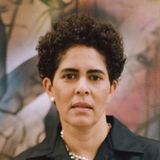
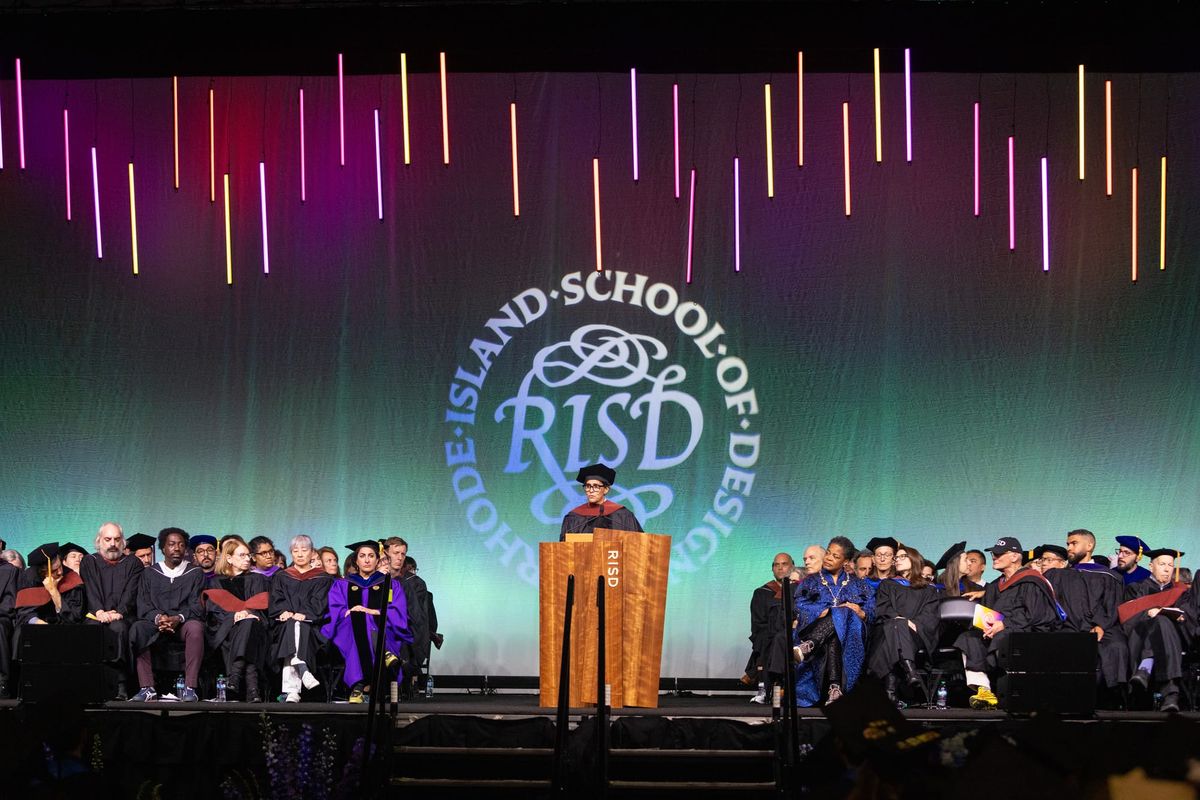
Editor's Note: The following text is the Rhode Island School of Design Commencement Address delivered by Julie Mehretu on behalf of the Class of 2026.
I. Arrival
It is an honor to be here with you today. I remember this moment. I remember standing where you are standing, in this city, and feeling the light, the way Providence glimmers, the water, the hills, feeling all of it at once — the nervousness, the joy, the strange relief of having finished something genuinely hard, something that asked everything of you. Before I say anything else, I want to congratulate you. You have already done something radical, before today, before this diploma. The most radical thing happened years ago, when you made a choice that the world around you probably questioned — maybe gently, maybe not so gently. I know those voices and the internal drive to create without knowing what that fully meant. I grew up in Michigan in a family that had come from Ethiopia, that loved art but was not steeped in contemporary art, that loved me and wanted a life for me that would sustain me, one they could understand. So much of who I was becoming challenged a lot of the assumptions from where I came — being queer, working as a server in restaurants for years, wanting to pursue a life in art. The path to a place like this, to a life made entirely of making and thinking and seeing, was not laid out for me. I had to find it, and then I had to insist on it, against real uncertainty and real doubt, including my own. I say this not to make this moment about me, but because I want you to know that whatever distance you traveled to get here (geographically, culturally, financially, personally) is not incidental to your work. It is inside it. It is part of what you see that others don’t — your parents, the economy, every algorithm optimizing for certainty and efficiency, every voice that asked, “but what will you do with that,” every cultural signal that said, “creativity is a luxury, making art is a detour, the real work of the world happens somewhere else.” You said no to all of that. You bet four years of your life (two or three if you are a graduate student), your late nights, your all-nighters, your failures, your breakthroughs, your entire formation as a thinking, feeling, making human being, on the belief that conjuring something into existence that wasn’t there before is not a waste of time, that it matters, that it might be the thing that matters most. That choice was the beginning of the work — the hard, necessary, endless work of reaching into what I can only call the radical imaginatory, that place of deep creative possibility where what doesn’t exist yet becomes thinkable, where the world as it is starts to give way to the world as it could be. You have been living inside that practice for these years at RISD. Today you carry it out into everything, even if that is a job waiting tables, or working for Pixar, or working with the architect or designer you have long admired.
II. The Apology
Before we celebrate though, we owe you an apology. The world we are handing you is in a precarious situation and feels genuinely broken — ecologically, politically, institutionally. The promises of the twentieth century, of modernity, progress, growth, the forward march of liberal democracy and modern technology, have not delivered what they promised. And our generation — the people who were supposed to steward these systems and reimagine them, who had every tool and every warning and every opportunity to invent something better — has failed to measure up. Instead, we have continued the old extractions. We have let new technologies serve old hungers. We have fed a global rise of right-wing extremism and fascism that is now eating at the foundations of democratic life itself. We have allowed wealth to concentrate at a scale that makes a mockery of every promise of shared prosperity. We have watched international law become shredded, awful and unnecessary wars and genocides unfold, and somehow found ways to place our bets on violence rather than restoration, on profit rather than empathy or possibility, on imprisonment rather than restorative justice, on narrow mindedness and paranoia rather than enlightenment and renaissance or the generous and the new. And our technologies (which could have been the instruments of something genuinely new) have largely become engines of the same old extraction, moving faster and with less accountability than anything that came before: robotic armed machines, fire-throwing dogs, an AI race that serves accumulation rather than generative imagination, social media that has shattered a collective reality of truth. This is what we’ve accomplished with our best tools. I’m not going to soften this or pivot away from it too quickly because you already know it. You’ve lived inside it. It is your inheritance. You deserve to hear someone stand up here and say it plainly. We are responsible for this — all of us who came before you, every generation that had the tools and the warnings and the opportunity to choose differently and didn’t (or not entirely, not enough). It’s a shit show out there. And you are the ones we are handing it to. I know that’s a heavy thing to say on a day of celebration. I know you didn’t ask for this inheritance. But I also know who is in this room. I know what you have spent the last few years learning to do. And I do not believe it is an accident that this particular question — how do we reimagine what we’ve nearly destroyed? — has landed in the hands of people trained in the radical imaginatory.
III. The Mushroom
A few years ago, during the first months of the pandemic shutdown, I found a book that I keep returning to. It’s called The Mushroom at the End of the World, by the anthropologist Anna Lowenhaupt Tsing. On the surface it is a book about a fungus — the Matsutake mushroom, a delicacy in Japan that can command extraordinary prices. But it is really a book about a question, a question I want to put to you today: what can live in the ruins we have made? The Matsutake is one of the strangest things in nature. It cannot be cultivated. It will not grow in healthy forests, in managed environments, in controlled conditions. It grows only where forests have been destroyed by human activity — logged, burned, poisoned, in the wreckage, in the places we have given up on. And yet it doesn’t simply survive there; it flourishes. It becomes something extraordinary. And in doing so, it begins the slow work of making the forest possible again — not the forest that was, but something new, something that couldn’t have existed without the destruction that preceded it. The Matsutake doesn’t restore the forest. It makes something that never existed before, out of conditions that seemed to make nothing possible. This is a story about radical invention, not restoration — about fruiting in the wreckage rather than mourning what was lost. Around this mushroom, Tsing finds an entire emergent ecosystem (human and more than human, economic and ecological, spanning continents and cultures): Japanese gourmets, Hmong jungle fighters turned foragers, Finnish nature guides, Yi Chinese goat herders, capitalist traders. All of them arise in the margins, in the precarious spaces between the old world and whatever comes next. All of them generate meaning, connection, even beauty, in the ruins of something that failed. She calls it “collaborative survival,” and to me it feels like such an affirmation in how I think creative work is made. The question the Matsutake poses — what manages to live and fruit, thrive and generate new life, in the ruins we have made? — is an artistic question, a design question. It is the question that everyone in this room has been training to answer, whether they knew it or not.
IV. The Studio as Epistemology
As a painter, some of my most instructive moments come out of process, and I would like to share some of what I have learned in the studio — not as biography, but as encouragement. When I am working at my best, my brain is not in charge. That sounds strange to say out loud, but every artist in this room knows exactly what I mean. There is a state you enter (some call it a flow state). You have all entered it, in your best moments, in the late nights, in the work that surprised you — where the hand seems to know something the conscious mind does not, where decisions get made visually, intuitively, pulling from everything you have ever seen and studied and felt, and from something that feels like it comes from nowhere, where chance enters and you follow it, where serendipity becomes a method. I want to be precise about what this is, because it is built, not bestowed. Intuition is a developed sense, earned slowly through the discipline of paying attention, through constant curiosity about everything — the way late afternoon light comes into the studio and changes what you thought you knew about a color, the way one painting reflects into another in a mirror and something in the oblique glimpse, the thing seen sideways, suddenly becomes the central question, the way the material talks back to you if you are willing to listen. This is a skill, one of the most demanding and important skills there is. And what it requires above all is patience and a genuine embrace of not knowing — not knowing as an internal sense of possibility rather than paralysis, the unresolved as the place where the real work lives. When I let my brain try to direct my hand, when I try to think my way to the painting, it closes down. It becomes self-conscious, derivative. The most necessary work comes from the willingness to stay in the discomfort of the open question, to resist the urge to conclude before the thing is ready to conclude. What I am describing is one of the hardest and most disciplined practices available to a human being, the practice of remaining open inside uncertainty, of making something from nothing, of reaching into the radical imaginatory for a thing that did not exist before and could not have been planned. And this work is never done alone. What we make in the studio is made in constant discourse with our ancestors, cosmic pasts and speculative futures, with other artists, with your closest friends, with the work you love and the work that challenges you, with the books that broke something open, the film that showed you a different way of seeing, the music that got inside your body and rearranged something. All of it participates in the creative process. All of it is in the room with you even when no one else is. Lean on each other. Work collectively. Build the kind of relationships where you can interrogate not just each other’s work but each other’s assumptions, especially the assumptions you don’t yet know you have. Those are the most important ones, the ones so deep they feel like facts. What I want to instill in you today, in this wounded, fractured and extraordinary world, is this: that practice is the answer to the crisis we are handing you. What artists know — what you know, what the last several years in these studios have trained into your hands and your eyes and your nervous system — is something different from what the world is reaching for. You know how to question the assumption before you accept it. You know how to sit with not-knowing long enough for something genuine to emerge. You know how to imagine what doesn’t exist yet with enough rigor and strangeness that it starts to become real. That is the work. I know this because I learned it here, at RISD. This is where I first had to unlearn everything I thought I knew about painting, about making, about what it meant to have a voice. It’s where I had to shed imitation, shed the temptation to follow trends and follow the safe path, and instead find something that could only come from inside me, from my own experience, my own life, my own particular way of seeing. That work — the work of becoming genuinely inventive rather than derivative — began here, in these studios, in this city, under teachers who refused to let me get away with the easy answer. And now it’s yours, as practice, as the thing you carry forward and deepen for the rest of your life. You remix, chop and screw, sample and reinvent. You take the wreckage of culture and make something new, including new language and neologisms with a fluency that astonishes. You can hold so many realities together with a seemingly cynical nihilistic irreverence, like so many of the memes created and shared that are impossible for me to mention up here, but you all know what I mean — old tame ones like “this is fine” (the dog sitting serenely in the burning room), or of our leaders making a mockery of themselves, or our political/social tragedies (think Epstein to hantavirus, processing the absurdity of the dumpster fire of our reality through humor sharp enough to cut). And underneath all of it, there is something I find genuinely moving: a palpable, almost defiant desire for a different kind of future, a cynical, irreverent optimism that functions as a sophisticated form of processing for a speculative futurity. You know what it means to live and create inside the non-binary, contradictory, the complicated, and the non-sensical. That is exactly what it looks like to live inside the ruins and refuse to stop imagining. The Matsutake flourishes and thrives where nothing else will grow. So how can you? How can we?
V. The Demand
Trust the work. Trust the obsessions that brought you here — the exuberant and sometimes inexplicable desire to make something that has never existed before, the beauty you reach for, the poetics that move you, the thing you are trying to conjure from the radical imaginatory. It is not a luxury. It is the potent instrument. The world you witness — unstable, contradictory, violent, breathtaking, sublime, unresolved — is already inside your work. Art and culture are not made elsewhere and brought back. They come from witness, from feeling, from the refusal to look away. What moves you deeply in the studio comes out of the world you inhabit, the world you are paying attention to, whether you name it or not. Beauty and poetics carry weight. They are how human beings have always processed what is unbearable, imagined what is not yet possible, and kept alive the sense that something else could exist. A painting that stops you in your tracks, a building that changes how you feel in your body, a piece of design so right it seems inevitable and yet somehow vulnerable — these are arguments about what the world could be. They always were. Artists know something that almost no one else does: how to work inside contradiction without resolving it too soon, how to hold opposites — beauty and rupture, grief and desire, the personal and the political, the exquisite and the catastrophic — and let them live together without forcing a resolution. The world is full of people who need clarity, determined outcomes, who reach for the easy answer because the difficult one is too uncomfortable. You have spent years training to do the opposite. That is the most sophisticated form of thinking there is. So, bring all of it. Bring the beauty and the rigor and the obsession and the exuberance. Bring the late nights and the failed paintings and the moment when something unexpected appears in the oblique glance and becomes the whole question. Bring your grief about the world and your fury and your tenderness and your irreducible desire to make something that matters. (As Bryan Stevenson would say) get proximate to where the suffering is, not to document it from a distance, but because proximity changes you, and what changes you changes the work, and the work changes something else. Don’t fall for the inherited binaries of traditional political and social constructs in all manners. Interrogate what is handed to you — the choices, the histories, the counter histories, the counter memories and the counter futures. Stay inside the messy place of it all. Figure out which elements to keep, to evolve, to throw away. It is always far more complicated than righteous or evil, good or bad, high or low, science or myth, technology or nature. Own every choice you make — the materials, the stories, the voices, the assumptions you refuse and whatever counter-futures you assemble. None of it is neutral. All of it is a decision about what kind of world you are building. Think radically about what that means. Reimagine an ecology of creativity that lives beyond the limitations of the marketplace and science. And think critically, honestly, and unflinchingly about the ways art and architecture have been used throughout history to both enslave and liberate our senses. That history is yours to reckon with and yours to redirect. The most beautiful thing you make may also be the most necessary. They are not in competition. For artists working in full possession of their gifts, in full witness of this seemingly broken and extraordinary world, they never were. The Matsutake thrives where nothing else will grow. The Matsutake grows, right here in all of you. You are here, we are here. You know how to do this.
VI. Close
You are a beautiful, insightful, witty, and inspiring generation. You are at home in the maze of contradictions that form our reality in a way that astonishes those of us who came before you. All the things that freak us out, even more so our elders — the non-binary, the fluid, the unresolved, the multiplicities — are native to you. You live inside possibilities the way the rest of us are still learning to. You toss age-old social constructs aside not out of recklessness but out of a deeper instinct for what is true. You have tools at your disposal we couldn’t have imagined. And you have a wicked sense of humor, as inventive, as generative, as genuinely radical as your imagination — the memes, the remixes, the absurdist joy in the face of the world ablaze — a creative intelligence at work. The Matsutake fruiting, right here in this room. I am so honored to have been here with you today. And I am genuinely, deeply excited for you and the worlds you will create. You deserve to celebrate. You deserve to revel in what you have done here. Congratulations, Class of 2026.