Radical Reclamation at the First-Ever ArtPhilly Festival
Hyperallergic joined the artists and organizers for the opening week of the new city-wide event, featuring over 30 original commissions.

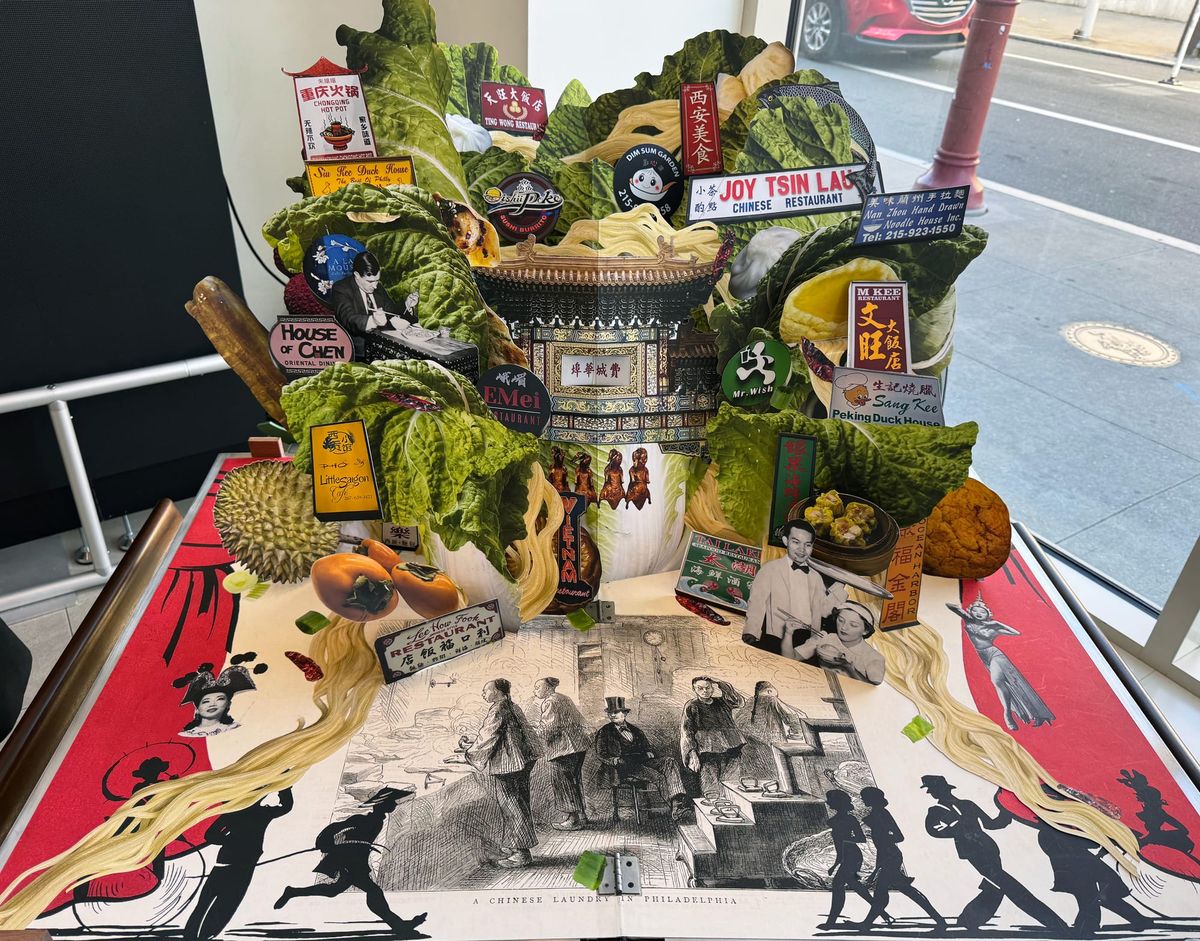
As President Trump threatens to turn the 250th anniversary of the United States’s founding into a MAGA rally, a brand-new arts festival in Philadelphia offers alternative plans. What Now: 2026, the inaugural edition of ArtPhilly’s planned biennial, features more than 30 original artistic commissions taking place across the city where the Declaration of Independence was signed.
Hyperallergic joined the artists and organizers for the festival’s opening week, finding little nationalism and a lot of radical reclamation. Read on for three highlights of the program, which kicked off on May 27 and runs through July 2.
A Procession to the River That Remembers
Most citizens know it’s been 250 years since the US declared its independence from England, but fewer will recall another brave, near-impossible act of independence that took place 230 years ago this spring. On May 21, 1796, Ona Judge escaped from the Philadelphia household of George and Martha Washington, who had enslaved her since birth, walked the half-mile to the Delaware River, and boarded a ship bound for New Hampshire. And on June 9, another anniversary: It will be six years since Dominique “Rem’mie” Fells, a Black transgender woman, was brutally murdered at age 27, her body dumped in the Schuylkill River, a tributary of the Delaware.
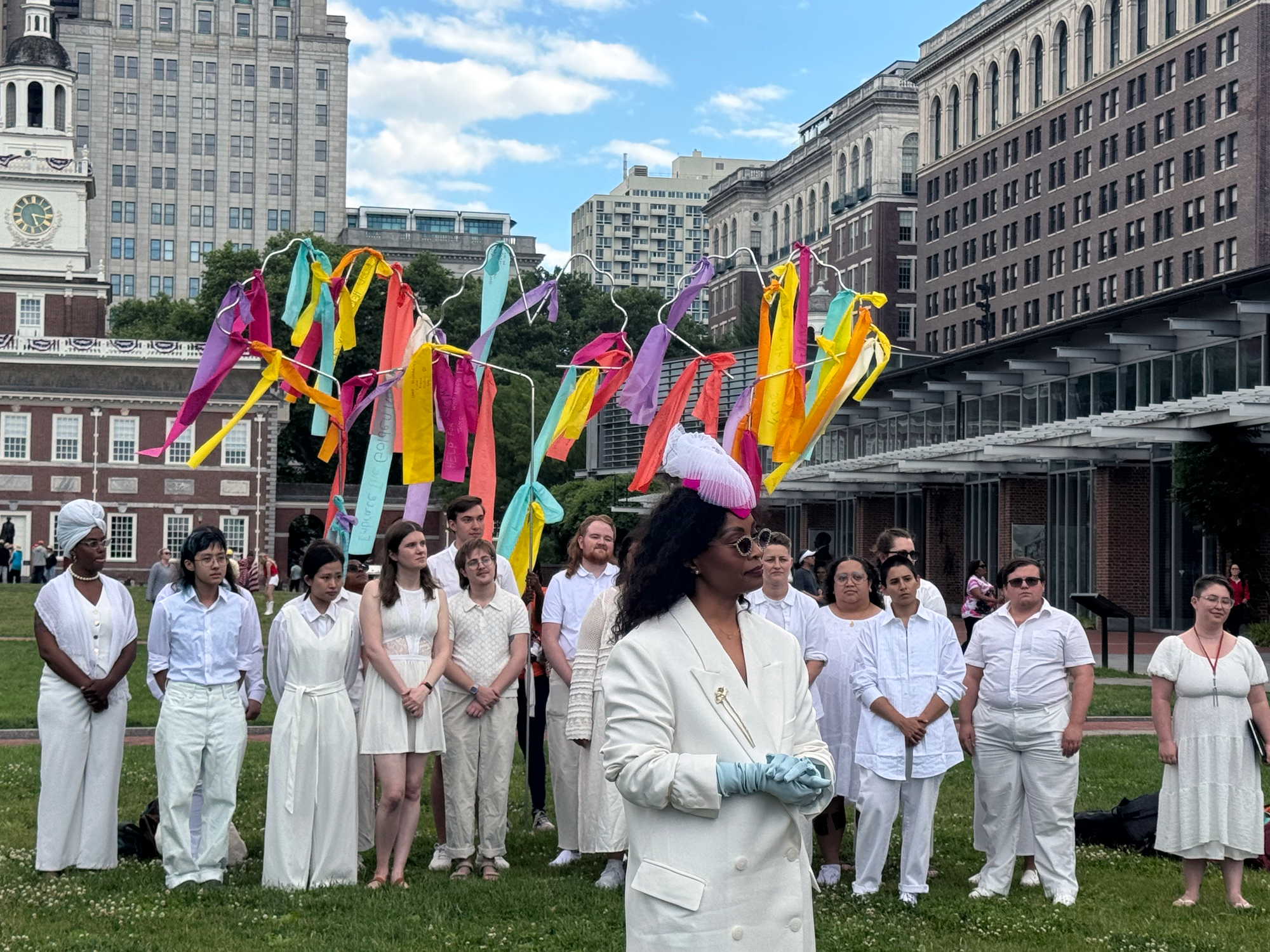
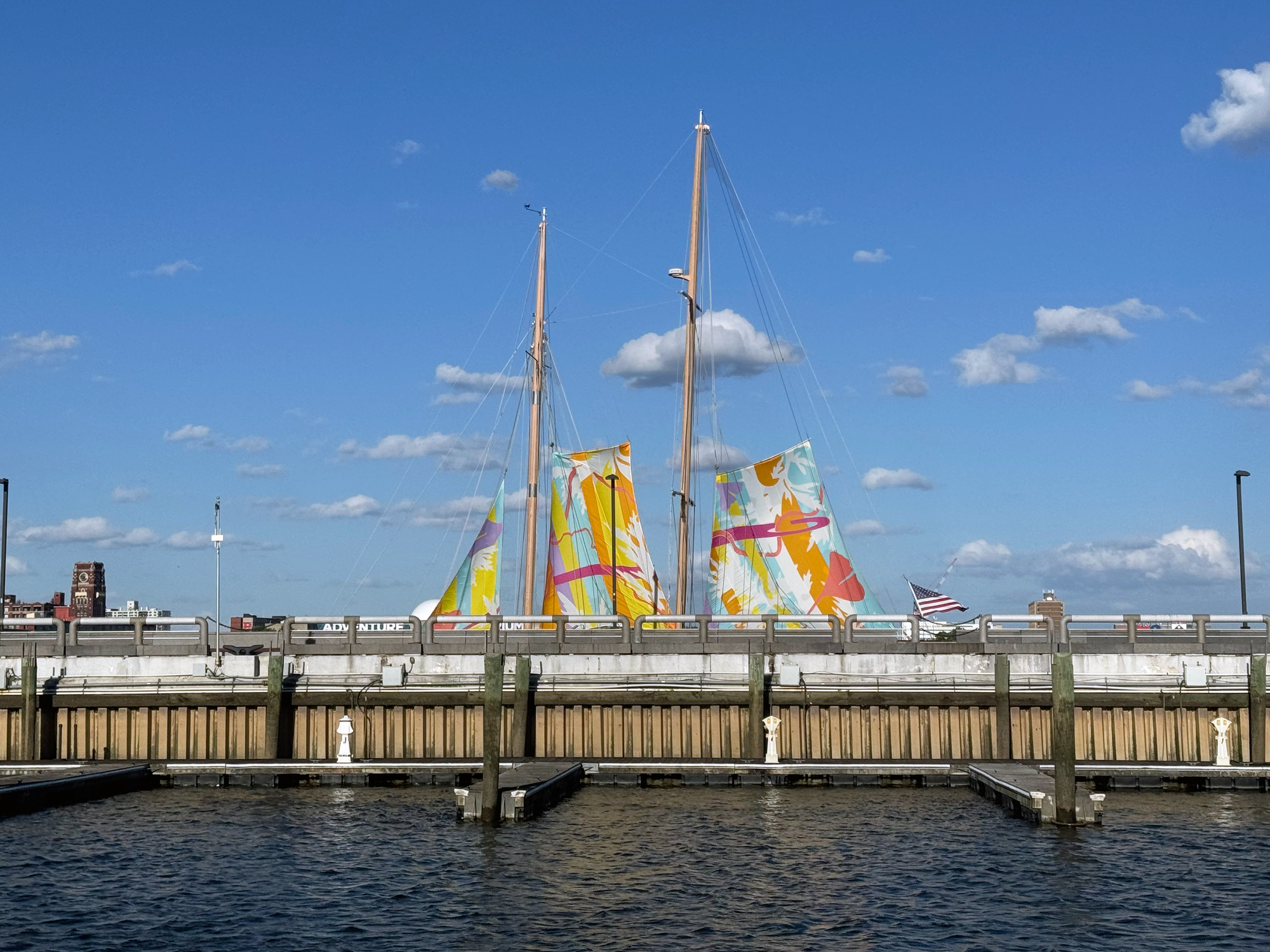
In their commission for ArtPhilly, Sail Through This to That, artist indira allegra honors, mourns, and explores the lives of both women by presenting three sails that will fly from the mast of a docked schooner. Colorful and abstract, the sails are adorned with an abstract rendering of gingko, an ancient plant symbolizing resilience, and mugwort, known for its healing powers and for facilitating dreams. On May 28, allegra and Philadelphia poet Evangeline Getty Brooks led a procession following the route Ona Judge would have taken toward her freedom. Participants in the public ritual, including members of Rem’mie’s family, met on the lawn outside the first President’s House to scrawl their dreams for the future on fabric strips attached to metal frames in the shape of gingko leaves.
The Transcendent Choir of Philadelphia opened with a choral performance, and then a hundred or so people walked to the river, pausing at different sites where sacred songs were performed by various ensembles, including a moving string rendition of Louis Armstrong’s “Go Down Moses.”
“We remember so much in our bodies, and that’s what bodies of water do. The Delaware remembers, the Schuylkill River remembers,” allegra told Hyperallergic. “To process is to become a human river moving through the city of Philadelphia. It’s an offering of love to walk with the memories of these women in the direction of liberation and emancipation.”
But they also hope that people feel a sense of lightness engaging with their work. “It’s been a heavy time. One of the functions of the procession, for me, is to point to other ways we can feel a sense of belonging with each other,” they continued. “To be a sail is to be a body that is moved by unseen forces. That’s what we need right now: to be able to be moved by imagination, so that we can move toward what’s closer to what it is that we want, and not just fight against what we don’t want.”
Upcoming programming related to Sail Through This to That includes a choral performance, a poetry sail, and a rest retreat inspired by Tricia Hersey’s Nap Ministry.
A Hand-Cranked Pop-Up Book Honoring Chinatown
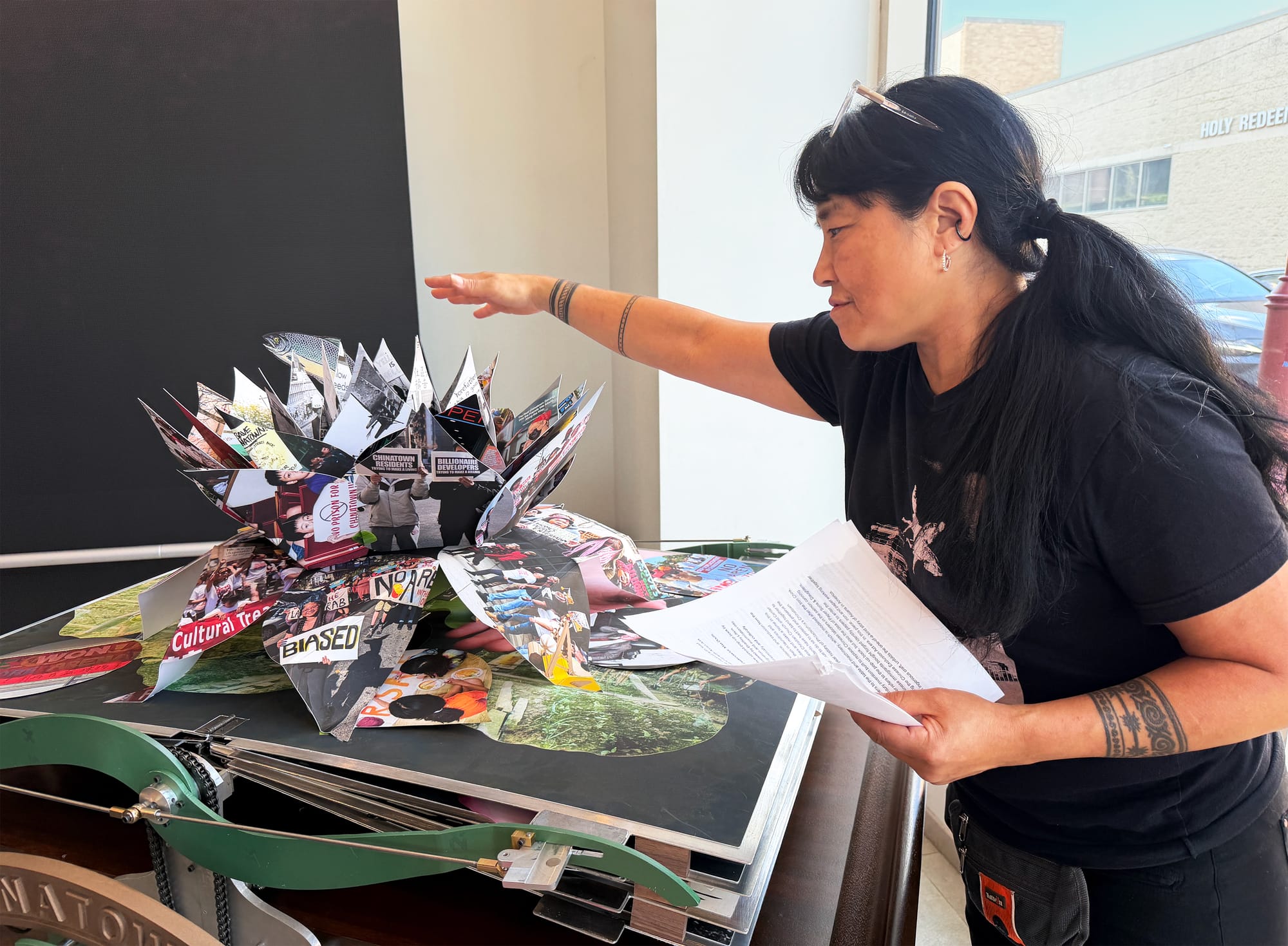
Artist Colette Fu has been making pop-up books for more than 20 years, but “Iron and Paper” is among her most politically powerful work yet. Across five spreads, she tells the story of why there is a Chinatown in Philly at all, tracing a story of exclusion, survival, community, resistance, and celebration all within the neighborhood the book now sits in. In the lobby of the Crane Community Center in Chinatown for the duration of the festival, visitors can turn the outsized pages themselves via a rotating crank and table engineered by “sculptor of kinetic automata” and Fu’s frequent collaborator Bradley Litwin.
As a three-dimensional collage, “Iron and Paper” is a rich text that delves into the intricacies of history while presenting a visually stunning mastery of craft. For example, the salmon jumping out of official-looking documents doesn’t just look epic; it also represents the salmon canning industry built on the backs of Chinese immigrants until the Chinese Exclusion Act of 1882 banned new laborers from entering the US. The pop-up book’s table is modeled after new canning machinery invented at the time, referred to as the “Iron Chink,” a racist slur.
All of this information isn’t explicit, but it’s layered within. “When I show a pop-up book publicly, it doesn’t even matter what it is — people of all ages get so happy and excited to look at it,” Fu told Hyperallergic.
“Maybe they don’t know what they’re looking at, but it’s a way to invite them in. Then they get close and say, ‘What are those plants?’ Well, they’re lotus leaves, and these pictures are of the Chinatown gardens that used to be here before they built the expressway, and now they’re gone,” Fu continued. Crane Community Center is technically in a part of Chinatown that real estate developers are trying to rename, but thanks to efforts like Fu’s, the truth will not go unrecorded.
A Galvanizing Dance Performance
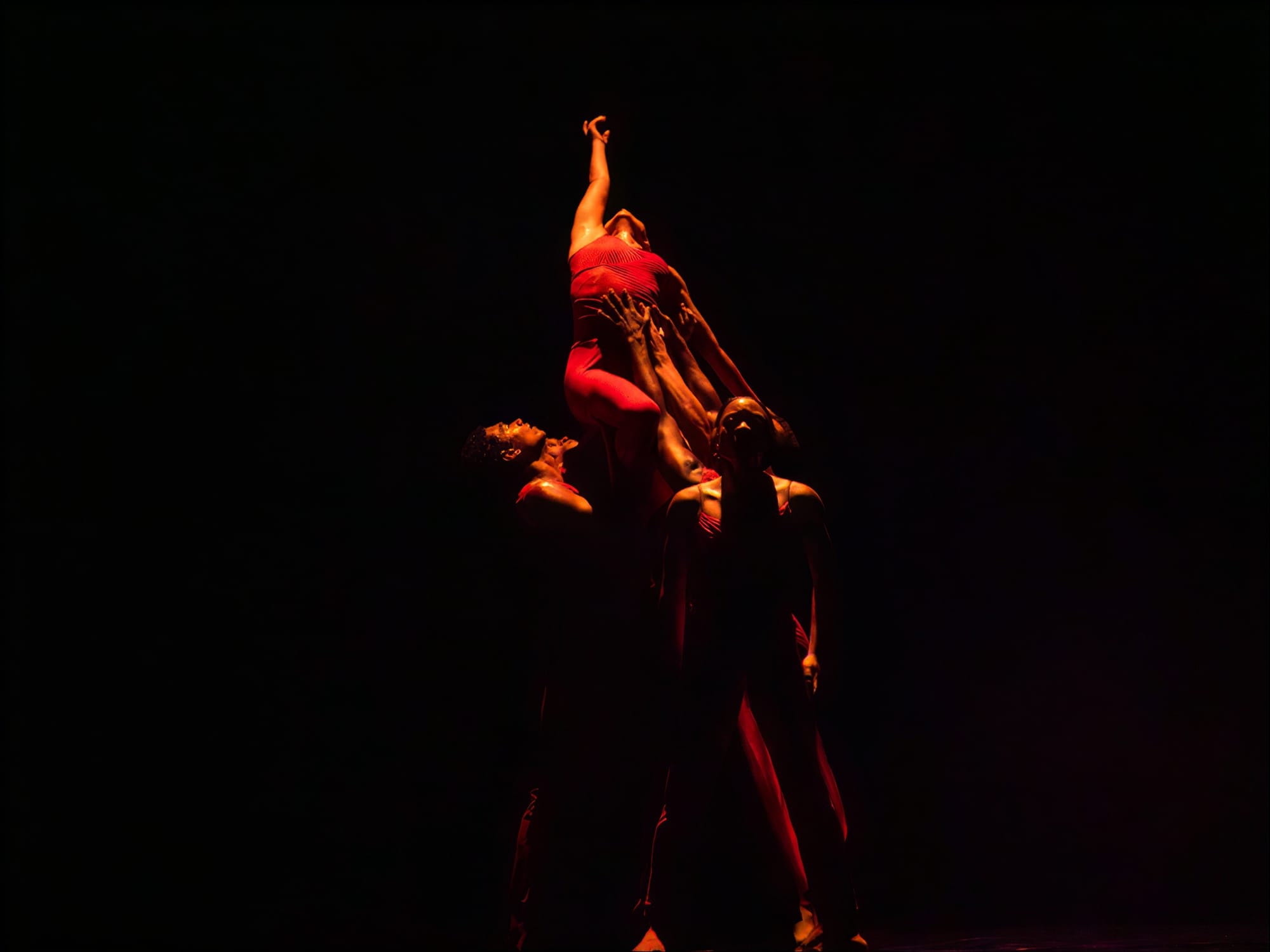
In 1938, Martha Graham choreographed “American Document” in response to the rise of fascism in Europe. It was her first piece to incorporate spoken word, and she chose seminal texts like the Declaration of Independence, the Emancipation Proclamation, and the Song of Solomon to argue for democracy at a time when it was under threat. “In case of fire, speak,” a new dance choreographed by Tommie-Waheed Evans, uses archival material alongside a new musical composition by Uwazi Zamani, performed by dancers from both the Martha Graham Dance Company (MGDC) and PHILADANCO!, to imagine what America means in this moment in our history, when fascism is very much on our shores.
MGDC, the first mainstream company to reject segregation in the field of dance, happens to be celebrating its centennial this year. It feels fitting that they are collaborating with PHILADANCO!, founded in 1970 as a company for Black American dancers who were historically not welcomed in more traditional institutions.
“In case of fire, speak” is a galvanizing and propulsive burst of energy and anger. Dancers run and leap and thrust through a cloud of fog illuminated by minimal overhead light. Strong and toiling bodies echo and refract. Their limbs, clothed in diaphanous red costumes, reverberate in and out of the rhythm of various songs — the new “documents” — from “This Land Is Your Land” by Woody Guthrie, to “This Bitter Land” by Nas and Erykah Badu, to “Sinnerman” by Nina Simone. If Graham’s “American Document” posed a question, Evans’s “in case of fire, speak” confidently answers.
Editor’s note: The writer’s travel and accommodations were paid for by ArtPhilly.