Raven Chacon Sounds the History of the Land
The Pulitzer Prize-winning Diné artist talks about his recent performances at the Park Avenue Armory, the freedom of improvisation, and the privilege of “deep listening.”

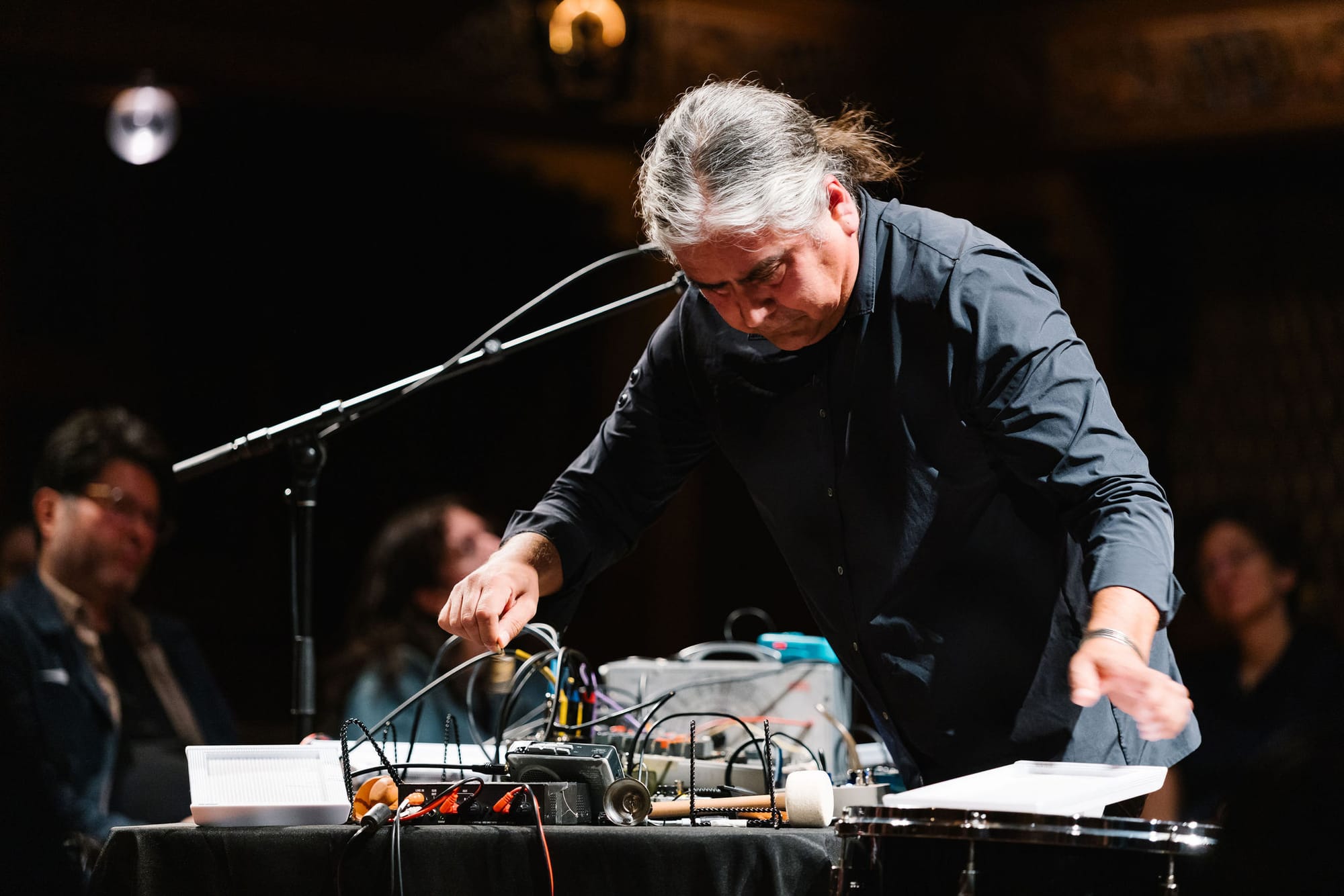
On Wednesday and Thursday night, sound mixers, synthesizers, pedals, speakers, whistles, a turkey call, and a ceramic horn sat on a table at the center of the Veterans Room in Manhattan’s Park Avenue Armory. Serving as the stage for Raven Chacon’s hour-long improvisation sessions for the Armory’s Artists Studio series, the table also offered audiences the rare opportunity to see the prolific artist at play.
During his performance on October 8, the Diné artist, composer, and Pulitzer Prize-winner used each object on the table to surprising and often discomfiting ends. He rigorously blew a whistle into a microphone, looping the sound and layering it atop a rising drone, which he intermittently cut to make room for the electronic transmission of the breath he recorded moments earlier. He mixed screeches over the whistles, eventually transforming the former into an oscillating, metallic sound redolent of the extraterrestrial signals in a sci-fi film. When the composition strayed too far into speculative abstraction, he’d snap it back with a clear, often frightening reminder of the world outside. Chacon ended the session by playing recordings of the wind through a hyperdirectional speaker that he moved in a circle around himself. He swept the sound of the wind over a new part of the room with each turn, transmitting with it the geography of alternative worlds much less violent than those sounded by the cars blaring up and down Park Avenue immediately outside, but whose continued existence depends upon our choosing to listen.
I talked with Chacon over the phone between his performances at the Armory about the role of location in his work, his repurposing of tools associated with colonial violence, and his turn to science fiction for an upcoming show at the San Francisco Museum of Modern Art.
Hyperallergic: For your Arts and Letters show, you were working with both local naturalist histories and the Lenape culture and history of New York. How do you bring site-specificity to a work like this that's entirely improvised?
Raven Chacon: I wish I could say I was responding to the Armory [laughs]. When I’m playing in the city, I tend to bring in more field recordings of the outdoors, of wind and other sounds from other places. A lot of these were gathered where I'm from in New Mexico. While not site-specific to the Armory in this case, I find myself incorporating those more indoors, amongst the other things that encroach upon the interior of the space. It’s unavoidable that we might hear sirens and traffic outside, and those usually become part of the soundtrack of what I’m working with.
H: Those sounds can have a different effect just based on the setting. We recently published a review of a group show you were in at the Hammer that likens your sound piece to a “California earthquake,” which is the type of resonance that you wouldn't get in New York.
RC: That was certainly a consideration. Also, with that show, there were a lot of works about the actual ground. That installation was situated at the entry, but immediately, you have works by Edgar Calel, Ana Mendieta, these works that involve soil and dirt. I wanted to reference that with that piece. And as you move through, you have these different interactions with different materials and visual concepts happening throughout the show.