Required Reading
This week, photos in museums, why art critics matter, a street art site that "steals", the East Village Eye goes online, political economy, a rapper's run in with Marxism on Twitter, what American voters think of hipsters and more …


This week, photos in museums, why art critics matter, a street art site that “steals”, the East Village Eye goes online, political economy, a rapper’s run in with Marxism on Twitter, what American voters think of hipsters and more …
Every wonder why you can’t take photographs in some museums? Here is a good discussion by Carolina Miranda of the issues around the issue over at Art News.
From WNYC’s audio piece on why art critics matter starts with this sad piece of information:
The last full-time art critic in the city of Chicago was laid off by Time Out magazine last month. Now, there are fewer than ten full-time art critics employed by newspapers and magazines in the country.
Though, are critics “bossy” like the speaker says? I don’t think so, not good ones anyway. This whole segment is a little old fogy, and demonstrates IMO why “art critics” are dying, because they aren’t adapting to new realities and prefer to pontificate rather than engage.
One website is taking street art off the street and selling it, and Berlin Art Parasites has something to say about it. Even though I mostly agree with the post, at the end of the day the act of street art is illegal, so taking it off the street isn’t exactly “stealing,” no? Though the background and motivation of this strange street art sale site is fascinating:
According to Street Art 4 Sale, who operates anonymously for his own “personal safety,” this ingenious little operation began after the proprietor saw the film Vigilante Vigilanteand felt compelled to,“Help out with the growing vandalism problem in the city.” But it was only after watching Exit Through the Gift Shop, the popular film by street artist Banksy, that our masked merchant, “Realized the potential value of the ‘art’ littering the streets” and, “Decided to sell what we clean up to help monetize the project as well as give back thru charity to the homeless of the city.”
And writer Hannah Nelson-Teutsch is completely on mark with this point:
Quite frankly, I find the notion that someone could perceive urban artwork as vandalism and yet profit from its clear and present value as a cultural product, suspect if not outright hypocritical.
The Onion does it again: “Artists Announce They’ve Found All The Beauty They Can In Urban Decay.” The last line is the best:
The world’s artists later confirmed plans to spend at least another 50 years churning out heavy-handed depictions of the inherent soullessness of suburban sprawl.
Anton Vidokle, who should write more IMO, has a good read over at e-flux about the political economy of art, including this insightful lede paragraph:
Since the early days of modernism, artists have faced a peculiar dilemma with regard to the economy surrounding their work. By breaking from older artistic formations such as medieval artisan guilds, bohemian artists of the nineteenth century distanced themselves from the vulgar sphere of day-to-day commerce in favor of an idealized conception of art and authorship. While on the one hand this allowed for a certain rejection of normative bourgeois life, it also required that artists entrust their livelihoods to middlemen — to private agents or state organizations. One result was that some of the most influential modernist artists, from Paul Gauguin to Mondrian and Rodchenko, died in abject poverty, not because their work was unpopular but because the economy produced by the circulation and distribution of their work was entirely controlled by others, whether under capitalist or communist regimes. While a concern with labor and fair compensation in the arts, exemplified by such recent initiatives as W.A.G.E. or earlier efforts such as the Art Workers Coalition, has been an important part of artistic discourse, so far it has focused primarily on public critique as a means to shame and reform institutions into developing a more fair system of compensation for “content providers.” It seems to me that we need to move beyond the critique of art institutions if we want to improve the relationship between artists and the economy surrounding their work.
Possibly related? Rapper Lupe Fiasco’s management takes control of his Twitter feed following Marxist theory debate.
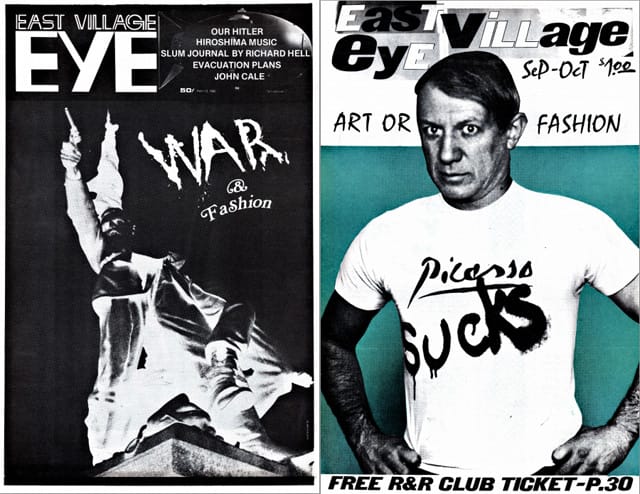
The East Village Eye (1979–87), which was one of the great punk media outlets of the 1980s, is now slowly digitizing the back issues so they can be searchable online. The Eye published a number of emerging writers and featured numerous artists on its cover, including Robert Mapplethorpe, Sue Coe, Richard Hambleton, and Mike Bidlo.
A New York theater critic Kevin Williamson got peeved at a woman using her cell phone during a performance, and decided to take matters into his own hands and chuck the phone against a wall. While we can all relate to being bothered by another’s digital habits during a performance, the culprit and the vigilante both seem slightly disturbed.
Meet Jeff Koons’ balloon animal consultant.
Last Friday night, Kanye West premiered his new song, “New Slaves,” on the streets of Williamsburg through large-scale projections on the side of buildings. A brilliant marketing tactic, which was, of course, followed by an appearance on Saturday Night Live. It turns out the projection wasn’t exclusive to Brooklyn, it has or will take place on 66 different buildings in 10 cities around the globe (New York, San Francisco, Los Angeles, Miami, Chicago, Toronto, Paris, London, Berlin, and Sydney).
The new Libyan government is searching for former dictator Qaddafi’s art collection:
Saif al-Islam, Qaddafi’s second son, who is in custody charged with crimes against humanity, was known to be a keen art collector and reportedly active on the Islamic art circuit. He was due to open a museum of Islamic art in Tripoli in September 2011, but its construction was halted by the uprising. Exhibits destined for the museum had already been bought from London auction houses.
There’s some controversy about this year’s World Press Photo winner, as some people are saying it is a composite, though the photographer says it isn’t. World Press Photo is standing by the winner.
And Public Policy Polling polled American voters’ attitudes towards hipsters and found some surprising (and bizarre) info:
- 10% of Americans consider themselves hipsters (15% Democrat, 10% Republican, 3% Independents)
- 50% of voters 18–29 consider themselves hipsters
- 27% of Americans think hipsters should be subject to a special tax
- 33% of Hispanics consider themselves hipsters, versus 6% of whites and 10% of African Americans
- 54% or Hispanics think hipsters make a positive contribution to society, versus 21% of white votes and 13% of African-American voters
- 17% of people in the Northeast identify as hipsters, versus 4% in the Midwest, 9% in the South, and 7% in the West (though there’s a high percentage of people in the South and West who aren’t sure how they identify)
Required Reading is published every Sunday morning EST, and it is comprised of a short list of art-related links to long-form articles, videos, blog posts or photo essays worth a second look.