Required Reading
This week, Scotland's Old Masters crisis, Anselm Kiefer's 200-acre studio, Virginia Woolf and portraiture, Apple Watch buzz, ISIS think pieces, 10 important books in people's lives, and more.


This week, Scotland’s Old Masters crisis, Anselm Kiefer’s 200-acre studio, Virginia Woolf and portraiture, Apple Watch buzz, ISIS think pieces, 10 important books in people’s lives, and more.

The vote for Scottish independence this week may be close, but did you know that an independent Scotland may face losing a number of Old Master paintings that are currently on loan to the region’s museums? The Art Newspaper reports:
Raphael’s The Virgin and Child (The Bridgewater Madonna), around 1507, is on the Revenue’s list of exempt items. The Old Master is among 28 works by artists including Titian, Poussin and Rembrandt that are on long-term loan to the NGS from the Duke of Sutherland. The Duke of Buccleuch’s Leonardo, the Madonna of the Yarnwinder, around 1501, is another significant loan, which has been on show in the Scottish National Gallery since 2009.
Inside Anselm Kiefer’s 200-acre studio:
The Kiefer worldview is best seen at La Ribaute, his 200 acre compound near Barjac in the Cévennes. At the centre of the estate is a handsome stone manor that was once the heart of a silk factory, and around it is a series of barns where the manufacturing processes took place. When Kiefer moved there in 1992 he needed 70 lorries to move the contents of his studio: he would need rather more now. The artist turned this quiet domain into a Brobdingnagian Gesamtkunstwerk, surely one of the most extraordinary artworks of the last century.
Writing for the London Review of Books, Jean McNicol looks at the National Portrait Gallery’s Virginia Woolf exhibition:
Woolf described the prospect of being photographed by Freund as ‘detestable and upsetting’. The demand for pictures and interviews had been an unwelcome accompaniment to her increasing fame. And she minded more about the images than the words they accompanied. She’d never much liked being painted or photographed: she felt uncomfortable with the scrutiny and didn’t like feeling that her identity was being fixed, settled, by someone else. There are portraits of her, but fewer than one might expect for someone who was close to several artists.
The topic of ISIS (aka ISIL, aka Islamic State) continues to provoke discussion and debate, and two articles this week were really worth reading, including a piece by Kevin McDonald, who says “we should look to revolutionary France if we want to understand the source of Islamic State’s ideology and violence” and writes:
It needs to be said very clearly: contemporary jihadism is not a return to the past. It is a modern, anti-traditional ideology with a very significant debt to western political history and culture.
… Maududi’s Islamic state is profoundly shaped by western ideas and concepts. He takes a belief shared between Islam and other religious traditions, namely that God alone is the ultimate judge of a person, and transforms this – reframing God’s possession of judgment into possession of, and ultimately monopoly of, “sovereignty”. Maududi also draws upon understandings of the natural world governed by laws that are expressions of the power of God – ideas at the heart of the 17th-century scientific revolution. He combines these in a vision of the sovereignty of God, then goes on to define this sovereignty in political terms, affirming that “God alone is the sovereign” (The Islamic Way of Life). The state and the divine thus fuse together, so that as God becomes political, and politics becomes sacred.
And there’s this piece by Slavoj Žižek that echoes some of the same ideas but emphasizes ISIS’s perverted sense of modernity:
Instead of seeing in ISIS a case of extreme resistance to modernization, one should rather conceive of it as a case of perverted modernization and locate it into the series of conservative modernizations which began with the Meiji restoration in 19th-century Japan (rapid industrial modernization assumed the ideological form of “restoration,” or the return to the full authority of the emperor).
Though, it should be mentioned that later the Times, which published the Žižek piece, admitted previous parts of the piece were “self-plagiarized” from the author’s own book.
Recently, people on Facebook have been listing the 10 books that stayed with them throughout their lives. The status update reads:
“List 10 books that have stayed with you in some way. Don’t take more than a few minutes, and don’t think too hard. They do not have to be the ‘right’ books or great works of literature, just ones that have affected you in some way.”
Now the social media giant’s data scientists went though 130,000 responses and discovered there was an interesting phenomena for the most common entries: they were written for children or young adults. Here are the top 10 (along with their frequency on the lists):
- J.K. Rowling’s Harry Potter series (21.08%)
- Harper Lee’s To Kill a Mockingbird (14.48%)
- JRR Tolkien’s The Lord of the Rings (13.86%)
- JRR Tolkien’s The Hobbit (7.48%)
- Jane Austen’s Pride and Prejudice (7.28%)
- The Holy Bible (7.21%)
- Douglas Adams’s The Hitchhiker’s Guide to the Galaxy (5.97%)
- Suzanne Collins’s The Hunger Games Trilogy (5.82%)
- J.D. Salinger’s The Catcher in the Rye (5.70%)
- C.S. Lewis’s The Chronicles of Narnia (5.63%)
Blogging for the LA Times, Carolina Miranda takes a look at art exhibition trailers:
As far back as 2006, the Museum of Modern Art (MoMA) in New York had an online trailer for Doug Aitken’s video installation “Sleepwalkers,” produced in collaboration with the arts nonprofit Creative Time. But the form seems to have picked up steam in the last several years; gallery shows now frequently employ them.
Curious what the most economically diverse top colleges in the US are? The New York Times crunched the numbers of found these are the top 10:
- Vassar
- Grinnell
- U.N.C.-Chapel Hill
- Smith
- Amherst
- Harvard
- Pomona
- St. Mary’s (Ind.)
- Susquehanna
- Columbia
Did you know that if it wasn’t for Dutch, we wouldn’t have words like “cookie,” “coleslaw,” “waffle,” “doughnut,” “stoop,” and “Yankee”?
Video games start responding to Ferguson, but that’s not to say there aren’t issues that face the video game designers when they turn their attention towards current events:
Videogames have a problem. There’s a stigma attached to them that usually prevents them from getting anywhere near current affairs or real tragedies, as somehow an inappropriate medium for such explorations. So while Case’s cartoon was praised and spread around on Twitter for its appropriation of events in Ferguson, adding animation and systems to it in order to create a videogame adds the “too soon” factor. It’d be understood by many, and possibly reported at large, as an opportunist capitalization of a hot topic, either that or as cheap entertainment that lacks any sensitivity. It wouldn’t stand a chance.
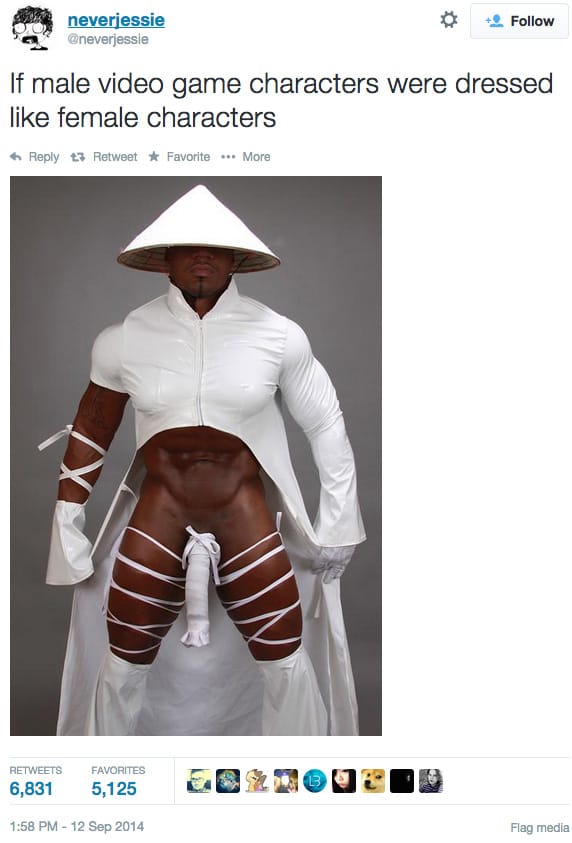
And sometimes sexism is just so obvious, such as:
… and there are some new high-quality GIFs by Kevin Weir (via Colossal). They are quite impressive and use archival photos:

Required Reading is published every Sunday morning EST, and is comprised of a short list of art-related links to long-form articles, videos, blog posts, or photo essays worth a second look.