Required Reading
This week, a new photo of Oscar Wilde, ancient art being used as a weapon in Syria, a meme hurts HK protesters, the importance of artists' queer identities, how Goya landed in Boston, San Fernando Valley art history, and more.

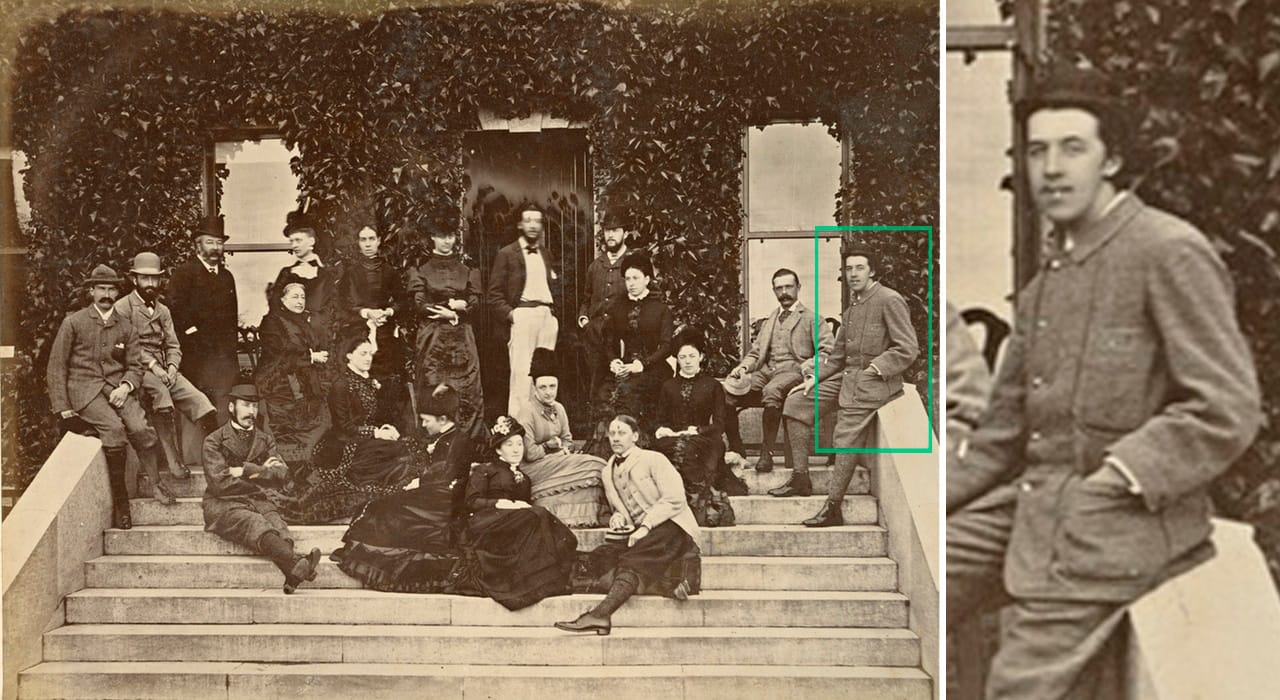
This week, a new photo of Oscar Wilde, ancient art being used as a weapon in Syria, a meme hurts HK protesters, the importance of artists’ queer identities, how Goya landed in Boston, San Fernando Valley art history, and more.

Writing in The Nation, Frederick Deknatel makes the case that Syria’s ancient heritage is being used as a weapon in the ongoing civil war:
Some of the worst attacks on heritage sites have come from the brutal jihadist groups that have gravitated to the chaos, most of all the Islamic State (formerly known as the Islamic State of Iraq and Syria, or ISIS), which has managed to alienate even the Al Qaeda affiliate in Syria, Jabhat al-Nusra. Both groups have reportedly desecrated churches in eastern Syria, along with statues of early Islamic leaders like the Abbasid Caliph Harun al-Rashid and even a medieval Syrian poet. In January, IS fighters blew up a Byzantine mosaic near the city of Raqqa, east of Aleppo, the first of Syria’s provincial capitals to fall into rebel hands. The Islamic State took over Raqqa from the Free Syrian Army last year and has made the city into its stronghold and self-declared capital; in May, IS fighters there used a German-made Hydrema bulldozer to smash two ancient statues of Assyrian lions from the eighth century BCE.
Last week, I published an article raising questions about the representation of queerness in the New Museum’s Here and Elsewhere exhibition. I was very surprised that many people — some of whom I respect — thought it shouldn’t matter. Now, over at the Getty Iris blog, Katie Poltz has penned a good post that explores the question, “Does It Matter If Artists Are Queer?” She writes:
I’m often asked to justify the need for a gallery that exclusively features work by queer, lesbian, gay, bisexual, and transgender (LGBT) artists. Aren’t they just artists? Shouldn’t we try to support queer artists by legitimizing them beyond their queerness? Should an artist’s sexuality even be a part of the academic and public dialogue? If an artist’s work is not explicitly queer in content, does it matter if he or she is LGBT-identified? Yes, yes, yes, and yes. The Civil Rights Movements of the past 60 years have not quite taken us to Utopia, and it is important to remember our struggles and celebrate our differences to remind ourselves, particularly in the United States, that we still have far to go. We need spaces for dialogue, processing, and action; lumping all the colors of the rainbow together leads to a dull and stagnant society. There is often a fine line between acceptance and assimilation that leads some to argue for blending in, but that never solves the underlying issues. In many cases, artists’ sexuality may not seem important to an interpretation of their work, particularly if that work does not explicitly address sexuality.
How did the Museum of Fine Arts, Boston, score the largest Goya exhibition in North America in a quarter-century? Like many things in the art world, it is about relationships, as the Boston Globe reports:
It is no accident that such an important show is at the MFA, and not New York’s Metropolitan Museum of Art or Washington’s National Gallery of Art. The Spanish loans for “Order and Disorder” shed light on a key relationship the museum has had with its counterpart in Spain, and in large part through Mena. Her connection to Boston, which began 40 years ago over lunch with renowned MFA curator Eleanor Sayre, has led to each institution loaning important works over the years, works that might not otherwise move so freely.
… The relationship works both ways. According to the MFA, since 2003, the Prado has loaned 39 works to the Boston museum, and the MFA has loaned 23 to the Prado, including, in 2010, one of its best-known masterpieces, John Singer Sargent’s “The Daughters of Edward Darley Boit.”
Jason Li look at how the Umbrella Revolution meme hurt the Hong Kong protest movement:
Because the umbrella is such an easily drawn, easily shared visual symbol, it quickly made its way across the internet. People who could not make it to the protest, whether if it was because they were abroad or had to stay home to take care of kids, phoned in with illustrations of the so-called “Umbrella Revolution.”
… My theory is that these umbrella images became so popular on the internet that they made their way into the protest itself. Most protesters were constantly on their cell phones and, despite rumors, the internet connection was never cut during the protest. So it’s easy to see how symbols and messages on the internet might have influenced what protesters thought.
Richard Price looks at the rise and fall of public housing in NYC:
From the beginning “the projects,” as they came to be known, were never envisioned as havens for the truly hopeless and disenfranchised.
The idea was to provide a living environment designed to improve the quality of life of people who had already exhibited, in their applications and interviews, a desire to improve.
… This was the beginning of public housing’s golden age. And it would last for roughly fifteen years.
… Keeping up with the Joneses was a piece of cake.
… None of the men seemed interested in taking advantage of the GI Bill to further their prewar education.
On the other hand, they all had jobs.
Everyone read the Daily News and the Daily Mirror, and occasionally the New York Post (vaguely Red), but rarely the New York Times, which, unlike the tabs, was too unwieldy for public transportation.
The art history of Southern California’s San Fernando Valley is often overlooked, but a new exhibition at Cal State Northridge is hoping to correct that (a little):
“Valley Vista” highlights the fine details in the history of Valley art that only locals might know. Between the 1930s and the 1960s, architecture and artistic sub-cultures quietly gained momentum in the area, rivaling its neighboring creative activity of Los Angeles. Artistic minds like Richard Neutra and Frank Ehrenthal helped shape the architectural landscape of the Valley with visionary mid-century buildings and ornate neon signage, while more eclectic visionaries like Daniel Can Meter, John Ehn, and Esteban Bojorquez brought an artistic flare to the Valley’s love of architecture with structural, quirky, accessible art.
The cover of the Independent newspaper in London has a very respectful approach to the news of the latest beheading video (via @josephwillits):
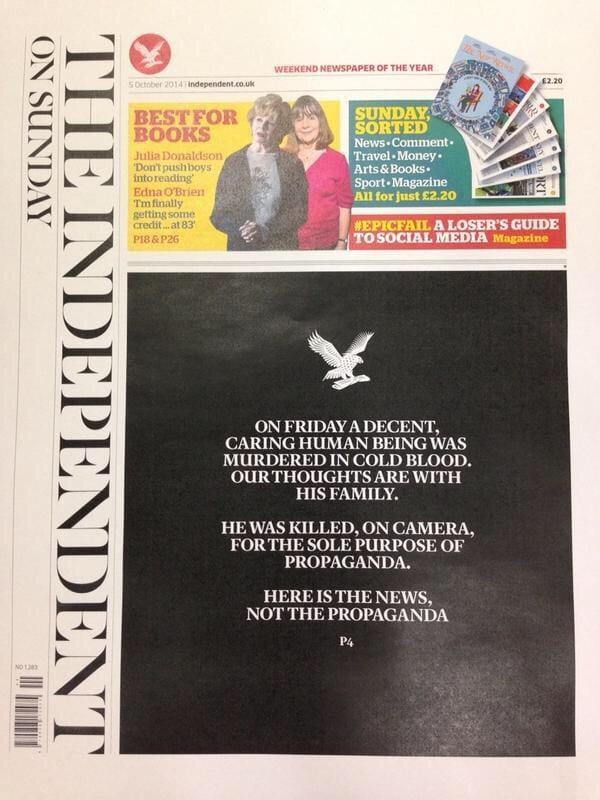
More news, less dissemination of propaganda!
Some new files have been released on one of the Metropolitan Museum’s “Monument Men,” James J. Rorimer:
In the Monuments, Fine Arts and Archives Section of the Seventh Army (MFAA, so-called Monuments Men) he quickly rose to Lieutenant, Captain, and then Chief, from which position he worked to protect, rescue from destruction, and restitute European art work looted by the Nazis. His 1950 book, Survival: the salvage and protection of art in war, details his experiences. For his and the MFAA’s accomplishments, he was awarded the Bronze Star, France’s Croix de Guerre, and named a Chevalier of the Legion of Honor, among other honors.
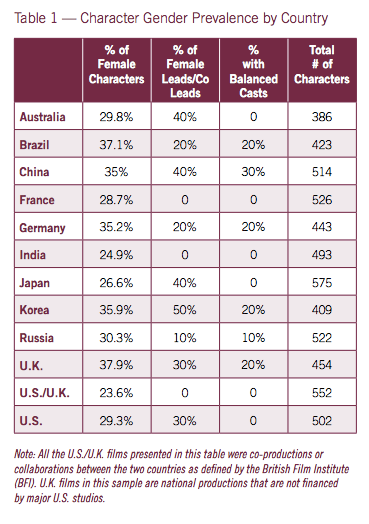
What does gender equality in the movies look like around the world? It appears East Asian nations are more likely to give women leading roles:
Ello is the hot thing right now in social media networking — btw, you can follow Hyperallergic at ello.co/hyperallergic ;) — but it is raising a lot of interesting questions, including What Does Ethical Social Networking Look Like? Quinn Norton writes:
The Ello folk have told me they’re not competing with Facebook, but Facebook is competing with them. Facebook is literally competing with everything else you might want to do online, and with all the AFK time they can push into as well. Big social networks seek an impossible level of total user engagement. The more they have you, and the more they have on you, the more they can feed their demons.
And they have more demons than their VCs (and later shareholders). Because social networking is so powerful, all social networks attract the attention of governments, many of which are abusive. Eventually all social network companies have to answer to men with guns.
And how long does it take to read some of the world’s most popular books? Here’s a helpful chart:

Required Reading is published every Sunday morning EST, and is comprised of a short list of art-related links to long-form articles, videos, blog posts, or photo essays worth a second look.